


An irrigation system is a water delivery design problem, not an equipment purchase. Everything that determines whether the system works over twenty years is decided before a head goes in the ground: what the water source can actually supply, how the property is divided into zones, whether the backflow assembly protects the potable supply, and whether the controller is scheduled by what plants need rather than by habit. This guide covers each of those decisions for Central Ohio properties, in the order a competent designer makes them.
In This Guide
- Whether the Property Actually Needs Irrigation
- The Water Source Governs Everything Downstream
- Backflow Prevention Is a Public Health Requirement
- Zone Design and Matched Precipitation
- Head Selection by Area Type
- The Controller Is Where Systems Are Won or Lost
- Central Ohio Clay and the Infiltration Problem
- Winterization and Spring Startup Are Annual Obligations
- Design Failures That Show Up Later
- What Actually Drives Cost
- How to Evaluate an Installer
- The Decision
- Where Transit & Flow Group Fits
- Frequently Asked Questions
Here is what most Central Ohio property owners get wrong. They shop for irrigation the way they shop for an appliance, comparing brands of heads and controllers and counting zones as if more zones meant more system. But heads and controllers are commodities, and every reputable manufacturer makes equipment that outlives the installation. What separates a system that keeps a lawn uniformly healthy from one that produces brown arcs, soggy corners, and a water bill nobody can explain is the design, and the design is governed by the site. A system designed around the equipment catalog rather than around the property is the most common failure in residential irrigation, and it is not fixable by replacing parts later.
Whether the Property Actually Needs Irrigation
Central Ohio is not an arid climate. Cool season turf here, primarily tall fescue and Kentucky bluegrass blends, is adapted to going dormant in a dry stretch and recovering when rain returns. Many lawns in Franklin, Delaware, and Licking counties look fine for decades without supplemental water. The first honest question a designer should raise is whether irrigation solves a real problem on your property or a perceived one.
There are properties where the answer is clearly yes. New sod and new seed need consistent moisture during establishment, and hand watering a whole yard on a schedule is a commitment most owners abandon by week three. Properties with substantial ornamental beds, specimen trees, or moisture sensitive plantings benefit from targeted delivery. And owners who want green turf in August rather than dormant turf are buying an aesthetic outcome, which is legitimate as long as it is named honestly.
There are also properties where irrigation makes things worse. Heavy shade, poor drainage, and low areas that already hold water do not need more water. If a lawn is thin because of compaction, grub damage, or a soil problem, irrigation will not fix it, and watering a poorly drained area reliably produces disease and moss. A designer who tells you two of your problem areas are drainage problems rather than water problems is giving you the most valuable thing in the conversation.
The Water Source Governs Everything Downstream
Pressure and flow are not the same measurement, and a system designed without measuring both on site is designed on assumption. Pressure is the force available at the point of connection. Flow is the volume the service moves over time without pressure collapsing. A head is engineered to distribute water within a pressure band, and outside that band it fails visibly: too little and the stream falls short with heavy droplets near the head, too much and it atomizes into fog that drifts onto the driveway.
These values are site specific. They depend on the municipal main, your elevation relative to it, the size and material of your service line, the meter, and in some neighborhoods the time of day. A well is a different problem again, governed by pump capacity, recovery rate, and tank cycling. Any proposal produced without an on site measurement is a guess.
The consequence is the part owners miss. Available flow sets how many heads run at once, which sets the number of zones, which sets the total time the system must run, which determines whether the cycle finishes inside the early morning window. A property with modest flow does not get a cheaper system with fewer zones. It gets more zones, each covering less area, and a longer cycle. Ignore this and you get a starved system, where too many heads on a zone drop pressure below what the nozzles need.
- Static pressure at the point of connection. Measured with no water moving, this establishes the ceiling the system will ever see.
- Working pressure under load. What remains once a zone is flowing, which is the number that governs nozzle performance.
- Available flow without starving the house. The system coexists with showers and laundry, so it cannot consume the entire service capacity.
- Service line size and material. An undersized or corroded supply line throttles flow regardless of what the street main offers.
- Elevation change across the property. Even the gently rolling terrain typical of Central Ohio shifts pressure between the low corner of a lot and the high one.
Backflow Prevention Is a Public Health Requirement
This is the part of an irrigation system that has nothing to do with your lawn and everything to do with your neighbors. It connects the potable supply to pipes and heads sitting in soil, in contact with fertilizer, pesticide, pet waste, and standing water. If pressure in the main drops, from a hydrant opening, a main break, or a fire event, water can be drawn backward out of that soil into the drinking water system. That is a cross connection, and preventing it is why backflow assemblies are regulated rather than optional.
In Ohio, backflow prevention is governed by state rule and administered by your local water purveyor. The assembly type required, where it must be installed, how it is protected from freezing, who may install it, and how often a certified tester must test it are determined by the Ohio Administrative Code and by your water system’s cross connection control program. Those requirements differ between jurisdictions, and this article states none of them, because the only authoritative answer comes from the purveyor serving your address.
What you should know is the shape of the obligation. There is a required assembly type, an initial test at installation, and a recurring test on a defined interval by a certified tester, reported to the purveyor. The obligation follows the property, so an inherited system with an untested assembly is yours now, not the previous owner’s. If you bought a house with an existing system and have never received a test notice, resolve that before an enforcement letter arrives.
Jurisdiction fragmentation makes this harder in Central Ohio than it needs to be. A property with a Columbus mailing address may be served by the City of Columbus or by a different purveyor entirely, and municipalities such as Westerville, Dublin, and Delaware run their own programs. Confirm who actually supplies your water first, because a correct answer from the wrong utility is still a wrong answer.
Zone Design and Matched Precipitation
A zone is a group of heads controlled by a single valve, which means every head on a zone runs for exactly the same length of time. That sentence contains the entire theory of zone design. If two areas need different amounts of water, they cannot share a zone, because there is no way to give one of them more without giving the other the same.
So zones are divided by conditions rather than by convenience. Sun and shade separate, because shaded turf needs less water and develops disease if watered like the sunny front lawn. Slopes separate from flat ground, because water runs downhill. Turf and planting beds always separate, because their delivery methods and water requirements have nothing in common. South and west exposures dry faster than north and east. And every zone must fit within the available flow, which is the hard ceiling nobody designs around.
Within a zone, the governing principle is matched precipitation. Every head should apply water at the same rate per unit of area, so a quarter circle head at a corner, a half circle head along a walk, and a full circle head in the open all deliver equivalent depth in the same run time. Manufacturers produce nozzle families specifically to make this possible, with flow scaled to the arc. Mix arcs without matching nozzles and the result is permanent: the narrow arcs overwater, the wide ones underwater, and no controller adjustment separates them because they share a run time.
The other half of coverage is head to head spacing. Heads apply more water near the head and less at the edge of the radius, which is why a proper layout places heads so each one’s spray reaches the next. This looks like overlap, and owners occasionally object to it as wasteful, but it is what produces uniform depth. Spacing stretched to save a few heads is the most common source of the dry rings that appear in the first genuinely hot week of July, and wind exposure on open lots tightens it further.

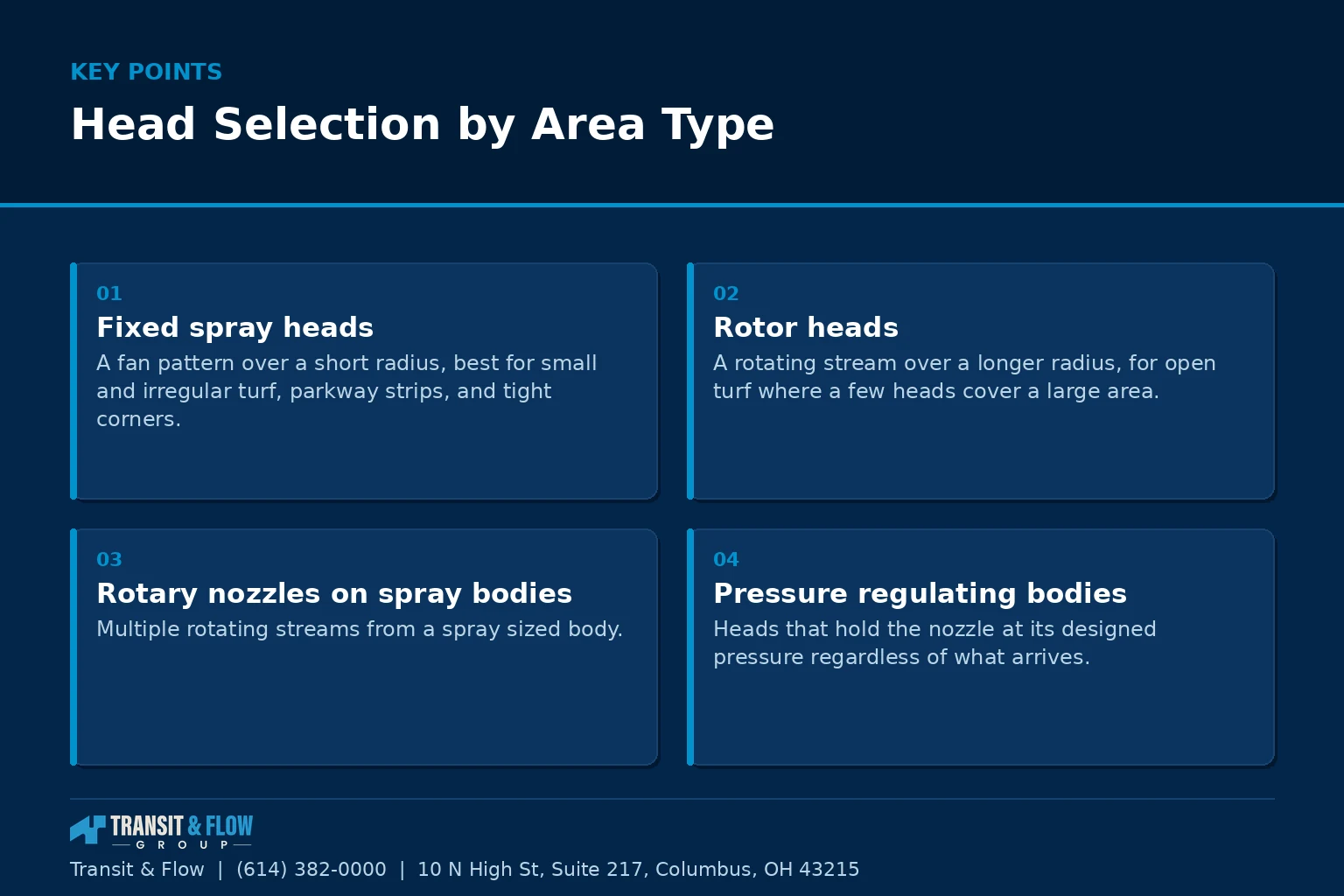
Head Selection by Area Type
Heads are selected by what the area is, not by what is on sale. Each family has a geometry it serves well and conditions where it is the wrong choice.
- Fixed spray heads. A fan pattern over a short radius, best for small and irregular turf, parkway strips, and tight corners. They apply water quickly, so they are the family most prone to runoff on clay and slopes.
- Rotor heads. A rotating stream over a longer radius, for open turf where a few heads cover a large area. They apply water more slowly, which suits tighter soils.
- Rotary nozzles on spray bodies. Multiple rotating streams from a spray sized body. The slower application rate is genuinely useful on Central Ohio clay and on slopes, and they retrofit into existing bodies.
- Pressure regulating bodies. Heads that hold the nozzle at its designed pressure regardless of what arrives. Where supply pressure is high or variable, these convert misting into usable water.
- Check valve bodies. Heads that hold water in the lateral at shutoff. On any sloped zone these stop the puddle that otherwise forms at the lowest head after every cycle.
- Drip and micro emitters. Delivery at the soil surface in beds, slow enough to infiltrate, with no water thrown onto foliage, mulch, siding, or hardscape.
- Bubblers. Localized delivery at the root zone of individual trees and large shrubs that need deep, slow water a turf zone would never provide.
Drip deserves emphasis, because spraying planting beds with turf heads is a design failure that persists mostly because it is cheap to install. Spray heads throw water onto foliage, which drives disease on hydrangeas, roses, and boxwood, and onto mulch, which absorbs it before the soil sees it. And they cannot deliver under a mature shrub canopy, because the canopy blocks the pattern the head was designed to produce.
Drip places water at the soil, under the mulch, slowly enough that clay can absorb it, and it lets plants with different needs share a zone by varying emitter placement and count. The tradeoff is honest. Drip requires filtration and pressure regulation at the zone, and emitters clog. A drip zone is not set and forget, and an installer who does not say so is not preparing you correctly.
The Controller Is Where Systems Are Won or Lost
The largest source of wasted water in residential irrigation is not leaks or broken heads. It is a controller running the same schedule in May and August, and running it through a week of rain. A perfectly designed system on a bad schedule wastes more water than a mediocre system on a good one.
Modern controllers solve this if configured to. The capability that matters most is a functioning rain sensor or rain delay. In Central Ohio, where spring can deliver several inches in a week and July almost nothing, a controller that does not respond to rain spends the entire spring irrigating saturated clay. Beyond that, seasonal adjustment scales every zone’s run time as conditions change, weather based controllers adjust automatically using local data, and flow sensing shuts a zone down when a broken head produces flow the controller does not expect. The EPA WaterSense program labels controllers verified against water efficiency criteria, a useful shortcut when comparing models.
The scheduling principle underneath is simple. Water deeply and infrequently rather than lightly and daily. Short daily cycles keep moisture in the top inch of soil, training roots to stay there and producing turf that collapses the moment the system is off for three days. Longer cycles spaced further apart pull roots down. Early morning is the correct window, because evaporation and wind are lowest and foliage dries as the sun comes up, while evening watering leaves grass wet overnight and invites disease.
Central Ohio Clay and the Infiltration Problem
Much of Central Ohio sits on glacial till soils with high clay content, and residential lots are frequently topped with compacted fill and a thin layer of imported topsoil left from construction. Clay holds a large amount of water once wet, which is an advantage, but it accepts water slowly, and that is the constraint shaping irrigation scheduling here. If water arrives faster than the soil takes it in, the excess runs to the driveway, the sidewalk, and the street rather than into the root zone. The system reports that it delivered water. The plants never received it.
The design answer is cycle and soak. Instead of running a zone once for its full time, the controller runs it in shorter intervals separated by pauses, letting each application infiltrate before the next begins. Nearly every modern controller supports this, and on clay and on slopes it is the difference between water reaching roots and water reaching the storm drain. It is also why slower application equipment tends to outperform fixed sprays on this soil.
Soil is not uniform across a property or across the region. The NRCS Web Soil Survey maps soil series down to the parcel level and will tell you whether your lot is a well drained silt loam or the dense clay that requires the schedule to be built around infiltration. Ohio State University Extension translates that data into practice. Both are free.
Winterization and Spring Startup Are Annual Obligations
Central Ohio freezes and thaws repeatedly rather than freezing once and staying frozen. Water left in a lateral, a valve, a head, or a backflow assembly expands and splits whatever contains it. Winterization is not optional maintenance. It is a condition of owning an irrigation system in this climate, and skipping it once can produce a repair bill larger than several years of service.
Blowout, using compressed air to clear the lines zone by zone, is the standard method here because gravity drainage cannot reliably empty a system on flat ground. It requires equipment producing adequate volume at controlled pressure, and it is genuinely possible to damage a system with the wrong compressor. The backflow assembly needs its own procedure, which depends on the assembly type. Timing matters too. Too early wastes fall watering established plants can still use, too late is a gamble against the first hard freeze.
Spring startup is the mirror obligation and is more than opening a valve. Charging a dry system too quickly sends a pressure surge through empty pipe that breaks fittings and heads. A proper startup pressurizes slowly, then runs every zone while someone watches, checking each head for arc, rotation, clogging, and settling, testing the rain sensor, and resetting the schedule for spring rather than leaving August runtimes in place. That walkthrough is the most valuable service visit of the year, and the one owners most often skip.

Design Failures That Show Up Later
- Too many heads on a zone. Taken to reduce valve and wire count. Every head underperforms, and the symptom looks like weak equipment rather than a design error.
- Mixed nozzle families on one zone. Different application rates sharing one run time permanently guarantees some of the area is overwatered and some is dry.
- Sun and shade sharing a zone. The shaded portion develops disease at the run time the sunny portion needs, and no schedule satisfies both.
- Spray heads in planting beds. Water on foliage, water absorbed by mulch, and nothing reaching the root zone under a mature shrub.
- Spacing stretched past head to head. Saves a handful of heads at install and produces dry rings visible in the first real heat of summer.
- No pressure regulation where supply pressure is high. The stream atomizes into fog, drifts on the wind, and never lands where it was aimed.
- No as built documentation. Nobody knows where the lines, valves, and wire runs are, so the next contractor is digging blind.
What Actually Drives Cost
Irrigation proposals are hard to compare because the line items rarely align. These factors genuinely move the number, and knowing them lets you read two bids that differ by thousands and understand why.
| Cost driver | What moves it | What owners underestimate |
|---|---|---|
| Zone count | Available flow, area, and the number of distinct conditions on the property | That low flow increases zone count and cost, rather than reducing it |
| Head count and type | Turf geometry, spacing, and whether regulation and check valves are specified | That a cheaper bid often has fewer heads spaced further apart, which is the defect |
| Backflow assembly | The type your purveyor requires and how it is protected from freezing | That the type is set by rule, not preference, and testing recurs |
| Trenching conditions | Rock, roots, hardscape, mature landscaping, lot size | That boring under a driveway costs far more than open trenching |
| Drip and bed zones | Bed area, plant count, and the filtration and regulation each zone needs | That drip is a separate system, not a cheaper spray zone |
| Controller and sensors | Zone capacity, weather based capability, flow sensing | That this is the cheapest component with the largest effect on the bill |
| Annual service | Winterization, startup, backflow testing, mid season adjustment | That this is a permanent cost of ownership, not an optional add on |
How to Evaluate an Installer
The difference between installers is design competence and documentation discipline, and both are visible before you sign. Use the following as a verification checklist.
- They measured pressure and flow on site. A proposal produced without testing your water source was designed on assumption, and every number in it inherits that assumption.
- They walked the property and asked about conditions. Shade patterns, wet areas, slope, existing plantings, and what has failed before. A designer who never left the truck did not design anything.
- They provided a zone map. A drawing showing zones, heads, valves, and the point of connection, before installation rather than after. This is the deliverable that proves a design exists.
- They named the backflow requirement and the purveyor. They should know which water system serves your address, what assembly it requires, and who tests it on what interval.
- They addressed permits and inspection directly. The connection and the assembly are permitted work in most Central Ohio jurisdictions, and an installer who waves this off is telling you something.
- They separated beds from turf. Drip or micro delivery for planting areas indicates the design was done by conditions rather than by convenience.
- They quoted annual service alongside installation. The installer who prices winterization and startup up front is the one planning to still be there.
- They provide as built documentation at completion. The final zone map with field changes marked, controller programming, and the backflow test record.
The Decision
Option A. Collect three bids, compare them on total price and zone count, select the middle one, and let the installer determine the design during installation.
Option B. Require an on site pressure and flow measurement and a zone map from every bidder before comparing anything, evaluate bids on whether the zoning matches the conditions on your property, confirm the backflow requirement with your water purveyor independently, and price annual service into the decision from the start.
Recommendation: Option B, because the design is the entire product and it is the only part you cannot change later. Heads, nozzles, and controllers are replaceable in an afternoon. Zone boundaries are not. Once the valves are set and the laterals are trenched, which areas share a run time is permanent for the life of the system, and every scheduling compromise you make for the next twenty years traces back to it. The bid that is lower because it has fewer zones and wider spacing is not a better price for the same thing, it is a worse thing at a lower price. Ask each bidder to show the zone map and explain why the sunny front slope and the shaded side yard are on separate valves. The ones who designed a system will answer immediately. The ones who priced equipment will not.
Where Transit & Flow Group Fits
We coordinate irrigation projects across Central Ohio as design problems rather than equipment installations. Pressure and flow are measured before anything is specified, zones are drawn from the conditions on the property, the backflow requirement is confirmed with the purveyor that actually serves the address, permitting is handled as a defined phase, and as built documentation is delivered at completion. If you are planning a system or making sense of one you inherited, start a conversation with our team. You can also review our irrigation design and installation services, our guidance on backflow prevention and cross connection control, our winterization and spring startup guide, our breakdown of zone design and scheduling, and our article on drainage and grading in Central Ohio clay, where a surprising number of apparent irrigation problems actually originate.
Transit & Flow Group coordinates projects and partners with properly licensed and insured specialty contractors when licensing is required, and work is performed under the appropriate permits.
Frequently Asked Questions
Does my property actually need an irrigation system
Not every property does. Established plantings on suitable soil in a normal Ohio season often need supplemental water only during dry stretches. The strongest case for a system is a property with high value plantings, meaningful turf area, or an owner whose schedule makes manual watering unreliable.
What governs how an irrigation system has to be designed
The water source, the available pressure and flow at the point of connection, and the soil’s ability to accept water. Those constraints set how many heads can run at once and therefore how the zones are laid out. Equipment selection follows those constraints rather than leading them.
Is backflow prevention required for irrigation
Irrigation creates a cross connection with the drinking water supply, and protection is a public health requirement rather than an option. The specific requirement is set by your water purveyor and the adopted plumbing code, so confirm with both before installation.
Why does my system water some areas better than others
Uneven coverage almost always traces to zone design rather than to the schedule. Mixed head types on one zone, insufficient overlap, and grouping areas with different sun, slope, or soil together all produce dry spots that no controller adjustment can correct.
Do I have to winterize an irrigation system in Ohio
Yes. Freezing damages backflow assemblies, valves, and lines, and the repairs cost far more than an annual service. Winterization and spring startup are recurring obligations of ownership, not optional add on services.
What should I look for when hiring an irrigation contractor
Ask how they will determine available pressure and flow, how they will zone the property and why, how backflow protection will be handled and permitted, and what the as built documentation will show. A contractor who answers from the site rather than from a catalog is designing your system.
Sources
- EPA WaterSense, water efficiency labeling for irrigation controllers and products
- EPA WaterSense Outdoors, landscape and irrigation water use guidance
- Ohio Administrative Code, state rules including backflow prevention and cross connection control
- Ohio State University Extension, turf, soil, and landscape water management guidance for Ohio
- USDA NRCS Web Soil Survey, parcel level soil series and infiltration properties
About This Guide
Written and edited by Micheal Parker, founder of Transit & Flow Group. Published October 26, 2026. This guide is checked against the agency and code sources listed above, and it is revised when those sources change.
General contractor of record. Micheal Parker holds City of Columbus General Contractor Registration G12064, issued by the Columbus Department of Building and Zoning Services under Transit & Flow LLC and valid through June 30, 2027. Trade work that falls outside the scope of that registration is performed by licensed trade partners, and the responsible license holder is identified before work begins.
Transit & Flow Group, home and commercial services for Columbus and the surrounding Central Ohio communities. Phone (614) 382-0000. Email solutions@transitflowgroup.com. 10 N High St, Suite 217, Columbus, OH 43215. Contact our team or review the communities we serve.
