


Dry spots and soggy spots in the same lawn are a design outcome, not a maintenance failure. A zone applies water at one rate, for one duration, to everything connected to it. If the areas on that zone do not dry out at the same rate, or if the heads do not overlap correctly, no schedule can satisfy both ends of it. You are looking at a layout problem wearing the costume of a programming problem.
In This Guide
- Why This Is a Design Question and Not a Schedule Question
- Distribution Uniformity, the Idea That Explains Dry Spots
- Head to Head Coverage Is Required, Not Wasteful
- Mixing Head Types in One Zone Is the Classic Error
- Zones Should Be Grouped by Hydrology and Exposure
- Pressure Loss Across a Zone and the Last Head Problem
- Wind and Spray Drift
- Beds and Turf Do Not Belong on the Same Zone
- The Catch Can Evaluation
- Telling a Design Problem From a Maintenance Problem
- The Decision
- Where Transit & Flow Group Fits
- Frequently Asked Questions
Here is what most Central Ohio property owners get wrong. They treat uneven coverage as something the controller can fix, so they add time to the zone containing the dry spot. The dry spot improves slightly. Everything else on that zone gets wetter, stays wetter longer in our heavy clay subsoil, and starts showing disease and shallow rooting. The lawn now has two problems, both created by one decision made at installation.
Why This Is a Design Question and Not a Schedule Question
A zone is the smallest unit of control in an irrigation system. Every head on it turns on and shuts off together, and the only variable the controller owns is duration. Which heads are grouped, what type they are, how far apart they sit, and what pressure does across the run were fixed the day the system was installed. So if a zone contains areas with different water demand, the correct duration for one is the wrong duration for the other, and you are only choosing which part of the lawn to fail. Most owners choose to overwater in order to rescue the dry spot, which is the more expensive failure because it wastes water every cycle and damages turf slowly enough that nobody connects cause to effect.
Distribution Uniformity, the Idea That Explains Dry Spots
Distribution uniformity is the professional term for how evenly a zone puts water on the ground. It compares what lands in the driest part of the zone against the zone average. Low uniformity means some areas get substantially less than others during the exact same run.
You cannot water for the average, because the average is not a place. The lawn is judged by its worst patch, so the schedule gets stretched until the driest area survives. Improving uniformity therefore pays twice. It removes the dry spot, and it lets you shorten the run for everything else, which fixes the soggy areas too.
Head to Head Coverage Is Required, Not Wasteful
No sprinkler applies water evenly on its own. Every head puts down more water near itself and progressively less toward the outer edge of its throw. Because of that, a properly designed zone places heads so the spray from each one reaches the heads next to it. That is head to head coverage. The thin outer edge of one pattern is filled in by the strong inner portion of another, and that overlap is what produces uniformity.
Homeowners see redundancy in that, as though they are paying for heads they do not need. The opposite is true. Heads placed so their patterns only just touch, or worse leave gaps, create a ring of underwatered turf at the edge of every pattern. Those rings are the arcs and crescents of brown you see in an underperforming lawn.
Mixing Head Types in One Zone Is the Classic Error
Fixed spray heads and rotary heads apply water at fundamentally different rates. A spray head delivers its water quickly in a fan pattern. A rotor delivers a stream that sweeps back and forth, covering more ground but laying water down far more slowly. Put both on one zone and you have guaranteed that one group finishes long before the other has started to matter.
No runtime resolves this. Run the zone long enough for the rotors and the spray areas flood and run off. Run it short enough for the spray heads and the rotor areas never get wet below the surface. This mistake produces more dry and soggy complaints than any other, and it is invisible from the controller because the zone looks normal in the programming.
Less obvious mismatches do the same thing. Rotary nozzles retrofitted into some heads but not others, or high efficiency nozzles mixed with standard ones, create the same conflict. One application rate per zone.

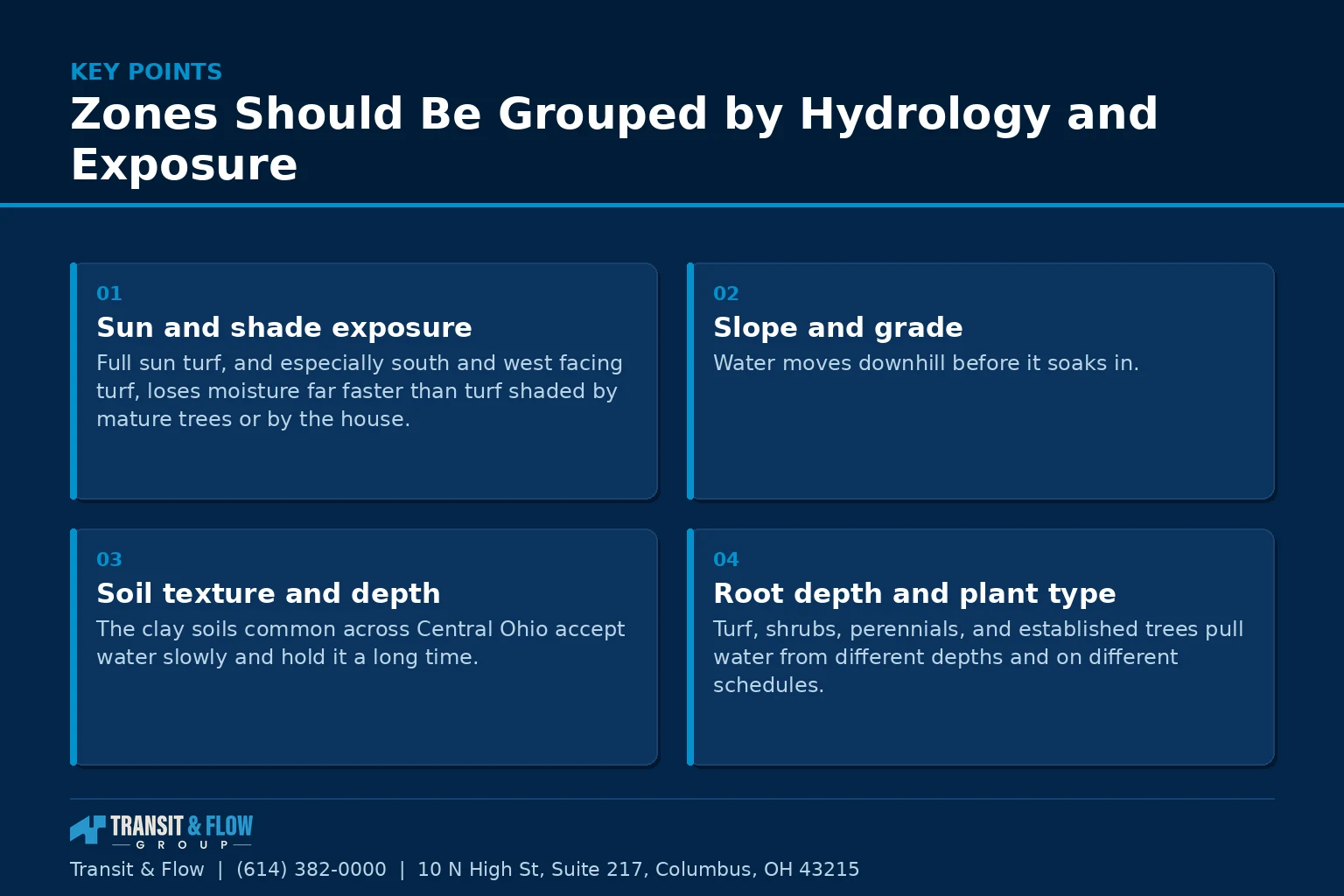
Zones Should Be Grouped by Hydrology and Exposure
The most common reason a system waters unevenly is that its zones were drawn to suit the installation rather than the property. Trenching along the shortest pipe route, or grouping heads because they happened to be near each other, produces zones containing areas with nothing in common except proximity. Convenience zoning is fast to install and permanently expensive to operate.
The correct organizing principle is that everything on a zone should want water at the same time, in the same amount, for the same reason. These criteria determine that.
- Sun and shade exposure. Full sun turf, and especially south and west facing turf, loses moisture far faster than turf shaded by mature trees or by the house. Grouping them together means one of the two is always wrong.
- Slope and grade. Water moves downhill before it soaks in. The top of a slope stays dry and the bottom stays saturated even when the heads are performing correctly, so slopes belong on their own zones.
- Soil texture and depth. The clay soils common across Central Ohio accept water slowly and hold it a long time. Areas with imported topsoil, sandier fill, or shallow soil over construction debris behave completely differently.
- Root depth and plant type. Turf, shrubs, perennials, and established trees pull water from different depths and on different schedules.
- Wind exposure and hardscape. Open frontages lose more spray to drift, and turf beside driveways and south facing walls picks up stored heat and dries faster.
- Drainage behavior. Low areas that already collect runoff during our spring rainfall need less supplemental water, not the same amount as everything around them.
A system zoned on those criteria has more zones, more valves, and more labor at installation than one zoned by pipe route. That is the tradeoff, and it is why the shortcut gets taken.
Pressure Loss Across a Zone and the Last Head Problem
Water loses pressure as it travels, to friction along the pipe wall, at every fitting and elbow, at the valve, and to elevation whenever it moves uphill. The head at the far end of a zone therefore operates at lower pressure than the head nearest the valve, and lower pressure means a shorter throw and a different pattern.
This is why so many lawns are dry in one specific corner. The zone was extended a head or two past what the pipe sizing and available pressure could support. Those last heads still spin and look like they are working, but they no longer reach the heads next to them, and the overlap the design depended on quietly disappears at that end of the run.
The opposite extreme matters too. Pressure too high for the nozzle atomizes the stream into mist, which drifts and evaporates instead of landing where it was aimed, so a zone can be misting at the valve end and falling short at the far end. Pipe sizing, zone length, elevation change, and pressure regulation are design decisions settled before the first head goes in the ground.
Wind and Spray Drift
Wind turns a design that works on paper into one that fails on an open site. Finer droplets travel farther off target, so a nozzle that performs well in a sheltered courtyard loses a meaningful share of its output on an exposed frontage. The flat to gently rolling terrain around Columbus offers little natural windbreak in newer subdivisions, and the effect shows as a dry band on the upwind side of every pattern.
The design responses are real. Larger droplet nozzles resist drift. Tighter head spacing on exposed areas buys back the margin wind takes away. Zoning exposed areas separately lets each be scheduled for the conditions it faces. Running those zones in the calmest part of the early morning helps, and that is the one genuine scheduling lever here, but it is a refinement on a sound layout, not a substitute for one.

Beds and Turf Do Not Belong on the Same Zone
Planting beds and lawn have almost nothing in common from a watering standpoint. Turf is shallow rooted and wants frequent moisture near the surface. Established shrubs and perennials root deeper, want less frequent and more thorough watering, and are far more sensitive to sitting wet. Mulched beds also hold surface moisture longer than open turf.
When beds and turf share a zone, the beds are almost always overwatered, because the schedule gets set for the grass everyone can see. In our clay soils, chronically saturated bed soil is a direct path to root rot in shrubs, and it kills slowly enough that the irrigation system is rarely suspected.
Beds also want a different delivery method. Drip and micro emission put water at the root zone with almost nothing lost to evaporation or drift. Overhead spray wets foliage, encourages disease, and gets blocked by the plants as they mature, which is why bed coverage from spray heads gets worse every year on its own.
The Catch Can Evaluation
You do not have to guess at uniformity. A catch can test measures it directly. Professionals use calibrated gauges and a standardized layout, but the principle is identical at the kitchen level, and it converts an argument into evidence.
- Set identical containers across one zone. Straight sided containers of the same size, spread in a rough grid over the whole zone rather than clustered in one area.
- Include the suspect areas deliberately. Put containers in the dry patch, in the soggy patch, at the far end of the run, and directly between two heads.
- Run only that zone, for one fixed period. One zone at a time, one duration, no adjustments partway through.
- Compare the containers to each other. Absolute amounts matter less than the spread. What you are looking for is how much less the lowest containers hold than the typical ones.
- Note where the low containers are. Low readings clustered at the far end point to pressure loss. Low readings between heads point to spacing. Low readings scattered randomly point to individual head problems.
- Run the test on a calm morning, one zone at a time. A windy test measures the wind rather than the design, and averaging zones together hides which one is broken.
Telling a Design Problem From a Maintenance Problem
Not every uneven lawn is a design failure. Maintenance issues produce similar symptoms and are cheaper to correct, so rule them out first. The distinguishing feature is history. Design problems have been there since installation. Maintenance problems appeared.
| What you observe | Points toward design | Points toward maintenance |
|---|---|---|
| Timing of the problem | Present every season since installation | Appeared in one season and got worse |
| Shape of the dry area | Repeating arcs or bands between heads | A single irregular patch around one head |
| Location within the zone | Consistently at the far end of the run | Anywhere, with no pattern |
| Response to added runtime | Dry spot improves only when the rest floods | Whole zone improves proportionally |
| Head appearance while running | All heads look normal, coverage still falls short | A head is tilted, blocked, clogged, or not rising |
| Beds versus turf | Both on one valve, one always wrong | A single emitter or line is damaged |
| Fix required | Re-zoning, added heads, valve or pipe changes | Cleaning, adjusting, replacing a nozzle or head |
Work the maintenance column first. Many complaints resolve there, and what remains is design.
- Sunken heads. A head that has settled below turf level sprays into the grass around it instead of over it.
- Tilted heads. Out of vertical, the pattern is thrown long on one side and short on the other.
- Blocked throw. Shrubs that have grown in, a new fence, or a patio added after the system went in.
- Clogged nozzles. The sediment and grit our clay soils produce restricts nozzles and screens over time.
- Wrong arc setting. A head knocked out of adjustment waters the driveway and starves the turf behind it.
- Leaking seals or cracked risers. Water lost at one head lowers performance for every head downstream of it.
The Decision
Option A. Keep adjusting the controller. Add minutes to the zone with the dry spot, subtract minutes when an area gets too wet, and accept that the lawn will always have both conditions somewhere.
Option B. Rule out maintenance causes, run a catch can evaluation on the problem zones, and treat what remains as the design defect it is. That may mean splitting a zone that mixes sun and shade, moving beds onto their own valve and converting them to drip, adding heads to restore overlap, correcting a zone extended past what its pressure supports, or replacing mixed nozzles.
Recommendation: Option B, and correct the zoning before you spend another season negotiating with the controller. Poor uniformity forces every zone to run longer than its average requirement, so the design defect bills you every cycle for the life of the system. A zone split is defined work with a defined cost that stops it permanently. The qualifier is sequence. Do the cheap diagnostics first, because paying to re-zone a system whose real problem was three sunken heads is the other way to waste money here.
Where Transit & Flow Group Fits
We coordinate irrigation work across Columbus and Central Ohio, and we treat zone layout as the first question rather than the last. That means evaluating exposure, slope, soil, and drainage before dividing a property, sizing zones to the pressure actually available, keeping beds and turf on separate valves, and documenting what each zone contains. If your lawn has dry and soggy spots at once, start a conversation with our team. You can also review our irrigation design and installation services, our guidance on lawn drainage in Central Ohio, our overview of grading and site water management, and our article on seasonal sprinkler system maintenance.
Transit & Flow Group coordinates projects and partners with properly licensed and insured specialty contractors when licensing is required, and work is performed under the appropriate permits.
Frequently Asked Questions
Why does my lawn have dry spots even though the system runs
Because output is not uniform across the zone. Where coverage is thin, the only way to green that spot is to run the whole zone long enough to overwater everything else. That is the signature of a distribution uniformity problem rather than a schedule problem.
Why do sprinkler heads need to overlap
Output from a single head is heaviest near the head and lightest at the edge of its throw. Overlapping the pattern so each area receives water from more than one head is what produces even application. Spacing heads to just touch leaves the weakest output at the seams.
Can I mix rotor and spray heads on the same zone
No, and this is the most common design error in residential systems. Different head types apply water at substantially different rates, so a single runtime either underwaters one type or overwaters the other. They belong on separate zones.
Should beds and lawn share a zone
No. Turf and planting beds have different water needs, different root depths, and different application methods, and drip irrigation for beds operates on a completely different timescale than turf spray. Sharing a zone guarantees one of them is watered wrong.
How do I test my system’s coverage
A catch can evaluation, where uniform containers are distributed across the zone and the system runs for a fixed period, shows you where output is heavy and light. It converts an argument about the schedule into measured evidence about the design.
Can a bad zone layout be fixed without a full redesign
Sometimes. Adding or relocating heads, correcting nozzle selection, and splitting a zone can address specific problems when the underlying hydraulics allow it. When the zone was overloaded from the start, splitting it is the fix and there is no cheaper substitute.
Sources
- EPA WaterSense Outdoors, outdoor water efficiency and irrigation system guidance
- EPA WaterSense, water efficient product specifications and program criteria
- Ohio State University Extension, Ohioline, turf, soil, and landscape water management resources for Ohio
- USDA NRCS Web Soil Survey, soil texture and drainage characteristics by property location
- National Weather Service, Wilmington Ohio, local rainfall, wind, and forecast data for Central Ohio
About This Guide
Written and edited by Micheal Parker, founder of Transit & Flow Group. Published October 26, 2026. This guide is checked against the agency and code sources listed above, and it is revised when those sources change.
General contractor of record. Micheal Parker holds City of Columbus General Contractor Registration G12064, issued by the Columbus Department of Building and Zoning Services under Transit & Flow LLC and valid through June 30, 2027. Trade work that falls outside the scope of that registration is performed by licensed trade partners, and the responsible license holder is identified before work begins.
Transit & Flow Group, home and commercial services for Columbus and the surrounding Central Ohio communities. Phone (614) 382-0000. Email solutions@transitflowgroup.com. 10 N High St, Suite 217, Columbus, OH 43215. Contact our team or review the communities we serve.
