

A gate fails before the rest of the fence because it is the only part that moves. Everything else is a static assembly that sits still and resists wind. The gate swings, slams, gets leaned on, and cycles through thousands of load reversals a year. If you want a fence that still works in year five, spend a disproportionate share of the budget on the gate posts, hinges, latch, and bracing.
In This Guide
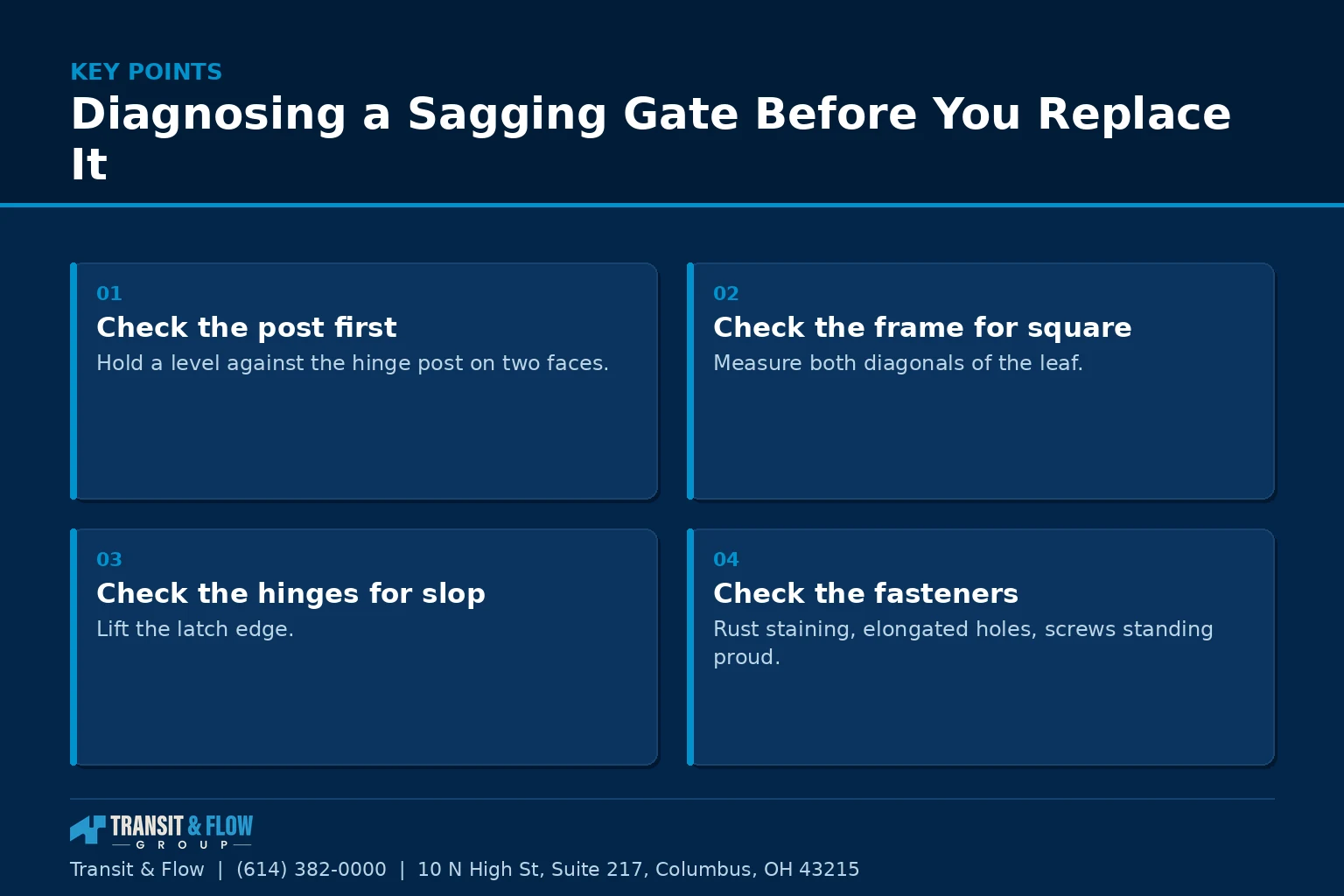
- Gate Posts Carry Loads Line Posts Never See
- Span and Sag Are a Geometry Problem
- Bracing Direction Decides Whether It Works
- Hinges: Count, Capacity, and Adjustability
- Latches, Pool Safety, and Pet Containment
- Self Closing and Self Latching Are a Code Category
- Metallurgy and Fastener Corrosion
- Ground Clearance and Seasonal Movement
- Double Gates, Drop Rods, and Equipment Access
- Diagnosing a Sagging Gate Before You Replace It
- Where the Money Actually Goes
- The Decision
- Where Transit & Flow Group Fits
- Frequently Asked Questions
Here is what most Central Ohio property owners get wrong. They price a fence by the linear foot and treat the gate as one more section of that run. The gate is not a section of fence. It is a small piece of structural engineering hung off a cantilevered post, and whether it works in year five is decided almost entirely in components that add a modest amount to the total.
Gate Posts Carry Loads Line Posts Never See
A line post is loaded in one direction, by wind, and braced on both sides by the panels attached to it. A hinge post has no help on the gate side. It carries the full dead weight of the leaf hanging off one face, an overturning moment at the ground line, continuously, for the life of the fence.
Add the dynamic loads. Every slam sends an impact through the latch post, and every child who rides the gate applies a live load several times the design weight. A hinge post set to the same depth, diameter, and concrete volume as a line post is undersized by definition and will lean toward the opening. That lean is the most common cause of what homeowners call a sagging gate.
Central Ohio soil makes it worse. Franklin County and its neighbors sit largely on glacial till with a high clay fraction. Clay holds water, swells when saturated, and loses bearing capacity when wet. Combine a wet March with a sustained overturning moment and a post that was fine in August moves in April.
Span and Sag Are a Geometry Problem
Sag is not mysterious. A gate leaf is a rectangular frame hung from two points on one edge. Without diagonal support that rectangle is a four bar linkage, and linkages rack. Gravity pulls the outer bottom corner down, the rectangle becomes a parallelogram, and the latch edge drops.
This is why a four foot walk gate built casually often survives and a six foot leaf built the same way does not. Doubling the width more than doubles the moment at the hinges and the deflection at the latch edge, and it doubles the wind area, which matters on solid panels. Prefer two narrow leaves over one wide leaf whenever the opening allows. When a wide leaf is unavoidable, treat the frame as structure, with welded or bolted corners, a real diagonal, and hardware rated for the weight.
Bracing Direction Decides Whether It Works
Diagonal support only works if it runs the correct way, and that depends on whether the member carries compression or tension. A rigid wood or steel diagonal carries compression, so it runs from the bottom of the hinge side up to the top of the latch side, propping the latch edge from below. A cable or rod with a turnbuckle carries tension only, so it runs the opposite way, top of the hinge side down to the bottom of the latch side.
Reverse either one and it does nothing. A wood brace in the tension orientation hangs there while the frame racks around it. A cable in the compression orientation goes slack. This is among the most botched details in residential fencing and it costs nothing to get right at build time. A rigid diagonal needs no adjustment. Cable kits work as a retrofit, but they require tightening and the cable is a corrosion path.
Hinges: Count, Capacity, and Adjustability
Two hinges is the default and the default is frequently wrong. A third hinge splits the vertical load across three bearing points and stiffens the hinge stile against twisting. On any gate that is tall, heavy, solid faced, or wide, three hinges should be the starting assumption.
- Load rating. Compare the manufacturer stated capacity against the actual leaf weight, including panel material, not against a guess.
- Adjustability. Slotted or threaded adjustment recovers alignment as posts settle. Fixed hinges force you to rehang the gate to fix a quarter inch of drop.
- Bearing type. Bushed hinges resist pin wear far better than a bare pin in a bare barrel, where cheap hinges develop slop.
- Fastener pattern. Through bolts spread load across the post section. Screws into end grain or thin post walls pull out under cyclic load.
- Security. Pins that drive out from the outside are a defeat path. Non removable pins or set screws address it.
- Material match. The hinge, its fasteners, and the post should be compatible metals.
Latches, Pool Safety, and Pet Containment
Latch selection is driven by what the gate is for. A latch adequate for a garden gate is not adequate for a pool enclosure, or for a dog that has learned how gravity latches work.
- Gravity latch. A pivoting arm drops into a catch as the gate closes. Cheap, tolerant of misalignment, easy to defeat from either side.
- Thumb latch. Operated by a lever through the gate. It requires a hand at a specific height, the basis of most child resistant configurations.
- Magnetic latch. A magnet pulls a bolt into the strike, so it engages even when alignment is imperfect. The common pool gate choice because it tolerates movement.
- Slide bolt. Secure when thrown, useless when someone forgets, and unsuitable as the sole means of securing a hazard.
- Lockable latch. Useful for equipment and side yards, but a locked gate is no substitute for a self latching one.
- Drop rod and keeper. Fixes the inactive leaf of a double gate so the active leaf has something to close against.
For pet containment the failure mode is usually the gap, not the latch. Dogs go under, not through, and a determined dog will work a gravity arm upward with its nose. A latch requiring a deliberate lift and pull, or a magnetic latch mounted high on the inside face, solves most of it.
Self Closing and Self Latching Are a Code Category
Barrier requirements for pools and spas are a distinct body of regulation, not a manufacturer recommendation. They are adopted through the building code your jurisdiction has in effect, and they typically govern barrier height, opening sizes, swing direction, the requirement that the gate close and latch by itself from any open position, and the placement of the release. Every specific number belongs to your building department, and the numbers change as code editions are adopted.
Two points hold regardless. Self closing hardware is a maintenance item. Spring hinges and hydraulic closers lose tension, collect grit, and stop pulling the leaf home. A pool gate that closes but does not latch has failed, and it fails silently, so test it monthly from a partly open position. Second, the post movement and sag described above can put a compliant installation out of compliance.
Jurisdiction matters here more than anywhere else in the project. Franklin County contains Columbus plus Dublin, Westerville, Gahanna, Upper Arlington, Hilliard, and unincorporated townships, and a Columbus mailing address does not establish which building department governs your property. Confirm that before you buy hardware.
Metallurgy and Fastener Corrosion
Gate hardware lives outdoors and holds moisture at every joint, but the hardware is usually not what fails first. The fasteners are. A stainless hinge bolted on with plated steel screws outlasts its own fasteners by decades, and when the screws corrode the hinge tears out of the post.
- Match fastener to hardware. Dissimilar metals in a wet joint set up galvanic corrosion, and the less noble metal dissolves.
- Hot dip beats electroplate. Electroplated zinc is thin, and thinnest where it gets scratched during installation. Hot dip carries far more zinc.
- Treated lumber is aggressive. Copper based preservatives accelerate corrosion of ordinary steel. Use fasteners the treatment manufacturer identifies as compatible.
- Powder coat is a finish, not a barrier. Coated hardware performs well until the coating chips at an edge or a fastener hole, after which corrosion works underneath.
- Springs and cables corrode from the inside. Closer springs and cables have tight coils that trap water. Treat them as consumables.
- Freeze and thaw drives water into joints. Central Ohio crosses freezing repeatedly each winter, and every cycle pumps moisture into gaps a milder climate would leave dry.
Ground Clearance and Seasonal Movement
Set a gate to swing an inch off the ground in August and it will drag in March. Clay heaves when it freezes and swells when it saturates, and the grade under a gate opening moves more than the grade under a fence line. Snow and ice raise it further for weeks at a time.
Make the trade off deliberately. Higher clearance keeps the gate swinging year round and self closing hardware working, at the cost of a gap small animals use. Lower clearance closes the gap and drags for part of the year. Where pet containment drives the decision, keep the clearance and close the gap at grade with a stone threshold, a buried barrier, or a mowing strip.
Double Gates, Drop Rods, and Equipment Access
A double gate splits the opening into two shorter leaves, each with its own hinge post and lever arm. It introduces one new part, the drop rod, and drop rods fail predictably. The keeper fills with soil, gravel, or ice and the rod no longer seats. A sleeve driven into bare earth collapses. The rod is too short and pops out under load.
The fix is a keeper set in concrete with a drainable bottom, a rod long enough to engage well past the surface, and a rule that it gets cleared every spring.
Width planning is the part people regret. Decide the width against the widest thing that will ever pass through it, not the mower you own today. Candidates include a compact excavator for future drainage work, a dumpster wheeled to the back yard, a hot tub, and plywood for a shed. A gate six inches too narrow gets removed and reinstalled every time.

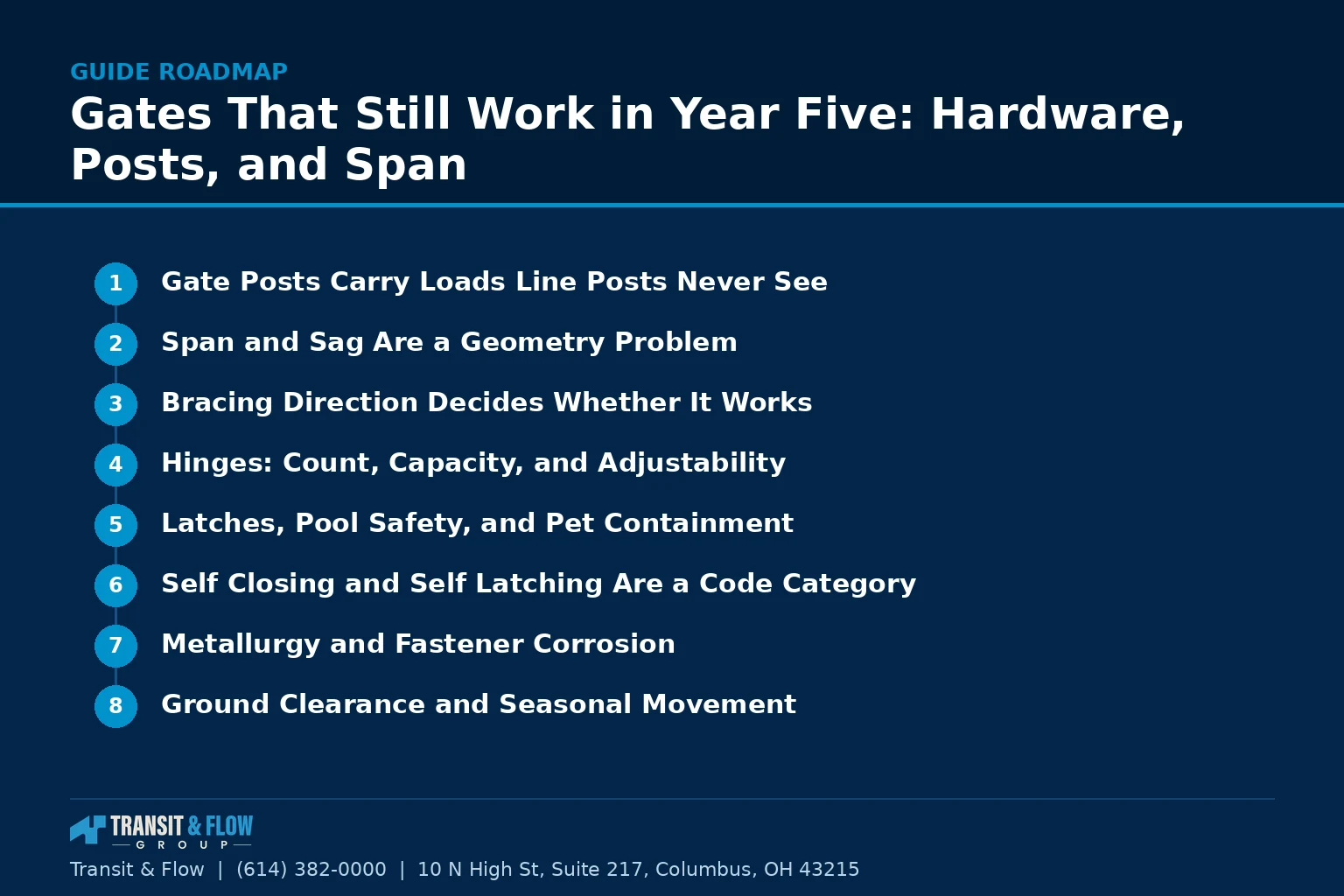
Diagnosing a Sagging Gate Before You Replace It
Most sagging gates do not need replacement. They need the correct one of four repairs, and the diagnosis takes ten minutes. Work through it in order, because fixing the wrong thing is how people replace a gate that was fine.
- Check the post first. Hold a level against the hinge post on two faces. If it leans toward the opening, the post is the problem, and nothing done to the leaf fixes it.
- Check the frame for square. Measure both diagonals of the leaf. Equal diagonals mean the sag comes from the post or hinges. Unequal means the frame has racked and needs a brace or a tightened cable.
- Check the hinges for slop. Lift the latch edge. If it moves before the frame flexes, the wear is at the pins or the fasteners are loose.
- Check the fasteners. Rust staining, elongated holes, screws standing proud. Fastener pull out mimics both post lean and hinge wear.
- Check latch alignment. Mark where the latch strikes now versus where it should. A quarter inch of drop traces to an item above, not to the latch.
- Check clearance seasonally. A gate that drags only in spring is telling you about soil moisture and grade, not the gate.
The repair follows directly. A leaning post gets reset with a larger footing. A racked frame gets a correctly oriented brace. Worn hinges get replaced, ideally with three adjustable ones. Loose fasteners get through bolted. Replacement is the answer only when the leaf material has deteriorated.
Where the Money Actually Goes
| Component | Share of cost | Share of failures | What moves the number |
|---|---|---|---|
| Gate posts and footings | Moderate | Highest | Size, embedment, concrete volume, soil |
| Hinges | Low | High | Count, load rating, adjustability, bearing type |
| Latch and closer hardware | Low | Moderate | Pool or containment requirements |
| Frame and bracing | Moderate | Moderate | Leaf width, panel weight, corner construction |
| Fasteners | Very low | Underestimated | Metallurgy match, galvanizing method |
| Panel or infill | Highest | Lowest | Material, privacy versus open |
Read that as an argument for reallocation, not for spending more. The components that fail are cheap. Upgrading posts, hinges, bracing, and fasteners moves the fence price by a small percentage and the failure rate substantially.
The Decision
Option A. Buy the fence by the linear foot, accept the standard gate package, and deal with sag when it appears.
Option B. Specify the gate separately from the fence. Oversize the gate posts and footings relative to the line posts, require three adjustable hinges on anything heavy or wide, require a correctly oriented diagonal, match fastener metallurgy to hardware, set the width against future equipment access, and confirm pool barrier requirements with the jurisdiction first.
Recommendation: Option B, and the extra cost is smaller than one service call. The asymmetry is the point. A gate built to Option A standards works fine for two seasons, long enough for the contractor to be gone. The repair is rarely a hardware swap. It is usually a post reset, meaning broken concrete, a disturbed fence line, and mobilization for a half day. Specify the gate once, correctly, and it becomes the part of the fence you stop thinking about.
Where Transit & Flow Group Fits
We coordinate fence and gate work across Central Ohio, and gates are scoped as their own line item rather than absorbed into a linear foot price. Post sizing and embedment are specified against actual leaf weight, hardware is selected against intended use, barrier requirements are confirmed with the jurisdiction, and widths are set against future equipment access. If you are planning a fence or deciding whether a gate is repairable, start a conversation with our team. You can also review our fencing and gate services, our guidance on setting fence posts in Central Ohio clay, our comparison of privacy fence materials, and our overview of property lines and setbacks.
Transit & Flow Group coordinates projects and partners with properly licensed and insured specialty contractors when licensing is required, and work is performed under the appropriate permits.
Frequently Asked Questions
Why does my gate sag
Sag is a geometry and load problem. The gate hangs off one post and every open and close cycle loads that post and the hinge line. Insufficient bracing, undersized gate posts, or hinges that cannot carry the weight produce sag regardless of the fence quality elsewhere.
Which way should a gate brace run
A diagonal brace works in one direction and is ineffective or harmful in the other, which is why bracing direction is a real specification rather than a detail. Ask the installer to explain the direction they use and how the gate resists sag over time.
How wide should a gate be
Plan for the widest thing that will ever need through, including mowers, equipment, and material for future projects. Widening a gate later means replacing posts. The cost difference at installation is small next to the cost of the retrofit.
What hardware does a pool gate require
Pool barrier gates are subject to safety requirements addressing self closing and self latching behavior and latch placement, and those come from the adopted code and the jurisdiction. Confirm the requirement with the authority having jurisdiction rather than relying on a hardware package description.
Why does gate hardware rust so quickly
Hardware sits at the wettest, most cycled point of the system, and mismatched metals accelerate corrosion where fasteners meet brackets. Specifying hardware and fasteners rated for exterior use, and matching materials at every connection, is the practical fix.
Can a sagging gate be fixed without replacing it
Often yes. Adjustable hinges, added bracing, or resetting the gate post address most cases when the post and frame are still sound. Diagnose whether the post moved or the frame racked first, because those are two different repairs.
Sources
- International Code Council, Ohio code editions including pool and spa barrier provisions
- Ohio Department of Commerce, Division of Industrial Compliance, adopted building codes and enforcement
- NIST Engineering Laboratory, structural performance and materials durability research
- ADA 2010 Standards for Accessible Design, gate opening force and clear width criteria
- National Weather Service, Wilmington Ohio, regional freeze and thaw and precipitation data
About This Guide
Written and edited by Micheal Parker, founder of Transit & Flow Group. Published October 22, 2026. This guide is checked against the agency and code sources listed above, and it is revised when those sources change.
General contractor of record. Micheal Parker holds City of Columbus General Contractor Registration G12064, issued by the Columbus Department of Building and Zoning Services under Transit & Flow LLC and valid through June 30, 2027. Trade work that falls outside the scope of that registration is performed by licensed trade partners, and the responsible license holder is identified before work begins.
Transit & Flow Group, home and commercial services for Columbus and the surrounding Central Ohio communities. Phone (614) 382-0000. Email solutions@transitflowgroup.com. 10 N High St, Suite 217, Columbus, OH 43215. Contact our team or review the communities we serve.
