


Identify before you act. A nest on your house is either a protected pollinator colony a beekeeper may want to relocate, or an aggressive colony defender a licensed pest professional should handle. The two look similar from twenty feet away and require completely different responses. Nothing here is a removal instruction, because removal is not a homeowner task.
In This Guide
- Five Insects, Five Different Answers
- Nest Structure Is the Better Identifier
- The Seasonal Arc, and Why Late Summer Is the Dangerous Part
- Where Nests Turn Up on Central Ohio Houses
- Ground Nests and the Mowing Injury
- The Medical Risk Is the Reason This Is Not a Homeowner Task
- Honey Bees in a Structure Are a Construction Problem
- Choosing the Right Professional
- Prevention Is Structural, Not Chemical
- The Decision
- Where Transit & Flow Group Fits
- Frequently Asked Questions
Here is what most Central Ohio property owners get wrong. They treat every flying insect around the house as the same problem, when the identification determines everything that follows: who you call, how urgent it is, whether the structure has to be opened, and whether the colony is worth saving. It is the first and most consequential decision in the sequence.
Five Insects, Five Different Answers
Almost every nest call in Central Ohio resolves to one of five insects. Separating them from a safe distance is the most useful thing a homeowner can do.
- Honey bees. Golden to amber, fuzzy, rice grain sized, and rarely aggressive away from the colony. They build sheets of wax comb, and in a structure that comb sits inside a wall void, soffit cavity, or chimney. Steady two way traffic at one small entry point, all day, is the signature.
- Bumble bees. Large, round, heavily furred, loud in flight, and generally tolerant of people. They nest in small colonies in insulation, under sheds, in old rodent burrows, and in mulch piles, and those colonies die out at the end of the season.
- Yellowjackets. Slender, hairless, sharply banded yellow and black, with a hard shiny look. They nest in the ground, in wall voids, and in any dark cavity they can find, and they cause most multiple sting incidents in the region.
- Paper wasps. Long bodied, with long legs that dangle in flight, and comparatively slow. Their nest is an open umbrella of hexagonal cells hanging from a single stalk, with no paper envelope around it.
- Bald faced hornets. Large, black, with bold white markings on the face and abdomen. Their nest is the enclosed gray paper football hanging from a branch or an eave, with one opening near the bottom. They defend it at a distance that surprises people.

Nest Structure Is the Better Identifier
Describe the nest accurately over the phone and a professional can usually tell you what you have before anyone drives out. That routes the call correctly the first time.
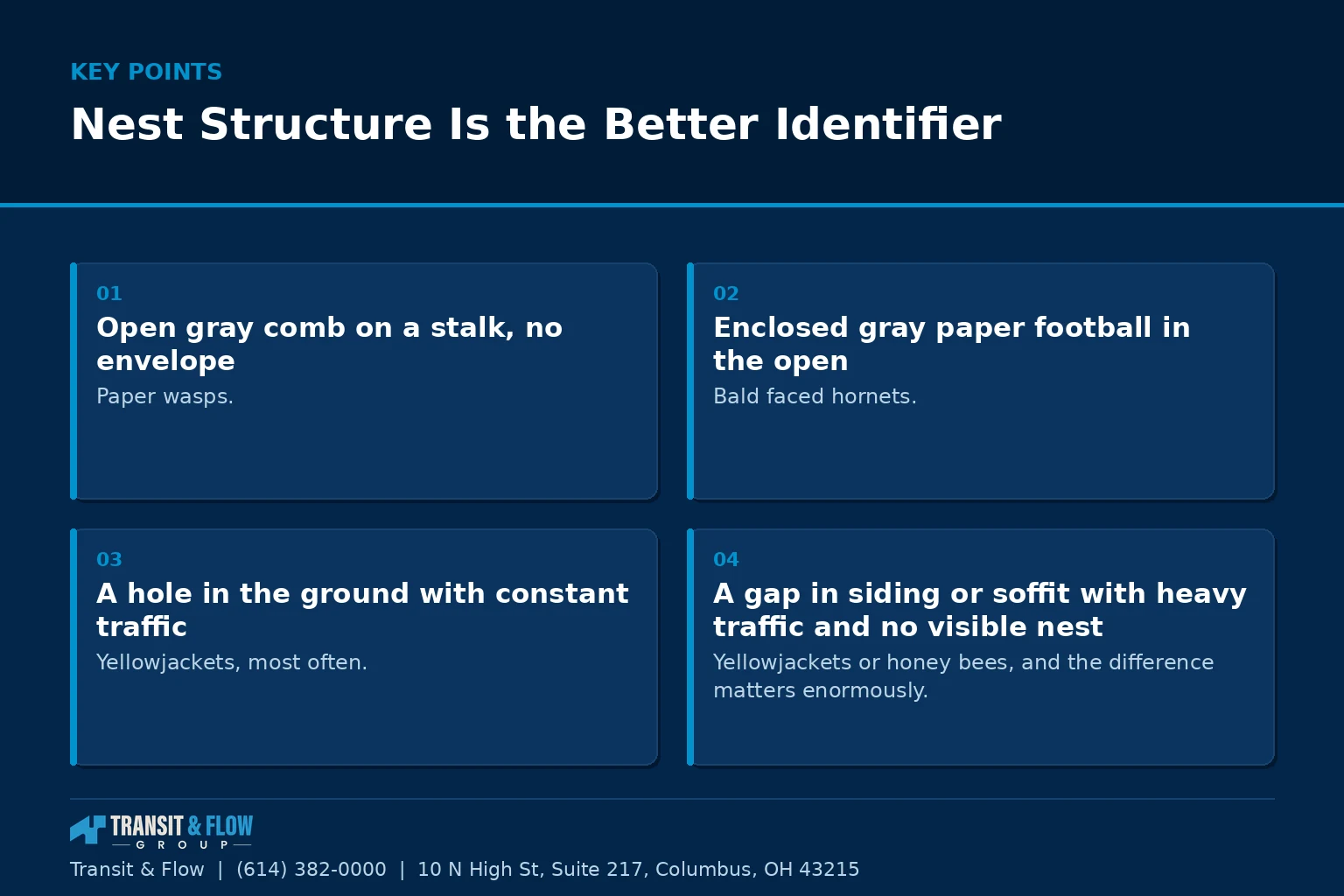
- Open gray comb on a stalk, no envelope. Paper wasps. Typically under a porch ceiling, inside a grill lid, under a deck rail, or in a door frame corner.
- Enclosed gray paper football in the open. Bald faced hornets. Usually in a tree, a large shrub, or under an eave, and rarely noticed until it reaches size.
- A hole in the ground with constant traffic. Yellowjackets, most often. No visible structure, just an entry point in turf, a bank, or a wall base.
- A gap in siding or soffit with heavy traffic and no visible nest. Yellowjackets or honey bees, and the difference matters enormously. The insects at the opening tell you which.
- Wax comb visible in a cavity, with the smell of honey. Honey bees. That is a structural situation, not just a pest situation.
- A loose cluster in insulation or under a shed floor. Bumble bees, usually a small colony and the least urgent of the group.
Observe from a distance, with binoculars or a zoom photo taken from well back. Do not approach a nest for a better look, and do not disturb, block, or seal an active opening. Sealing an entry point drives a colony deeper into the structure or into living space.
The Seasonal Arc, and Why Late Summer Is the Dangerous Part
Yellowjacket, paper wasp, and hornet colonies in Ohio follow an annual cycle. A single overwintered queen starts a nest in spring, working alone. Through early summer the colony stays small, which is why the nest under your soffit in May goes unnoticed.
Through midsummer the worker population climbs steadily. By late summer and early fall the colony has reached peak size, natural food sources are declining, and the colony shifts toward producing next year’s queens. That combination makes August through the first hard frost the highest risk window in Central Ohio. Colonies are largest, the defensive response is strongest, and the insects are far more interested in your food and drink than they were in June.
It also explains a pattern professionals see every year. Homeowners call in late summer about a nest that appeared overnight. It did not. It has been there since spring and only became large enough to notice once the colony matured. Wasps and hornets do not reuse last year’s nest, but the conditions that attracted a queen once attract one again, which is why the same soffit corner produces a nest year after year.
Honey bees do not follow this arc. Their colonies are perennial, overwintering as a cluster inside the structure on stored honey and emerging larger the following spring. A honey bee colony in a wall grows across years rather than dying with the first frost.
Where Nests Turn Up on Central Ohio Houses
- Soffit and fascia gaps. The most common structural location. Separated vinyl soffit panels, gaps at the fascia return, and the corners where a roofline meets a wall are standing invitations, and Central Ohio freeze and thaw movement opens those joints a little more each winter.
- Wall voids behind siding. Entry comes through a gap around a hose bib, dryer vent, utility penetration, or lifted siding. The nest is invisible, and the only evidence is traffic at the opening and sometimes sound inside the wall.
- The ground. Abandoned rodent burrows, voids under landscape stone, mulch beds, the gap under a stoop, and slopes with loose soil. Central Ohio clay holds a cavity well once one exists, which is why ground nests recur in the same spots.
- Grills, meter boxes, and utility enclosures. Anything with a lid that stays shut for weeks qualifies. Unused grills, electric and gas meter enclosures, irrigation valve boxes, and pool equipment covers are classic paper wasp and yellowjacket sites.
- Deck framing and porch ceilings. The underside of deck rails, the cavity between joists, and sheltered corners of a covered porch, all of which are places people pass within inches of daily.
- Sheds, playsets, and mailbox posts. Hollow metal posts, unused shed corners, and playground tubing. Children encounter these first, and usually by accident.
- Chimneys and attic vents. Unscreened flues and gable vents offer a large protected cavity, and these are the hardest nests to reach.
Ground Nests and the Mowing Injury
Ground nesting yellowjackets cause a predictable category of injury, and it happens the same way every time. A mower passes over or near a concealed entry hole. The vibration triggers a mass defensive response. The operator is directly over the nest, cannot see it, and is moving slowly. Multiple stings follow within seconds.
The same mechanism applies to string trimmers along fence lines, to landscape work in mulch beds, and to anyone stepping into tall grass at a yard edge. The flat to gently rolling terrain across Central Ohio means large expanses of mowed turf, and turf with old burrows underneath is exactly what yellowjackets prefer.
The protection is observation, not equipment. Before mowing an area you have not touched in a week or more, especially from midsummer onward, stand at the edge and watch. Steady traffic to and from one point in the ground is the only warning you will get. If you see it, stop, keep children and pets away, and call a professional.
The Medical Risk Is the Reason This Is Not a Homeowner Task
Unlike a honey bee, which stings once, yellowjackets, paper wasps, and hornets sting repeatedly. A disturbed mature colony delivers many stings in seconds, and the person receiving them is often on a ladder or a mower, where the reaction causes a second injury worse than the first.
A severe allergic reaction to a sting is a medical emergency. Difficulty breathing, swelling of the face, throat, or tongue, dizziness, or a reaction away from the sting site all call for 911 and emergency medical services immediately. Anyone with a known sting allergy should not be near an identification effort, let alone a removal.
That risk profile is the whole argument for professional handling. A licensed applicator brings protective equipment, training, an escape plan, and legal responsibility for the outcome. A homeowner on a ladder at dusk has none of those.
Honey Bees in a Structure Are a Construction Problem
This is the case handled wrong most often, and the consequences are expensive. A colony living in a wall void, soffit cavity, or chimney has built wax comb and filled it with honey. Killing the colony without removing the comb leaves all of that inside the structure.
What follows is predictable. With no bees to maintain temperature, wax softens and honey runs. It stains drywall and siding from the inside, saturates insulation, and draws ants, beetles, rodents, and other bees to the residual comb. Homeowners then pay twice, once for the extermination and again for the cleanout and repair that was always necessary.
The correct sequence for an established colony is a live removal, often called a cutout: the cavity is opened, comb and colony are removed, the cavity is cleaned, and the opening is sealed and repaired. That work sits between beekeeping and carpentry, and the repair side is real construction.
A swarm is a different situation. It is a cluster of bees on a branch, fence, or post, in transit and without comb, usually in late spring, and it typically moves on within a day or two. Many local beekeepers collect swarms at little or no cost, and catching one before it enters a structure prevents the whole cutout scenario. Report it promptly.

Choosing the Right Professional
| What you have | Who to call | What the job actually involves |
|---|---|---|
| Honey bee swarm in the open, no comb | Local beekeeper or association swarm list | Collection and relocation, fast and often free |
| Honey bee colony inside a wall, soffit, or chimney | Beekeeper experienced in cutouts, plus a contractor for the repair | Opening the cavity, removing comb and colony, cleaning, sealing, rebuilding |
| Bumble bee colony in a low traffic area | Often nobody, or a licensed professional if near a door or play area | Monitoring, or removal where proximity forces it |
| Yellowjackets in the ground or a wall void | Licensed pest control professional | Treatment by a trained applicator, then exclusion once inactive |
| Paper wasp nest in a doorway, grill, or porch ceiling | Licensed pest control professional | Removal, plus follow up on what attracted it |
| Bald faced hornet nest near the house or a walkway | Licensed pest control professional | Treatment in full protective equipment, then nest removal |
| Any nest with a sting allergic person in the household | Licensed professional, no homeowner involvement | Professional handling, and separately a conversation with a physician |
When you call, ask three things: whether the company is licensed for commercial pesticide application in Ohio, whether the technician on site has handled that nest type and location, and whether the price includes exclusion. Treatment without exclusion is a service you buy again next year.
Prevention Is Structural, Not Chemical
- Close openings before spring. Sealing gaps in soffit, siding, trim, and utility penetrations in late fall or winter, when nothing is nesting inside, denies queens the cavities they hunt for in March and April.
- Screen vents and flues. Gable vents, ridge and soffit venting, and open flues are large invitations. Proper screening keeps the ventilation and removes the access.
- Maintain the roof edge. Loose fascia, separated soffit panels, and rotted trim are how most structural nests begin.
- Manage food and trash. Sealed exterior containers, rinsed recycling, and covered outdoor drinks cut late summer yellowjacket pressure more than anything else you can do.
- Check enclosures early. Look into grills, meter boxes, and valve boxes at the start of the season and again in midsummer, from a step back, before reaching in.
- Fill old burrows and voids. Collapsed rodent burrows and gaps under stone and stoops are ready made yellowjacket sites, and closing them in early spring costs nothing.
Exclusion is a building maintenance activity, and it belongs on the same schedule as gutter cleaning and caulking. Our overview of seasonal exterior maintenance in Central Ohio puts it in the right part of the calendar.
The Decision
Option A. Treat any nest as a generic problem, handle it yourself or hire whoever answers first, and deal with whatever follows.
Option B. Identify the insect and the nest type from a safe distance, route the call to the right specialist for that identification, and treat the opening in the building as a repair item rather than a sealed over symptom.
Recommendation: Option B, and the identification step takes ten minutes with binoculars. The asymmetry is stark. A correct identification costs a photo and a careful look. A wrong one costs a beekeeper a colony that could have been relocated, or a homeowner a wall full of abandoned comb, or puts someone on a ladder in front of a mature hornet nest. No homeowner should be spraying, burning, flooding, sealing, or knocking down a nest of any kind. Identify it, call the right person, and stay away from it in the meantime.
Where Transit & Flow Group Fits
Transit & Flow Group does not perform pest treatment. We handle the building side of the problem, which is where the real cost usually sits, on homes across Columbus and the surrounding communities. That means rebuilding a soffit or wall after a honey bee cutout, repairing the fascia and trim that let a colony in, screening vents and flues, and sealing the penetrations that produce a new nest in the same corner every spring. If your nest situation has a structural component,start a conversation with our team. You can also review our exterior maintenance services, our guidance on soffit and fascia repair, and our article on moisture and contamination in wall voids, which covers what has to happen after any cavity is opened and cleaned.
Transit & Flow Group coordinates projects and partners with properly licensed and insured specialty contractors when licensing is required, and work is performed under the appropriate permits.
Frequently Asked Questions
How do I identify a nest without getting close
Nest structure and location carry most of the information. Open comb under an eave, an enclosed paper envelope in a shrub or on a branch, activity at a ground opening, and activity at a single small gap in siding each point in a different direction. Observe from a distance.
Why is late summer the worst time for stinging insects
Colonies reach their largest population late in the season and food sources shift, which increases both the number of insects and how assertively they defend and forage. The same nest that went unnoticed in June becomes a genuine hazard by August.
What should I do if I find a honey bee colony in my wall
Contact a beekeeper or a professional experienced in structural bee removal. Honey bees are valuable pollinators, and a colony inside a wall leaves comb and stored honey behind that must be removed, or it creates a moisture, odor, and secondary pest problem.
Is it safe to remove a nest myself
No. Disturbing a colony triggers a defensive response, and ground nests in particular produce injuries every year during routine yard work. The risk is not worth the saved service fee, and a professional handles identification and removal together.
What if someone is stung and has a reaction
A severe allergic reaction is a medical emergency. Call emergency services immediately. Anyone with a known sting allergy should follow the plan established with their physician. This is a medical question, not a pest control question.
How do I prevent nests from forming near the house
Inspect early in the season when colonies are small and easier to address, keep garbage and food sources managed, seal gaps in siding and soffits, and check sheltered spots such as grills, meter boxes, and play equipment before the season builds.
Sources
- Ohio State University Extension, Ohioline, fact sheets on stinging insects, pollinators, and household pests
- U.S. Environmental Protection Agency, safe pest control guidance for homeowners
- U.S. Environmental Protection Agency, integrated pest management principles including exclusion and prevention
- Ohio Department of Agriculture, pesticide applicator licensing and apiary program
- Ohio Department of Natural Resources, native pollinators and Ohio wildlife information
About This Guide
Written and edited by Micheal Parker, founder of Transit & Flow Group. Published October 25, 2026. This guide is checked against the agency and code sources listed above, and it is revised when those sources change.
General contractor of record. Micheal Parker holds City of Columbus General Contractor Registration G12064, issued by the Columbus Department of Building and Zoning Services under Transit & Flow LLC and valid through June 30, 2027. Trade work that falls outside the scope of that registration is performed by licensed trade partners, and the responsible license holder is identified before work begins.
Transit & Flow Group, home and commercial services for Columbus and the surrounding Central Ohio communities. Phone (614) 382-0000. Email solutions@transitflowgroup.com. 10 N High St, Suite 217, Columbus, OH 43215. Contact our team or review the communities we serve.
