

Homeowners hire a general contractor for one of two reasons, and only one of them is the right reason. The wrong reason is that a project felt big and hiring someone to be in charge seemed safer. The right reason is that the project has multiple trades whose work has to happen in a specific order, and someone has to own that order, the schedule, the permits, and the consequences when one trade runs late. This guide explains what the role actually consists of, when it earns its cost, and when you are better off hiring trades directly. It follows our guide to verifying a contractor in Ohio.
In This Guide
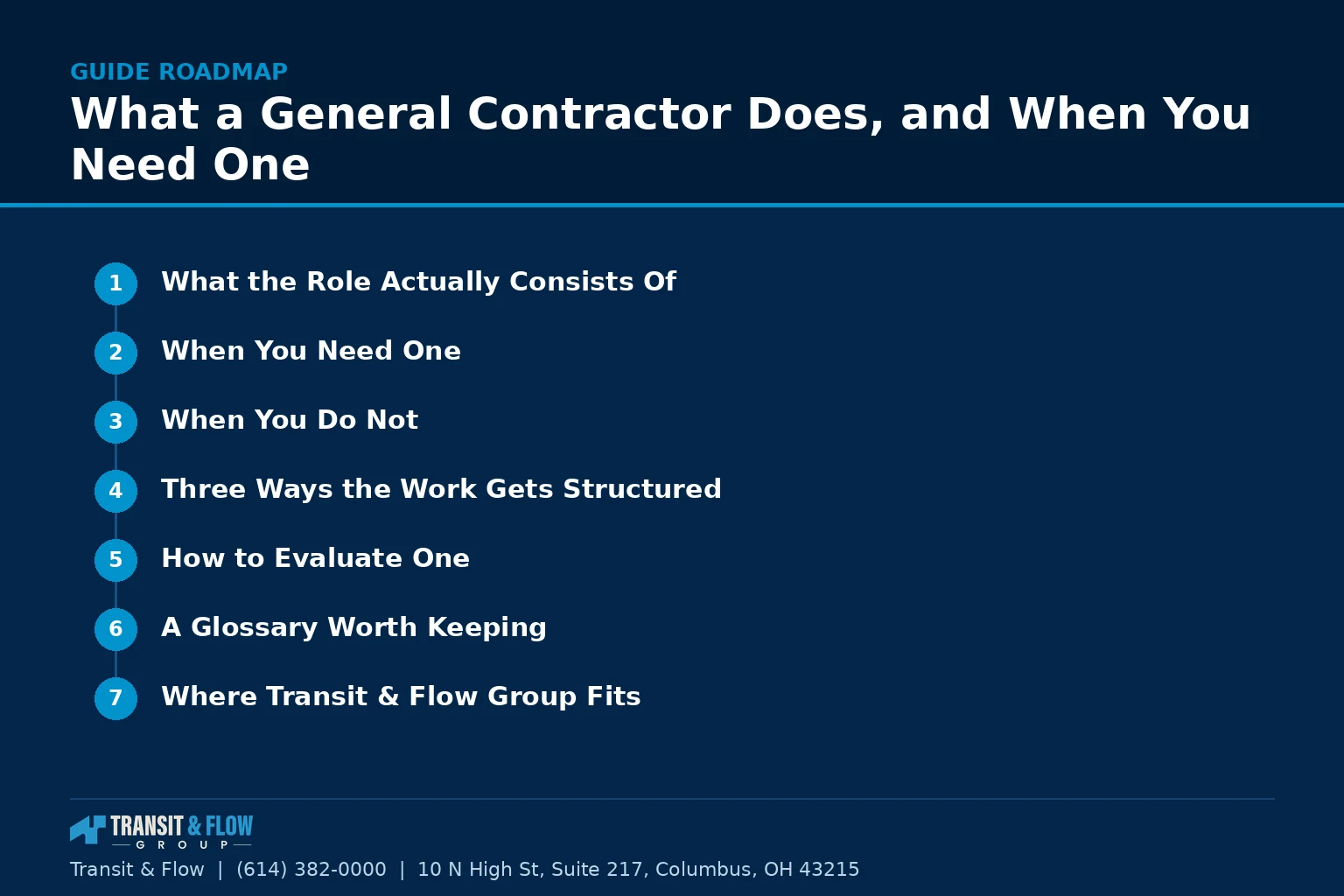
- What the Role Actually Consists Of
- When You Need One
- When You Do Not
- Three Ways the Work Gets Structured
- How to Evaluate One
- A Glossary Worth Keeping
- Where Transit & Flow Group Fits
- Frequently Asked Questions
Transit & Flow Group coordinates projects and partners with properly licensed and insured specialty contractors when licensing is required.
What the Role Actually Consists Of
Most people picture a general contractor as the person who shows up with the crew. The visible part is the smallest part. The work that determines whether a project finishes on time and on budget happens before anyone arrives and between the trades once they do.
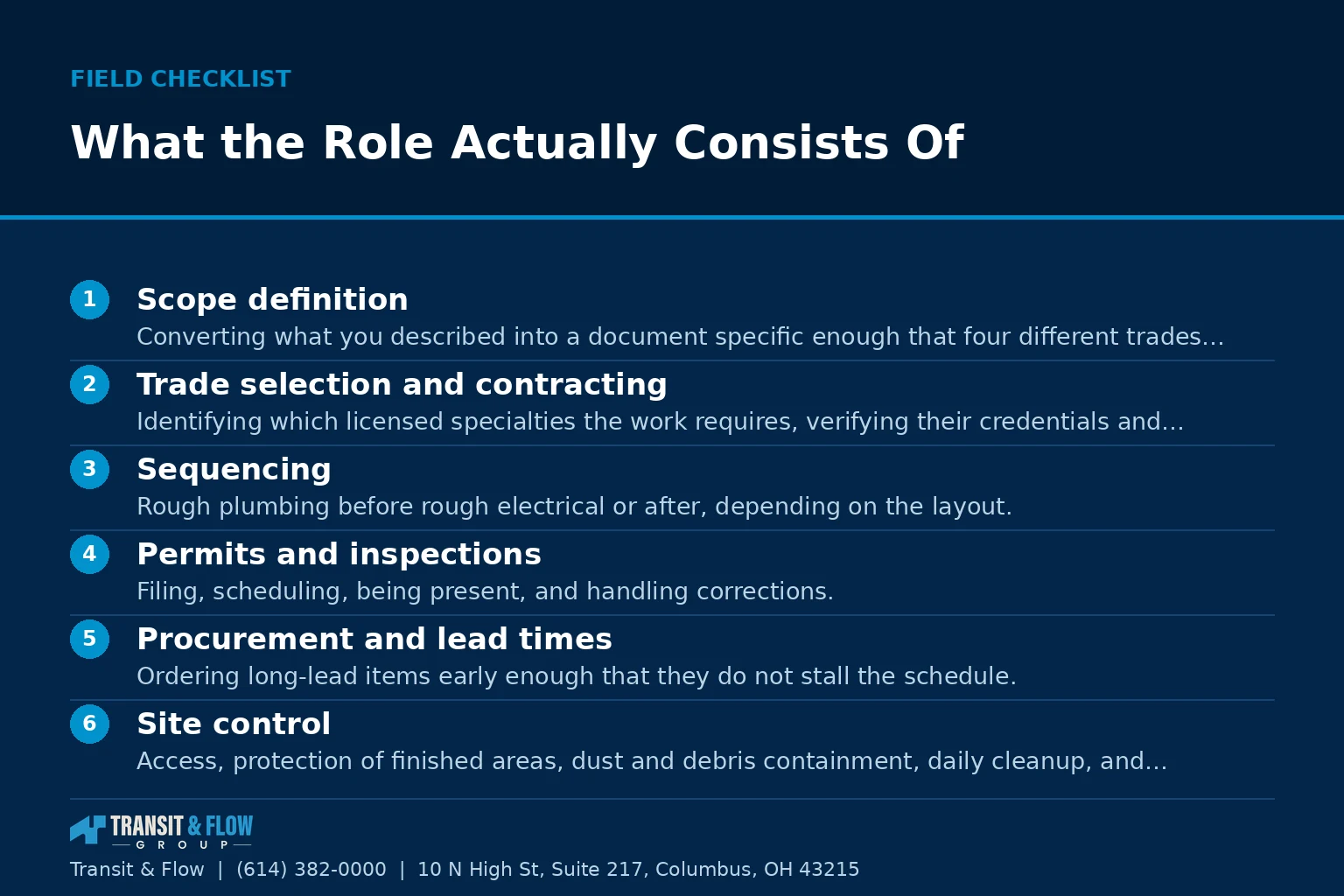
- Scope definition. Converting what you described into a document specific enough that four different trades price the same project. Vague scope is the single largest source of change orders.
- Trade selection and contracting. Identifying which licensed specialties the work requires, verifying their credentials and insurance, and contracting them with defined scope and terms.
- Sequencing. Rough plumbing before rough electrical or after, depending on the layout. Inspection before insulation. Insulation before drywall. Flooring after paint or before, depending on the material. Getting this wrong costs weeks, and it is the core of the skill.
- Permits and inspections. Filing, scheduling, being present, and handling corrections. In a multi-trade project this means multiple permits and multiple inspections that gate each other.
- Procurement and lead times. Ordering long-lead items early enough that they do not stall the schedule. Windows, cabinets, specialty equipment, and increasingly ordinary electrical and mechanical equipment.
- Site control. Access, protection of finished areas, dust and debris containment, daily cleanup, and safety on a property people are living in.
- Change management. Documenting every scope change with a price before it is performed, which is what prevents the end-of-project dispute.
- Payment administration. Paying subcontractors and suppliers, and collecting lien waivers that prove they were paid.
- Punch list and closeout. Final corrections, permit finals, warranties, and documentation.
The lien waiver item deserves a sentence of its own. In many circumstances a subcontractor or supplier who was not paid can place a claim against your property even if you paid the general contractor in full. Collecting waivers as you release payments is the mechanism that protects you, and it is the administrative task homeowners most often skip.
When You Need One
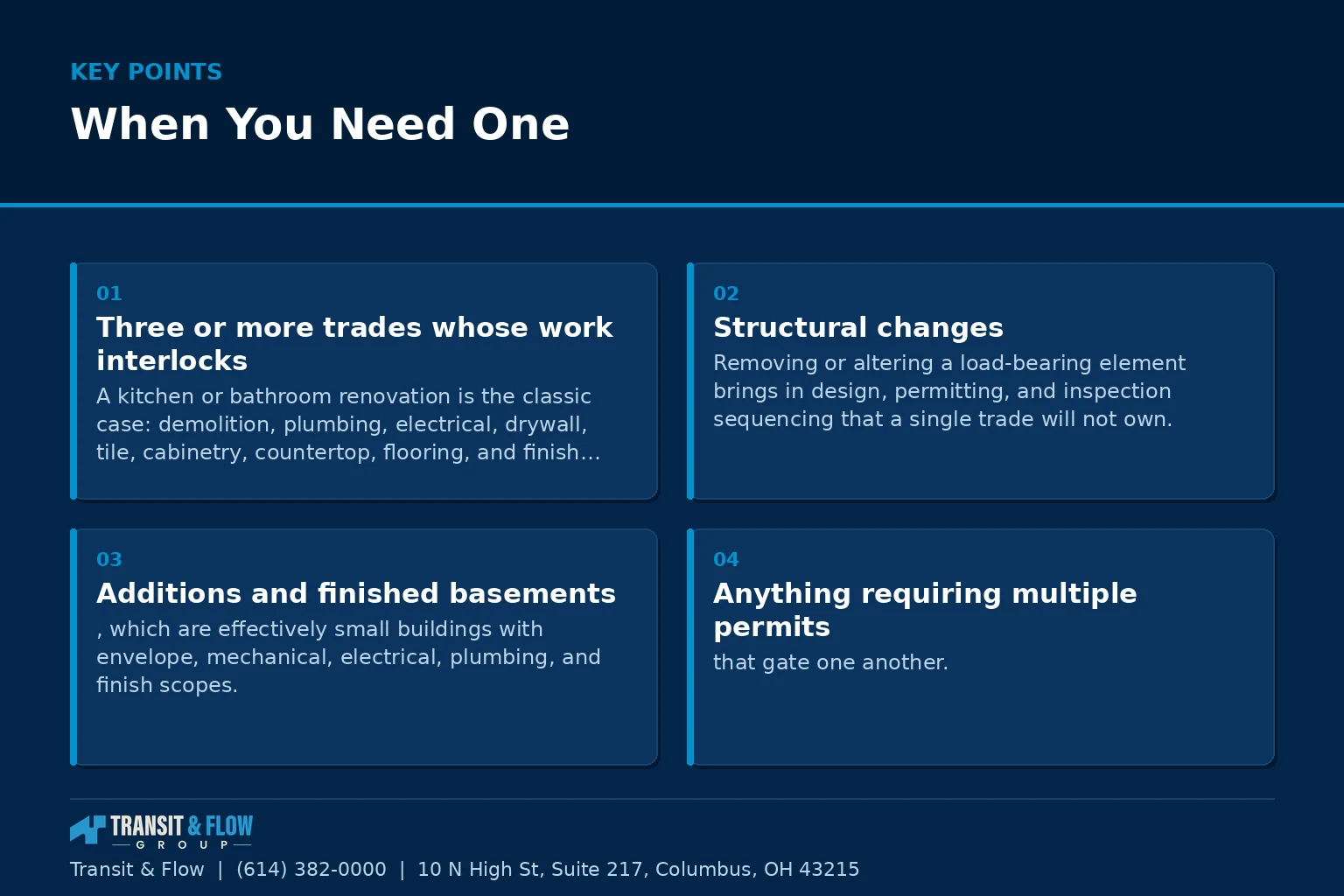
- Three or more trades whose work interlocks. A kitchen or bathroom renovation is the classic case: demolition, plumbing, electrical, drywall, tile, cabinetry, countertop, flooring, and finish, each gating the next.
- Structural changes. Removing or altering a load-bearing element brings in design, permitting, and inspection sequencing that a single trade will not own.
- Additions and finished basements, which are effectively small buildings with envelope, mechanical, electrical, plumbing, and finish scopes.
- Anything requiring multiple permits that gate one another.
- A hard deadline. A move-in date, an event, or a lease expiration. Schedule enforcement across independent trades is exactly the service being bought.
- You are not going to be present. Someone has to make small decisions daily. If it will not be you, it has to be someone with authority.
- Insurance restoration work with an adjuster, a scope of loss, and supplements. The documentation burden alone justifies the role.
When You Do Not
- Single-trade work. A water heater, a panel, a furnace, a roof, a driveway. Hire the specialist directly. A layer of coordination over a one-trade project adds cost without adding function.
- Sequential work with no interlock. Paint this month, carpet next month. You can manage that yourself.
- Small, well-defined repairs where the scope is obvious and the risk of surprise is low.
- Emergency single-system failures. Call the trade. Speed matters more than coordination.
Three Ways the Work Gets Structured
- General contractor with subcontracted trades. One contract, one point of accountability, subs contracted by the general. The most common residential structure and usually the right one.
- Design-build. Design and construction under one agreement. Fewer handoffs between the person who drew it and the person who builds it, and less finger-pointing when something does not fit. Worth considering when the design is not settled.
- Owner as general contractor. You hold every trade contract yourself. This saves the coordination fee and transfers every piece of the job list above onto you, including sequencing, permit responsibility, lien exposure, and the phone call at seven in the morning when the tile setter arrives and the plumber has not finished. Legitimate if you have the time, the knowledge, and the schedule flexibility, and expensive when it goes wrong.
Option A is the general contractor structure. Option B is self-managing. My recommendation is straightforward: if the project has three or more interlocking trades and you have a full-time job, take Option A. The coordination fee is not a markup on labor you could have bought yourself. It is the price of someone else owning the sequence, the permits, and the risk, and self-managing households consistently underestimate how many hours that ownership takes.
How to Evaluate One
- Ask who is actually on the job every day and how many other projects that person is running simultaneously. This single question predicts your experience better than any other.
- Ask which trades are in-house and which are subcontracted. Neither answer is wrong. Not knowing the answer is.
- Ask how change orders are handled, and confirm that pricing is agreed in writing before work is performed.
- Ask for the proposed sequence and schedule in writing, with the inspection points marked. A contractor who cannot produce a sequence has not thought about your project yet.
- Ask who pulls each permit and who is present for each inspection.
- Ask how subcontractor payment and lien waivers are handled and whether waivers come to you.
- Ask what happens if a trade fails to show. The answer reveals whether they have depth or a single option per trade.
- Ask for references on projects of similar scope completed within the last year, and call them. Ask the references specifically about communication when something went wrong.
- Verify licensing, registration, and insurance independently rather than accepting a forwarded document.
- Compare proposals by inclusion and exclusion before comparing totals. The lowest number is frequently the one with the most excluded.
A Glossary Worth Keeping
- Scope of work. The written definition of what is being built. Your primary protection.
- Allowance. A placeholder amount for a selection not yet made, such as tile or fixtures. Allowances that are set unrealistically low are how a proposal is made to look competitive.
- Change order. A written amendment to scope and price, signed before the work is performed.
- Substantial completion. The point at which the project is usable for its intended purpose, even with punch items open. Often the trigger for a payment milestone.
- Punch list. The itemized list of corrections remaining at the end.
- Retainage. A portion of payment withheld until closeout. Worth negotiating into the contract.
- Lien waiver. A signed release confirming a party was paid and waives lien rights for that work.
- Design-build. A single agreement covering both design and construction.
Where Transit & Flow Group Fits
Transit & Flow Group coordinates projects across Columbus and Central Ohio and partners with properly licensed and insured specialty contractors when licensing is required, which is the coordination role described on this page. Our standard is a written scope before pricing, a written sequence with inspection points marked, change orders priced in writing before work proceeds, and lien waivers collected as payments are released. Whether the project runs through plumbing, electrical, or heating and cooling, one coordinator carries it and the documentation comes to you. To start a project with that structure in place, request an assessment.
Frequently Asked Questions
When does a project actually need a general contractor?
When three or more trades interlock and the order of their work determines whether the job finishes. Kitchen and bathroom renovations are the classic case, with demolition, plumbing, electrical, drywall, tile, cabinetry, countertop, flooring, and finish each gating the next. Structural changes, additions, finished basements, work requiring multiple permits that gate one another, a hard deadline, and insurance restoration work all point the same direction. So does the simple fact that you will not be on site to make small decisions daily.
When is hiring a general contractor unnecessary?
On single trade work, hire the specialist directly. A water heater, a panel, a furnace, a roof, or a driveway does not benefit from a layer of coordination over a one trade project, and that layer adds cost without adding function. The same applies to sequential work with no interlock, such as paint this month and carpet next month, and to small well defined repairs where the scope is obvious. For an emergency single system failure, call the trade, because speed matters more than coordination.
What is a lien waiver and why does it matter to a homeowner?
A lien waiver is a signed release confirming that a subcontractor or supplier was paid and waives their lien rights for that work. It matters because in many circumstances a party who was not paid can place a claim against your property even if you paid the general contractor in full. Collecting waivers as you release payments is the mechanism that protects you, and it is the administrative task homeowners most often skip. Confirm before signing a contract whether waivers will be collected and whether they come to you.
Is the coordination fee just a markup on labor I could buy myself?
No. It is the price of someone else owning the sequence, the permits, and the risk. Scope definition, trade selection and credential verification, sequencing, permit filing and inspection attendance, procurement and lead times, site control, change management, payment administration, and closeout are all inside that fee. Households that self manage consistently underestimate how many hours that ownership takes, and the hours arrive on the project’s schedule rather than on yours.
Can I act as my own general contractor?
You can, and it is legitimate if you have the time, the knowledge, and the schedule flexibility. Holding every trade contract yourself saves the coordination fee and transfers the entire job list onto you, including sequencing, permit responsibility, lien exposure, and the early morning phone call when the tile setter arrives and the plumber has not finished. It is inexpensive when it goes well and expensive when it does not. Be honest about which of those your schedule can absorb.
What should I confirm before hiring a general contractor?
Establish who is on the job every day and how many other projects that person is running at the same time, which predicts your experience better than anything else. Confirm which trades are in house and which are subcontracted, how change orders are priced and documented before work proceeds, and the proposed sequence and schedule in writing with inspection points marked. Get clarity on who pulls each permit, who attends each inspection, how subcontractor payment and lien waivers are handled, and what happens if a trade fails to show. Verify licensing, registration, and insurance independently rather than accepting a forwarded document, and compare proposals by inclusion and exclusion before comparing totals.
Sources
- Ohio Construction Industry Licensing Board, state specialty trade licensing
- Ohio Attorney General, consumer protection resources
- City of Columbus, Get a Permit, permit application channels
About This Guide
Written and edited by Micheal Parker, founder of Transit & Flow Group. Published October 18, 2026. This guide is checked against the agency and code sources listed above, and it is revised when those sources change.
General contractor of record. Micheal Parker holds City of Columbus General Contractor Registration G12064, issued by the Columbus Department of Building and Zoning Services under Transit & Flow LLC and valid through June 30, 2027. Trade work that falls outside the scope of that registration is performed by licensed trade partners, and the responsible license holder is identified before work begins.
Transit & Flow Group, home and commercial services for Columbus and the surrounding Central Ohio communities. Phone (614) 382-0000. Email solutions@transitflowgroup.com. 10 N High St, Suite 217, Columbus, OH 43215. Contact our team or review the communities we serve.
