

When the first hard freeze rolls across Central Ohio, it does not send a warning to your tenants, your maintenance budget, or your net operating income. It simply arrives, and it finds every weakness a portfolio has deferred. Commercial winter facilities readiness Central Ohio owners can count on is not a seasonal chore to delegate and forget. It is a capital-preservation discipline that protects asset value, tenant safety, and business continuity across every building you hold.
At the executive level, the calculus is straightforward. A single burst riser or a failed rooftop unit in January can generate emergency repair costs, tenant claims, lost rent, and reputational damage that dwarf a full season of proactive preparation. The properties that sail through an Ohio winter are the ones whose owners treated readiness as strategy, not reaction. That is the standard Transit & Flow brings to commercial portfolios across Columbus and its suburbs.
In This Guide
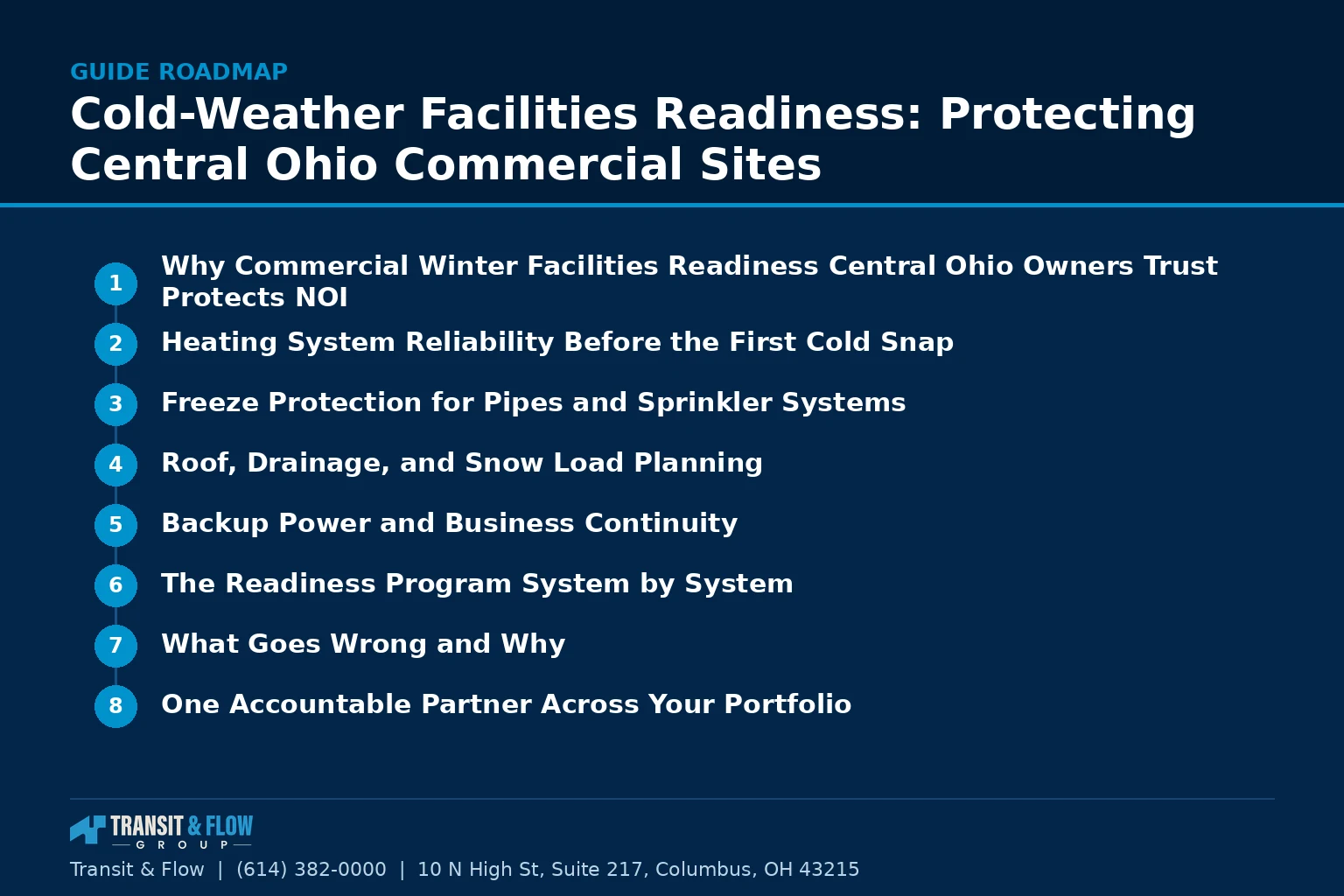
- Why Commercial Winter Facilities Readiness Central Ohio Owners Trust Protects NOI
- Heating System Reliability Before the First Cold Snap
- Freeze Protection for Pipes and Sprinkler Systems
- Roof, Drainage, and Snow Load Planning
- Backup Power and Business Continuity
- The Readiness Program System by System
- What Goes Wrong and Why
- One Accountable Partner Across Your Portfolio
- Frequently Asked Questions
- Sources
- Related Transit & Flow Services
Why Commercial Winter Facilities Readiness Central Ohio Owners Trust Protects NOI
Deferred maintenance is the quietest threat to asset value, because its cost is invisible until it is catastrophic. A heat exchanger that limped through last winter, a roof drain half-clogged with fall debris, a sprinkler line running through an unconditioned space: none of these show up on a rent roll, but each one is a live liability. Commercial winter facilities readiness Central Ohio operators plan for converts those hidden risks into a managed, budgeted line item.
The financial logic favors prevention every time. Emergency service after a freeze commands premium rates, arrives on the vendor’s timeline rather than yours, and often addresses the symptom instead of the cause. A planned readiness program lets you schedule work during business hours, negotiate predictable pricing, and keep control of the tenant experience. For facilities directors managing NOI targets, that predictability is the point.
Heating System Reliability Before the First Cold Snap
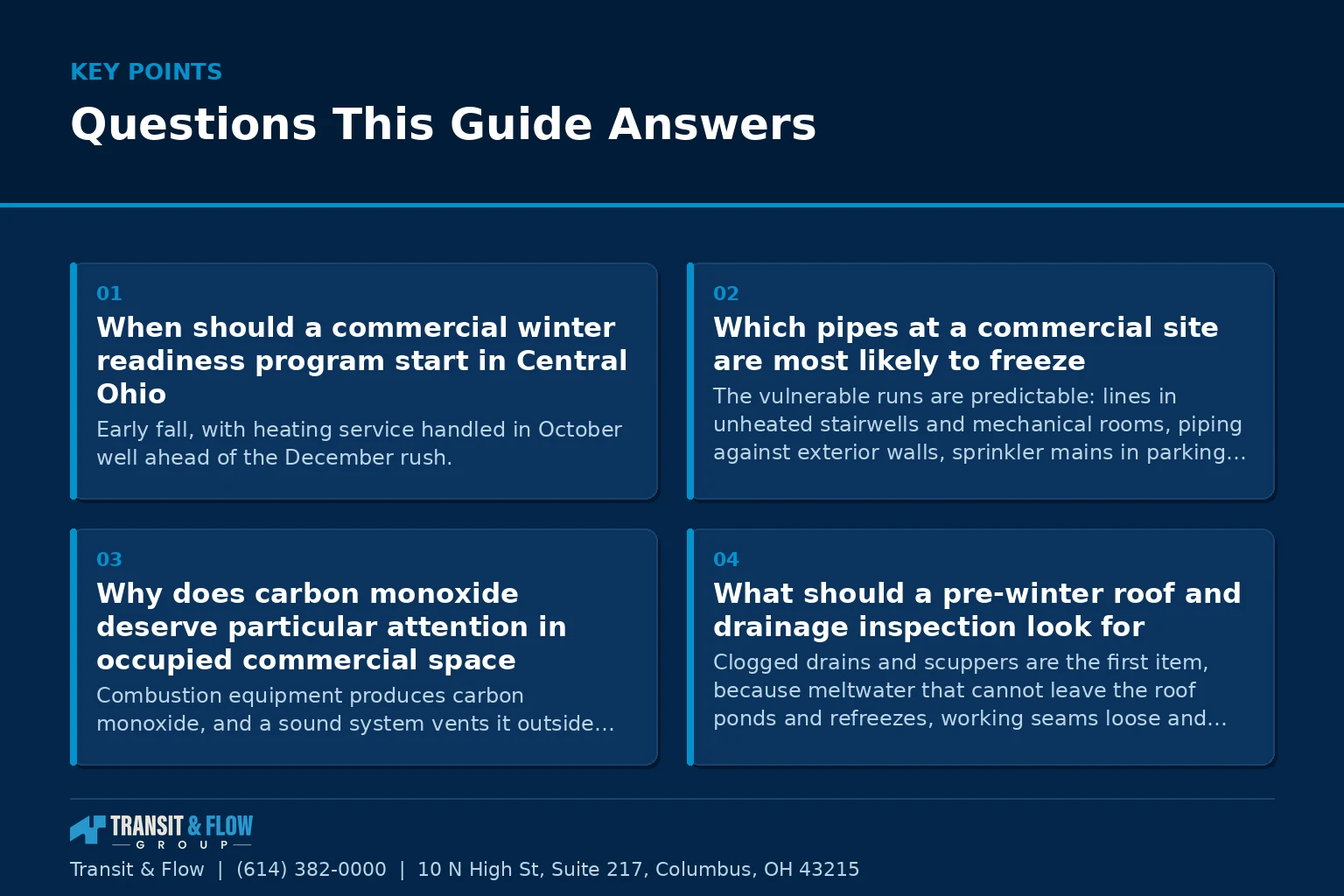
Your heating plant is the single most consequential system in a winter portfolio. Rooftop units, boilers, and packaged systems that ran hard through summer cooling now face their most demanding season with no margin for failure. Early-fall service in October, well ahead of the December rush, is the difference between a scheduled tune-up and a frantic call when a tenant space drops to fifty degrees on the coldest morning of the year.
A disciplined heating review covers combustion and heat-exchanger integrity, ignition and safety controls, belts and bearings, filters, and the building automation logic that governs setpoints and staging. Carbon monoxide safety deserves particular attention in occupied commercial space, where a cracked exchanger is both a life-safety and a liability exposure. Reliable heat is not a comfort amenity. It is a condition of your lease obligations and your duty of care.
Freeze Protection for Pipes and Sprinkler Systems
Frozen and burst pipes are the most expensive, most preventable failures in any Ohio winter. Water expands with tremendous force, and a single rupture in a supply line or a wet-pipe fire sprinkler system can flood multiple floors, damage tenant inventory, and trigger a mold remediation project that lingers for months. Commercial freeze protection in Columbus starts with knowing exactly where your vulnerable runs are.
The high-risk locations are predictable: pipes in unheated stairwells and mechanical rooms, lines against exterior walls, sprinkler mains in parking structures and loading docks, and any run in a space that loses conditioning when a unit is vacant. Effective facilities winter prep in Ohio addresses each with insulation, heat trace where appropriate, sealed penetrations, and verified minimum temperatures in every space that carries water. A dry-pipe or antifreeze-loop review on your sprinkler system belongs on the same checklist.
Roof, Drainage, and Snow Load Planning
Central Ohio delivers a punishing freeze-thaw cycle, and flat and low-slope commercial roofs absorb the worst of it. Clogged drains and scuppers force meltwater to pond and refreeze, working seams loose and driving leaks that appear far from their source. Ice dams at the roof edge back water under membranes and flashing. A pre-winter roof and drainage inspection catches the small failures before a snow load turns them into interior damage.
Snow and ice response is the other half of the plan. Before the season starts, you should know who clears your lots and walks, what triggers a service dispatch, and how quickly it happens. Slip-and-fall liability is a real and recurring exposure at commercial sites, and a documented, contracted response program protects both your tenants and your insurance position. To protect commercial property in winter, the plan has to exist on paper before the first snowfall, not after.
Backup Power and Business Continuity
Winter storms take down grid power, and for many commercial tenants an outage is not an inconvenience but a shutdown. Medical, data, food-service, and logistics tenants depend on continuity, and their leases and their loyalty reflect it. Standby generators, transfer switches, and battery systems need to be tested under load before the season, not discovered to be dead when they are needed.
Business continuity planning also means knowing your priorities in advance. Which systems must stay live, which tenants require immediate communication, and who holds the accountability to execute when conditions deteriorate. A readiness program that spans heating, plumbing, electrical, and exterior response under one accountable partner removes the finger-pointing that costs hours during an emergency.
The Readiness Program System by System
A program only holds up if every system has a named owner, a verification method, and a date. The table below is the skeleton most Central Ohio commercial portfolios can build from.
| System | Pre-Season Verification | Exposure If Skipped | Target Window |
|---|---|---|---|
| Heating plant | Combustion and heat-exchanger integrity, safety controls, filters, drive components | Tenant space without heat, life-safety exposure | October |
| Building automation | Setpoints, staging logic, alarm routing, after-hours schedules | Equipment running against itself, unnoticed faults | October |
| Wet piping and sprinkler | Mapped vulnerable runs, insulation, heat trace, verified space temperatures | Multi-floor water loss and a remediation project | Late October |
| Roof and drainage | Drains, scuppers, seams, flashing, edge conditions | Ponding, refreeze, interior damage and tenant claims | November |
| Standby power | Load testing of generators, transfer switches, battery systems | Tenant shutdown during a storm outage | November |
| Snow and ice response | Contracted scope, dispatch triggers, response times, documentation | Slip-and-fall liability and insurance friction | Before first snowfall |
What Goes Wrong and Why
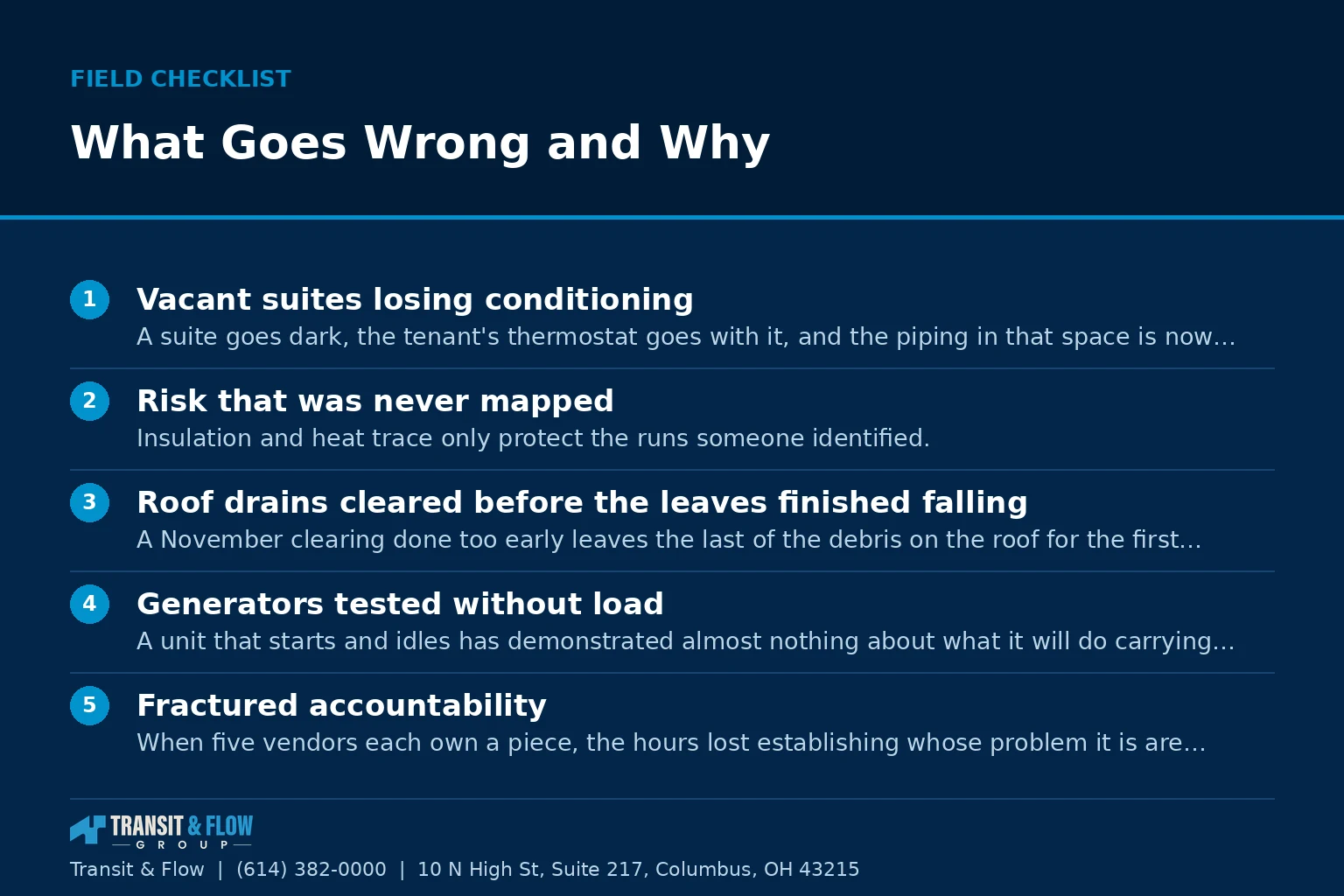
- Vacant suites losing conditioning. A suite goes dark, the tenant’s thermostat goes with it, and the piping in that space is now unheated. Vacancy is the single most reliable predictor of a freeze loss in a commercial building.
- Risk that was never mapped. Insulation and heat trace only protect the runs someone identified. The line nobody walked is the line that ruptures.
- Roof drains cleared before the leaves finished falling. A November clearing done too early leaves the last of the debris on the roof for the first freeze to lock in place.
- Generators tested without load. A unit that starts and idles has demonstrated almost nothing about what it will do carrying the building.
- Fractured accountability. When five vendors each own a piece, the hours lost establishing whose problem it is are the hours the damage compounds.
One Accountable Partner Across Your Portfolio
The operational advantage of consolidation is decisive in winter. When HVAC, plumbing, electrical, roofing, and snow response run through separate vendors, accountability fractures at exactly the moment you need it whole. A single multi-trade partner delivers one point of contact, coordinated scheduling across every building, consistent documentation for compliance and insurance, and faster response when a freeze hits multiple sites at once.
Transit & Flow serves commercial portfolios throughout Dublin, Westerville, Hilliard, Gahanna, Grove City, Upper Arlington, Worthington, New Albany, Powell, Pickerington, and greater Columbus. You can review our full coverage on our service areas page, and explore more operational playbooks in our related guides. Commercial winter facilities readiness Central Ohio portfolios depend on works best as a coordinated program, not a building-by-building scramble.
The first hard freeze is a deadline, and it is closer than it looks. Protect your assets, your tenants, and your operating income by getting ahead of winter now. Get an instant estimate on the Transit & Flow homepage, or call our commercial team at (614) 382-0000 to build a winter readiness program tailored to your portfolio. Confident, coordinated preparation today is the cost you choose instead of the emergency you cannot.
Transit & Flow Group coordinates projects and partners with properly licensed and insured specialty contractors when licensing is required, and work is performed under the appropriate permits.
Frequently Asked Questions
When should a commercial winter readiness program start in Central Ohio?
Early fall, with heating service handled in October well ahead of the December rush. Starting early keeps the work inside business hours, keeps pricing predictable rather than at emergency-response rates, and leaves room to order parts before the first hard freeze. It also means service arrives on your schedule instead of the vendor’s. The portfolios that come through an Ohio winter cleanly are the ones that treated readiness as a planned program rather than a reaction.
Which pipes at a commercial site are most likely to freeze?
The vulnerable runs are predictable: lines in unheated stairwells and mechanical rooms, piping against exterior walls, sprinkler mains in parking structures and loading docks, and any run in a space that loses conditioning when a suite goes vacant. Locating those runs is the first step, because a risk that has not been mapped cannot be managed. Insulation, heat trace where appropriate, sealed penetrations, and verified minimum temperatures in every space carrying water are the usual measures. The specifics belong to a licensed mechanical contractor working from the adopted code and the product manufacturer’s published instructions.
Why does carbon monoxide deserve particular attention in occupied commercial space?
Combustion equipment produces carbon monoxide, and a sound system vents it outside the building. A compromised heat exchanger or a compromised venting path is both a life-safety matter and a liability exposure in space occupied by tenants and their customers. Combustion and heat-exchanger integrity should be evaluated by a qualified technician before the heating season, alongside ignition and safety controls. Detection equipment should be maintained on the schedule set out in the manufacturer’s published instructions.
What should a pre-winter roof and drainage inspection look for?
Clogged drains and scuppers are the first item, because meltwater that cannot leave the roof ponds and refreezes, working seams loose and driving leaks that surface far from their origin. Ice accumulation at the roof edge can back water under membranes and flashing. Flat and low-slope commercial roofs absorb the worst of the Central Ohio freeze-thaw cycle, so this is an annual inspection rather than a one-time item. The purpose is to find the small failures before a snow load converts them into interior damage and a tenant claim.
Should snow and ice response be contracted before the season starts?
Yes, and it should be documented before the season rather than negotiated during it. You want to know in advance who clears your lots and walks, what conditions trigger a dispatch, and how quickly crews arrive. Slip-and-fall liability is a recurring exposure at commercial sites, and a contracted, documented response program supports both tenant safety and your insurance position. A plan that only comes together after the first snowfall is not a plan.
How should standby power be verified before winter?
Test it under load before the season rather than discovering its condition during an outage. Standby generators, transfer switches, and battery systems all need verification, and the testing interval and method should follow the equipment manufacturer’s published instructions and be carried out by a licensed electrical contractor. Pair the testing with a written priority list covering which systems must stay live, which tenants require immediate notification, and who is accountable for executing. Medical, data, food-service, and logistics tenants treat an outage as a shutdown rather than an inconvenience.
Sources
- National Weather Service, winter weather safety
- Ohio Department of Commerce, Division of Industrial Compliance, licensing and code enforcement
- National Fire Protection Association, home fire safety
Related Transit & Flow Services
Every service below is delivered by the same accountable Transit & Flow team, so one call covers the whole property.
- Commercial and Facilities Services
- Integrated Facilities Maintenance
- Planned Preventive Maintenance
- Vendor Consolidation Programs
- Snow and Ice Response Coordination
- Property Solutions
Serving Columbus and every community across Central Ohio. See the full service areas map, or get an instant estimate on the Transit & Flow homepage.
About This Guide
Written and edited by Micheal Parker, founder of Transit & Flow Group. Published August 24, 2026. This guide is checked against the agency and code sources listed above, and it is revised when those sources change.
General contractor of record. Micheal Parker holds City of Columbus General Contractor Registration G12064, issued by the Columbus Department of Building and Zoning Services under Transit & Flow LLC and valid through June 30, 2027. Trade work that falls outside the scope of that registration is performed by licensed trade partners, and the responsible license holder is identified before work begins.
Transit & Flow Group, home and commercial services for Columbus and the surrounding Central Ohio communities. Phone (614) 382-0000. Email solutions@transitflowgroup.com. 10 N High St, Suite 217, Columbus, OH 43215. Contact our team or review the communities we serve.
