


An Ohio irrigation system needs two service visits a year and neither is optional. Winterization clears water from the pipes, valves, and backflow assembly before the ground freezes, using compressed air rather than gravity alone. Spring startup repressurizes the system slowly, inspects every zone, cleans and adjusts heads, reprograms the controller, and confirms the backflow device still works. Skip either and you buy repairs.
In This Guide
- What Freeze Damage Actually Does
- Why Draining Alone Is Usually Insufficient
- Blowout, Conceptually
- The Wrong Equipment Problem
- Timing by Conditions, Not Calendar
- What a Documented Winterization Visit Includes
- The Spring Startup Sequence
- Backflow Testing in Spring
- Reading the Damage That Shows Up at Startup
- The Decision
- Where Transit & Flow Group Fits
- Frequently Asked Questions
Here is what most Central Ohio property owners get wrong. They treat winterization as the important visit and spring startup as a convenience they can handle by turning a valve. Startup is when you find out whether winterization worked, and it is the only moment all year when every component is visible and testable at once. A system turned on carelessly in April can also destroy itself in under a minute.
What Freeze Damage Actually Does
Water expands when it freezes. That is the entire mechanism, and everything else follows from where the trapped water sits and what surrounds it. The damage is not uniform, because components differ in material and wall thickness.
- The backflow assembly. Brass or bronze, above grade, and the most expensive item on the property to replace. Brass does not stretch, so trapped water cracks the casting, splits the bonnet, or ruptures a test cock, invisibly until spring.
- Zone valves. Plastic bodies with rubber diaphragms in below-grade boxes. Ice deforms the diaphragm seat or cracks the body, and a distorted diaphragm weeps or refuses to close, which reads as a zone that never shuts off.
- Lateral lines. The buried piping between valves and heads, installed above frost depth by design. Polyethylene splits along a seam and PVC shatters. Both leak underground, and the water surfaces away from the break.
- Sprinkler heads. Water trapped in the riser lifts the cap, cracks the housing, or destroys the seal. A cracked head geysers at startup and floods the surrounding turf.
- The mainline and point of connection. The pressurized run from the building to the valves. A break here leaks continuously on a live line, unnoticed until a water bill or a soft spot announces it.
Central Ohio makes this worse than a colder climate would. A steadily frozen system freezes once. Franklin County and its neighbors cycle above and below freezing repeatedly, so residual water freezes, thaws, migrates, and freezes again, working each crack open. The region’s heavy clay holds water against buried components rather than draining it away.

Why Draining Alone Is Usually Insufficient
Some systems have manual drain valves at low points, others automatic drains that open when pressure drops. Both work in theory, and both depend on the pipe running downhill, the drain being clear, and the water having somewhere to go.
None of those conditions is reliable here. Central Ohio terrain is flat to gently rolling, so laterals run near level with no pitch toward a drain and water sits in the belly of the line. Automatic drains silt up or stick. Clay does not accept water quickly, so a drain opening into saturated ground stops draining while the pipe is still partly full.
Then there is the part gravity cannot reach. Valve bodies hold water in the diaphragm chamber above the outlet. Heads hold it in the riser, and check valves installed to stop low-head drainage are designed to retain it. The backflow assembly holds water between two closed checks. A drain-down leaves all of it in place, which is why blowout is standard in this climate and why manufacturers write their cold-climate instructions around it.
Blowout, Conceptually
Blowout introduces compressed air downstream of the supply and pushes water out through the heads, zone by zone, until each circuit runs dry. Done correctly it is methodical and unremarkable. Done incorrectly it destroys more than a freeze would have.
The sequence runs like this. The supply is isolated and the system depressurized. Air enters at a designated connection point, never through the backflow assembly in a way the manufacturer prohibits. Zones open one at a time, starting furthest from the compressor, so air volume concentrates in one circuit rather than dividing across several. Each zone runs until the heads discharge mist rather than water, then closes before running dry under air. The backflow assembly is drained and its test cocks and isolation valves left partially open so remaining moisture has room to expand. The controller is set so it will not open valves during winter.
Two constraints govern all of it, and both come from the component manufacturer rather than a rule of thumb. The first is the maximum pressure the piping, valves, and heads are rated to see. The second is how long a zone can run on air without water, since water cools and lubricates a rotor gear drive. Those limits are published for the products on your property, and a contractor who cannot say where yours come from is working from habit.
The Wrong Equipment Problem
Blowout requires volume, measured as airflow, not pressure. That distinction ruins systems every autumn in Columbus neighborhoods where a homeowner or a low-cost operator arrives with a compressor built for nail guns.
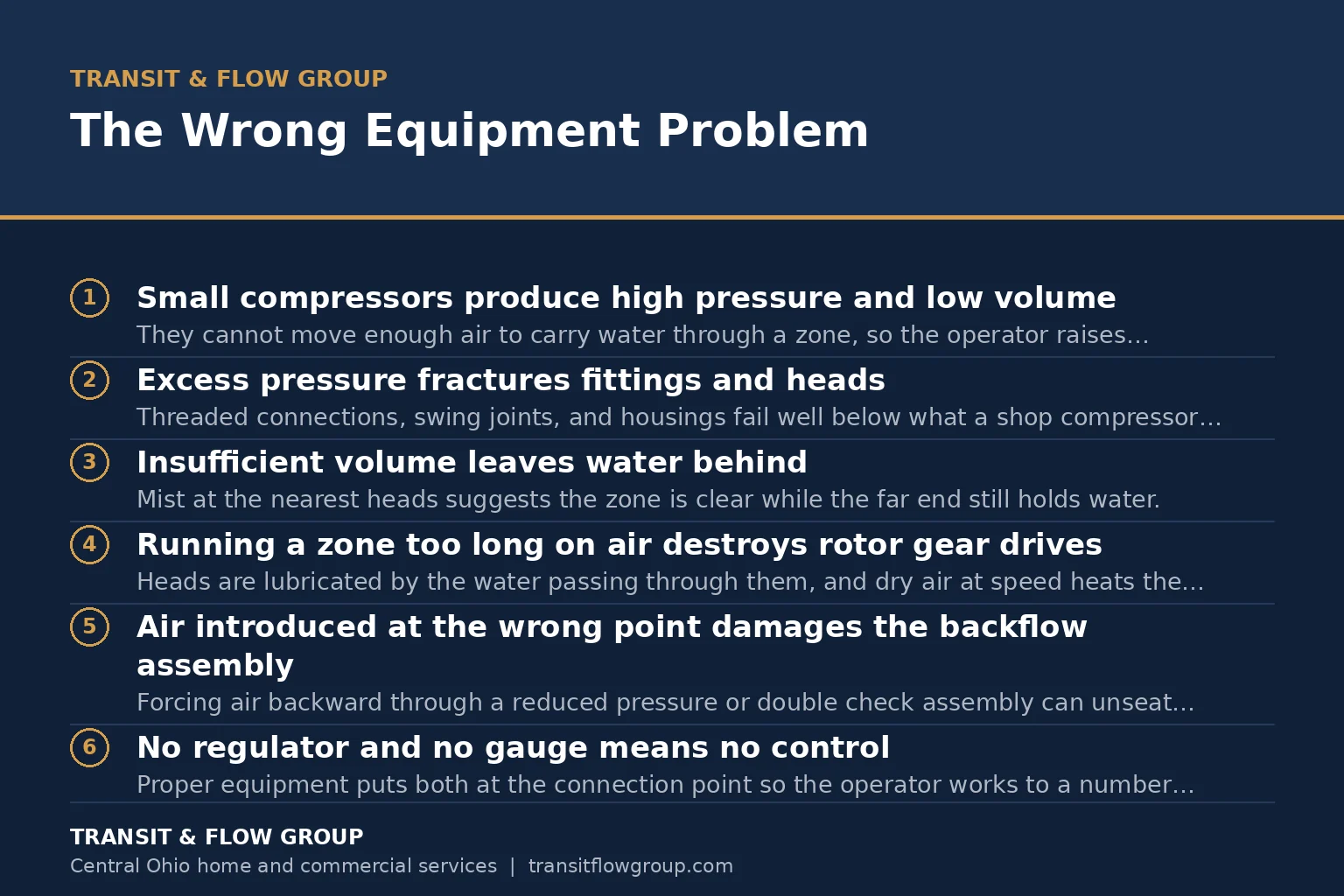
- Small compressors produce high pressure and low volume. They cannot move enough air to carry water through a zone, so the operator raises pressure, the one parameter that must stay bounded.
- Excess pressure fractures fittings and heads. Threaded connections, swing joints, and housings fail well below what a shop compressor delivers, often as a stressed fitting that lets go next season.
- Insufficient volume leaves water behind. Mist at the nearest heads suggests the zone is clear while the far end still holds water. The system is declared winterized and freezes anyway.
- Running a zone too long on air destroys rotor gear drives. Heads are lubricated by the water passing through them, and dry air at speed heats the gear train. The rotors will not turn in spring.
- Air introduced at the wrong point damages the backflow assembly. Forcing air backward through a reduced pressure or double check assembly can unseat the internal checks, and manufacturers are explicit about where air may enter.
- No regulator and no gauge means no control. Proper equipment puts both at the connection point so the operator works to a number rather than to feel.
A blowout visit costs a fraction of one cracked backflow assembly, and a bad blowout can produce that crack plus failed rotors plus a lateral repair. This is one of the few maintenance items where the cheapest provider is a risk, not a tradeoff.
Timing by Conditions, Not Calendar
There is no correct date, only a correct condition. The work has to be complete before the first sustained hard freeze reaches the shallowest components, which means before the ground itself begins to freeze and before overnight lows hold below freezing for consecutive nights.
Central Ohio autumns are inconsistent, and an early cold snap does not care that your service is booked for next month. Watch the National Weather Service forecast for the office covering Central Ohio rather than a general app, because you want the first run of consecutive freezing nights. And book early, because schedules here compress into a short window and the last appointments of the season slip past the first freeze.
The reverse constraint matters less than people think. Winterizing early costs a few weeks of irrigation you likely do not need, since established turf takes little water once autumn rainfall resumes. Early costs nothing. Late costs an assembly.
What a Documented Winterization Visit Includes
Winterization is not a truck in the driveway for twenty minutes. Hold a provider to this.
- Water supply isolated and system depressurized. The irrigation shutoff is closed and its location is shown to you or noted on the ticket.
- Every zone blown out individually. The count is written down. If your controller runs eight zones and the ticket says six, two circuits are still full of water.
- Air introduced at the correct connection point. Consistent with the backflow manufacturer’s instructions, with a regulator and gauge in line.
- Backflow assembly drained and left in the winter position. Test cocks and isolation valves partially open, insulated or removed if the installation calls for it.
- Manual and automatic drains addressed. Manual drains opened, automatic drains confirmed functional or noted as suspect.
- Controller set off or to rain mode with the program preserved. A dead backup battery gets noted now rather than discovered in April.
- Pre-existing damage documented. Broken heads, leaking valves, and sunken or misaimed heads recorded in autumn, so spring is not the first anyone hears of them.
- A written service record. Date, zones serviced, condition notes, technician. This is what turns a warranty conversation from an argument into a document.
The Spring Startup Sequence
Startup is a diagnostic visit that ends with a working system. Order matters, and the first step is the one homeowners skip.
Slow pressurization
An empty system filled fast produces a surge as water slams into closed valves and dead ends. That surge, commonly called water hammer, breaks fittings, unseats backflow checks, and blows heads off risers in systems that wintered perfectly. The main valve opens a fraction of a turn, the system fills gradually, and air ahead of the water is given somewhere to escape. Only when the system is full does the valve go fully open.
Zone by zone inspection
Each zone runs individually and is watched start to finish, looking for heads that do not pop up or retract, heads leaking at the base, rotors that do not turn, shifted spray patterns, wet spots indicating a lateral break, and zones that never activate. A controller reporting no fault says nothing about a nozzle buried in mulch.
Head cleaning and adjustment
Nozzles and filter screens are cleared of grit from winter and from the blowout. Settled heads are raised back to grade, which in clay happens routinely as the ground heaves. Arcs and radii are reset so water lands on turf and beds, not driveways and siding. Most of a system’s real efficiency lives here.
Controller reprogramming
Date, time, and season are set, and run times matched to spring conditions rather than left at the previous August schedule. Central Ohio spring rainfall is substantial, and summer durations in April waste water and encourage shallow roots. Sensors are tested rather than assumed, and backup batteries replaced.

Backflow Testing in Spring
An irrigation system connected to a potable supply requires a backflow prevention assembly, and in Ohio that assembly is subject to testing requirements set out in the Ohio Administrative Code and enforced by your water purveyor. The interval, who may test, and where results are filed are set by that purveyor, and they differ between Columbus and neighboring municipalities such as Dublin, Westerville, and Hilliard.
Spring is the natural time to satisfy this, since the assembly is being handled anyway and a failed test needs repair before the season, not during it. The test must be done by a certified tester with calibrated gauges, and the report goes to the purveyor, not into a drawer. An assembly that survived winter can still fail, because a stressed check that holds under normal flow may not hold under the differential the test applies.
Reading the Damage That Shows Up at Startup
What fails in April tells you what happened in November.
| What you see at startup | What it usually indicates |
|---|---|
| Leaking backflow body or test cock | Trapped water froze in the assembly, so the blowout did not clear it or it was left closed |
| A zone that will not activate | Solenoid, diaphragm, or wiring failure, often freeze deformation of the diaphragm seat |
| A zone that will not shut off | Debris or a distorted diaphragm holding the valve open, common after grit was pushed downstream |
| Persistent wet area with low pressure in one zone | Lateral line break underground, from freeze or from heaving and settling in clay |
| Rotors that pop up but do not rotate | Gear drive damage, most often from a zone run too long on dry air |
| Heads geysering or spraying from the base | Cracked housing or broken riser, from freeze or from a pressure surge at fill |
| Heads below grade or spraying pavement | Normal seasonal settling in Central Ohio clay, adjustment rather than repair |
| Low pressure across every zone | Main supply, pressure regulation, or a partially closed isolation valve |
The pattern is worth naming. Damage in one component points at that component. Damage spread across the assembly, multiple valves, and multiple laterals points at the winterization, and is the signature of a system drained rather than blown out, or blown out with equipment that could not move the volume.
The Decision
Option A. Handle it yourself or hire the lowest bidder each autumn. Drain what you can reach, borrow a compressor, open the valve in spring and see what happens.
Option B. Contract both visits with one provider, scheduled by condition in autumn, with spring startup covering slow fill, zone by zone inspection, head service, controller programming, and backflow testing filed with the purveyor.
Recommendation: Option B, and the argument is arithmetic rather than preference. Two visits a year for ten years is a known, budgetable number. One cracked backflow assembly, replaced and retested, plus a lateral repair and a set of rotors, routinely exceeds it in a single event. The failure mode is concentrated, not gradual. You do not lose a little each year, you lose everything at once in the season when a hard freeze arrived a week before the appointment. The same visit also satisfies a backflow testing obligation you carry regardless.
Where Transit & Flow Group Fits
We coordinate irrigation service across Central Ohio on a two visit schedule, with autumn winterization sequenced against forecast conditions rather than a fixed calendar slot, and spring startup run as a full inspection with a written condition report. Blowout uses volume-rated, regulated, gauged equipment, worked zone by zone to the manufacturer’s limits. To have both visits handled properly, start a conversation with our team. You can also review our irrigation services, our guidance on backflow prevention and testing, our Central Ohio irrigation design guide, and our article on drainage in clay soil.
Transit & Flow Group coordinates projects and partners with properly licensed and insured specialty contractors when licensing is required, and work is performed under the appropriate permits.
Frequently Asked Questions
Is draining the system enough for winter
Usually not. Water remains trapped in valves, low points, backflow assembly bodies, and lateral runs even after a drain, and that residual water is what cracks components when it freezes. A documented blowout addresses what draining leaves behind.
When should winterization happen
Timing should track conditions rather than a fixed date. The work needs to be complete before a sustained hard freeze, and Ohio autumns do not deliver that on the same date each year. Scheduling early in the window is safer than scheduling late.
Can I blow out my own irrigation system
Compressed air at the wrong volume or pressure damages components and creates a genuine injury risk, and a homeowner compressor generally cannot move the volume required. This is one of the clearer cases for professional service.
What should a winterization visit include
Shutting off and isolating the supply, protecting the backflow assembly, clearing each zone, verifying the controller is set appropriately for the off season, and leaving a record of what was done and anything found. A visit with no documentation is hard to evaluate.
What does spring startup involve
Slow repressurization to avoid surge damage, a zone by zone inspection for leaks and damage, head cleaning and adjustment, verification of the backflow assembly and any required testing, and reprogramming the controller for the season ahead.
What kind of damage shows up at startup
Cracked backflow components, split valve bodies, damaged heads, and wet spots indicating a lateral break are the usual findings. Most of it traces back to freeze exposure or to physical damage during the off season, and finding it in spring is far better than finding it in July.
Sources
- National Weather Service, Wilmington Ohio, forecasts and freeze conditions for Central Ohio
- Ohio Administrative Code, backflow prevention and cross connection control rules
- Ohio codes on ICC Digital Codes, adopted plumbing and building code text
- United States Environmental Protection Agency WaterSense, irrigation efficiency and seasonal scheduling
- Ohio State University Extension, Ohioline, turf water requirements and Ohio soil conditions
About This Guide
Written and edited by Micheal Parker, founder of Transit & Flow Group. Published October 28, 2026. Updated October 31, 2026. This guide is checked against the agency and code sources listed above, and it is revised when those sources change.
General contractor of record. Micheal Parker holds City of Columbus General Contractor Registration G12064, issued by the Columbus Department of Building and Zoning Services under Transit & Flow LLC and valid through June 30, 2027. Trade work that falls outside the scope of that registration is performed by licensed trade partners, and the responsible license holder is identified before work begins.
Transit & Flow Group, home and commercial services for Columbus and the surrounding Central Ohio communities. Phone (614) 382-0000. Email solutions@transitflowgroup.com. 10 N High St, Suite 217, Columbus, OH 43215. Contact our team or review the communities we serve.
