

A smart controller is worth it on a sound irrigation system, and it is the highest return upgrade available on one. It will not fix poor head spacing, mismatched nozzles, or zones that were never hydraulically balanced. It converts watering from a habit into a response. A timer runs because it is Tuesday. A smart controller runs because the soil, the weather, and the plant material say it should.
In This Guide
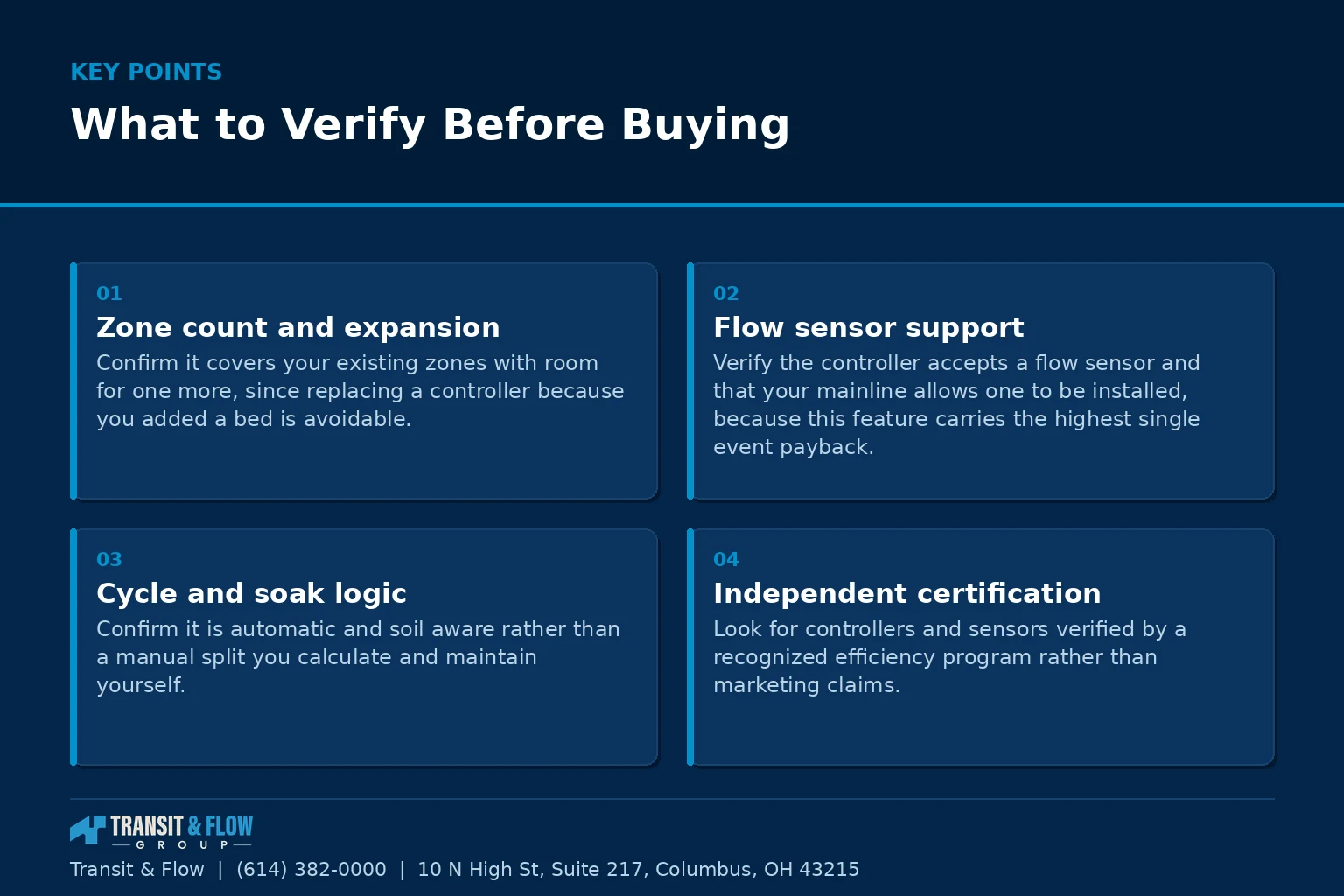
- What a Controller Can and Cannot Fix
- Weather Based and Soil Moisture Based Control
- Rain Sensors and Why They Are Expected
- Cycle and Soak on Central Ohio Clay
- Deep and Infrequent Beats Daily and Shallow
- Seasonal Adjustment Through the Ohio Year
- Zone Specific Scheduling
- Leak and Flow Monitoring, the Feature That Pays for Itself
- Connectivity and What Happens When It Fails
- Conservation Programs and Where to Look for Incentives
- What to Verify Before Buying
- The Decision
- Where Transit & Flow Group Fits
- Frequently Asked Questions
Here is what most Central Ohio property owners get wrong. They treat overwatering as a scheduling problem when it is usually a delivery problem. On heavy clay with a modest slope, water applied faster than the soil accepts it leaves as runoff, the surface looks wet, the root zone stays dry, and the owner responds by adding minutes. A controller that understands infiltration stops that cycle. One installed over a system that sprays sidewalks will simply spray sidewalks on a smarter schedule.
What a Controller Can and Cannot Fix
A controller decides when valves open and for how long. That is the entire scope of its authority. Everything downstream of the valve, the pipe sizing, head type, nozzle selection, spacing, and operating pressure, is fixed by design and installation.
The most common irrigation complaints in Central Ohio are distribution complaints, not timing complaints. Dry rings around heads, saturated low corners, and misting fog on a hot afternoon are symptoms of pressure and spacing problems. Adding runtime is how homeowners compensate, and the compensation drives the water bill.
So correct distribution first, then automate. On a system with reasonable uniformity, a smart controller produces a visible reduction in applied water while the turf looks better. On a system with poor uniformity, the controller inherits the problem and the savings are muted.
Weather Based and Soil Moisture Based Control
These are the two families of smart control, answering the same question from opposite ends.
Weather based control, often called evapotranspiration or ET control, estimates how much water the landscape lost since the last cycle. It combines temperature, humidity, solar radiation, wind, and rainfall, from a weather service feed or an on site sensor, and replaces the estimated loss. It is predictive, it adapts continuously, and its accuracy depends on how well the data source represents your actual yard.
Soil moisture based control measures what is actually in the ground. A probe buried in the root zone of a representative area reports moisture content, and the controller permits or suppresses the scheduled cycle against a threshold. It does not care why the soil is wet, only that it is.
The practical difference is where the error lives. Weather based control fails when the data does not match the site, a yard shaded by mature trees, a walled courtyard, a zone under a roof overhang. Soil moisture control fails when the probe sits somewhere unrepresentative, since one sensor speaks for a whole zone. Many well specified residential systems use weather based logic with a soil moisture input as a veto.
Rain Sensors and Why They Are Expected
A rain sensor is an interrupt device. When it detects rainfall past a set point it opens the circuit, and the controller cannot energize a valve regardless of the schedule. Older designs use expanding hygroscopic discs, newer ones conductive or capacitive sensing. Both are cheap, and both are the last defense against the most visible waste in irrigation, a system running in a thunderstorm.
Many jurisdictions and water providers require or expect a functioning rainfall shutoff device on new or modified automatic systems. The requirement is often written into the plumbing code adoption or the utility’s service rules rather than a zoning ordinance. Franklin County’s fragmentation makes this worth checking directly, since Columbus, Dublin, Westerville, and surrounding townships do not administer it identically, and the water provider is not always the permitting authority.
Two practical notes. A rain sensor does not substitute for a smart controller, since it only prevents watering during rain and has nothing to say about the days afterward. And it is a maintenance item. Sensors mounted years ago in what was then open sky are frequently found under a grown canopy, dry while the yard is soaked.
Cycle and Soak on Central Ohio Clay
This is the feature that matters most in this region and the one homeowners understand least. Central Ohio soils are dominated by silt loams and clay loams over glacial till, and their infiltration rate is low. Nearly every sprinkler zone applies water faster than the soil absorbs it, and the excess moves sideways and downhill. The gently rolling terrain here means it has somewhere to go.
Cycle and soak splits a zone’s total runtime into shorter applications with a rest interval between them. The zone runs, stops before runoff begins, and the controller moves to other zones while the applied water infiltrates, then returns for the next increment. The same total volume goes down, but essentially all of it enters the soil.
This is a smart controller feature rather than a timer feature because of the bookkeeping. Splitting cycles by hand across a dozen zones is tedious, and it has to be redone whenever the seasonal adjustment changes. On a sloped clay lot, this capability often accounts for the largest share of the savings.
Deep and Infrequent Beats Daily and Shallow
Roots grow toward available moisture. Water lightly every morning and moisture is never available below the top inch or two, so the root system stays there. The result is turf entirely dependent on the irrigation system, with no drought reserve, stressed within a day of any interruption.
Watering less often and more thoroughly drives moisture deeper and lets the surface dry between events. Roots follow the water down. The lawn gains a buffer, shallow weed species that thrive on constant surface moisture lose their advantage, and the wet leaf periods that favor fungal disease get shorter.
The caveat is that new sod, seed, and plant material need frequent light watering until rooted. That is a temporary establishment schedule, and the transition to maintenance is a step almost nobody takes deliberately. The schedule that was correct in May is wasteful by August.
Seasonal Adjustment Through the Ohio Year
Central Ohio demand curves are steep. Spring is typically wet enough that established turf needs little supplemental water, so systems that start in April on a summer schedule waste most of what they apply. Demand climbs through June, peaks in July and August, falls off through September, and ends before the first hard freeze.
A basic timer handles this with a global percentage the owner is supposed to remember to change. In practice it gets set once in spring and left alone, so the system either underwaters in August or, far more commonly, overwaters from April through October. That is the largest single source of wasted irrigation water on residential properties here.
A weather based controller performs this adjustment continuously, responding to a cool wet week in July and a dry stretch in September alike. It is not smarter than an attentive owner. It is more consistent than one, every day, for years.
Zone Specific Scheduling
A zone is only as good as the information the controller has about it. Smart controllers ask for zone characteristics because their scheduling logic depends on them. These are the inputs worth getting right.
- Plant type. Cool season turf, established shrubs, annual beds, and native plantings have different water demand and different tolerance for drying between events.
- Emitter type. Spray heads, rotors, rotary nozzles, and drip apply water at very different rates, and runtime is meaningless without knowing which is in use.
- Soil type. This drives how much water the root zone holds and how fast it accepts it, which sets both cycle length and soak interval.
- Sun exposure. Full sun, partial shade, and deep shade under mature canopy differ enough that identical runtimes leave one zone stressed and another saturated.
- Slope. Slope shortens the time before runoff begins, so it directly changes how a zone must be split.
- Root depth. Established turf, new sod, and deep rooted shrub beds draw from different depths and should be refilled on different intervals.
Most disappointing installations trace back to this step being rushed. The hardware was configured with defaults, and defaults describe a flat sunny lawn on sandy loam, which is not a Central Ohio property.
Leak and Flow Monitoring, the Feature That Pays for Itself
Scheduling intelligence saves water gradually. Flow monitoring prevents the catastrophic loss, and it is the feature most likely to justify the upgrade in one event. A flow sensor on the mainline reports actual flow to the controller, which learns each zone’s normal draw and checks every cycle against it.
- Broken lateral line. Flow spikes above the learned baseline, and the controller can shut the valve and flag the zone rather than running a full cycle into a trench.
- Broken or missing head. A head sheared off by a mower produces a smaller persistent overage, easy to miss visually if it is behind the garage.
- Mainline break. Flow registers when no zone is scheduled, the signature of a failure upstream of the valves and the one that runs day and night.
- Stuck valve. A diaphragm that fails to close leaves a zone weeping after the cycle ends, and the controller sees flow that should not exist.
- Clogged or blocked zone. Flow well below baseline indicates a closed valve, a failed solenoid, or debris, which is a coverage failure otherwise discovered by finding dead grass.
An underground break on a system that runs before dawn can go unnoticed for a full billing cycle. Central Ohio freeze and thaw cycles and improper winterization make spring breaks routine, and a startup performed without anyone standing in the yard is how a mainline failure goes undetected.
Connectivity and What Happens When It Fails
Most weather based controllers need an internet connection to pull weather data and serve the app. Controllers live in garages, basements, and outdoor enclosures, the weakest signal locations on a property, and a marginal connection produces a unit that appears to work while silently no longer adapting.
Resolve before purchase what the controller does when the connection drops. Good ones fall back to the last known schedule and resume adapting when the connection returns. Weaker ones run a stale schedule with no indication anything is wrong, and the worst case is a system running a July schedule through a wet October because it lost contact in August.
Also confirm whether the manufacturer’s service is free or subscription based, and whether the controller stays usable if that service ends. Hardware outlives software, and a controller that becomes a paperweight when a company changes direction is a poor purchase.
Conservation Programs and Where to Look for Incentives
Water providers and regional conservation programs sometimes offer rebates, credits, or free equipment for efficient irrigation hardware, and availability changes year to year. Because water service in Central Ohio is delivered by a mix of municipal systems and contract arrangements, the program that applies two miles away may not apply to you.
Check the conservation section of your actual water provider’s site, not the city you receive mail from, and look for language about irrigation efficiency and certified products. Where incentives exist they are commonly tied to independently certified controllers and sensors, a useful filter even if no money is attached. Ask about deadlines and documentation before you buy, since most programs require the purchase to follow enrollment.
What to Verify Before Buying
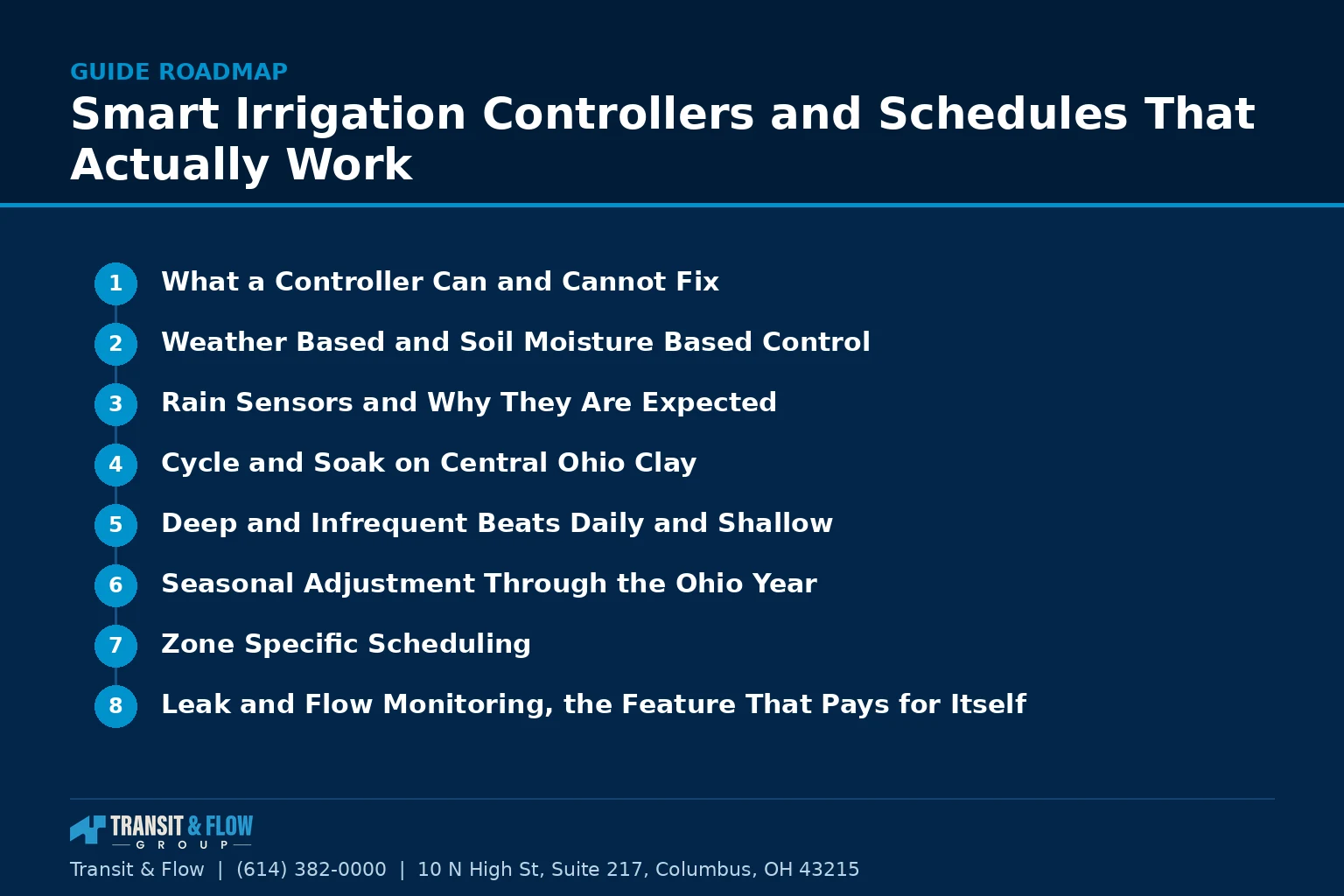
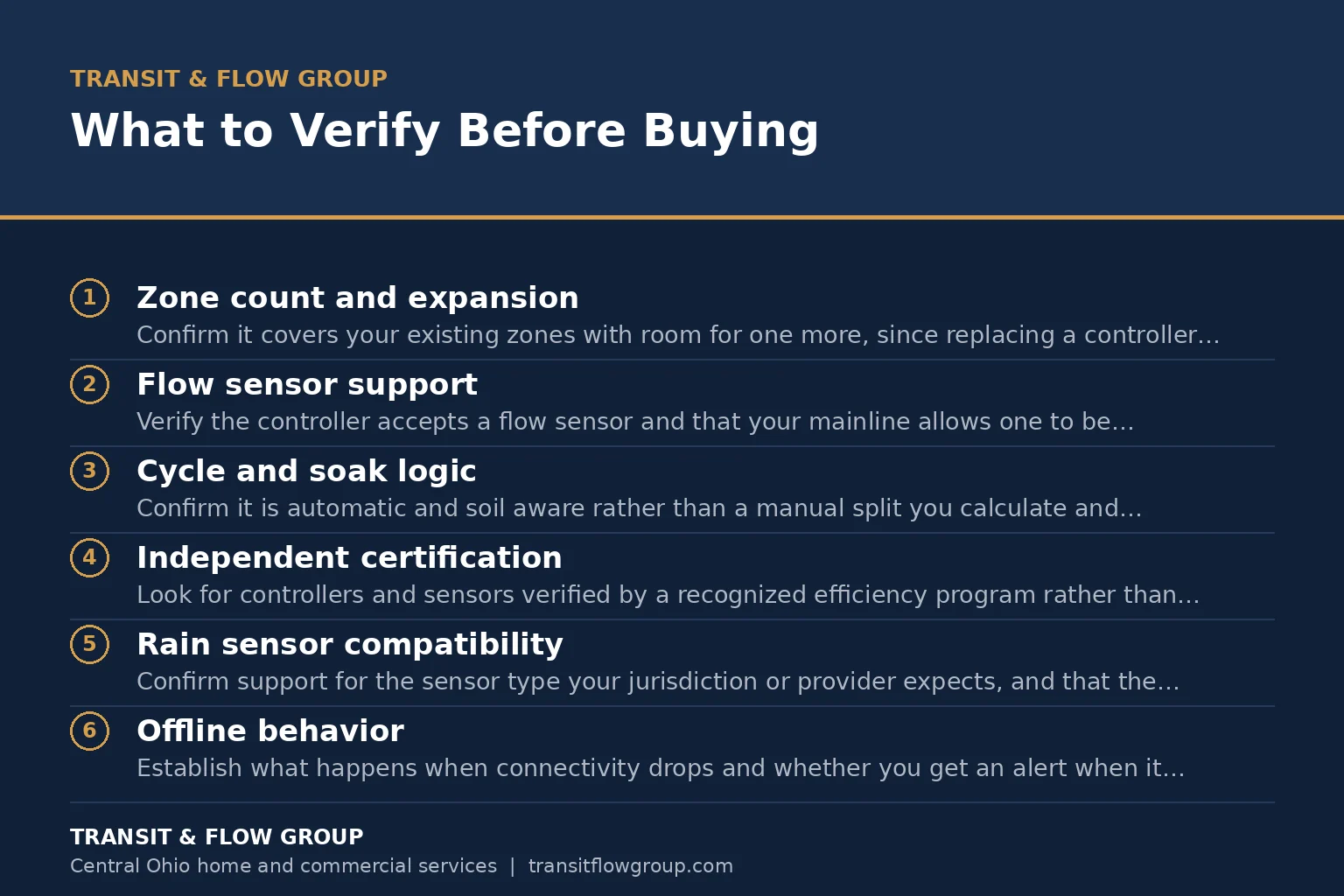
- Zone count and expansion. Confirm it covers your existing zones with room for one more, since replacing a controller because you added a bed is avoidable.
- Flow sensor support. Verify the controller accepts a flow sensor and that your mainline allows one to be installed, because this feature carries the highest single event payback.
- Cycle and soak logic. Confirm it is automatic and soil aware rather than a manual split you calculate and maintain yourself.
- Independent certification. Look for controllers and sensors verified by a recognized efficiency program rather than marketing claims.
- Rain sensor compatibility. Confirm support for the sensor type your jurisdiction or provider expects, and that the mounting location has open sky.
- Offline behavior. Establish what happens when connectivity drops and whether you get an alert when it does.
- Backflow compliance. Verify the backflow prevention assembly is present, correct, and testable, since a controller upgrade often triggers a look at the whole installation.
- Who configures it. Establish whether zone characteristics will be entered by someone who walked the property or accepted from defaults.
The Decision
Option A. Keep the existing timer, set a conservative schedule, and adjust it manually a few times per season.
Option B. Audit distribution first, correct spacing, pressure, and nozzle problems, then install a weather based controller with cycle and soak, a rainfall shutoff device, and flow monitoring, configured zone by zone from a site walk.
Recommendation: Option B, with the audit as a non negotiable first step. Option A is defensible in theory and fails in practice, because the manual adjustment that makes it work is the task nobody performs consistently for five years running. The controller wins on consistency, not cleverness. Two points decide the outcome. Fix distribution before automating, since a controller cannot deliver water the system does not deliver evenly. And insist on flow monitoring, because the avoided cost of an undetected mainline break is what pays for the upgrade. If budget forces a sequence, do the audit and the rain sensor first and the controller next season.
Where Transit & Flow Group Fits
We coordinate irrigation work across Central Ohio, and a controller upgrade is treated as the last step of an evaluation rather than the first step of a purchase. The system is audited for uniformity and pressure, distribution problems are corrected, zone characteristics are recorded on a site walk, and the controller is configured against those records rather than defaults. To have your system evaluated before you spend on hardware, start a conversation with our team. You can also review our irrigation services, our guidance on irrigation design for Central Ohio soils, our overview of backflow prevention and testing, and our notes on winterization and spring startup.
Transit & Flow Group coordinates projects and partners with properly licensed and insured specialty contractors when licensing is required, and work is performed under the appropriate permits.
Frequently Asked Questions
Are smart irrigation controllers worth the money
On a well designed system, generally yes, because the savings come from not running when water is not needed and from catching problems early. On a poorly designed system the controller will faithfully deliver uneven water on a smarter schedule, so fix the design first.
How does a weather based controller decide when to water
It estimates how much water the landscape has lost since the last irrigation using weather data, then replaces that amount. Soil moisture based systems measure conditions in the ground directly instead. Both replace a fixed calendar with a response to conditions.
What is cycle and soak and why does it matter in Ohio
It splits a single watering into shorter applications with pauses between them so water has time to infiltrate. Central Ohio clay accepts water slowly, so a long continuous run produces runoff. Cycle and soak puts the same water into the soil instead of into the street.
Is it better to water deeply and less often
For established turf and plantings, yes. Deep and infrequent watering encourages roots to develop downward, which makes the landscape more resilient during dry stretches. Daily shallow watering trains roots to stay near the surface where they dry out first.
Do I need a rain sensor if I have a smart controller
Many programs and water providers expect a functioning rain shutoff regardless of controller type, and a sensor provides a direct local reading that weather data cannot always match. Confirm what your water provider requires for your address.
What feature matters most after weather based scheduling
Flow or leak monitoring. A broken head or a cracked lateral can waste an enormous amount of water quietly between inspections. A controller that detects abnormal flow and shuts a zone down often pays for itself in a single incident.
Sources
- EPA WaterSense, watering practices and scheduling guidance
- EPA WaterSense, product certification and water efficiency labeling
- EPA WaterSense Outdoors, irrigation system efficiency and controller information
- Ohio State University Extension, Ohio soils, turf, and landscape water management
- National Weather Service Wilmington, Ohio, Central Ohio precipitation and seasonal climate data
About This Guide
Written and edited by Micheal Parker, founder of Transit & Flow Group. Published October 27, 2026. This guide is checked against the agency and code sources listed above, and it is revised when those sources change.
General contractor of record. Micheal Parker holds City of Columbus General Contractor Registration G12064, issued by the Columbus Department of Building and Zoning Services under Transit & Flow LLC and valid through June 30, 2027. Trade work that falls outside the scope of that registration is performed by licensed trade partners, and the responsible license holder is identified before work begins.
Transit & Flow Group, home and commercial services for Columbus and the surrounding Central Ohio communities. Phone (614) 382-0000. Email solutions@transitflowgroup.com. 10 N High St, Suite 217, Columbus, OH 43215. Contact our team or review the communities we serve.
