


A roof replacement is one of the largest single projects most Central Ohio homeowners ever take on. It is also one of the easiest to get wrong, not because the work itself is mysterious, but because most people replace a roof once or twice in a lifetime and have to make every decision for the first time. This guide walks through the full decision, from confirming you actually need a replacement to signing a contract you understand, using standards from the National Roofing Contractors Association, the Insurance Institute for Business and Home Safety, and the City of Columbus permit office.
In This Guide
- Step One: Confirm You Actually Need a Replacement
- How Long Roofs Last in Central Ohio
- The Decision Framework: Repair, Overlay, or Tear-Off
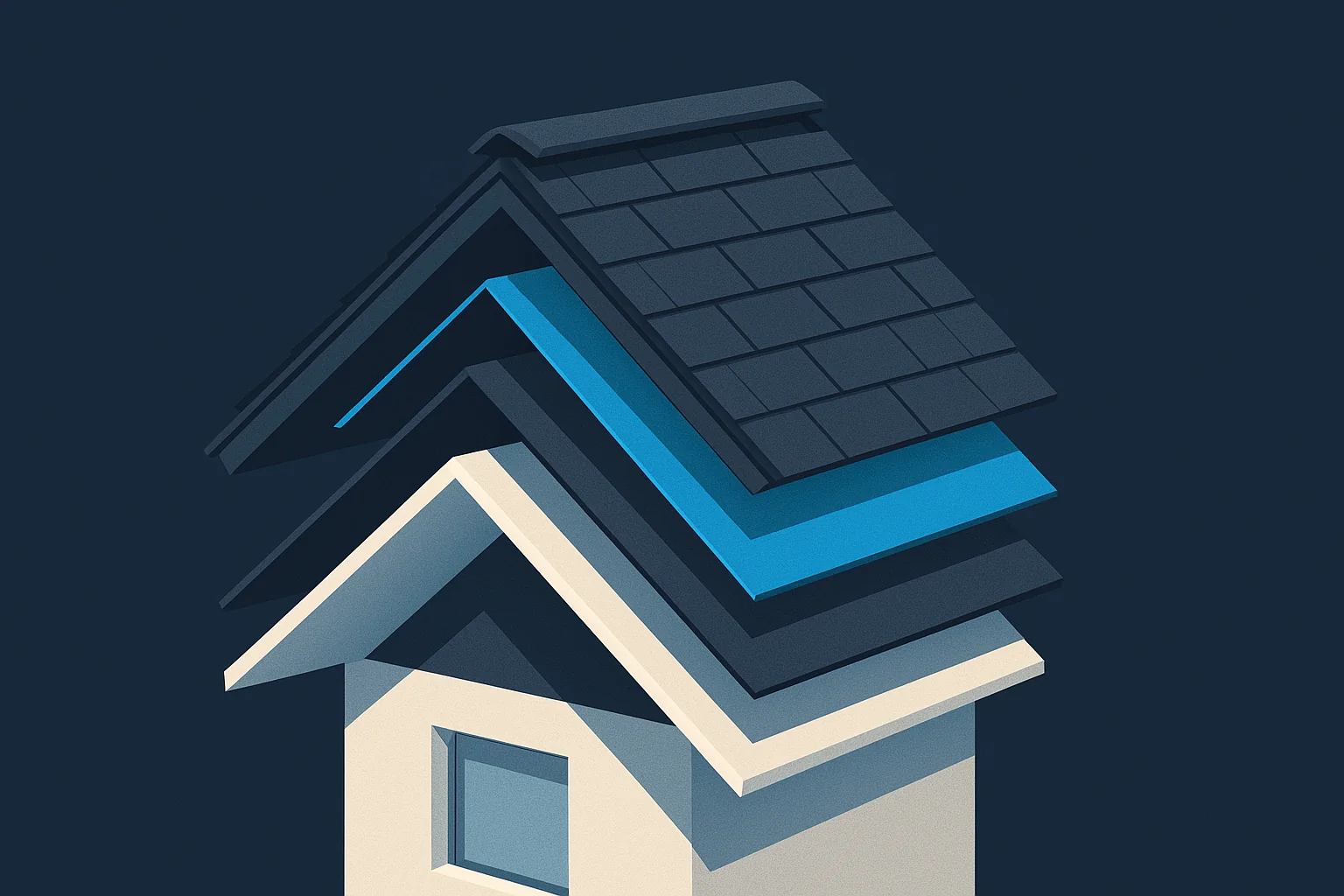
- What a Complete Roof Replacement Includes
- Permits: What Columbus and Franklin County Require
- What Drives the Price of a Roof
- Reading and Comparing Estimates
- Ten Things to Confirm Before You Sign
- Storm Damage: A Different Starting Point
- Timeline: What a Well-Run Replacement Looks Like
- Five Mistakes That Cost Central Ohio Homeowners the Most
- A Homeowner’s Roofing Glossary
- How Transit & Flow Group Runs Roofing Projects
- Frequently Asked Questions
Transit & Flow Group coordinates projects and partners with properly licensed and insured specialty contractors when licensing is required. That model matters for a roof: you get one point of contact for the whole project, and the roofing work itself is performed by a specialty contractor whose credentials you can verify before anyone climbs a ladder.
Step One: Confirm You Actually Need a Replacement
The roofing industry has a structural bias toward replacement, because replacement is the bigger ticket. Your first job is to resist that bias until the evidence supports it. A roof needs replacement when the problems are widespread and structural. It needs repair when the problems are local and contained. The difference is not always obvious from the ground, which is why the decision starts with a documented inspection rather than an opinion shouted from a driveway.
Signs That Point to Replacement
- Shingles are curling, cupping, or losing granules across large areas of the roof, not just in one spot. Granule loss shows up as bald patches on shingles and heavy grit in gutters.
- The roof deck feels spongy or sags visibly along ridge lines or between rafters. This suggests moisture has reached the structural wood.
- Leaks appear in multiple rooms, or the same leak returns after repeated repairs.
- Daylight is visible through the roof boards from inside the attic.
- The roof is at or past the expected service life for its material, and problems are starting to cluster.
Signs That Point to Repair Instead
- Damage is confined to one slope or one area, such as a patch of shingles lifted by a single wind event.
- Flashing has failed around a chimney, vent, or valley, but the surrounding shingle field is sound.
- A few shingles are cracked or missing while the rest of the roof lies flat and holds granules.
- The roof is young relative to its material lifespan and has no history of chronic leaks.
An honest assessment will tell you which category you are in and show you the photographic evidence behind the call. If an estimator recommends full replacement without walking the roof or showing you photos, treat that recommendation with caution and get a second opinion.
How Long Roofs Last in Central Ohio
Material lifespan ranges are published by manufacturers and industry bodies, and they assume proper installation and ventilation. Central Ohio weather works against the high end of every range. Our region sees freeze-thaw cycling through winter, hail-capable storms in spring and summer, and hot attics in July and August. The National Weather Service office covering the Columbus area documents this storm climatology every season. Freeze-thaw cycles are especially hard on roofs, because water that slips under a lifted shingle expands when it freezes and pries the roof apart in slow motion.
- Three-tab asphalt shingles: the budget option, with the shortest expected life of common materials, often outlived by the homes they cover.
- Architectural asphalt shingles: the Central Ohio default. Thicker, heavier, better wind ratings, and a meaningfully longer service life than three-tab.
- Metal standing seam: a step up in cost and a large step up in longevity, with strong performance in wind and snow shedding.
- Premium materials such as slate and tile: lifespans measured in generations, with structural and cost considerations that put them in a different project class entirely.
Two roofs of the same material can age very differently based on what is happening under the shingles. Attic ventilation is the quiet variable. A poorly vented attic cooks shingles from below in summer and feeds ice dams in winter. The U.S. Department of Energy publishes guidance on how roof and attic choices affect heat load, and any replacement quote worth signing should address ventilation, not just the surface material.
The Decision Framework: Repair, Overlay, or Tear-Off
When replacement is on the table, you have three paths. Use this framework to think through them in order.
Path One: Targeted Repair
Choose repair when damage is localized, the deck is dry and sound, and the roof has meaningful life left. A good repair uses matching materials, addresses the cause and not just the symptom, and comes with documentation of what was done. The risk to manage is the patchwork trap: if you find yourself paying for the third repair in two years, the roof is telling you something, and the repair money is no longer buying you time at a fair rate.
Path Two: Overlay
An overlay installs new shingles over the existing layer. It is cheaper and faster because it skips tear-off and disposal. It is also the option most often regretted. An overlay hides the deck, so rot stays hidden until it is worse. It adds weight the structure was not necessarily designed for. It shortens the life of the new shingles, which telegraph every imperfection beneath them. Building codes limit how many layers a roof may carry, and if your roof already has two, an overlay is off the table entirely. Most careful contractors in our area will talk you out of an overlay except in narrow situations, and that reluctance is a good sign, not a sales tactic.
Path Three: Full Tear-Off Replacement
A tear-off strips the roof to the deck, repairs or replaces damaged decking, and rebuilds the entire system: underlayment, ice and water barrier at eaves and valleys, drip edge, flashing, ventilation, and the finished surface. It costs the most and delivers the most, because it is the only path that lets anyone actually see and fix what is underneath. If your roof is at end of life, this is almost always the right answer, and everything else in this guide assumes you are evaluating this path.
What a Complete Roof Replacement Includes
A roof is a system, not a surface. The Insurance Institute for Business and Home Safety publishes research on which roof system details determine performance in high wind and hail, and their findings consistently point below the shingle. When you compare quotes, compare them at the system level.
- Deck inspection and repair: rotten or delaminated decking replaced, and the quote should state how deck replacement is priced when discovered mid-project.
- Underlayment: the water-resistant layer between deck and shingles. Synthetic underlayment has largely replaced felt in quality installations.
- Ice and water barrier: a self-sealing membrane at eaves, valleys, and penetrations. In a freeze-thaw climate like ours, this is not optional.
- Drip edge: metal edging that keeps water out of the fascia. Required by modern code and skipped by cut-rate installers.
- Flashing: new metal at chimneys, walls, and valleys. Reusing old flashing on a new roof is a common corner cut that produces the first leak.
- Ventilation: intake at the soffits and exhaust at the ridge, balanced to the attic volume.
- Shingles and fasteners: installed to the manufacturer’s nailing pattern, which is what wind warranties actually hinge on.
- Tear-off, disposal, and site protection: dumpster placement, landscaping protection, and a magnetic sweep for nails at the end.
Permits: What Columbus and Franklin County Require
Roof replacement in the City of Columbus requires a permit, and the city’s Building and Zoning Services department handles applications and inspections. Surrounding jurisdictions in Franklin, Delaware, and Fairfield counties run their own permit offices with their own rules, so the answer changes at municipal borders. Verify the current requirements for your address through the City of Columbus permit office or your local building department before work is scheduled.
Here is the permit checklist that keeps a project clean:
- Confirm which jurisdiction your address falls under. City limits do not follow school district or postal boundaries.
- Ask your contractor, in writing, who is pulling the permit. The contractor performing the work should pull it, not you. A contractor who asks the homeowner to pull the permit is shifting liability onto you, and that is a warning sign worth heeding.
- Confirm the permit is issued before tear-off begins, and ask for the permit number.
- Ask how inspections are scheduled and what happens if an inspection finds a problem.
- Keep the closed permit with your home records. It matters at resale.
What Drives the Price of a Roof
Every roof is priced individually, and any flat number quoted before someone has measured your roof is a marketing number. What you can understand in advance is the set of variables that move the price, so you can read an estimate intelligently.
- Roof size and complexity: measured in squares, with valleys, dormers, hips, and penetrations all adding labor.
- Pitch: steep roofs are slower and require more safety equipment.
- Stories and access: a ranch with driveway access prices differently than a three-story home on a tight lot.
- Material selection: the largest single lever, from three-tab asphalt through metal and premium materials.
- Deck condition: unknown until tear-off, which is why the per-sheet decking price in the contract matters.
- Layers to remove: tearing off two layers costs more than one.
- Ventilation and code upgrades: bringing an older roof up to current code adds line items that a cut-rate quote quietly omits.
When two quotes are far apart, the explanation almost always lives in this list. The cheaper quote is usually not more efficient. It is quoting a smaller scope, and you find out which scope was real when the project is underway.
Reading and Comparing Estimates
Collect at least two detailed written estimates for a full replacement. Then compare them line by line against this list of items that estimates commonly leave out:
- Deck repair pricing, stated per sheet, for damage discovered after tear-off
- Ice and water barrier coverage, stated in feet from the eave, not just “included”
- New flashing versus reused flashing at chimneys and walls
- Ventilation work, specified as intake and exhaust, not just “ridge vent”
- Permit fees and who pays them
- Disposal, dumpster, and driveway protection
- Gutter protection or replacement, which is a separate trade and a separate decision
- Warranty terms, separated into manufacturer material warranty and contractor workmanship warranty, with the years stated for each
An estimate that specifies these items is written by a contractor who intends to do them. An estimate that says “install new roof” in one line is not shorter because the contractor is efficient.
Ten Things to Confirm Before You Sign
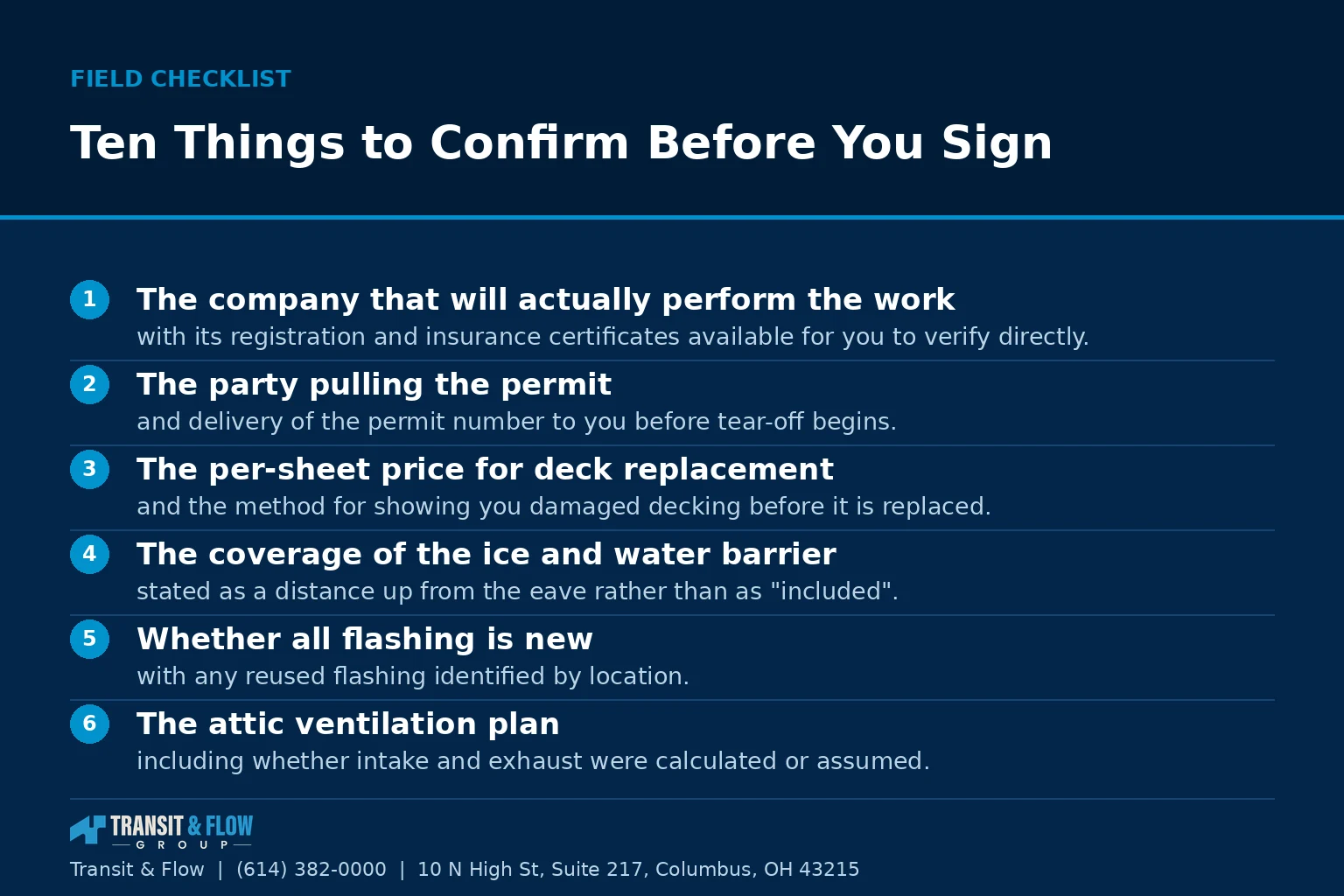
- The company that will actually perform the work, with its registration and insurance certificates available for you to verify directly.
- The party pulling the permit, and delivery of the permit number to you before tear-off begins.
- The per-sheet price for deck replacement, and the method for showing you damaged decking before it is replaced.
- The coverage of the ice and water barrier, stated as a distance up from the eave rather than as “included”.
- Whether all flashing is new, with any reused flashing identified by location.
- The attic ventilation plan, including whether intake and exhaust were calculated or assumed.
- The manufacturer material warranty, the contractor workmanship warranty, and the conditions that void each.
- The protection plan for landscaping, siding, and driveway during tear-off and disposal.
- The payment schedule, including the amount due before any work begins.
- Your single point of contact if something goes wrong a year from now.
The answers matter, and so does the manner of answering. A contractor who welcomes this kind of scrutiny runs projects that can survive it.

Storm Damage: A Different Starting Point
If your roof was damaged by wind or hail, the sequence changes. Document first: date of the storm, wide photos of each roof slope from the ground, close photos of any interior leaks, and photos of collateral damage such as dented gutters or torn window screens. Do this before any contractor is on your roof. Be cautious with door-to-door canvassers who appear after storms; the Insurance Institute for Business and Home Safety and consumer protection offices publish repeated warnings about post-storm contracting schemes. Choose your contractor the same way you would without a storm: verification first, signatures second. Decisions involving an insurance claim are between you and your insurer, and a contractor’s role is to document the roof’s condition honestly, not to promise claim outcomes.
Timeline: What a Well-Run Replacement Looks Like
- Inspection and documentation: the roof is walked, photographed, and measured.
- Estimate and scope review: you receive a line-item estimate and walk through it with your project coordinator.
- Material selection: shingle line, color, and ventilation plan are locked.
- Permit issued: before any tear-off.
- Installation: most single-family asphalt replacements complete in one to three working days, weather permitting.
- Inspection and closeout: the jurisdiction’s inspection, the magnetic nail sweep, your walkthrough, and delivery of warranty documents and the closed permit.
Five Mistakes That Cost Central Ohio Homeowners the Most
Choosing on price alone. The lowest bid is quoting the smallest scope, and the difference reappears later as a change order or a leak. Compare scopes first, then prices. A fair comparison is only possible between two estimates that specify the same system components, which is exactly why the line-item checklist above exists.
Ignoring ventilation. New shingles over a badly vented attic age on an accelerated schedule, and some manufacturer warranties are weakened or voided when ventilation does not meet specification. If an estimate never mentions intake and exhaust, the estimator never looked in your attic, and that tells you how the rest of the project will be run.
Paying too much up front. A reasonable deposit secures materials and a slot on the schedule. A demand for most of the project price before a single shingle comes off is a red flag that consumer protection offices warn about consistently. Tie payments to milestones: deposit, completion of tear-off and deck review, and final payment after your walkthrough and the closing inspection.
Letting the permit slide. Unpermitted roof work saves days now and surfaces later, at resale, at refinance, or at the insurance claim where documentation suddenly matters. The permit is cheap relative to the project and it buys you a jurisdiction inspection of the finished work, which is a quality check you did not have to pay for.
Signing under storm pressure. The days after a hail event are the single most common window for regrettable roofing contracts. The storm did not change how contractor selection works. Verification first, signatures second, every time.
A Homeowner’s Roofing Glossary
Estimates are easier to read when the vocabulary is familiar. These are the terms that appear on nearly every Central Ohio roofing quote.
- Square: the unit roofers measure in. One square covers one hundred square feet of roof surface.
- Decking or sheathing: the wood panels fastened to the rafters that everything else is built on.
- Underlayment: the water-resistant sheet layer installed over the deck and under the shingles.
- Ice and water shield: a self-adhering membrane that seals around nails, used at eaves and valleys where ice dams and concentrated water flow occur.
- Drip edge: metal edging at the roof perimeter that directs water away from the fascia boards.
- Flashing: shaped metal that waterproofs the joints where the roof meets chimneys, walls, and other roof planes.
- Valley: the internal channel where two roof slopes meet, which carries more water than any other part of the roof.
- Pitch: the steepness of the roof, expressed as inches of vertical rise per twelve inches of horizontal run.
- Ridge vent: an exhaust vent running along the peak of the roof, paired with soffit intake vents to move air through the attic.
- Starter strip: the first course of shingle material at the eave, which seals the leading edge against wind uplift.
- Boot: the flexible collar that seals around pipes penetrating the roof, and a frequent source of small leaks as it ages.
- Change order: a written amendment to the contract scope and price, which is how mid-project discoveries such as rotten decking should always be handled.
How Transit & Flow Group Runs Roofing Projects
Transit & Flow Group serves Columbus and the surrounding Central Ohio communities as a project coordinator. For roofing work, that means we manage the assessment, the estimate, the permit process, the specialty roofing contractor performing the installation, and the closeout, and you deal with one accountable point of contact throughout. Roofing decisions also connect to the systems around them, and we coordinate gutter and siding work under the same roof, so drainage changes and roof changes are planned together instead of colliding.
If your roof is showing the signs described in this guide, the next step is a documented assessment, not a commitment. Request a roof assessment and we will schedule an inspection, share the photos with you, and give you a straight answer on whether repair or replacement is the right path.
Frequently Asked Questions
How do I know whether my roof needs repair or a full replacement?
The distinction is whether the problems are localized or widespread. Damage confined to one slope, failed flashing at a chimney with a sound shingle field around it, or a few cracked shingles on an otherwise young roof all point toward repair. Curling and granule loss across large areas, a spongy or sagging deck, leaks in multiple rooms, or daylight visible through the boards from inside the attic point toward replacement. Insist on a documented inspection with photographs rather than an opinion offered from the driveway, because the industry carries a structural bias toward replacement as the larger job.
Is an overlay a reasonable way to avoid a full tear-off?
It is cheaper and faster because it skips tear-off and disposal, and it is also the option homeowners most often regret. An overlay conceals the deck, so rot underneath stays hidden and keeps progressing, and it adds weight the structure was not necessarily designed to carry. It also shortens the life of the new shingles, which telegraph every imperfection beneath them. Adopted building codes limit how many layers a roof may carry, so whether an overlay is even permitted on your house is a determination for your building department. A contractor who talks you out of one is usually giving you good advice rather than a sales pitch.
Do I need a permit to replace a roof in Central Ohio?
Roof replacement in the City of Columbus requires a permit, handled through the city’s Building and Zoning Services department. Surrounding jurisdictions in Franklin, Delaware, and Fairfield counties run their own permit offices with their own rules, so the answer can change at a municipal border and a mailing address does not settle which jurisdiction governs your property. Verify the current requirements for your specific address with that building department before work is scheduled. The contractor performing the work should be the one pulling the permit, and a request that you pull it yourself shifts liability onto you.
Why does attic ventilation keep coming up in roofing quotes?
Ventilation is the variable that determines whether two roofs of the same material age the same way. A poorly vented attic heats shingles from below through the summer and contributes to ice dams in winter, so new shingles installed over a bad ventilation situation age on an accelerated schedule. Manufacturers also tie warranty coverage to their own published installation and ventilation instructions, which means a shortfall can weaken or void the material warranty. If an estimate never mentions intake at the soffits and exhaust at the ridge, the estimator most likely never looked in your attic.
Why are two estimates for the same roof so far apart?
Almost always because they describe different scopes, not because one contractor is more efficient. The items that separate them usually sit below the shingle: deck repair pricing, ice and water barrier coverage, whether flashing is new or reused, ventilation work, permit fees, disposal and site protection, and the warranty terms. Compare the two documents line by line on those items before you compare the totals. An estimate that reads “install new roof” on a single line is not shorter because the work is simpler.
What should I do first after a storm damages my roof?
Document before anyone climbs a ladder. Record the date of the storm, wide photographs of each roof slope taken from the ground, close photographs of any interior leaks, and photographs of collateral damage such as dented gutters or torn window screens. Be cautious with door-to-door canvassers who appear in the days after a hail event, because consumer protection offices and the Insurance Institute for Business and Home Safety publish repeated warnings about post-storm contracting schemes. Then select a contractor exactly as you would without a storm, with verification first and signatures second. Anything involving an insurance claim is between you and your insurer.
Sources and Further Reading
- National Roofing Contractors Association, industry installation standards
- Insurance Institute for Business and Home Safety, roof system performance research
- City of Columbus Building and Zoning Services, permit requirements and applications
- U.S. Department of Energy, Energy Saver, roof and attic energy guidance
- National Weather Service, Wilmington Ohio office, Central Ohio storm climatology
About This Guide
Written and edited by Micheal Parker, founder of Transit & Flow Group. Published August 3, 2026. This guide is checked against the agency and code sources listed above, and it is revised when those sources change.
General contractor of record. Micheal Parker holds City of Columbus General Contractor Registration G12064, issued by the Columbus Department of Building and Zoning Services under Transit & Flow LLC and valid through June 30, 2027. Trade work that falls outside the scope of that registration is performed by licensed trade partners, and the responsible license holder is identified before work begins.
Transit & Flow Group, home and commercial services for Columbus and the surrounding Central Ohio communities. Phone (614) 382-0000. Email solutions@transitflowgroup.com. 10 N. High St., Suite 217, Columbus, OH 43215. Contact our team or review the communities we serve.
