


October is the quiet month that decides how your winter goes. The properties that sail through a Central Ohio freeze without a single 2 a.m. emergency are the ones where someone did the unglamorous work now, before the first hard frost. If you manage single-family rentals or a multifamily portfolio, the smartest move you can make this month is to winterize property Central Ohio conditions demand, system by system, before demand spikes and every contractor in Columbus is booked out for weeks.
In This Guide
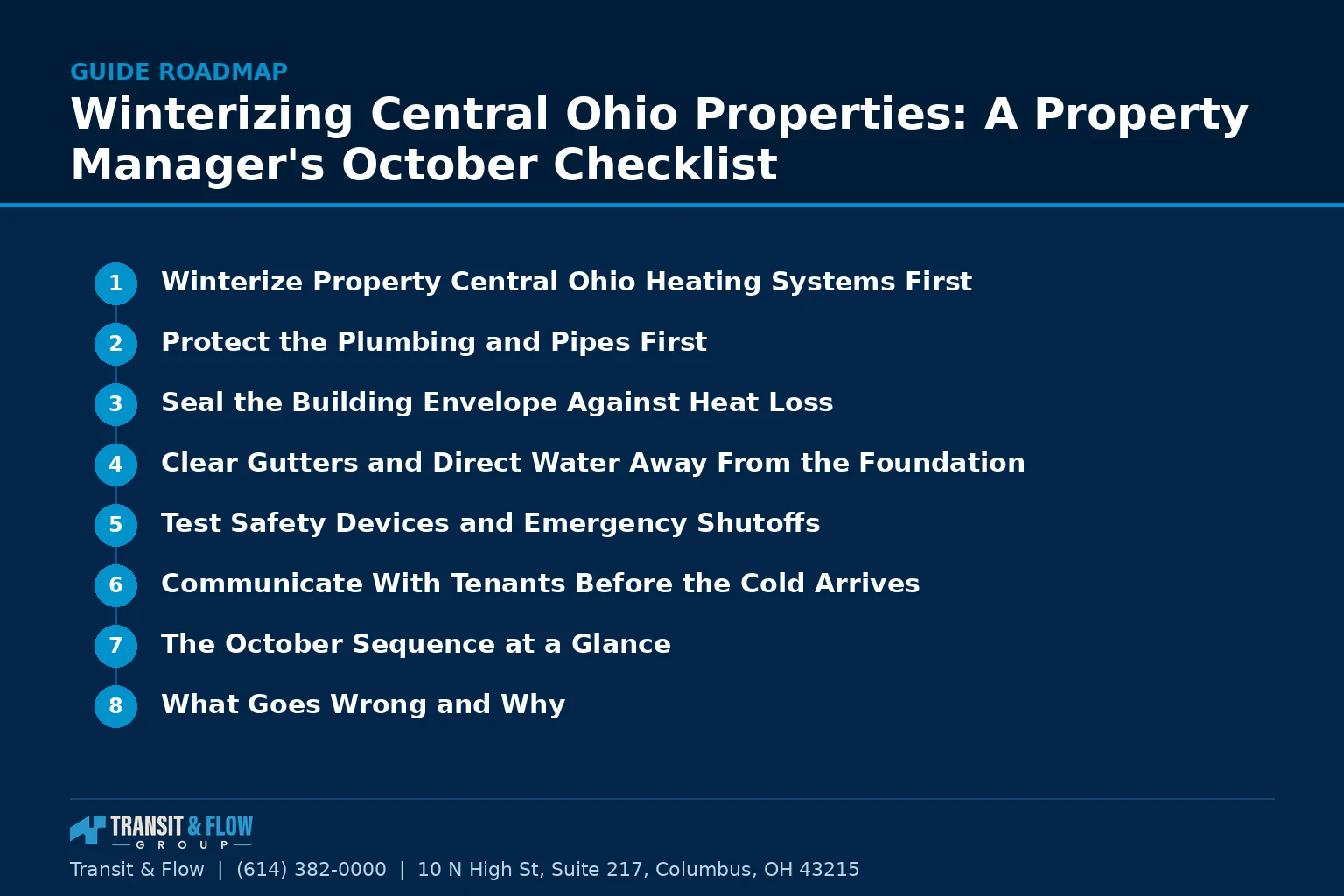
- Winterize Property Central Ohio Heating Systems First
- Protect the Plumbing and Pipes First
- Seal the Building Envelope Against Heat Loss
- Clear Gutters and Direct Water Away From the Foundation
- Test Safety Devices and Emergency Shutoffs
- Communicate With Tenants Before the Cold Arrives
- The October Sequence at a Glance
- What Goes Wrong and Why
- Why One Coordinated Partner Wins in October
- Frequently Asked Questions
- Sources
- Related Transit & Flow Services
Transit & Flow Group coordinates projects and partners with properly licensed and insured specialty contractors when licensing is required, which matters in October because the heating, electrical, and plumbing work on this list falls under trades that carry their own credentialing.
As a property manager, I have learned that winter damage is rarely dramatic in the moment. It is a slow drip behind a wall, a furnace that quietly fails on the coldest night, a downspout dumping water against a foundation. This October checklist is built from real turns and real emergency calls across Dublin, Westerville, Hilliard, and Gahanna, and it is designed to protect both your tenants and your net operating income.
Winterize Property Central Ohio Heating Systems First
Nothing generates an angry call faster than no heat in December. Before the season turns, schedule a professional furnace or heat pump inspection for every unit. A technician should check the heat exchanger for cracks, test ignition and safety controls, replace filters, and verify the thermostat is calibrated and, ideally, programmable. In older Columbus housing stock, carbon monoxide risk rises the moment furnaces fire back up, so confirm every combustion appliance is venting properly. Servicing early in October means you beat the rush and you are not competing for emergency slots when the first cold snap hits Worthington and Powell all at once.
Protect the Plumbing and Pipes First
Frozen pipes are the single most expensive winter failure I see, and they are almost entirely preventable. Insulate any exposed supply lines in crawl spaces, basements, garages, and along exterior walls. Pay special attention to units that sit vacant during a turn, since an unheated home with water in the lines is a burst waiting to happen. This is a core part of any serious winterization checklist Columbus managers rely on, and it protects you from the kind of water damage that displaces tenants and drains a reserve fund overnight.
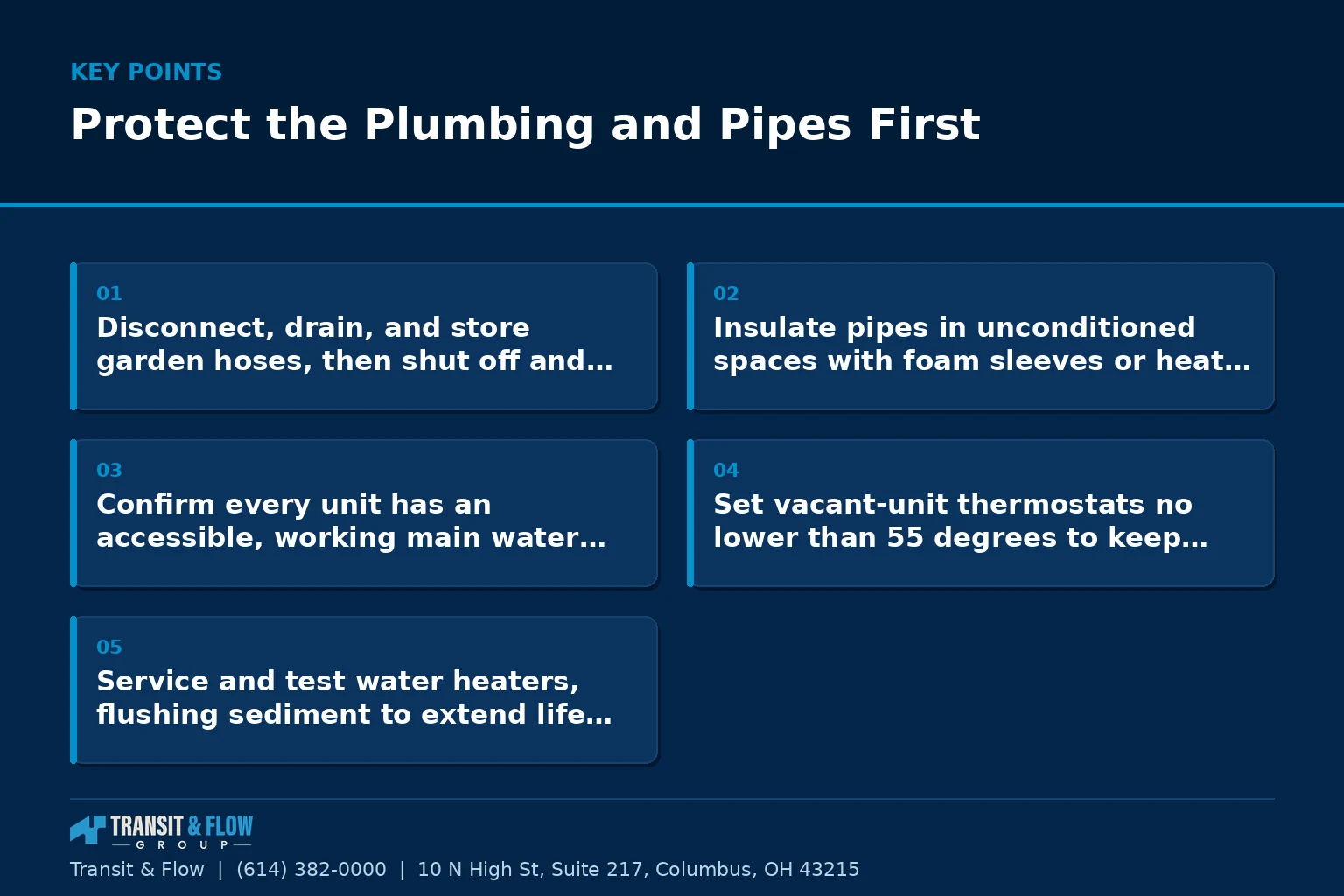
- Disconnect, drain, and store garden hoses, then shut off and drain exterior hose bibs.
- Insulate pipes in unconditioned spaces with foam sleeves or heat tape.
- Confirm every unit has an accessible, working main water shutoff and that maintenance staff know where it is.
- Set vacant-unit thermostats no lower than 55 degrees to keep pipes above freezing.
- Service and test water heaters, flushing sediment to extend life and efficiency.
Seal the Building Envelope Against Heat Loss
Weather sealing is where property winter prep Ohio veterans separate a comfortable, efficient unit from an expensive one. Walk each property and check weatherstripping around doors and operable windows, then re-caulk any gaps where cold air and moisture sneak in. Look at attic insulation levels, since heat rising out of a poorly insulated attic both raises heating bills and feeds ice dams. Tightening the envelope keeps tenants comfortable, lowers utility complaints, and directly reduces the load on the heating equipment you just serviced.
Clear Gutters and Direct Water Away From the Foundation
Fall leaves and winter freeze-thaw cycles are a bad combination. Clogged gutters overflow, refreeze, and form ice dams that push water under shingles and into ceilings. Before the leaves finish dropping across Upper Arlington and New Albany, clean every gutter and downspout, then confirm water is discharging well away from the foundation. Grading and drainage matter just as much as the roof itself, because saturated soil that freezes against a foundation is a recipe for cracks and basement seepage. A quick roof inspection now, checking flashing and any loose or missing shingles, catches small problems while they are still cheap to fix.
Test Safety Devices and Emergency Shutoffs
Winter is peak season for furnace use, space heaters, and, unfortunately, fires and carbon monoxide incidents. Test every smoke and carbon monoxide detector, replace batteries on a documented schedule, and log the date for your records. This is not only good practice, it is liability protection. While you are in each unit, verify that electrical panels are labeled, that emergency shutoffs for water and gas are accessible and functional, and that no space heaters are chained into overloaded outlets. Documenting these checks helps you winterize property Central Ohio insurers and owners will hold you accountable for, and it demonstrates the operational discipline that sets a professional manager apart.
Communicate With Tenants Before the Cold Arrives
Even the best winterization plan needs tenant cooperation. Send a clear, friendly notice explaining how to prevent winter damage: keep heat set at a reasonable minimum even when traveling, let faucets drip during extreme cold, know where the water shutoff is, and report leaks or heating issues immediately rather than waiting. Give tenants an after-hours emergency number they trust. Proactive communication turns your residents into partners who catch small issues early, which is the difference between a quick service call and a flooded unit. For more seasonal maintenance strategies, our related guides cover everything from fall furnace prep to freeze protection across our full service areas in Central Ohio.
The October Sequence at a Glance
Order matters more than most managers expect. Heating work comes first because the scheduling queue fills fastest and because everything downstream assumes the units will be warm. Envelope and drainage work follow, and documentation closes the month. The table below is the sequence we run against a portfolio, not a prescription for any one building.
| Stage | Focus | Reason for the Position | Trade Involved |
|---|---|---|---|
| First | Heating equipment inspection and filters | Contractor availability shrinks fastest here | Licensed heating and cooling |
| Second | Exterior bibs, exposed lines, vacant units | Freeze exposure begins before the first sustained cold | Licensed plumbing |
| Third | Gutters, downspouts, and grade | Has to follow most of the leaf drop to hold | Roofing and grounds |
| Fourth | Weatherstripping, caulking, attic review | Reduces load on equipment already serviced | General and insulation |
| Fifth | Detectors, panel labeling, shutoff verification | Creates the record owners and insurers ask for | Licensed electrical and in-house staff |
What Goes Wrong and Why
After enough Januaries, the emergency calls start to sort themselves into categories. Almost none of them are bad luck. They are October decisions arriving late.
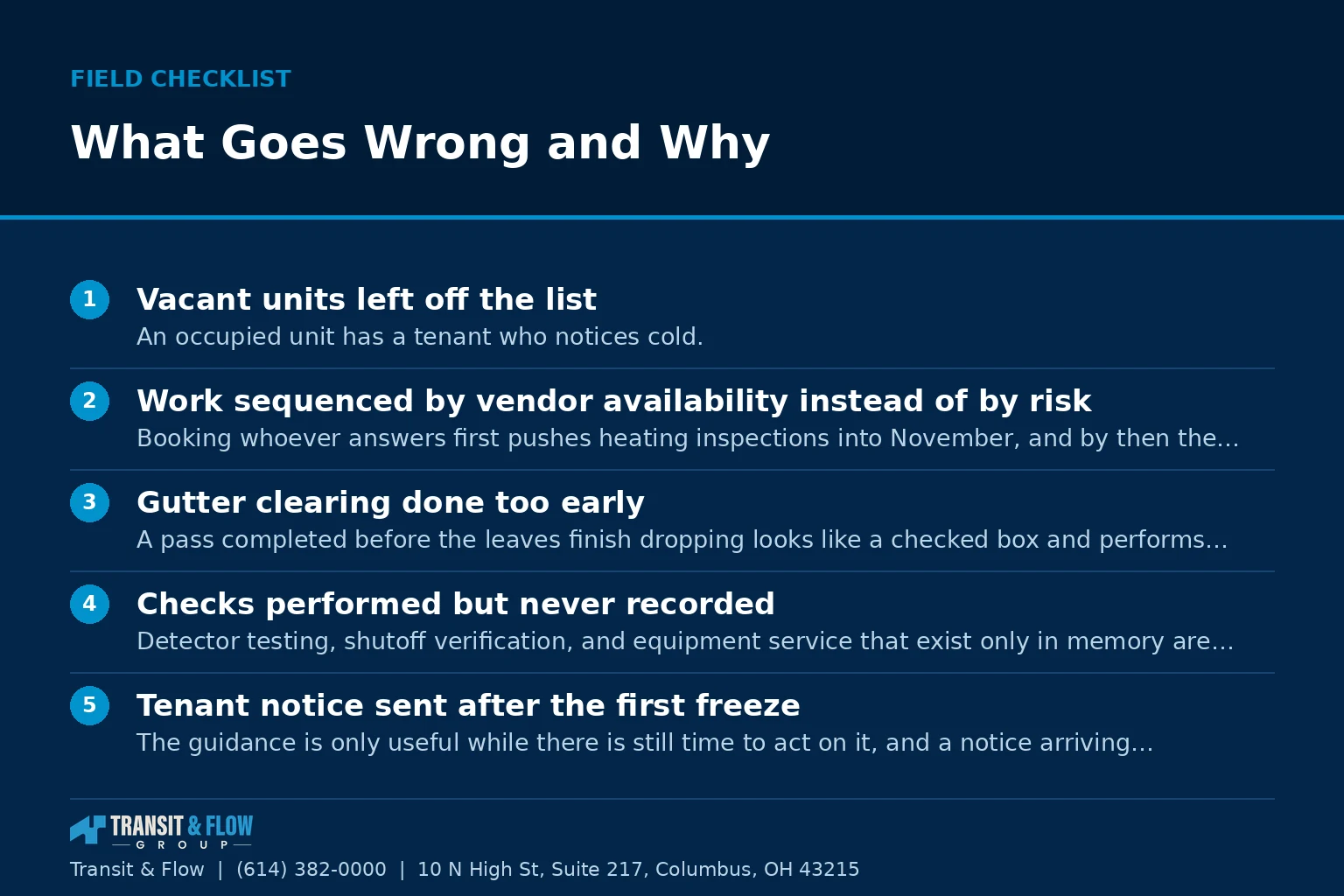
- Vacant units left off the list. An occupied unit has a tenant who notices cold. A unit between turns has nobody, which is why the burst lines almost always show up in the empty ones.
- Work sequenced by vendor availability instead of by risk. Booking whoever answers first pushes heating inspections into November, and by then the queue belongs to no-heat calls rather than to preventive visits.
- Gutter clearing done too early. A pass completed before the leaves finish dropping looks like a checked box and performs like an unmaintained system through the entire freeze.
- Checks performed but never recorded. Detector testing, shutoff verification, and equipment service that exist only in memory are worth very little when an owner, an insurer, or a court asks for the history.
- Tenant notice sent after the first freeze. The guidance is only useful while there is still time to act on it, and a notice arriving mid-cold-snap reads as an excuse rather than as help.
Why One Coordinated Partner Wins in October
When you winterize property Central Ohio portfolios at scale, the trouble is that the work spans every trade at once. HVAC, plumbing, roofing, and electrical all need attention in the same tight window, and juggling four vendors across a portfolio in Grove City, Pickerington, and beyond is how deadlines slip. Transit & Flow handles all of it under one accountable roof, so a single coordinated visit can knock out the furnace tune-up, pipe insulation, gutter clearing, and detector checks together. That is fewer invoices, faster turnaround, and one team that knows your properties, which is exactly what a busy manager needs before the first freeze.
Do not wait for the first cold snap to find out which units are ready. Get an instant estimate on the Transit & Flow homepage, or call our team at (614) 382-0000 to build your October winterization plan today. We will help you protect your properties, your tenants, and your bottom line all winter long.
Frequently Asked Questions
When should winterization work be scheduled on a rental portfolio?
October, before the first hard frost and before demand spikes. The properties that get through a Central Ohio freeze without an after-hours emergency are the ones where the unglamorous work was done early. Servicing heating equipment in early October means you are not competing for emergency slots when the first cold snap hits Worthington and Powell at the same time. Waiting until the cold arrives means contractors across Columbus are already booked out for weeks.
Why are frozen pipes the most expensive winter failure in rental property?
Because a burst line does not just cost a repair, it displaces tenants and drains a reserve fund at the same time. The exposure sits in crawl spaces, basements, garages, and along exterior walls, where supply lines run through unconditioned space. Vacant units during a turn are the highest risk of all, since an unheated home with water still in the lines is a burst waiting to happen. Insulating exposed lines, draining exterior hose bibs, and confirming every unit has an accessible main shutoff removes most of that exposure before the season starts.
What should a vacant unit be set to over the winter?
Keep vacant-unit thermostats no lower than 55 degrees so the plumbing stays above freezing. The point is not tenant comfort, it is keeping water in the lines from reaching the temperature at which it expands. Pair the thermostat setting with insulation on exposed supply lines and a confirmed, accessible main water shutoff. If a unit will sit vacant through a hard freeze, treat it as the highest-risk property in the portfolio rather than the lowest.
What should a pre-season heating inspection cover?
A technician should check the heat exchanger for cracks, test ignition and safety controls, replace filters, and verify the thermostat is calibrated and ideally programmable. In older Columbus housing stock, carbon monoxide risk rises the moment furnaces fire back up after a dormant season, so confirming that every combustion appliance is venting properly belongs in the same visit. This work is performed by a licensed heating contractor, not by maintenance staff. Schedule it in early October rather than after the first cold night.
How do clogged gutters turn into interior water damage?
Fall leaves and freeze-thaw cycling combine badly. A clogged gutter overflows, the overflow refreezes, and the resulting ice dam pushes water back under the shingles and into ceilings. The fix is unglamorous: clean every gutter and downspout before the leaves finish dropping, then confirm the discharge is carrying water well away from the foundation. Grading and drainage matter as much as the roof surface, because saturated soil that freezes against a foundation contributes to cracks and basement seepage.
What should tenants be told before the first freeze?
Send a clear, friendly notice covering four things: hold the heat at a reasonable minimum even when traveling, let faucets drip during extreme cold, know where the water shutoff is, and report leaks or heating problems immediately rather than waiting. Give them an after-hours emergency number they will actually use. Proactive communication turns residents into partners who catch small issues early, which is the difference between a quick service call and a flooded unit. Document the notice for your own records alongside the detector and shutoff checks.
Sources
- National Weather Service, winter weather safety
- U.S. Department of Energy, Energy Saver, insulation
- Ready.gov, U.S. Department of Homeland Security, severe weather preparedness
Related Transit & Flow Services
Every service below is delivered by the same accountable Transit & Flow team, so one call covers the whole property.
- Property Solutions
- Preventive Property Maintenance
- Rental Turnovers
- Seasonal Property Maintenance
- Handyman and Home Repair
- Commercial and Facilities Services
Serving Columbus and every community across Central Ohio. See the full service areas map, or get an instant estimate on the Transit & Flow homepage.
About This Guide
Written and edited by Micheal Parker, founder of Transit & Flow Group. Published August 19, 2026. This guide is checked against the agency and code sources listed above, and it is revised when those sources change.
General contractor of record. Micheal Parker holds City of Columbus General Contractor Registration G12064, issued by the Columbus Department of Building and Zoning Services under Transit & Flow LLC and valid through June 30, 2027. Trade work that falls outside the scope of that registration is performed by licensed trade partners, and the responsible license holder is identified before work begins.
Transit & Flow Group, home and commercial services for Columbus and the surrounding Central Ohio communities. Phone (614) 382-0000. Email solutions@transitflowgroup.com. 10 N. High St., Suite 217, Columbus, OH 43215. Contact our team or review the communities we serve.
