


After two decades on job sites across Central Ohio, I can tell you the biggest reason older homes feel cold in January has almost nothing to do with the furnace. It is air. Learning how to seal drafts and heat loss in Central Ohio homes is the single highest-return project most homeowners overlook, and in our older housing stock it can quietly inflate every winter’s heating bill. Here is how a construction lens approaches the problem, from diagnosis to the fixes that actually move the needle.
In This Guide
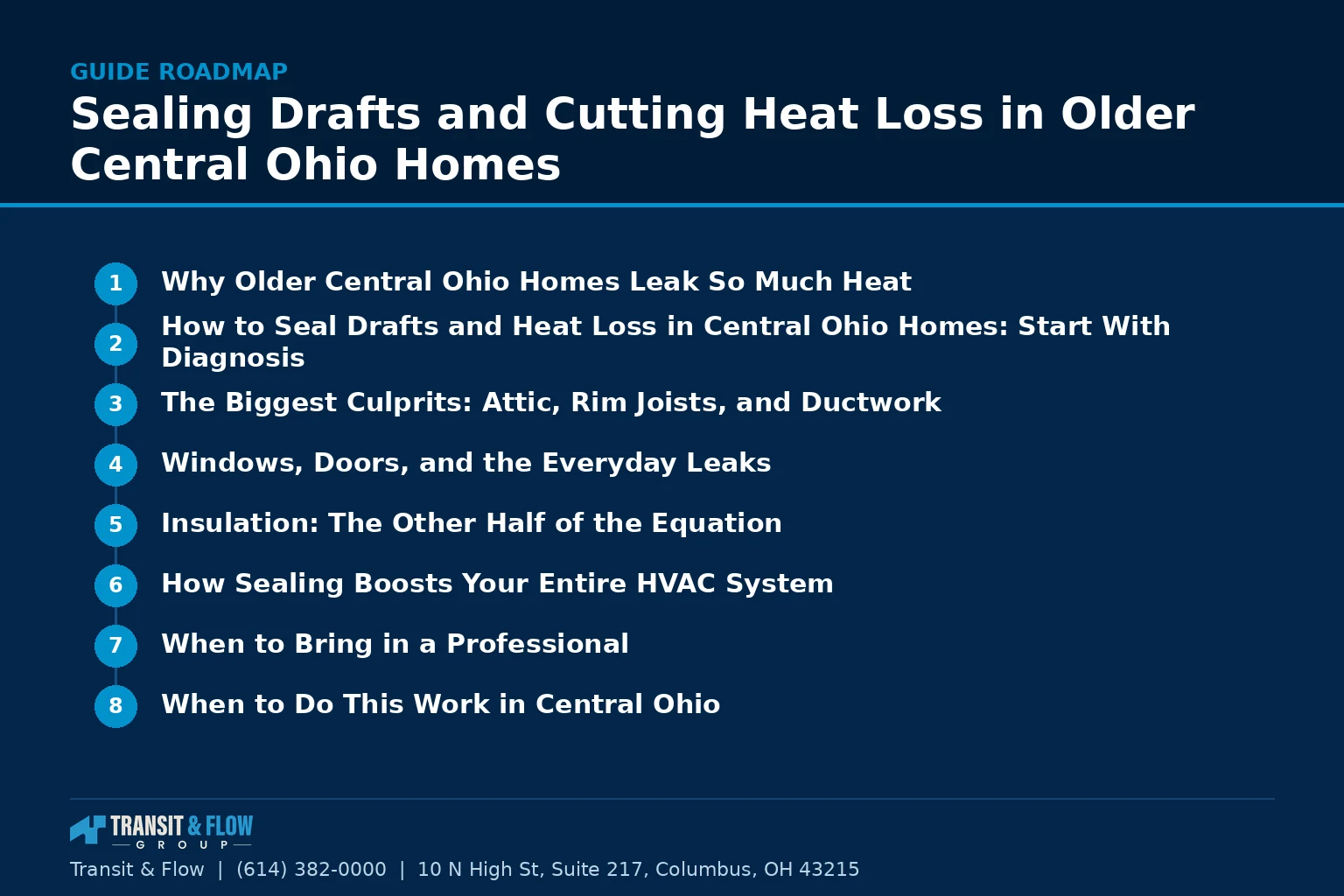
- Why Older Central Ohio Homes Leak So Much Heat
- How to Seal Drafts and Heat Loss in Central Ohio Homes: Start With Diagnosis
- The Biggest Culprits: Attic, Rim Joists, and Ductwork
- Windows, Doors, and the Everyday Leaks
- Insulation: The Other Half of the Equation
- How Sealing Boosts Your Entire HVAC System
- When to Bring in a Professional
- When to Do This Work in Central Ohio
- A Plain Glossary of Sealing and Insulation Terms
- Sources
- Related Transit & Flow Services
- Frequently Asked Questions
Why Older Central Ohio Homes Leak So Much Heat
Central Ohio has a deep inventory of homes built before modern energy codes. The century houses in Worthington and Upper Arlington, the mid-century ranches in Westerville and Gahanna, and the 1970s two-stories in Hilliard and Grove City were all built when energy was cheap and air sealing was an afterthought. Over time, wood frames shift, caulk shrinks, weatherstripping crumbles, and small gaps compound. A typical older home can leak the equivalent of leaving a window open around the clock. Your furnace runs longer, cycles harder, and wears out faster, all to replace heat that is escaping through cracks you cannot see.
How to Seal Drafts and Heat Loss in Central Ohio Homes: Start With Diagnosis
You cannot fix what you have not found, so we always begin with diagnosis. The gold standard is a blower door test, which depressurizes the home and reveals exactly where outside air is pulling in. Paired with an infrared camera, it turns invisible leaks into a clear map. If you want a quick do-it-yourself version, wait for a cold, windy day, turn off the furnace, and move a lit incense stick slowly around window frames, outlets, baseboards, and attic hatches. Where the smoke dances, air is moving. This is the foundation of smart air sealing in older homes, and the surest way to seal drafts and heat loss in Central Ohio houses: prioritize the biggest leaks first instead of chasing every hairline crack.
The Biggest Culprits: Attic, Rim Joists, and Ductwork
Most homeowners assume windows are the main problem, but the largest losses usually happen where you rarely look. Warm air rises and escapes through the attic, so gaps around light fixtures, plumbing stacks, chimney chases, and the attic access hatch are prime offenders. In the basement, the rim joist, where the wood framing meets the foundation, is often completely uninsulated and riddled with gaps. And leaky ductwork running through unconditioned attics or crawl spaces can waste a substantial share of the air your furnace heats. Sealing and insulating these three areas delivers the fastest, most dramatic results and is central to any serious effort to reduce heating bills in Ohio homes.
Windows, Doors, and the Everyday Leaks
Once the big items are handled, the everyday leaks are worth closing. These are the drafts you actually feel, and sealing them improves both comfort and efficiency. A focused afternoon of work here pays off quickly:
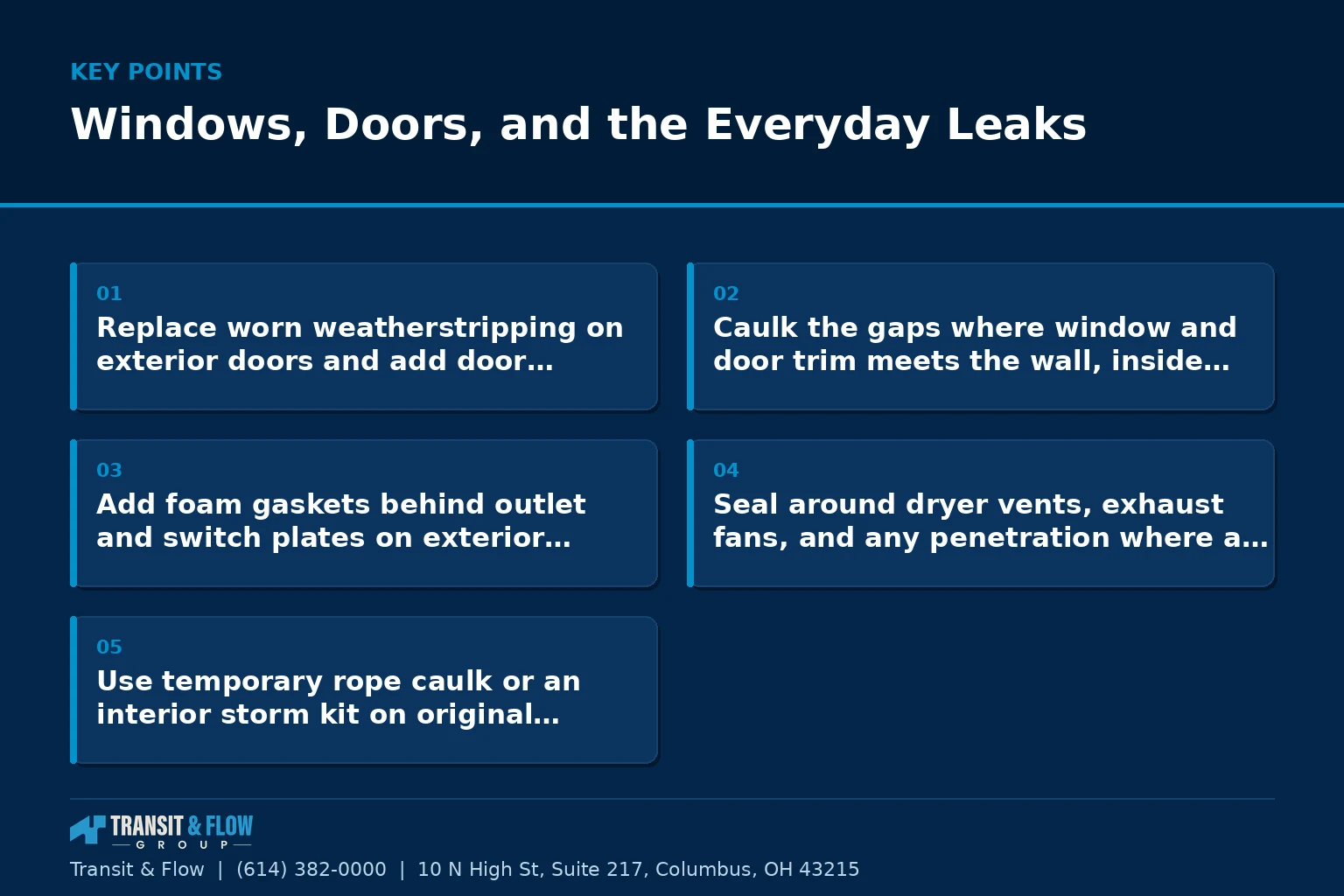
- Replace worn weatherstripping on exterior doors and add door sweeps to close the gap at the threshold.
- Caulk the gaps where window and door trim meets the wall, inside and out.
- Add foam gaskets behind outlet and switch plates on exterior walls, a surprisingly common leak point.
- Seal around dryer vents, exhaust fans, and any penetration where a pipe or wire passes through an exterior wall.
- Use temporary rope caulk or an interior storm kit on original single-pane windows you are not ready to replace.
None of this is glamorous, but together these small fixes meaningfully cut the heat loss that drives your thermostat to work overtime.
Insulation: The Other Half of the Equation
Air sealing and insulation work as a team. Sealing stops the drafts; insulation slows the heat that conducts straight through walls, floors, and ceilings. Many older homes have attic insulation that has settled, compressed, or was never installed to today’s recommended depth. Topping up attic insulation to roughly R-49 is one of the most cost-effective upgrades available, and adding rim joist and crawl space insulation locks in the gains from sealing. When we handle home insulation in Columbus and the surrounding suburbs, we always seal first, then insulate, because blowing insulation over an unsealed attic simply lets air pass right through it. Do them in the right order and the comfort difference is immediate.
How Sealing Boosts Your Entire HVAC System
Here is the part most homeowners miss. A tighter, better-insulated home changes how your whole heating system performs. When the envelope stops leaking, your furnace runs shorter cycles, maintains even temperatures between rooms, and stops that frustrating pattern where the bedroom over the garage never warms up. You extend equipment life, reduce repair calls, and often find you can run a lower thermostat setting comfortably. If you have been considering a furnace replacement, tightening the envelope first may let you install a smaller, less expensive system. This is why we treat air sealing, insulation, and HVAC as one connected project rather than three separate jobs. For homeowners in New Albany, Powell, Dublin, and Pickerington who want to go deeper, our related guides walk through furnace prep and efficiency upgrades that pair perfectly with a well-sealed home.
When to Bring in a Professional
Plenty of draft sealing is a capable homeowner’s weekend project. But attic bypasses, duct sealing, rim joist work, and anything involving your furnace or combustion safety call for a trained crew with the right diagnostic tools. A professional blower door test also gives you a measured before-and-after so you know your money delivered results. Transit & Flow serves homeowners throughout Central Ohio, and you can see every community we cover on our service areas page. Our technicians handle the sealing, the insulation, and the HVAC tune-up together, so you get one accountable partner instead of three separate contractors pointing fingers.
If your older home fights you every winter, this is the season to fix it. Getting ahead of the cold with proper sealing and insulation is the surest way to seal drafts and heat loss in Central Ohio homes and to reduce heating bills in Ohio for years to come. Get an instant estimate right on the Transit & Flow homepage, or call our team at (614) 382-0000 to schedule a comfort assessment before the first hard freeze. Warmer rooms and lower bills start with one call.
When to Do This Work in Central Ohio
Sealing work has a season, and it is not the one most homeowners pick. The calls come in January, when the drafts are obvious and the crews are booked solid on no-heat emergencies.
Late summer through October is the productive window. Attics are workable in the morning rather than punishing, caulk and foam cure properly at those temperatures, and a blower door test run in mild weather gives you time to act on what it finds.
Winter has one real advantage, which is diagnosis. A cold, windy day makes leaks findable in ways a mild afternoon never will. Use the cold months to locate and prioritize, and schedule the actual sealing for the shoulder season that follows.
A Plain Glossary of Sealing and Insulation Terms
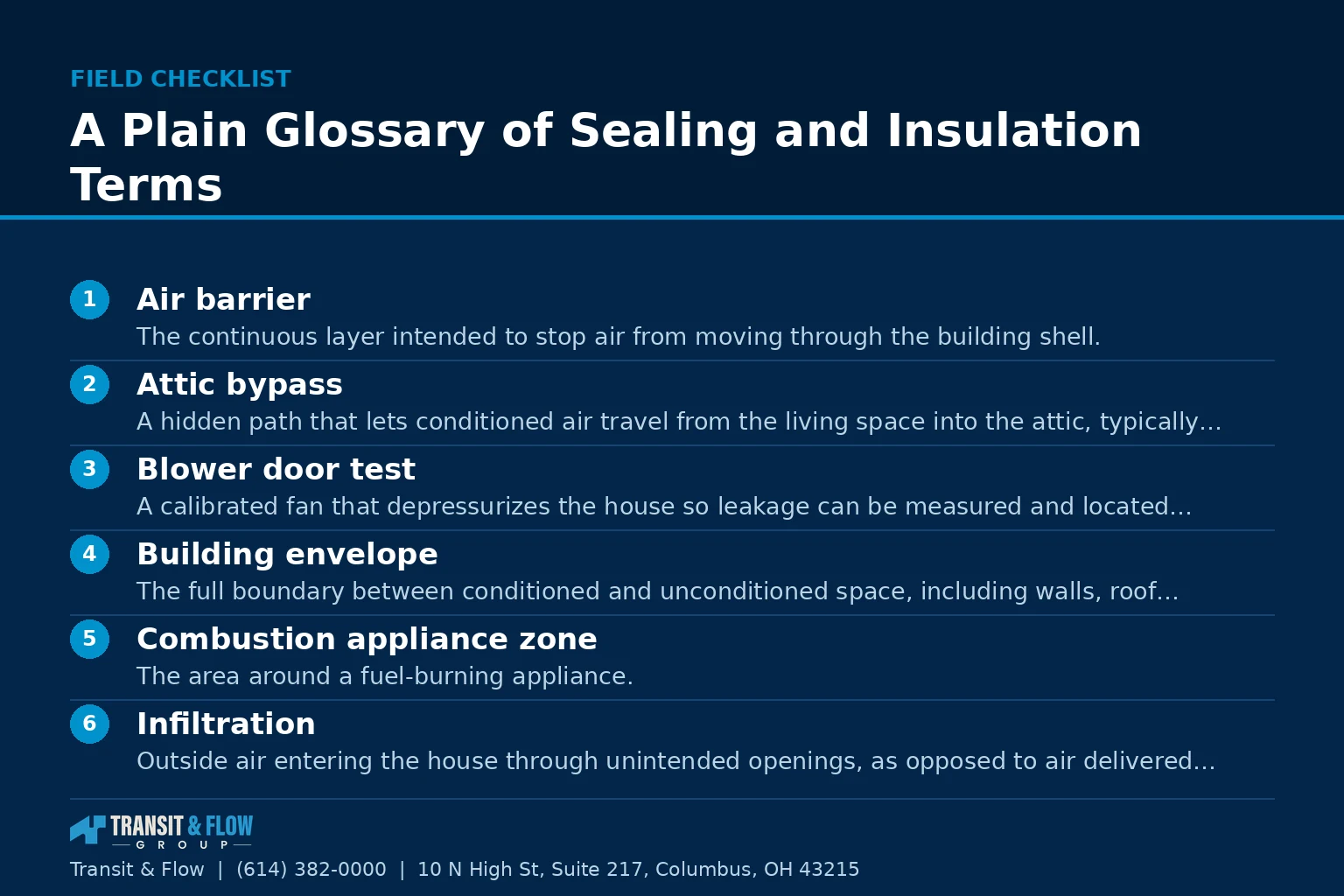
- Air barrier. The continuous layer intended to stop air from moving through the building shell.
- Attic bypass. A hidden path that lets conditioned air travel from the living space into the attic, typically at a chase, a stack, or a recessed fixture.
- Blower door test. A calibrated fan that depressurizes the house so leakage can be measured and located rather than guessed at.
- Building envelope. The full boundary between conditioned and unconditioned space, including walls, roof, floors, windows, and doors.
- Combustion appliance zone. The area around a fuel-burning appliance. Tightening a house changes conditions here, which is why it belongs to a trained professional.
- Infiltration. Outside air entering the house through unintended openings, as opposed to air delivered on purpose by a ventilation system.
- Infrared imaging. A camera that shows surface temperature differences, used alongside a blower door to turn invisible leaks into a visible map.
- Rim joist. The framing member where the floor structure meets the foundation wall.
- R-value. A measure of resistance to heat conducting through a material.
- Stack effect. The tendency of warm air to rise and escape high in the house, pulling cold air in low to replace it.
- Thermal bridge. A path through the assembly where heat moves more readily than through the surrounding insulated area, often at framing members.
- Weatherstripping. The compressible material that seals the gap at a moving joint, such as a door or an operable window.
Sources
- U.S. Department of Energy, Energy Saver, insulation
- U.S. Department of Energy, Energy Saver home energy guidance
- ENERGY STAR, heating and cooling guidance
Related Transit & Flow Services
Every service below is delivered by the same accountable Transit & Flow team, so one call covers the whole property.
Serving Columbus and every community across Central Ohio. See the full service areas map, or get an instant estimate on the Transit & Flow homepage.
Frequently Asked Questions
Where does an older Central Ohio home actually lose the most heat?
Usually not the windows, which is where most homeowners start. The largest losses tend to happen in places you rarely look: the attic, where warm air escapes around light fixtures, plumbing stacks, chimney chases, and the access hatch, and the basement rim joist where framing meets the foundation, which in older houses is often uninsulated and full of gaps. Ductwork running through unconditioned attics or crawl spaces is the third major path. Addressing those three areas moves the needle far more than caulking every hairline crack.
How do I find the leaks before spending money on fixes?
Start with diagnosis rather than guessing. A blower door test depressurizes the house and reveals where outside air is pulling in, and pairing it with an infrared camera turns invisible leaks into a clear map. A rough do-it-yourself version is to wait for a cold, windy day, turn the furnace off, and move a lit incense stick slowly around window frames, outlets, baseboards, and the attic hatch, watching for the smoke to move. Either way the point is the same, which is to rank the leaks by size and fix the biggest ones first.
Should I air seal first or add insulation first?
Seal first, then insulate. The two do different jobs, since sealing stops moving air and insulation slows heat conducting through walls, floors, and ceilings, and they only work as a team. Blowing insulation over an unsealed attic lets air pass straight through it, so the sealing work has to come first for the insulation to perform. Once that order is respected, the comfort difference is usually noticeable right away.
What can a homeowner reasonably do without a contractor?
The everyday leaks are well within a capable homeowner’s reach. Replacing worn weatherstripping on exterior doors, adding door sweeps, caulking where window and door trim meets the wall, fitting foam gaskets behind outlet and switch plates on exterior walls, and sealing around dryer vents and exhaust fan penetrations are all straightforward afternoon work. Rope caulk or an interior storm kit can help on original single-pane windows you are not ready to replace. None of it is glamorous, but together it closes the drafts you actually feel.
What should be left to a professional?
Attic bypasses, duct sealing, rim joist work, and anything touching the furnace or combustion safety belong with a trained crew carrying the right diagnostic tools. Combustion safety in particular is not a judgment to make from a homeowner’s vantage point, and tightening a house changes how a combustion appliance behaves. A professional blower door test also gives you a measured before and after, so you know the work actually delivered. If you have any concern about how your heating equipment is venting, have it assessed rather than assumed.
Does sealing the house change what furnace I need?
It can, which is why the sequence matters if a replacement is on the horizon. A tighter, better insulated envelope means the furnace runs shorter cycles, holds more even temperatures between rooms, and stops the pattern where the bedroom over the garage never warms up. Because the load on the house drops, tightening the envelope before replacing equipment may allow a smaller system than the existing one. That is a determination for the contractor sizing the system, and it is a good reason to treat sealing, insulation, and heating as one connected project rather than three separate jobs.
Transit & Flow Group coordinates projects and partners with properly licensed and insured specialty contractors when licensing is required.
About This Guide
Written and edited by Micheal Parker, founder of Transit & Flow Group. Published August 21, 2026. This guide is checked against the agency and code sources listed above, and it is revised when those sources change.
General contractor of record. Micheal Parker holds City of Columbus General Contractor Registration G12064, issued by the Columbus Department of Building and Zoning Services under Transit & Flow LLC and valid through June 30, 2027. Trade work that falls outside the scope of that registration is performed by licensed trade partners, and the responsible license holder is identified before work begins.
Transit & Flow Group, home and commercial services for Columbus and the surrounding Central Ohio communities. Phone (614) 382-0000. Email solutions@transitflowgroup.com. 10 N. High St., Suite 217, Columbus, OH 43215. Contact our team or review the communities we serve.
