
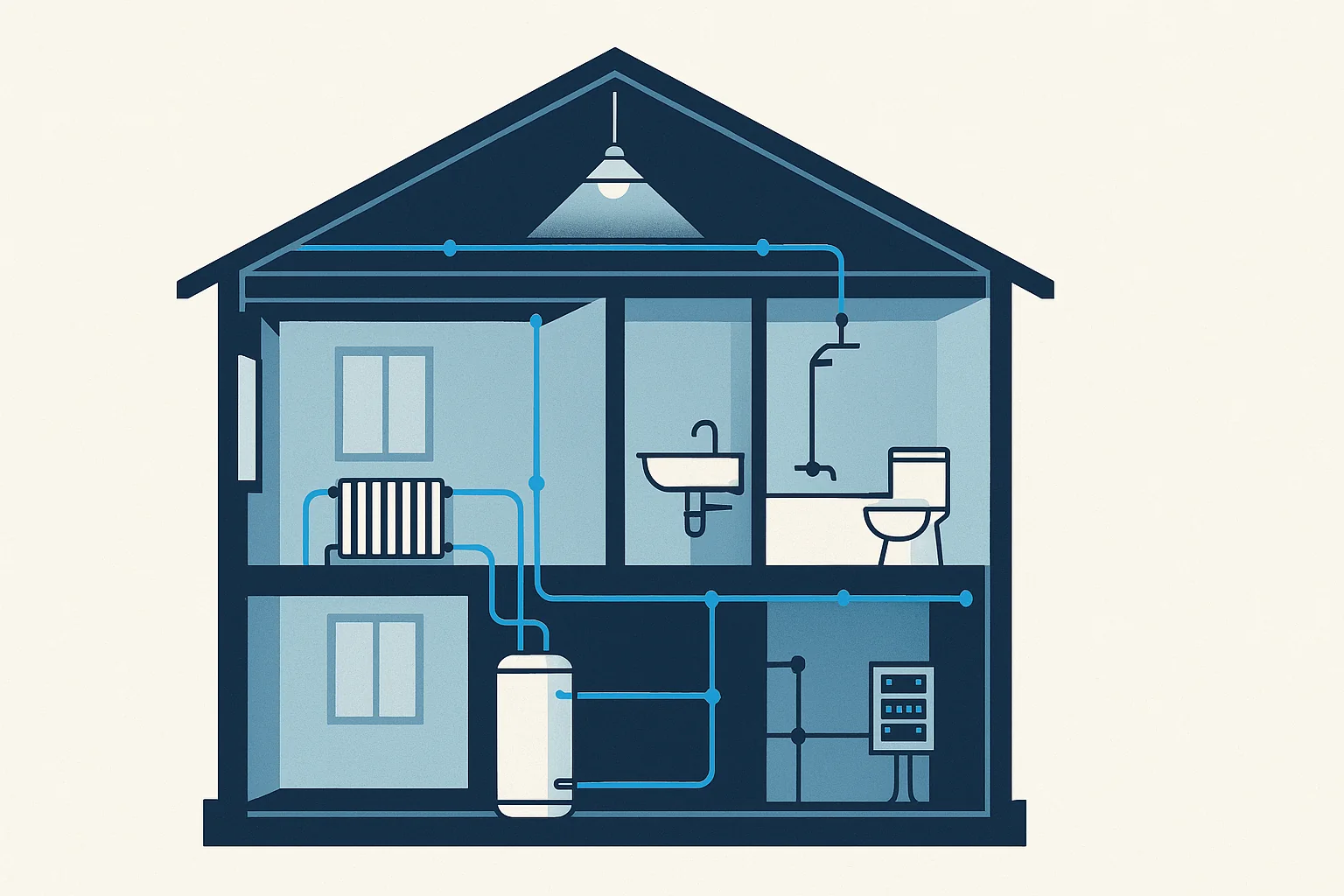

Every November, the smartest property owners in Central Ohio stop treating winter as a series of separate emergencies and start treating it as one coordinated project. A well-planned pre winter home tune up central Ohio families and facility managers can rely on means every system, heating, plumbing, electrical, and exterior, gets checked before the first hard freeze, not after a 2 a.m. failure. At Transit & Flow, we build that readiness the way we build client relationships: one accountable partner, one clear plan, and measurable peace of mind.
In This Guide
- Why a Pre Winter Home Tune Up Central Ohio Owners Trust Pays for Itself
- One Partner, Every Trade: The Coordination Advantage
- What a Complete Winter Home Checklist Columbus Properties Actually Need
- Built for Homes and Light-Commercial Sites Alike
- The Real Return: Predictability and Peace of Mind
- Two Ways to Buy the Work
- What Goes Wrong and Why
- Schedule Your Pre-Winter Tune-Up With Transit & Flow
- Frequently Asked Questions
- Sources
- Related Transit & Flow Services
Here is the reality most homeowners and small facility operators discover the hard way. When you juggle four different contractors for four different trades, you also juggle four schedules, four invoices, and four versions of “that’s not my department.” The value of a single multi-trade partner is not just convenience. It is speed, accountability, and a complete picture of your property before the season that stresses it most.
Why a Pre Winter Home Tune Up Central Ohio Owners Trust Pays for Itself
Central Ohio winters do not arrive gently. Temperatures swing, humidity drops, and equipment that limped through summer suddenly runs for months without a break. A pre-winter tune-up is the highest-return maintenance dollar you can spend because it converts unpredictable emergency spend into planned, budgeted care. A cracked heat exchanger, a slow supply-line leak, or an overloaded electrical panel almost never announces itself politely. Caught early, each is a modest repair. Ignored, each becomes a holiday-weekend disaster with premium pricing attached.
From a business standpoint, the math is simple. Coordinated prevention reduces total cost of ownership, extends equipment life, and eliminates the productivity drain of chasing vendors. That logic holds whether you own a single home in Westerville or manage a light-commercial building in Hilliard.
One Partner, Every Trade: The Coordination Advantage
The phrase one contractor every trade sounds like marketing until you have lived through a January where your plumber blames your HVAC tech and neither will touch the thermostat wiring. Transit & Flow removes that friction. A single visit, one scheduled window, and a technician team that sees how your systems interact, because a furnace, a water heater, and an electrical panel are not independent islands. When one partner owns the whole property, small issues get flagged before they cascade, and nothing falls through the cracks between specialties. This is the coordination that makes a pre winter home tune up central Ohio owners schedule feel effortless rather than exhausting.
That integrated view is exactly what a proper whole home maintenance Ohio strategy requires. You get one point of contact, one documented record of what was inspected, and one number to call if anything changes.
What a Complete Winter Home Checklist Columbus Properties Actually Need
A serious pre-winter visit is not a quick glance at the furnace. Our technicians work through a comprehensive winter home checklist Columbus and suburban properties genuinely benefit from, covering the systems most likely to fail under cold-weather load:
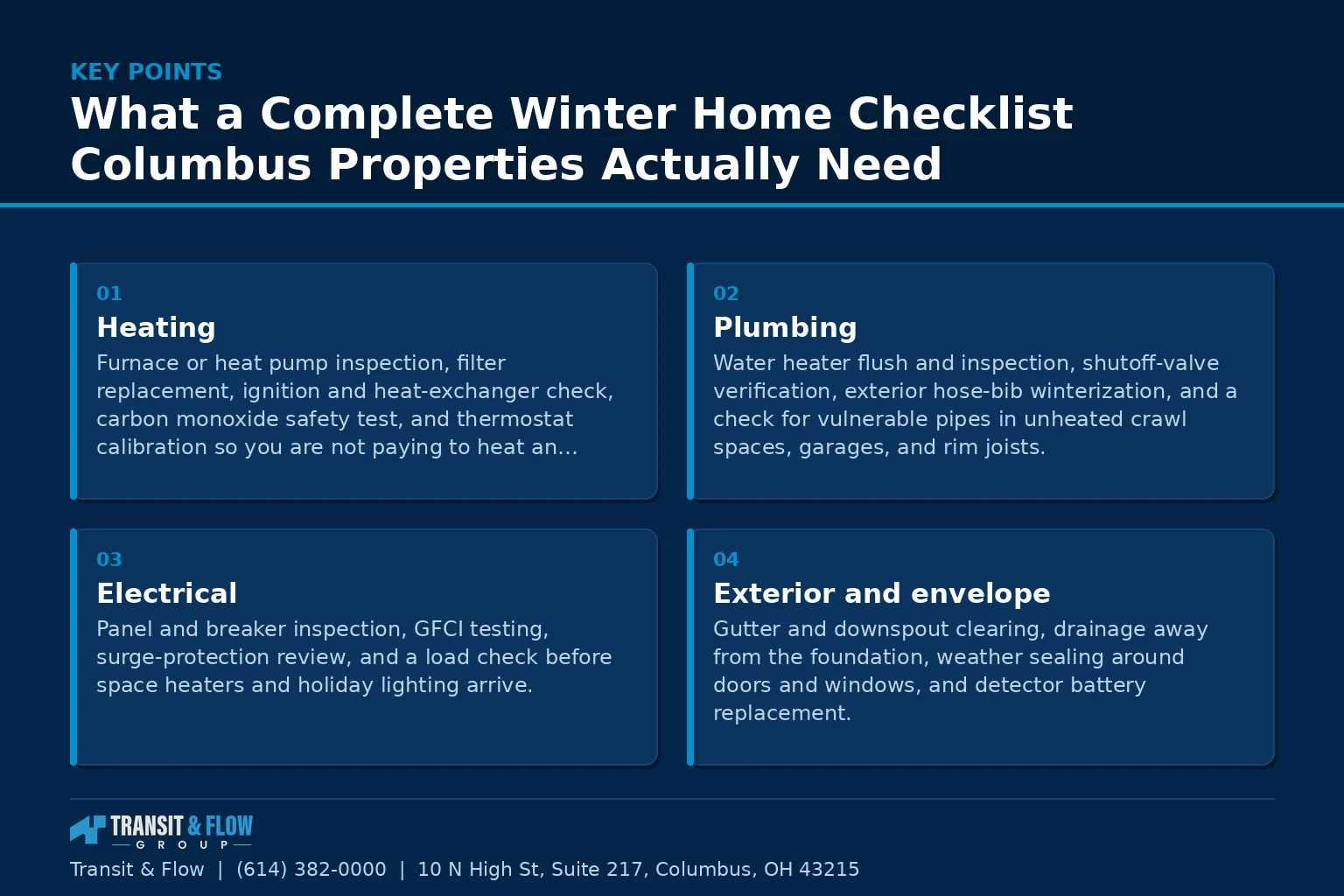
- Heating: Furnace or heat pump inspection, filter replacement, ignition and heat-exchanger check, carbon monoxide safety test, and thermostat calibration so you are not paying to heat an empty schedule.
- Plumbing: Water heater flush and inspection, shutoff-valve verification, exterior hose-bib winterization, and a check for vulnerable pipes in unheated crawl spaces, garages, and rim joists.
- Electrical: Panel and breaker inspection, GFCI testing, surge-protection review, and a load check before space heaters and holiday lighting arrive.
- Exterior and envelope: Gutter and downspout clearing, drainage away from the foundation, weather sealing around doors and windows, and detector battery replacement.
Each item is small on its own. Together they are the difference between a comfortable, predictable winter and a season of reactive repairs. You can find deeper breakdowns of individual systems in our related guides.
Built for Homes and Light-Commercial Sites Alike
The same coordinated model scales cleanly. A homeowner in Dublin or Upper Arlington wants comfort, safety, and a bill that does not surprise them. A property manager in Gahanna or Grove City wants uptime, tenant satisfaction, and documentation that protects the asset. Transit & Flow delivers both from the same disciplined playbook. We serve Columbus and the surrounding communities, and our technicians know how the region’s older housing stock and mixed-age commercial buildings behave when the temperature drops.
Whether you own one property or manage several, consolidating your pre-winter work with a single accountable team means faster response and a consistent standard of quality across every location. Explore where we work on our service areas page.
The Real Return: Predictability and Peace of Mind
The strongest argument for a coordinated pre winter home tune up central Ohio owners can schedule now is not any single repair. It is control. You know your systems are ready. You know what was checked and when. You know that if something does need attention, one partner already understands your property and can move fast. Heading into the holidays, that certainty is worth more than the modest cost of the visit.
Deferred maintenance does not disappear. It compounds, quietly, until the coldest night of the year forces the issue at the worst possible time. A planned tune-up simply refuses to play that game.
Two Ways to Buy the Work
There are only two honest structures for pre-winter work. Option A is trade-by-trade, where you hold the schedule and hire each specialty separately. Option B is a single multi-trade partner who holds the schedule for you. Both can produce good work. They differ in where the coordination burden lands and in what happens when one finding depends on another.
| Consideration | Option A: Trade by Trade | Option B: One Multi-Trade Partner |
|---|---|---|
| Scheduling | Four calendars you reconcile yourself | One window covering every system |
| Findings that cross trades | Each vendor reports only its own scope | Interactions get flagged in one report |
| Accountability when something recurs | Divided, and often disputed | Held in one place |
| Documentation | Separate formats and separate records | A single record of what was inspected |
| Specialty depth | Strongest when a system is unusual or failing | Depth comes through licensed specialty partners |
| Best fit | One known problem on one system | Whole-property seasonal readiness |
Our recommendation is Option B for routine seasonal readiness and Option A when you already know exactly which system is failing and want the deepest possible specialty attention on that one thing. The reason is not loyalty to our own model. It is that most pre-winter findings are relational rather than isolated, and a report that treats the furnace, the panel, and the envelope as one property is far more useful in November than three reports that each stop at the edge of a scope.
What Goes Wrong and Why
The failures we are called out for in deep winter tend to share a small number of origins, and none of them require bad luck to explain.
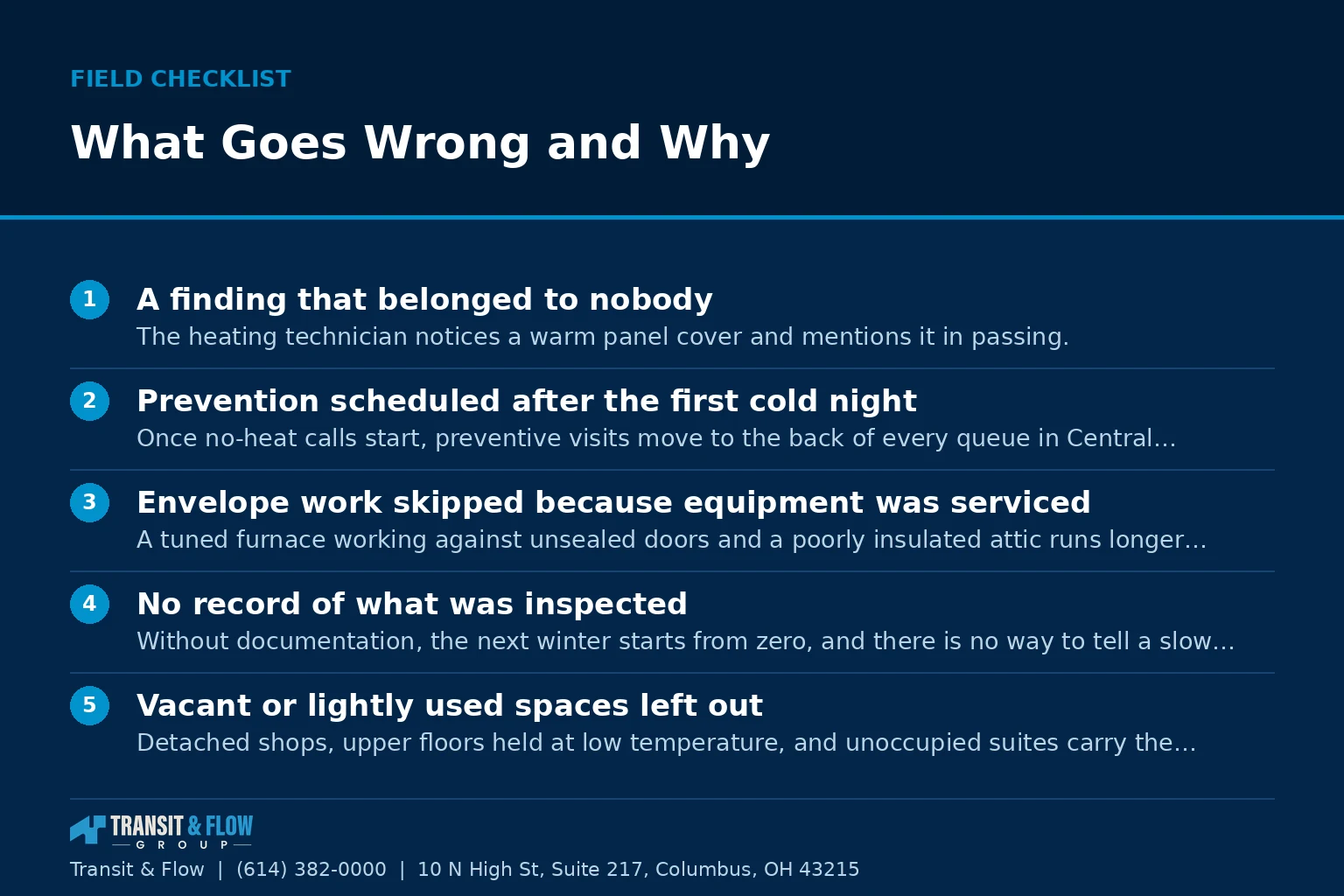
- A finding that belonged to nobody. The heating technician notices a warm panel cover and mentions it in passing. It is outside that scope, it never reaches a report, and it surfaces again in January as an electrical call.
- Prevention scheduled after the first cold night. Once no-heat calls start, preventive visits move to the back of every queue in Central Ohio, and the work you meant to do in November happens in February or not at all.
- Envelope work skipped because equipment was serviced. A tuned furnace working against unsealed doors and a poorly insulated attic runs longer and harder than it should, which shortens its life and shows up on the utility bill.
- No record of what was inspected. Without documentation, the next winter starts from zero, and there is no way to tell a slow decline from a sudden failure.
- Vacant or lightly used spaces left out. Detached shops, upper floors held at low temperature, and unoccupied suites carry the same freeze exposure as the rooms people actually stand in.
Schedule Your Pre-Winter Tune-Up With Transit & Flow
Winter in Central Ohio rewards the prepared and punishes the procrastinator. Get every system, HVAC, plumbing, electrical, and exterior, checked by one accountable partner before the first freeze arrives. Get an instant estimate right now on the Transit & Flow homepage, or call our team at (614) 382-0000 to lock in your pre-winter tune-up. One partner, every trade, and a property that is genuinely ready for the season ahead.
Transit & Flow Group coordinates projects and partners with properly licensed and insured specialty contractors when licensing is required, and work is performed under the appropriate permits.
Frequently Asked Questions
When should a pre-winter tune-up happen in Central Ohio?
Before the first hard freeze, which in practice means scheduling it in the fall rather than waiting for the first cold night to reveal a problem. Equipment that ran through the summer is about to run for months without a real break, and the failures that matter tend to appear under sustained load. Booking early also means the work happens on a planned schedule instead of during the weeks when every other property owner is calling at once. The season that stresses a property most is the worst time to be discovering its condition.
Why use one partner instead of separate contractors for each trade?
Because the systems in a property are not independent, and neither are their failures. When four trades are managed separately you also manage four schedules, four invoices, and the gap between specialties where issues quietly sit. A single accountable partner produces one scheduled window, one documented record of what was inspected, and one point of contact if something changes. The practical benefit is that small issues get flagged before they cascade rather than being handed between vendors.
What does a complete pre-winter visit actually cover?
Heating, plumbing, electrical, and the building envelope, treated as one pass rather than four errands. On the heating side that includes the furnace or heat pump, the filter, ignition and heat exchanger condition, a carbon monoxide safety test, and thermostat calibration. Plumbing covers the water heater, shutoff valves, exterior hose bib winterization, and pipes in unheated crawl spaces, garages, and rim joists. Electrical covers the panel and breakers, GFCI testing, and surge protection, and the exterior work covers gutters, drainage, weather sealing, and detector batteries.
Is carbon monoxide something a homeowner can check themselves?
Working carbon monoxide detectors with fresh batteries are the homeowner’s job, and testing them is worth doing at the same time as the rest of the seasonal checklist. The condition of the combustion equipment itself is not a homeowner assessment. Carbon monoxide risk in a home is a health question, and any concern about a gas appliance should be evaluated by a qualified professional rather than interpreted from symptoms or a hardware store reading. If a detector alarms, treat it as a reason to leave the building and call for help, not a reason to investigate.
Does the same approach work for a small commercial building?
Yes, and the model scales without changing. A homeowner is generally after comfort, safety, and a bill without surprises, while a property manager is after uptime, tenant satisfaction, and documentation that protects the asset. Both come from the same disciplined pass through the property, and consolidating several sites with one accountable team keeps the standard consistent across locations. It also means the last building on the list is not the one still waiting after the first freeze.
What is the actual return on a pre-winter tune-up?
Predictability more than any single repair. Deferred maintenance does not go away, it compounds quietly until the coldest night forces the issue at the least convenient moment. A planned visit converts unpredictable emergency work into scheduled, budgeted care, extends equipment life, and leaves you with a written record of what was checked and when. If something does need attention later, the partner who already knows the property can move faster than one meeting it for the first time.
Sources
- U.S. Consumer Product Safety Commission, carbon monoxide safety
- ENERGY STAR, heating and cooling guidance
- National Weather Service, winter weather safety
Related Transit & Flow Services
Every service below is delivered by the same accountable Transit & Flow team, so one call covers the whole property.
- Heating and Cooling Services
- HVAC Replacement Consultation
- Dryer Vent Service
- Electrical Panel Upgrades
- Preventive Property Maintenance
- Plumbing Services
Serving Columbus and every community across Central Ohio. See the full service areas map, or get an instant estimate on the Transit & Flow homepage.
About This Guide
Written and edited by Micheal Parker, founder of Transit & Flow Group. Published August 28, 2026. This guide is checked against the agency and code sources listed above, and it is revised when those sources change.
General contractor of record. Micheal Parker holds City of Columbus General Contractor Registration G12064, issued by the Columbus Department of Building and Zoning Services under Transit & Flow LLC and valid through June 30, 2027. Trade work that falls outside the scope of that registration is performed by licensed trade partners, and the responsible license holder is identified before work begins.
Transit & Flow Group, home and commercial services for Columbus and the surrounding Central Ohio communities. Phone (614) 382-0000. Email solutions@transitflowgroup.com. 10 N High St, Suite 217, Columbus, OH 43215. Contact our team or review the communities we serve.
