
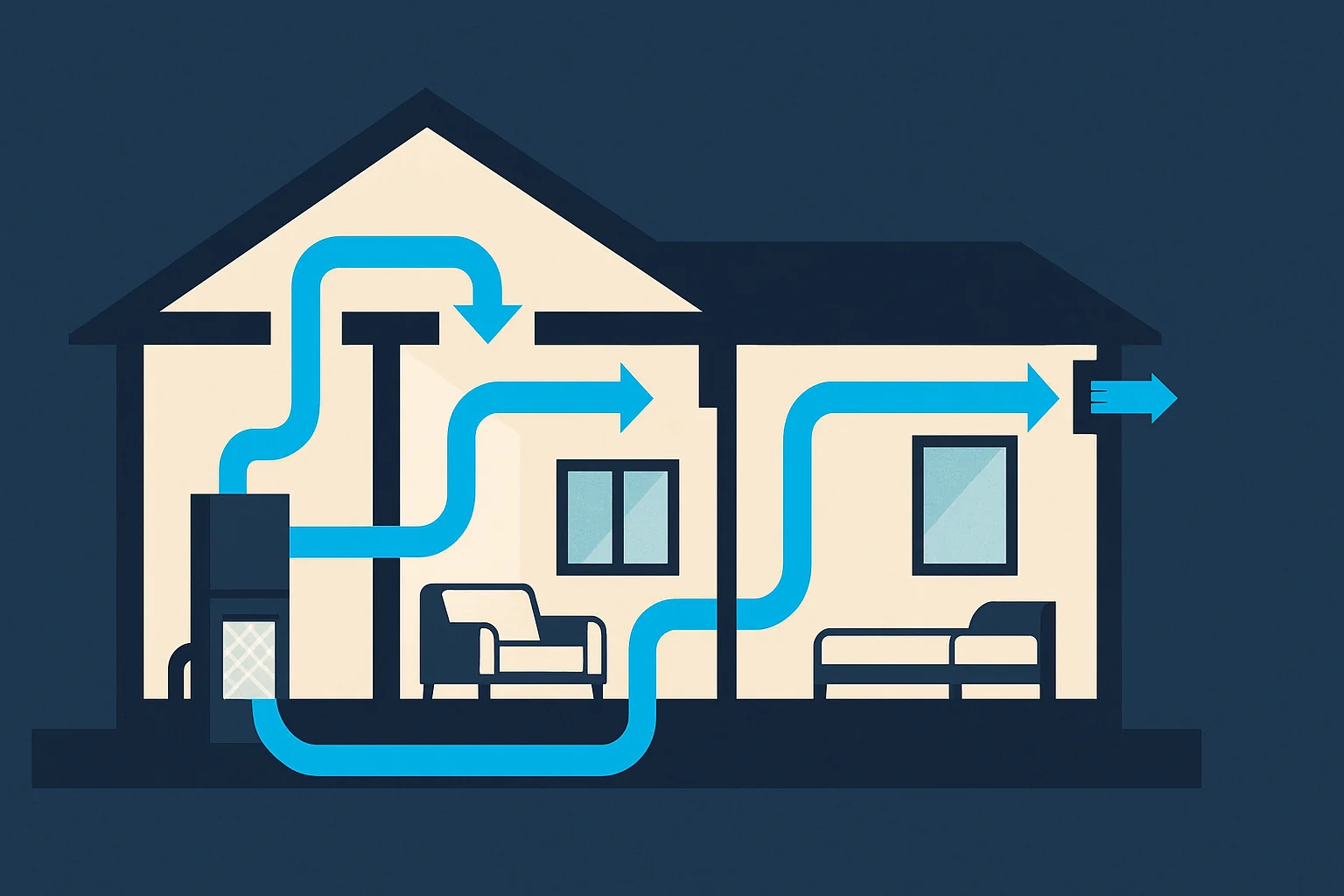

Water damage in an Ohio winter is not one event. It is a sequence, and the sequence has a clock on it. What happens in the first hour determines how much water enters. What happens in the first day determines whether the materials in your home can be dried or have to be removed. What happens in the first two days determines whether you are managing a drying project or a mold remediation project. Almost none of that is decided by the water itself. It is decided by what people do while the water is still on the floor.
In This Guide
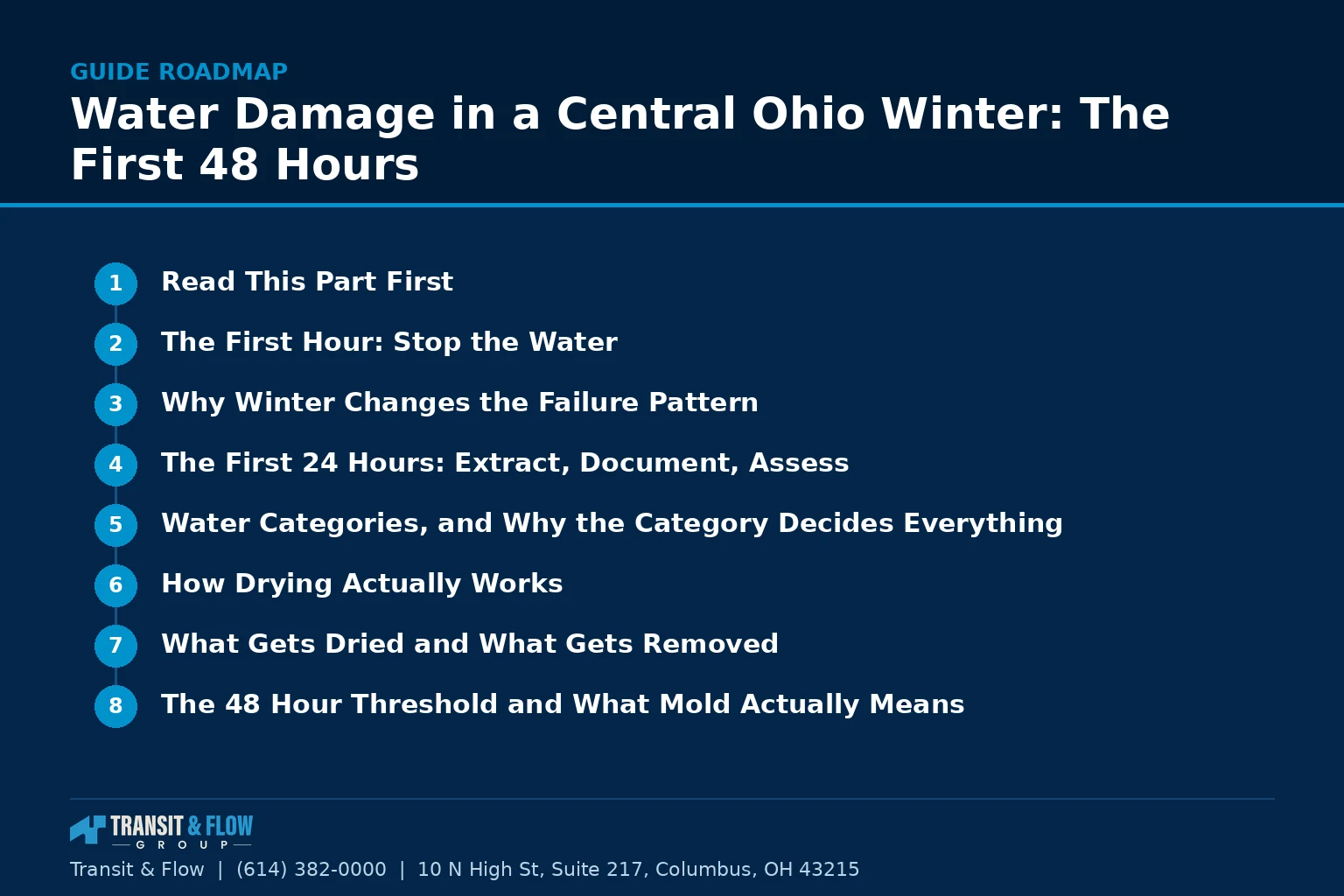
- Read This Part First
- The First Hour: Stop the Water
- Why Winter Changes the Failure Pattern
- The First 24 Hours: Extract, Document, Assess
- Water Categories, and Why the Category Decides Everything
- How Drying Actually Works
- What Gets Dried and What Gets Removed
- The 48 Hour Threshold and What Mold Actually Means
- Working With an Insurance Claim
- How to Tell a Competent Response From an Opportunistic One
- Prevention That Actually Prevents
- Glossary
- The Decision That Matters Most
- Where Transit & Flow Group Fits
- Frequently Asked Questions
This guide is written for the moment it actually gets read, which is usually while something is still wet. It covers the immediate response, the documentation that protects you later, how drying actually works and why it takes as long as it does, what mold does and does not mean, and how to tell a competent restoration response from an opportunistic one. It is the anchor for our restoration coverage across Columbus and Central Ohio.
Transit & Flow Group coordinates projects and partners with properly licensed and insured specialty contractors when licensing is required.
Read This Part First
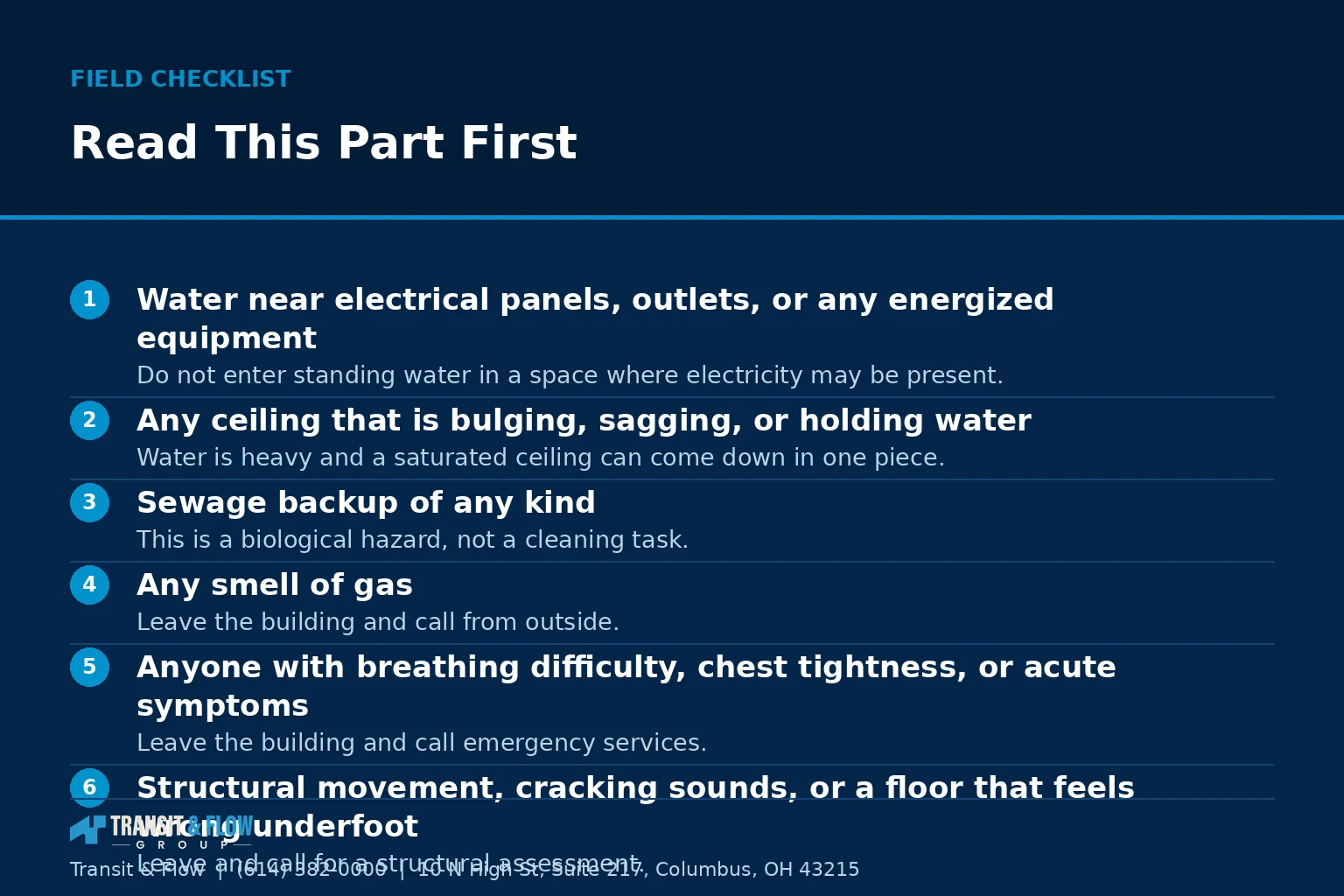
Some water situations are not restoration situations. They are safety situations, and the correct action is to leave.
- Water near electrical panels, outlets, or any energized equipment. Do not enter standing water in a space where electricity may be present. Do not reach for a breaker panel while standing in water. Call a licensed electrician or the utility.
- Any ceiling that is bulging, sagging, or holding water. Water is heavy and a saturated ceiling can come down in one piece. Stay out of the room underneath it.
- Sewage backup of any kind. This is a biological hazard, not a cleaning task. It requires containment and personal protective equipment. Do not attempt to clean it yourself.
- Any smell of gas. Leave the building and call from outside. Do not operate switches on the way out.
- Anyone with breathing difficulty, chest tightness, or acute symptoms. Leave the building and call emergency services. Health effects are a medical question and this article is not medical advice.
- Structural movement, cracking sounds, or a floor that feels wrong underfoot. Leave and call for a structural assessment.
If none of those apply, the rest of this guide is yours to work through.
The First Hour: Stop the Water
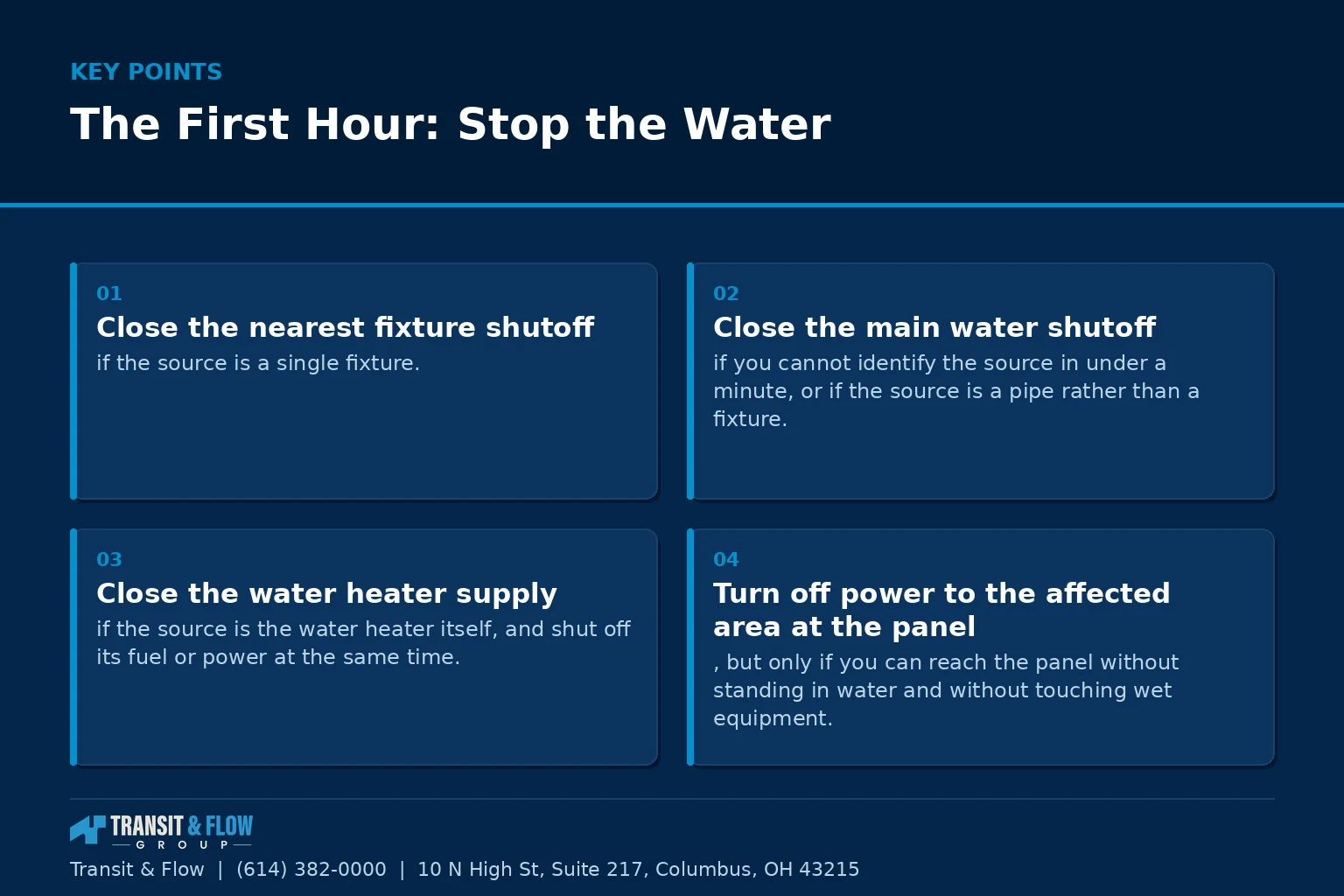
Everything else is secondary to volume. A leak stopped in three minutes and a leak stopped in forty minutes are different projects with different costs and different outcomes, and the only variable that separates them is whether someone knew where the shutoff was.
- Close the nearest fixture shutoff if the source is a single fixture. Under a sink, behind a toilet, at a supply line to an appliance.
- Close the main water shutoff if you cannot identify the source in under a minute, or if the source is a pipe rather than a fixture. In most Central Ohio homes the main valve is where the supply enters the basement or crawl space, often near the meter.
- Close the water heater supply if the source is the water heater itself, and shut off its fuel or power at the same time.
- Turn off power to the affected area at the panel, but only if you can reach the panel without standing in water and without touching wet equipment. If you cannot do that safely, do not do it. Call for help instead.
- Open the exterior path for water to leave if the space has a floor drain or a sump, and confirm the sump pump is running.
- If the source is outside the house, a supply main break or a sewer backup, contact the utility or the city rather than treating it as a plumbing repair.
The preventive version of this list is worth doing on a dry Saturday. Locate the main shutoff, confirm it turns, tag it, and show every adult in the house. Photograph it and put the photo somewhere findable. That fifteen minutes is worth more than any product you can buy.
Why Winter Changes the Failure Pattern
Winter water damage in Central Ohio comes from a different set of causes than summer water damage, and the causes cluster during specific weather events rather than spreading evenly across the season.
- Frozen and burst supply lines. Water expands as it freezes and the pressure has nowhere to go. The break most often happens in an unheated space: an exterior wall, a crawl space, an attic run, a garage, an unheated addition. The break frequently is not discovered at the moment of freezing. It is discovered at the thaw, when the ice plug melts and the line begins delivering water into the structure at full pressure.
- Ice dams. Heat escaping into an attic melts snow on the upper roof, that meltwater runs down and refreezes at the cold eave, and the resulting ridge of ice backs water up under the shingles. The water enters at the top of exterior walls and appears at ceilings and window headers. Our article on attic ventilation and ice dams covers the mechanism and the prevention in detail.
- Frozen sump discharge lines. The pump runs, the discharge line is blocked with ice, and the water returns to the basement or the pump burns out trying.
- Failed heat during an absence. A furnace outage in an empty house is a whole-house freeze event rather than a single line, and it is the reason vacant properties and vacation absences produce the largest losses of the season.
- Snowmelt against the foundation. A rapid thaw with frozen ground beneath produces surface water that cannot infiltrate, and it finds the lowest entry point available. Our guidance on basement floor drain backups covers the drainage side of this.
- Roof leaks under snow load. A defect that was tolerable in rain becomes a leak under prolonged standing snow and melt.
The pattern that matters for response: winter losses are more likely to be discovered late. A summer leak announces itself. A winter leak often begins inside a wall cavity during a freeze and is only discovered when the thaw arrives, which means the material has already been wet for a while when the clock starts.
The First 24 Hours: Extract, Document, Assess
Once the water has stopped, three things happen in parallel. Water comes out, evidence goes in the record, and someone qualified determines what can be saved.
Extraction
Removing standing water is the highest-value hour of the entire project, because every gallon extracted mechanically is a gallon that does not have to be evaporated later. Extraction is fast. Evaporation is slow. Professional extraction equipment removes water from carpet, pad, and hard surfaces at a rate no shop vacuum approaches, which is the single strongest argument for calling early rather than starting the project yourself and calling when it is not going well.
What you can reasonably do while waiting: move furniture off wet flooring or put foil or blocks under the legs, because wood stain and metal glides transfer into carpet permanently within hours. Lift area rugs off wet floors. Remove items of value from the affected area. Open interior doors so air can move between spaces. Do not run the furnace fan to circulate air through the building if the affected area may involve sewage or if there is any question of contamination.
Documentation
Do this before anything is moved, cut, or thrown away. Documentation is easy to create in the moment and impossible to recreate afterward, and it is the difference between a claim that is straightforward and a claim that becomes a negotiation.
- Photograph and video everything before touching anything. Wide shots that establish the room, then close shots of the damage, then the source itself.
- Photograph the source specifically, including the failed component. If a supply line burst, photograph the burst. If a valve failed, photograph the valve.
- Capture the water line on walls, which establishes depth and is difficult to demonstrate later.
- Photograph contents, including inside cabinets and closets, before removal.
- Note the date and time of discovery, and of when the water was stopped.
- Keep every receipt, including for the fan you bought, the hotel, and the emergency plumber.
- Keep damaged materials where practical, or photograph them thoroughly before disposal. A failed component is evidence.
- Write a running log of who came, when, and what they said. Names and times.
- Do not throw anything away until it has been documented and, where a claim is involved, until the carrier has had the opportunity to see it.
The same discipline applies to storm and roof events, and our article on storm damage documentation covers the exterior version of this record.
Assessment
A competent assessment establishes three things: how far the water actually traveled, what category of water it was, and what class of drying situation you have. All three drive the response, and none of them are visible to the eye.
Water travels much further than the visible wet area. It moves laterally under flooring, wicks upward into drywall, runs along the top plate of walls, and follows electrical and plumbing penetrations into cavities. Moisture meters and thermal imaging are how the actual boundary gets found. An assessment that consists of looking at the floor and declaring the affected area has not been performed.
Water Categories, and Why the Category Decides Everything
Restoration practice classifies water by contamination level, and that classification determines whether materials get dried in place or removed. It is the single most consequential judgment in the project.
- Clean water. From a supply line, a water heater, or a similar sanitary source. The widest range of materials can be dried in place, provided drying starts quickly.
- Gray water. Water with significant contamination, from appliances such as dishwashers and washing machines, or clean water that has sat long enough to degrade. Some materials come out. Porous materials are treated with more caution.
- Black water. Grossly contaminated. Sewage, rising surface water, or water that has been sitting long enough to support substantial microbial growth. Porous materials are removed. This is not a category to negotiate down.
Two points that surprise homeowners. First, clean water does not stay clean. It degrades over time as it contacts building materials and soil, so a clean water loss discovered late may be handled as gray. Second, the category applies to the water at the affected location, so clean supply water that has run through a contaminated space arrives contaminated.
How Drying Actually Works
Drying is not fans pointed at a wet floor. It is a controlled process with four variables that have to be balanced, and understanding them is what lets you evaluate whether the equipment in your house is doing anything.
- Airflow. Air movers break the layer of saturated air sitting directly against wet surfaces so evaporation can continue. Without airflow, evaporation stalls even in a dry room.
- Humidity control. Evaporated water is now in the air, and it will condense somewhere else in your house if it is not removed. Dehumidifiers pull it out. This is why running fans alone can spread damage rather than reduce it.
- Temperature. Warmer air holds more moisture and drives evaporation faster, within limits, which is why a drying plan in an Ohio January accounts for the fact that the outside air is not helping.
- Time. Materials release water at their own rate. Drywall gives it up quickly. Framing lumber, subfloor, plaster, and concrete take substantially longer, and the surface will feel dry long before the material is.
The last point deserves emphasis, because it is the most common source of failed restoration. A wall that feels dry can hold enough moisture in the framing behind it to support growth for weeks. The only way to know is to measure, with a moisture meter, in the same locations, daily, and compare against a dry standard elsewhere in the building. A drying project that produces no daily readings has produced no evidence that it worked.
What Gets Dried and What Gets Removed
- Solid hardwood. Often salvageable with specialized drying if the response is fast, frequently not if it is slow. Worth an explicit conversation before anyone pulls it.
- Engineered wood and laminate. Usually not salvageable once the core swells, because the damage is physical rather than moisture content.
- Carpet. Often salvageable on clean water. The pad underneath is usually removed regardless, because it holds water and cannot be dried in place reliably.
- Drywall. Frequently dried in place on clean water, though a controlled removal of the lower portion is common where water wicked upward, because it opens the cavity for drying.
- Insulation. Fibrous insulation in a wet cavity is usually removed. It holds water, dries slowly, and blocks airflow to the framing behind it.
- Framing and subfloor. Dried in place in most cases, monitored with meters, and replaced only where the material has lost integrity.
- Cabinetry. Depends heavily on construction. Particle board substrates rarely survive. Plywood substrates often do, particularly if the toe kick is opened for airflow.
- Contents. A separate assessment from the structure, and one that is worth pushing for rather than accepting a blanket judgment on.
The 48 Hour Threshold and What Mold Actually Means
The figure that circulates is that microbial growth can begin on wet materials within roughly one to two days under favorable conditions. Treat it as a planning threshold rather than a deadline with a bell on it. Growth depends on temperature, on the material, on the water category, and on how thoroughly the material is wetted. The useful takeaway is directional and it is not controversial: speed matters more than any other decision you make.
Some things worth stating plainly, because this subject attracts more marketing than almost any other in the trades. Mold spores are present in all indoor environments. They are not evidence of a problem by themselves. What creates a problem is a moisture source that lets them grow, which means the moisture source is the actual target of any legitimate remediation. Anyone who proposes to treat growth without identifying and correcting the water source has proposed to do the work twice.
Health effects from mold exposure vary considerably between individuals, and questions about your own health belong with a physician rather than with a restoration contractor or with an article. The EPA publishes public guidance on mold and moisture in homes, including on the size of an affected area at which professional remediation is generally recommended, and it is worth reading directly rather than through a vendor’s summary of it.
What should raise your guard: a contractor who leads with air quality testing before addressing moisture, who cannot name the water source, who uses health language to create urgency, or who both performs the testing and sells the remediation without disclosing the conflict. Independent assessment and remediation are cleaner when they are separate.
Working With an Insurance Claim
This section is general information about process, not advice about your policy. Coverage depends entirely on your specific policy language and on the facts of your loss, and those are questions for your carrier and, where the amounts justify it, for a professional who represents your interests rather than the carrier’s.
- Report the loss promptly. Most policies require prompt notice and delay is an avoidable problem.
- Understand your duty to mitigate. Policies generally require you to take reasonable steps to prevent further damage. Doing nothing while waiting for an adjuster is usually the wrong reading of the situation.
- Document before mitigating, which is why the photography step comes first.
- Get the claim number and the adjuster’s name and direct contact in writing.
- Understand that you choose your contractor. A carrier may recommend a preferred vendor. Understand the relationship before deciding, and know that a recommendation is not a requirement.
- Get the scope in writing from your contractor, independently of the carrier’s estimate, and compare them line by line.
- Keep the running log of every conversation, with dates, names, and what was said.
- Do not sign anything you have not read, particularly assignment of benefits documents, which transfer your rights under the policy to a contractor. Understand exactly what you are giving up.
On cost: this guide contains no dollar figures on purpose. Restoration pricing depends on the affected square footage, the water category, how many days of equipment are required, whether demolition and reconstruction are involved, contents handling, access, and whether the work is being scoped against a carrier’s estimating platform. There is no meaningful published range, and any contractor giving you a firm number before measuring moisture is guessing. Get a written scope tied to documented readings.
How to Tell a Competent Response From an Opportunistic One
Restoration is sold under time pressure to people who have just had a bad day, which is precisely the condition in which bad decisions get made. These are the markers worth knowing before you need them.
- Moisture readings are taken and recorded at the initial visit, with locations named, and repeated daily thereafter.
- The affected boundary is mapped with instruments rather than estimated by eye.
- The water source is identified and named, and correcting it is part of the plan rather than someone else’s problem.
- The water category is stated, with the reasoning behind it.
- A written drying plan exists, including equipment count, expected duration, and the target readings that will define completion.
- Completion is defined by measurement, not by the calendar or by the equipment being needed elsewhere.
- Demolition is justified item by item rather than performed broadly by default. Removal is sometimes correct and it should always be explained.
- The company is licensed and insured for the trades involved, verified independently. Our guide to verifying a contractor in Ohio covers the mechanics.
- Contract terms are readable and do not include an assignment of benefits buried in a signature you are asked to give on a phone screen at midnight.
- Pressure is absent. Urgency about stopping water is legitimate. Urgency about signing a contract is not the same thing.
Prevention That Actually Prevents
- Know and tag the main shutoff, and make sure it turns. A seized main valve is a discovery best made on a dry day.
- Insulate supply lines in unheated spaces, particularly in crawl spaces, garages, and exterior walls.
- Keep heat on in vacant or rarely used spaces, and use a low-temperature alarm on any property that sits empty.
- Disconnect and drain exterior hose bibs before the first freeze, every year.
- Address attic ventilation and insulation, which is the actual fix for ice dams rather than removing them each year.
- Confirm the sump pump works and the discharge line is clear, and consider a battery backup where the basement is finished.
- Replace washing machine supply hoses on a schedule, before they fail. This is one of the most common and most preventable losses in any house.
- Install leak sensors at the water heater, the washing machine, under sinks, and near the sump. They are inexpensive and they buy you the hours that decide the outcome.
- Consider an automatic shutoff valve on the main for properties that sit empty or where a loss would be severe.
- Plan water heater replacement before failure rather than after, which our article on water heater lifespan covers directly.
Glossary
- Extraction. Mechanical removal of standing and absorbed water, as opposed to evaporating it.
- Air mover. A directional fan used to disrupt the saturated air layer at wet surfaces and sustain evaporation.
- Dehumidification. Removal of evaporated water from the air so it does not redeposit elsewhere in the building.
- Moisture content. The measured amount of water in a material, compared against a dry standard taken from an unaffected area of the same building.
- Dry standard. The baseline reading from unaffected material that defines what dry means in your specific house.
- Category. The contamination classification of the water, which determines what may be dried in place.
- Containment. Physical isolation of a work area, with controlled air pressure, to keep contaminants from spreading.
- Remediation. Removal of microbial growth and correction of the moisture source that allowed it.
- Mitigation. The emergency phase, stopping damage from progressing, as distinct from the repair phase that restores the building.
- Assignment of benefits. A document transferring your rights to policy proceeds to a contractor. Read it fully before signing.
The Decision That Matters Most
Option A is handling the initial response yourself with rented equipment and calling for help if it is not going well. Option B is stopping the water yourself, documenting thoroughly, and calling a qualified restoration response immediately for extraction and a metered assessment.
My recommendation is Option B for anything beyond a small, contained, clean water spill on a hard surface that you can fully extract in an hour. The reason is narrow and it is not about equipment quality. It is that the window in which materials can be dried rather than removed is measured in hours, and the most common path to a much larger project is a homeowner spending a day and a half discovering that rented fans were not enough. Extraction speed and metered boundary mapping are the two things that decide the size of the job, and both of them are decided on day one.
The corollary is equally important. Calling early does not commit you to a large scope. A competent responder will map the boundary, extract, set drying, measure daily, and stop when the readings say stop. If the scope only ever grows and never resolves, that is information about the contractor rather than about your house.
Where Transit & Flow Group Fits
Transit & Flow Group coordinates restoration projects across Columbus and Central Ohio and partners with properly licensed and insured specialty contractors when licensing is required. Our standard on a water loss is that moisture readings are recorded at the first visit with locations named, that the affected boundary is mapped with instruments before any demolition is proposed, that the water source is identified and its correction is written into the scope, and that completion is defined by readings against a dry standard rather than by a number of days. Because these projects routinely cross plumbing, roofing, drain and sewer, and electrical trades in the same week, one coordinator carries the project from mitigation through reconstruction. To get an assessment, request an assessment.
Frequently Asked Questions
What is the very first thing to do when water is coming into the house?
Stop the volume, because everything else is secondary to how much water enters. Close the nearest fixture shutoff if the source is a single fixture, and close the main shutoff if you cannot identify the source quickly or if the source is a pipe rather than a fixture. If the water heater is the source, close its supply and shut off its fuel or power at the same time. Before any of that, check the safety conditions: if water is near the panel, outlets, or energized equipment, if a ceiling is bulging or holding water, if there is sewage or a smell of gas, or if anyone has acute symptoms, leave the building and call from outside.
Why is winter water damage different from a summer leak?
The causes cluster around specific weather events and the losses are more likely to be discovered late. Frozen supply lines often break in an unheated space and are not found at the moment of freezing but at the thaw, when the ice plug melts and the line delivers water at full pressure. Ice dams push water in at the top of exterior walls, so it shows up at ceilings and window headers rather than at the source. Frozen sump discharge lines, failed heat in a vacant house, snowmelt against a foundation over frozen ground, and roof leaks under snow load round out the pattern. A summer leak announces itself, while a winter leak may have been wetting material for a while before the clock starts.
How much can a homeowner safely do before help arrives?
Assuming none of the safety conditions apply, you can move furniture off wet flooring or put foil or blocks under the legs, since wood stain and metal glides transfer into carpet permanently within hours. Lift area rugs, remove items of value, and open interior doors so air can move between spaces. Do not run the furnace fan to circulate air if the affected area may involve sewage or if there is any question of contamination. The one thing worth doing before you touch anything is photographing and video recording the scene, because that record is easy to create in the moment and impossible to recreate later.
Why does drying take so long, and how do I know it is working?
Drying is a controlled process balancing airflow, humidity control, temperature, and time, not fans pointed at a wet floor. Air movers break the saturated air layer at wet surfaces so evaporation continues, and dehumidifiers remove that evaporated water from the air so it does not condense somewhere else in the house, which is why running fans alone can spread damage instead of reducing it. Materials also release water at their own rate, and framing lumber, subfloor, plaster, and concrete take substantially longer than drywall, so a surface feels dry long before the material is. The only proof is measurement, meaning moisture readings taken in the same named locations daily and compared against a dry standard from an unaffected part of the building.
Does water damage automatically mean a mold problem?
No, and this subject attracts more marketing than almost any other in the trades. Mold spores are present in all indoor environments and are not by themselves evidence of a problem. What creates a problem is a moisture source that lets growth occur, which means correcting the water source is the actual target of any legitimate remediation, and anyone proposing to treat growth without identifying that source has proposed to do the work twice. Mold questions in a home are health questions, so anyone with a concern about existing growth should have it assessed by a qualified professional, and questions about your own health belong with a physician rather than with a contractor or an article. The EPA publishes public guidance on mold and moisture in homes that is worth reading directly rather than through a vendor’s summary.
How can I tell a competent restoration response from an opportunistic one?
Look for moisture readings taken and recorded at the first visit with locations named and repeated daily, an affected boundary mapped with instruments rather than estimated by eye, the water source identified by name with its correction written into the plan, a stated water category with the reasoning behind it, and a written drying plan including equipment count, expected duration, and the target readings that define completion. Demolition should be justified item by item rather than performed broadly by default. Verify licensing and insurance independently for the trades involved, read every contract term, and be especially careful with assignment of benefits documents, which transfer your rights under the policy. Urgency about stopping water is legitimate, but urgency about signing a contract is not the same thing.
Sources
- U.S. Environmental Protection Agency, sanitary sewer overflow information
- Ohio Construction Industry Licensing Board, trade licensing
- Ohio Attorney General, consumer protection and home improvement resources
- City of Columbus, Get a Permit, building and trade permit channels
About This Guide
Written and edited by Micheal Parker, founder of Transit & Flow Group. Published November 29, 2026. This guide is checked against the agency and code sources listed above, and it is revised when those sources change.
General contractor of record. Micheal Parker holds City of Columbus General Contractor Registration G12064, issued by the Columbus Department of Building and Zoning Services under Transit & Flow LLC and valid through June 30, 2027. Trade work that falls outside the scope of that registration is performed by licensed trade partners, and the responsible license holder is identified before work begins.
Transit & Flow Group, home and commercial services for Columbus and the surrounding Central Ohio communities. Phone (614) 382-0000. Email solutions@transitflowgroup.com. 10 N High St, Suite 217, Columbus, OH 43215. Contact our team or review the communities we serve.
