
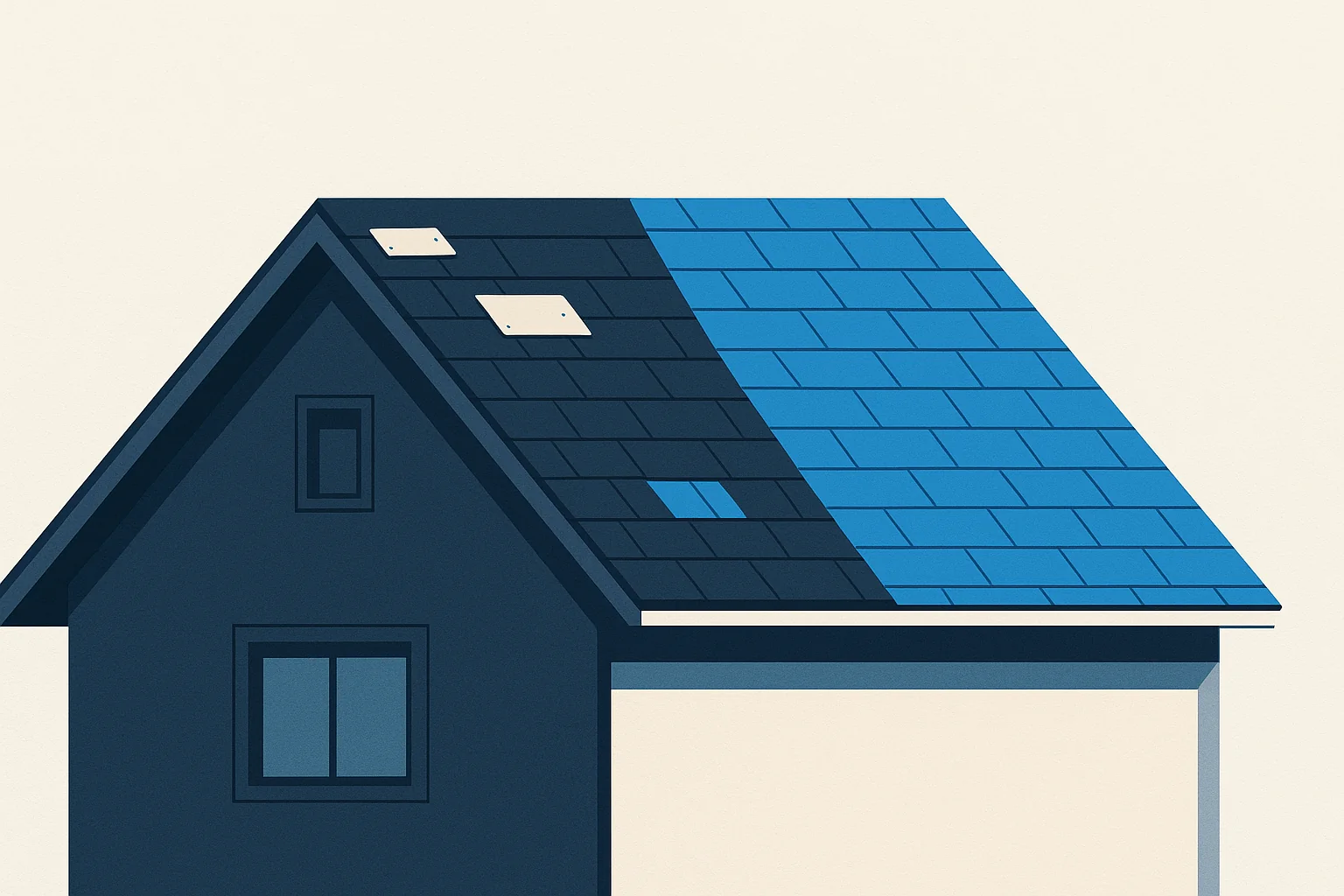

Every aging roof eventually forces the same question: keep repairing it, or replace it now. Most homeowners answer under pressure, right after a leak, with a contractor standing in the driveway. This article gives you a framework to answer it calmly, on evidence, before the pressure arrives. It is a companion to our complete roof replacement decision guide, which covers the full project once replacement wins the argument.
In This Guide
- Start With Evidence, Not Opinions
- The Four Questions That Decide It
- Putting It Together: Three Common Scenarios
- Roof Repair or Replace: The Honest Case for Each Path
- Repair, Planned Replacement, and Forced Replacement Compared
- What to Verify in a Roof Assessment Report
- Get the Evidence First
- Frequently Asked Questions
Transit & Flow Group coordinates projects and partners with properly licensed and insured specialty contractors when licensing is required. The framework below is the same one we walk through with homeowners before recommending either path.
Start With Evidence, Not Opinions
The repair-or-replace call rests on three facts you can establish: the age of the roof relative to its material lifespan, the condition of the deck underneath, and the pattern of failures so far. All three come from a documented inspection with photos, not from a glance at the shingles from the street. Insist on seeing the photos. A recommendation without evidence is a sales pitch, whichever direction it points.
The Four Questions That Decide It
Question One: How Localized Is the Damage?
Walk the perimeter of your home and look at each roof slope separately. Damage confined to one slope, one valley, or one flashing point argues for repair. Damage that shows up on multiple slopes, or the same class of failure repeating in different places, argues that the whole system is reaching the end together. A roof rarely wears out one shingle at a time. When granule loss, lifting, and cracking appear in several areas at once, the material itself is done, and every repair from that point is a payment on a roof you will replace anyway.
Question Two: Is the Deck Dry and Sound?
The wood deck under the shingles is the dividing line between a surface problem and a structural one. From inside the attic, look for water staining on the underside of the roof boards, dark streaks running down rafters, compressed or damp insulation, and any daylight showing through. A dry, solid deck keeps repair on the table. A spongy deck, visible rot, or repeated staining in new places moves the conversation to replacement, because the damage you can see from the attic is rarely the whole of it. The Insurance Institute for Business and Home Safety’s roof research is blunt on this point: the system under the shingles determines how a roof performs, and a compromised deck compromises everything above it.
Question Three: What Is the Repair History Telling You?
Pull out your records and count. One repair in a decade is maintenance. Two repairs in the same area is a warning that the first repair treated a symptom. Three or more repairs in a few years is a trend line, and trend lines do not reverse on their own. There is a useful way to think about this: every dollar spent repairing a roof in its final years buys less time than the same dollar spent earlier, because the surrounding material keeps degrading around each patch. When repairs get closer together, the roof is amortizing itself in front of you.
Question Four: How Much Life Is Left on the Clock?
Age is not the whole story, but it sets the frame. A ten-year-old architectural shingle roof with one flashing leak deserves a repair, because there is real service life left to protect. The same leak on the same roof at year twenty-two deserves harder questions, because the repair protects very little. Central Ohio’s freeze-thaw winters and storm-capable summers, documented season after season by the National Weather Service office covering our region, push most roofs toward the earlier end of their published lifespan ranges. When the roof is within a few years of its realistic end, replacement stops being the expensive option and starts being the honest one.
Putting It Together: Three Common Scenarios
The young roof with a single fault. A wind event lifted a patch of shingles on one slope, or a pipe boot has cracked. The deck is dry, the roof has most of its life ahead, and there is no repair history. Repair, with matching materials, and keep the documentation. This is exactly what repair is for.
The middle-aged roof at a crossroads. The roof is past its halfway point. There have been two repairs in five years, and the inspection finds wear that is general but not yet failure. This is the scenario where honest advice matters most. The right answer is usually a planned replacement on your schedule, one to three years out, with minor repairs bridging the gap. Planning the replacement while the roof still works means you choose the contractor, the material, and the season, instead of the roof choosing them for you during a February leak.
The old roof asking for one more patch. The roof is at or past its expected life, repairs are recurring, and the deck shows moisture history. Stop repairing. Each additional patch spends money that should go toward the replacement, and every winter the roof stays on is a season of risk to the structure, the insulation, and the interior underneath it.
Roof Repair or Replace: The Honest Case for Each Path
Repair is underrated by contractors who profit from replacement, and replacement is underrated by homeowners who dread the cost. Both biases cost money. A good repair on a roof with life left is one of the best values in home ownership. A stubborn series of repairs on a finished roof is one of the worst. The framework above exists to tell you which one you are actually buying, and the deciding evidence is always the same: the spread of the damage, the state of the deck, the repair history, and the clock.
Permits matter on the replacement path: roof replacement in Columbus requires one, and surrounding jurisdictions set their own rules, so verify your address with the City of Columbus permit office or your local building department. Repairs generally sit below permit thresholds, but the rules are local and worth a phone call when the repair is substantial.
Repair, Planned Replacement, and Forced Replacement Compared
There are really three outcomes available to an aging roof, and only two of them are chosen. The table below sets them side by side on the terms that actually differ.
| Path | When it is the right call | Who controls the timing | What it leaves behind |
|---|---|---|---|
| Targeted repair | Damage confined to one slope or detail, dry deck, real service life remaining | You, within a normal scheduling window | Documentation and a roof that keeps its remaining life |
| Planned replacement | General wear past the halfway point, repairs clustering, deck still sound | You, across a season or more of lead time | Choice of contractor, material, and season, plus a clean warranty start |
| Forced replacement | Active intrusion on a roof at or past its expected life | The weather and the failure | Interior and insulation damage to resolve alongside the roof itself |
Between the first two, the recommendation is straightforward. If the evidence puts you in the middle-aged band, choose planned replacement and treat the interim repairs as a bridge with a known end date. A planned replacement gives up a little remaining service life. A forced one gives up the contractor, the material, the season, and usually the interior underneath.
What to Verify in a Roof Assessment Report
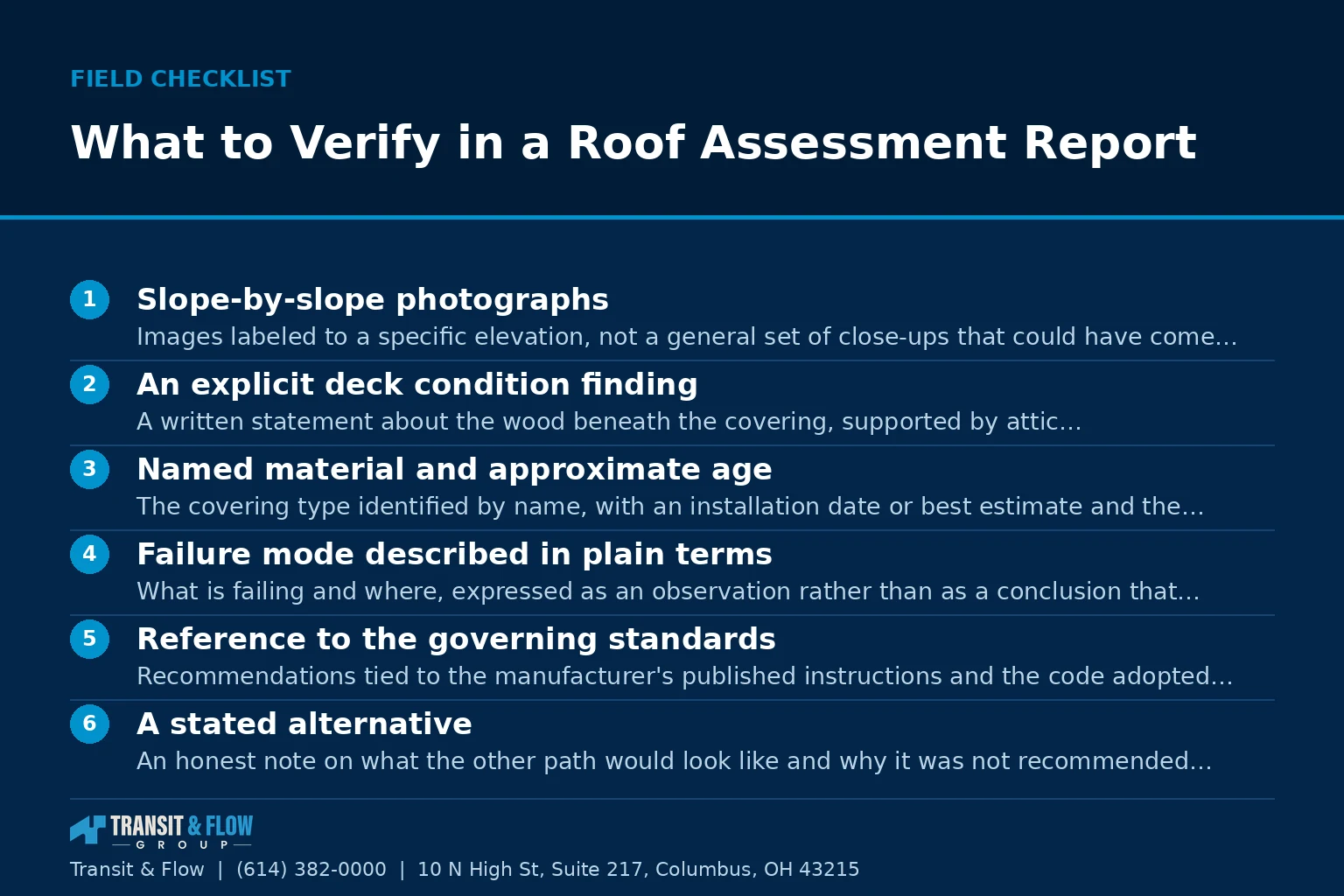
The assessment is the evidence the framework rests on, so read it closely rather than skimming to the recommendation. These elements separate a documented evaluation from a proposal wearing an inspection’s clothes.
- Slope-by-slope photographs. Images labeled to a specific elevation, not a general set of close-ups that could have come from any roof, so you can tell whether damage is localized or spread.
- An explicit deck condition finding. A written statement about the wood beneath the covering, supported by attic observations, rather than silence on the one factor that decides surface versus structural.
- Named material and approximate age. The covering type identified by name, with an installation date or best estimate and the basis for it, since the clock only means something once the material is known.
- Failure mode described in plain terms. What is failing and where, expressed as an observation rather than as a conclusion that happens to match a proposal.
- Reference to the governing standards. Recommendations tied to the manufacturer’s published instructions and the code adopted by your jurisdiction, with permit and inspection questions routed to the building department rather than answered in the report.
- A stated alternative. An honest note on what the other path would look like and why it was not recommended, which is the fastest way to tell whether you are reading an evaluation or a pitch.
Get the Evidence First
Transit & Flow Group coordinates roofing assessments and projects across Columbus and Central Ohio through vetted specialty roofing contractors, with one point of contact from inspection through closeout. If your roof is somewhere in the middle of this framework, request a documented assessment. You will get the photos, the honest read on deck condition, and a recommendation you can hold us to, whichever path it points down.
Frequently Asked Questions
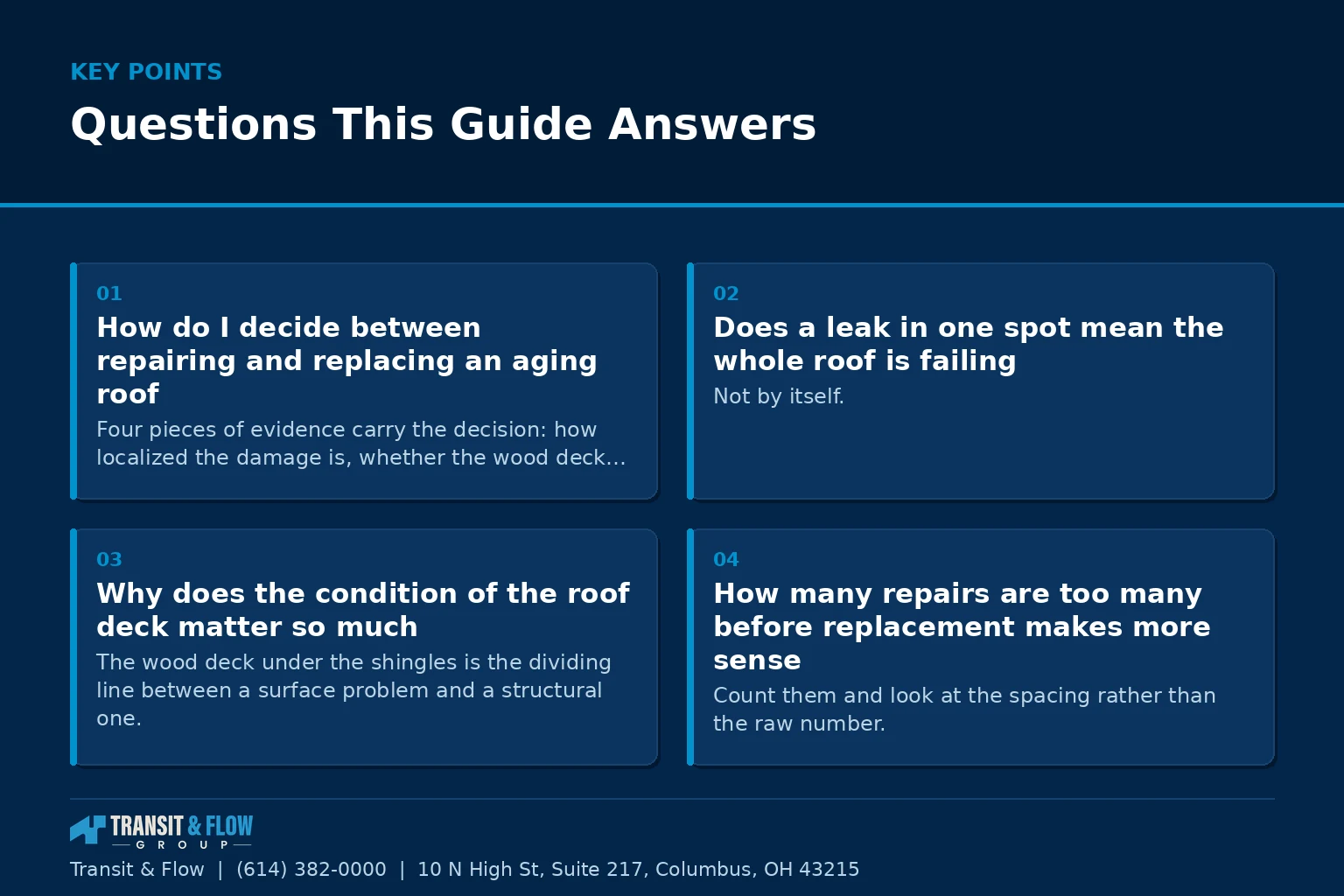
How do I decide between repairing and replacing an aging roof?
Four pieces of evidence carry the decision: how localized the damage is, whether the wood deck underneath is dry and sound, what the repair history shows, and how much service life the material has left. Each of those should come from a documented inspection with photographs, not from a look at the shingles from the street. When damage is confined to one slope or one flashing point on a roof with real life left, repair is usually the right call. When the same class of failure repeats across multiple slopes on an older roof, the system is finishing together and further repairs buy very little.
Does a leak in one spot mean the whole roof is failing?
Not by itself. A single fault on a young roof, such as a wind-lifted patch of shingles or a cracked pipe boot, is exactly what repair exists for. The signal to watch is repetition and spread. When granule loss, lifting, and cracking appear in several areas at once, or the same failure keeps showing up in different places, the material itself is at the end of its service life rather than suffering an isolated injury.
Why does the condition of the roof deck matter so much?
The wood deck under the shingles is the dividing line between a surface problem and a structural one. A dry, solid deck keeps repair on the table. Staining on the underside of the roof boards, dark streaks down rafters, damp insulation, or daylight showing through are the observations that move the conversation toward replacement, because what is visible from the attic is rarely the full extent of it. Anything you notice in the attic is worth documenting and handing to a qualified roofing professional for assessment rather than interpreting on your own.
How many repairs are too many before replacement makes more sense?
Count them and look at the spacing rather than the raw number. One repair in a decade is ordinary maintenance. Two repairs in the same area suggests the first one treated a symptom. Three or more in a few years is a trend line, and repairs on a roof in its final years buy less time than the same work would have bought earlier, because the surrounding material keeps degrading around every patch.
Do I need a permit to replace a roof in Central Ohio?
Roof replacement in Columbus requires a permit, and the surrounding jurisdictions set their own rules, so the only reliable answer comes from verifying your specific address with the City of Columbus permit office or your local building department. Repairs generally sit below permit thresholds, but the thresholds are local and a substantial repair is worth a phone call before work starts. Treat any permit answer given to you by a contractor as something to confirm with the authority rather than as settled.
Is it better to plan a replacement in advance or wait until the roof fails?
Planning ahead is almost always the stronger position. A roof that is past its halfway point with a couple of repairs behind it and general wear is the classic case for a planned replacement one to three years out, with minor repairs bridging the gap. Deciding on your own schedule means you choose the contractor, the material, and the season. Waiting until a February leak forces the issue hands all three choices to the weather.
Sources
- Insurance Institute for Business and Home Safety, roof system performance research
- National Roofing Contractors Association, installation and repair standards
- City of Columbus Building and Zoning Services, permit requirements
- National Weather Service, Wilmington Ohio office, regional storm climatology
About This Guide
Written and edited by Micheal Parker, founder of Transit & Flow Group. Published August 9, 2026. This guide is checked against the agency and code sources listed above, and it is revised when those sources change.
General contractor of record. Micheal Parker holds City of Columbus General Contractor Registration G12064, issued by the Columbus Department of Building and Zoning Services under Transit & Flow LLC and valid through June 30, 2027. Trade work that falls outside the scope of that registration is performed by licensed trade partners, and the responsible license holder is identified before work begins.
Transit & Flow Group, home and commercial services for Columbus and the surrounding Central Ohio communities. Phone (614) 382-0000. Email solutions@transitflowgroup.com. 10 N. High St., Suite 217, Columbus, OH 43215. Contact our team or review the communities we serve.
