


Anyone can print a card that says licensed and insured. Verifying it takes about twenty minutes, costs nothing, and is the single highest-return thing a homeowner can do before signing a contract. This guide walks through exactly what to check, where the public records live, what Ohio actually licenses at the state level versus what your city handles, and the specific documents to request before any money changes hands.
In This Guide
- How Contractor Licensing Works in Ohio
- The Verification Sequence
- Reading a Certificate of Insurance
- Warning Signs Worth Acting On
- What Your Contract Should Contain
- A Glossary Worth Keeping
- Where Transit & Flow Group Fits
- Frequently Asked Questions
Transit & Flow Group coordinates projects and partners with properly licensed and insured specialty contractors when licensing is required.
How Contractor Licensing Works in Ohio
The most common homeowner misunderstanding is assuming there is one contractor license. There is not. Ohio operates on a split model, and knowing which half applies to your project determines where you look.
At the state level, the Ohio Construction Industry Licensing Board licenses specific specialty trades, including electrical, plumbing, HVAC, hydronics, and refrigeration. These are the trades where a licensed contractor is required for commercial work statewide, and the state maintains a searchable license roster.
Below that, individual municipalities and counties impose their own registration, licensing, bonding, and permitting requirements, and these vary considerably across Central Ohio. A contractor properly registered in one jurisdiction is not automatically authorized in the next one over. General contracting and many trades outside the state-licensed specialties are regulated at this local level, or in some jurisdictions not licensed at all.
This article describes the general structure for planning purposes and is not legal advice. Requirements change, and they differ by jurisdiction and by scope of work. Confirm what applies to your specific project with the state board and with the building department where the property sits.
The Verification Sequence
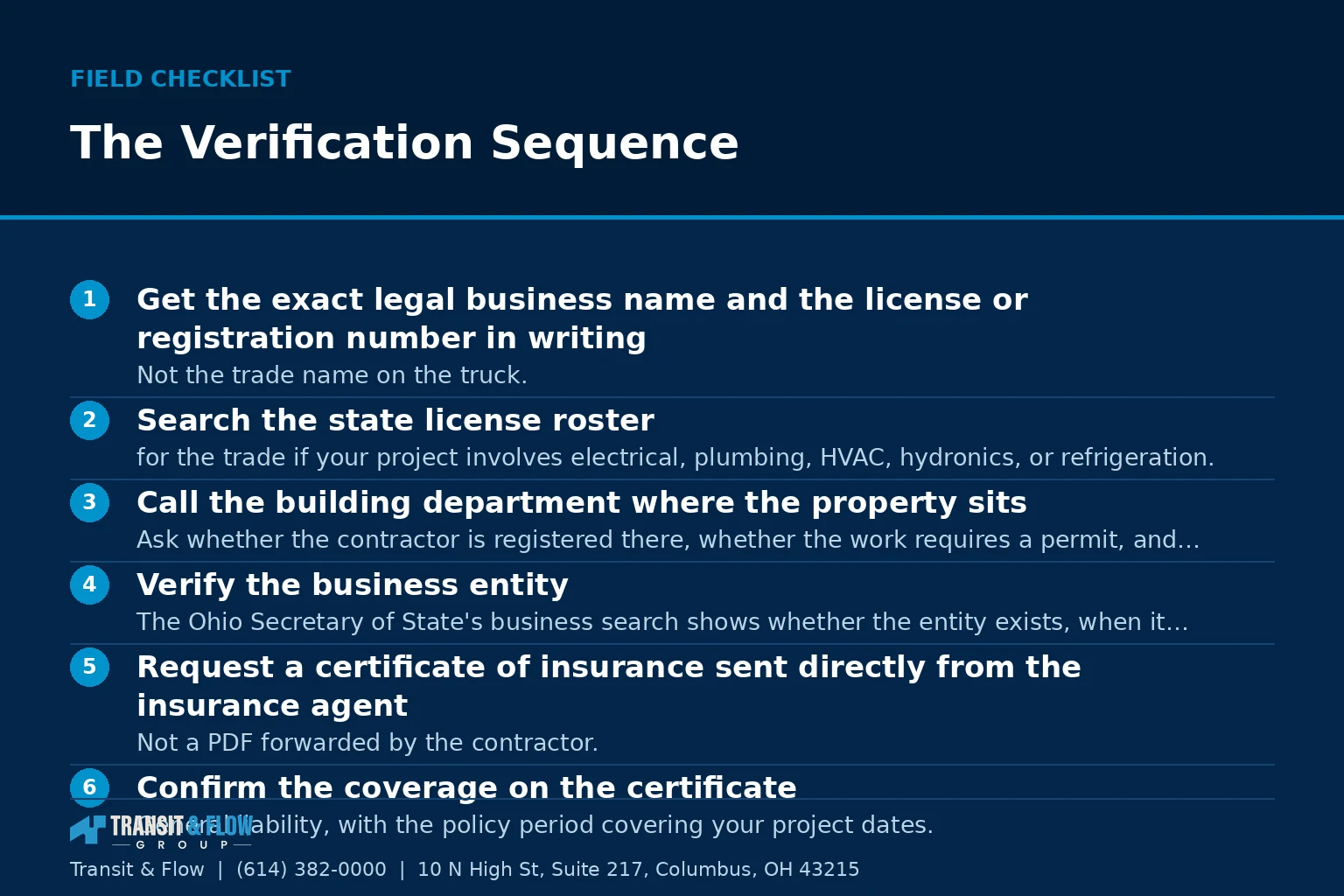
- Get the exact legal business name and the license or registration number in writing. Not the trade name on the truck. The name on the contract. If these do not match, resolve that before going further.
- Search the state license roster for the trade if your project involves electrical, plumbing, HVAC, hydronics, or refrigeration. Confirm the license is active, confirm the name matches, and note the expiration date.
- Call the building department where the property sits. Ask whether the contractor is registered there, whether the work requires a permit, and whether they will pull it. This one call surfaces more problems than any other step.
- Verify the business entity. The Ohio Secretary of State’s business search shows whether the entity exists, when it was formed, and whether it is in good standing. A company formed six weeks ago is not disqualifying, and it is information you should have.
- Request a certificate of insurance sent directly from the insurance agent. Not a PDF forwarded by the contractor. Ask the agent to email it to you and to list you as a certificate holder. This is standard practice and no legitimate agent will find it unusual.
- Confirm the coverage on the certificate. General liability, with the policy period covering your project dates. Workers compensation coverage for anyone who will be on your property. Verify Ohio workers compensation status through the Bureau of Workers Compensation coverage lookup.
- Check the public complaint and legal record. The Ohio Attorney General’s consumer complaint database, your county clerk of courts for civil filings, and the Better Business Bureau. Patterns matter more than any single entry.
- Ask for and actually call three recent references, specifically for work similar to yours, completed within the last year.
Reading a Certificate of Insurance
Most homeowners glance at a certificate and see that it exists. What matters is on the page and takes a minute to read.
- The named insured, matched exactly against the entity on your contract. A certificate for a related but different company protects you from nothing.
- The policy period, checked against the dates your work will actually happen, including likely delays.
- General liability limits. Both per occurrence and aggregate. The aggregate applies across all claims in the period, not just yours.
- Workers compensation. If a worker is injured on your property and there is no coverage, the exposure can reach you. This line matters more than most homeowners realize.
- Subcontractors. Ask directly whether subs will be used and whether they carry their own coverage. Then ask for their certificates too.
- The producer. The agency name and phone number are on the certificate. Call it. Verification takes two minutes.
Warning Signs Worth Acting On
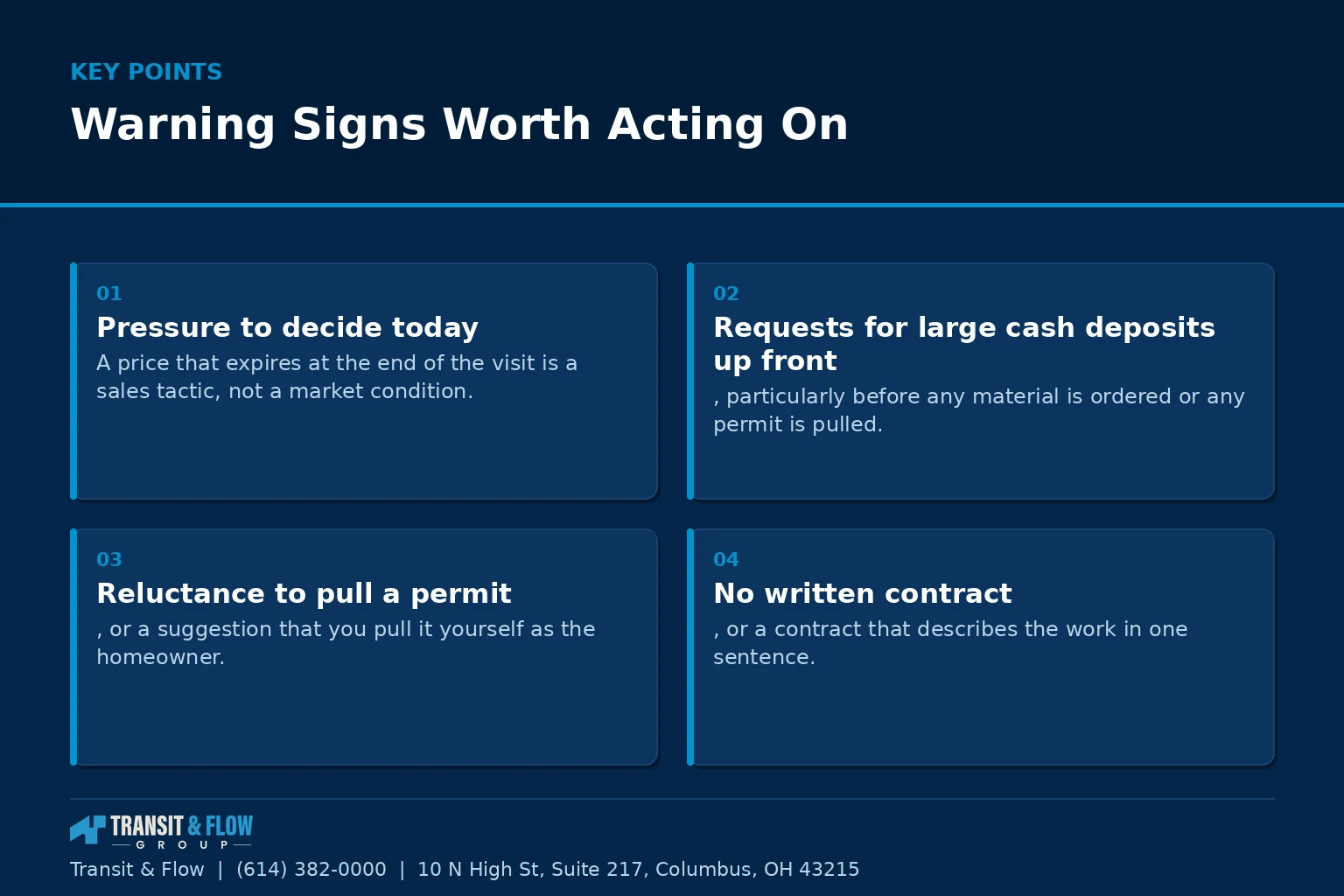
- Pressure to decide today. A price that expires at the end of the visit is a sales tactic, not a market condition.
- Requests for large cash deposits up front, particularly before any material is ordered or any permit is pulled.
- Reluctance to pull a permit, or a suggestion that you pull it yourself as the homeowner. Pulling your own permit shifts responsibility for code compliance onto you.
- No written contract, or a contract that describes the work in one sentence.
- A physical address that is a mailbox service, combined with a phone number that only reaches voicemail.
- Door-to-door solicitation after a storm, especially from a company with no local track record.
- An offer to absorb or waive your insurance deductible. This is not a discount and you should decline it.
- Refusal to provide the license number, the certificate, or references when asked directly and politely.
What Your Contract Should Contain
- Full legal business name, physical address, phone, and license or registration number.
- A scope of work specific enough that a stranger could read it and know what is being built, including materials by manufacturer and model where it matters.
- What is explicitly excluded. Exclusions prevent more disputes than inclusions do.
- Total price, and a payment schedule tied to milestones rather than to dates.
- Who pulls the permit and who schedules the inspection.
- Start date, substantial completion date, and what happens if either slips.
- Warranty terms: what is covered, for how long, by whom, and whether it transfers on sale.
- Change order process, in writing, with pricing agreed before any change is performed.
- Cleanup, debris removal, and site restoration.
- Lien waiver provisions, particularly for any subcontractors and suppliers.
- Any cancellation rights that apply under Ohio law to your type of transaction.
A Glossary Worth Keeping
- Certificate of insurance. A one-page summary of active coverage issued by the insurance agency. It is evidence, not the policy itself.
- Additional insured. A status extending certain policy protections to another party. Sometimes appropriate on larger projects, and worth asking about.
- Mechanic’s lien. A claim a contractor, subcontractor, or supplier can place against your property for unpaid work or materials, including in cases where you paid the general contractor and they did not pay the sub.
- Lien waiver. A signed release confirming a party has been paid and waives lien rights for that work. Collect these as you make payments.
- Registration versus licensing. Registration typically records who is working in a jurisdiction. Licensing typically involves demonstrated competency and examination. They are not the same protection.
- Bond. A financial guarantee some jurisdictions require. It protects against specific defined failures and is not general insurance.
Where Transit & Flow Group Fits
Transit & Flow Group coordinates projects across Columbus and Central Ohio and partners with properly licensed and insured specialty contractors when licensing is required, which means the verification described on this page is work we do before a trade partner ever reaches your property rather than work we leave to you. Whether the project is roofing, electrical, or drain and sewer, one coordinator carries it and the documentation comes to you. To start a project with that structure in place, request an assessment.
Frequently Asked Questions
Does Ohio issue one contractor license that covers everything?
No, and assuming otherwise is the most common homeowner misunderstanding. Ohio uses a split model in which the state licensing board handles specific specialty trades, including electrical, plumbing, heating and cooling, hydronics, and refrigeration, while municipalities and counties impose their own registration, licensing, bonding, and permitting rules on top of that. General contracting and many other trades are handled locally, or in some jurisdictions are not licensed at all. Which half applies to your project determines where you look, so confirm it with the state board and with the building department where the property sits.
Why should the certificate of insurance come from the agent rather than the contractor?
Because a forwarded document proves only that a document exists. Asking the agency to email the certificate directly and to list you as a certificate holder confirms the coverage is real and current on the day you are looking at it. This is ordinary practice and no legitimate agent will treat the request as unusual. The producer’s name and phone number are printed on the certificate itself, so the verification call takes about two minutes.
A contractor asked me to pull the permit myself. Is that a problem?
It is worth pausing on. Pulling your own permit shifts responsibility for code compliance from the contractor onto you as the homeowner, which is a meaningful change in who carries the risk. Ask directly why the request is being made, and take the answer to the building department where the property sits if it is not clear. That same call also establishes whether the contractor is registered in that jurisdiction and whether the work requires a permit at all.
Can a lien be placed on my house even if I paid the contractor in full?
Yes, which is why lien waivers appear on the contract checklist above. A mechanic’s lien is a claim that a contractor, subcontractor, or supplier can place against your property for unpaid work or materials, including situations where you paid the general contractor and the general contractor did not pay the subcontractor or supplier. A lien waiver is the signed release confirming a party has been paid and gives up lien rights for that work. Collect those waivers as you make payments rather than after the project closes.
Is registration the same thing as licensing?
No, and the difference matters when you are deciding how much comfort to take from a number on a business card. Registration typically records who is working in a jurisdiction. Licensing typically involves demonstrated competency and examination. A bond is a third and separate thing, a financial guarantee some jurisdictions require that protects against specific defined failures rather than acting as general insurance. Confirm which of the three you are actually looking at before treating it as verification.
Should I accept an offer to absorb or waive my insurance deductible?
Decline it. This article lists that offer among the warning signs worth acting on, alongside pressure to decide the same day, large cash deposits requested before materials are ordered or a permit is pulled, and door-to-door solicitation after a storm. None of those are discounts, and each one tends to travel with other problems. If a contractor also refuses to provide a license number, a certificate, or references when asked directly, treat the pattern rather than the single item as your answer.
Sources
- Ohio Construction Industry Licensing Board, state specialty trade licensing
- Ohio Secretary of State, business entity search
- Ohio Bureau of Workers Compensation, employer coverage lookup
- Ohio Attorney General, consumer complaint resources
- City of Columbus, Get a Permit, permit application channels
About This Guide
Written and edited by Micheal Parker, founder of Transit & Flow Group. Published September 30, 2026. This guide is checked against the agency and code sources listed above, and it is revised when those sources change.
General contractor of record. Micheal Parker holds City of Columbus General Contractor Registration G12064, issued by the Columbus Department of Building and Zoning Services under Transit & Flow LLC and valid through June 30, 2027. Trade work that falls outside the scope of that registration is performed by licensed trade partners, and the responsible license holder is identified before work begins.
Transit & Flow Group, home and commercial services for Columbus and the surrounding Central Ohio communities. Phone (614) 382-0000. Email solutions@transitflowgroup.com. 10 N High St, Suite 217, Columbus, OH 43215. Contact our team or review the communities we serve.
