

Every property owner eventually faces the same choice: pay a little on a planned schedule, or pay a lot when a system fails at the worst possible moment. From where I sit on the business side of Transit & Flow, the math is rarely close. A preventive maintenance agreement Central Ohio owners rely on turns unpredictable emergency spending into a calm, budgeted line item, and it keeps your buildings running while your competitors are waiting on a callback. This guide walks through why planned maintenance wins on cost, risk, and peace of mind for commercial and residential portfolios alike.
In This Guide
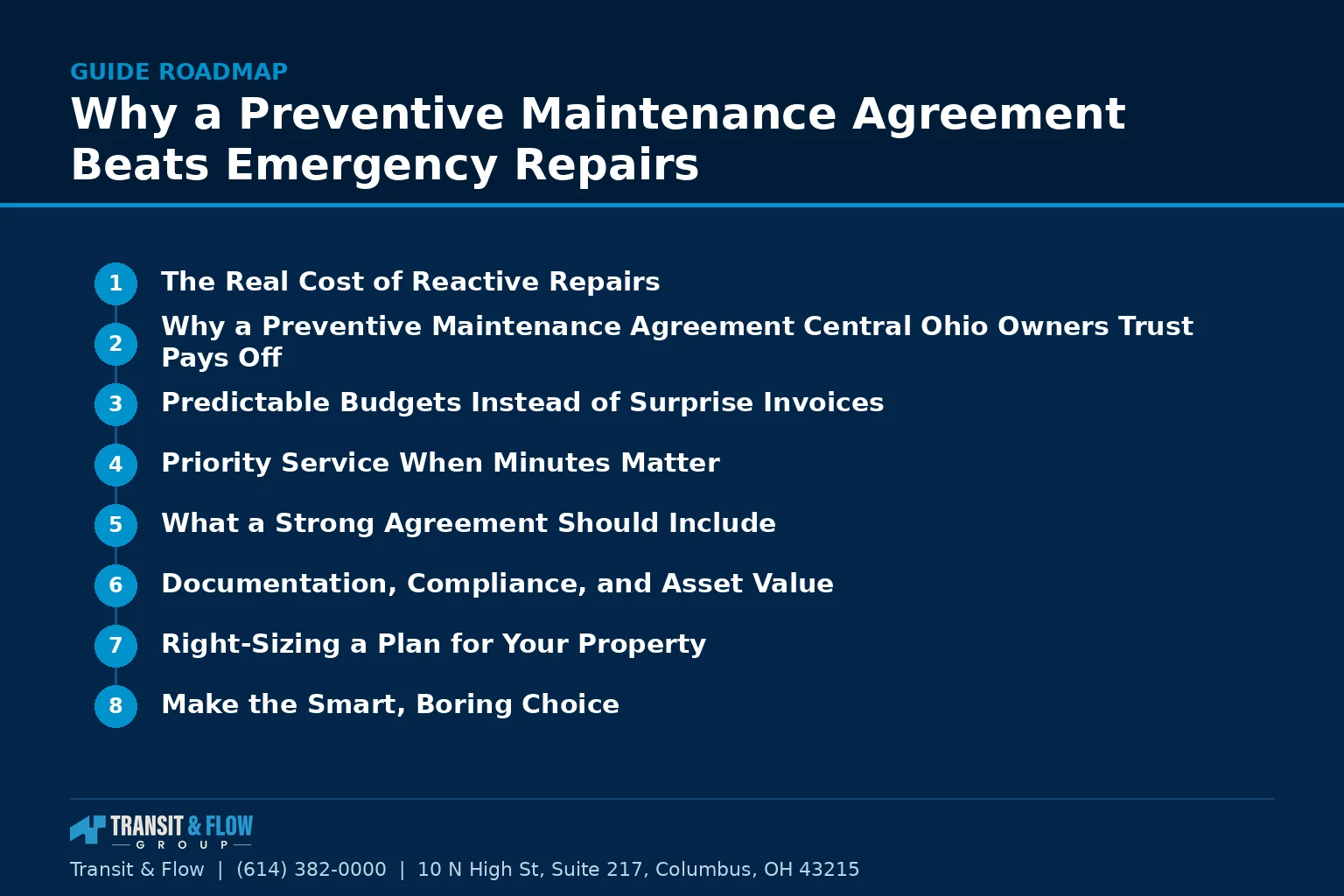
- The Real Cost of Reactive Repairs
- Why a Preventive Maintenance Agreement Central Ohio Owners Trust Pays Off
- Predictable Budgets Instead of Surprise Invoices
- Priority Service When Minutes Matter
- What a Strong Agreement Should Include
- Documentation, Compliance, and Asset Value
- Right-Sizing a Plan for Your Property
- Make the Smart, Boring Choice
- What Goes Wrong and Why
- Two Ways to Structure Coverage
- Central Ohio Timing and Seasonal Load
- Frequently Asked Questions
- Sources
- Related Transit & Flow Services
The Real Cost of Reactive Repairs
Emergency repairs are expensive in ways that never show up on the invoice alone. When a rooftop unit quits during a July heat wave in Dublin or a boiler fails on a January morning in Westerville, you pay premium after-hours rates, you pay for rushed parts sourcing, and you pay in tenant frustration and lost productivity. A failure that a routine inspection would have caught can easily become a full replacement plus collateral water or electrical damage. Reactive work also compounds: deferred issues rarely stay small, and one neglected system often drags down the ones connected to it.
The hidden cost is your time. Chasing down an available contractor, comparing quotes under pressure, and explaining the same building history to a stranger every time is a tax on your operation. That is precisely the drag a planned relationship removes.
Why a Preventive Maintenance Agreement Central Ohio Owners Trust Pays Off
A preventive maintenance agreement flips the model from reacting to preventing. Instead of waiting for equipment to break, our technicians visit on a set cadence, inspect every critical system, and correct small problems before they escalate. Across HVAC, plumbing, and electrical, the pattern is consistent: clean coils and fresh filters cut energy use, tightened connections prevent electrical faults, and early leak detection stops water damage before it spreads. A well-run preventive maintenance agreement Central Ohio wide typically returns far more than it costs once you factor in avoided failures and lower utility bills.
Just as important, planned care extends the usable life of expensive assets. Equipment that is serviced on schedule routinely outlasts neglected equipment by years, which pushes major capital expenses further into the future and improves the return on every system you own.
Predictable Budgets Instead of Surprise Invoices
Ask any facilities director or homeowner what they hate most, and it is the unbudgeted surprise. A maintenance contract Columbus property teams can rely on converts that volatility into a known, level cost you can plan around. You know what you are spending, when the visits happen, and what is covered. For commercial portfolios, that predictability strengthens net operating income forecasts and makes capital planning far more accurate. For homeowners, it means no scrambling when the furnace picks the coldest night of the year to fail.
Predictable spending also improves negotiating leverage. When you commit to planned maintenance Ohio wide across multiple properties, you unlock better pricing than one-off emergency calls could ever deliver.
Priority Service When Minutes Matter
Agreements are not only about prevention. When something does go wrong, contract customers move to the front of the line. Priority scheduling means a Transit & Flow technician is dispatched to you first, not after every walk-in request in the queue. During peak season, when demand spikes across Hilliard, Gahanna, and Grove City, that difference can be the gap between a two-hour response and a two-day wait. For a commercial tenant whose storefront depends on cooling, or a landlord whose tenant has no heat, response time is everything.
What a Strong Agreement Should Include
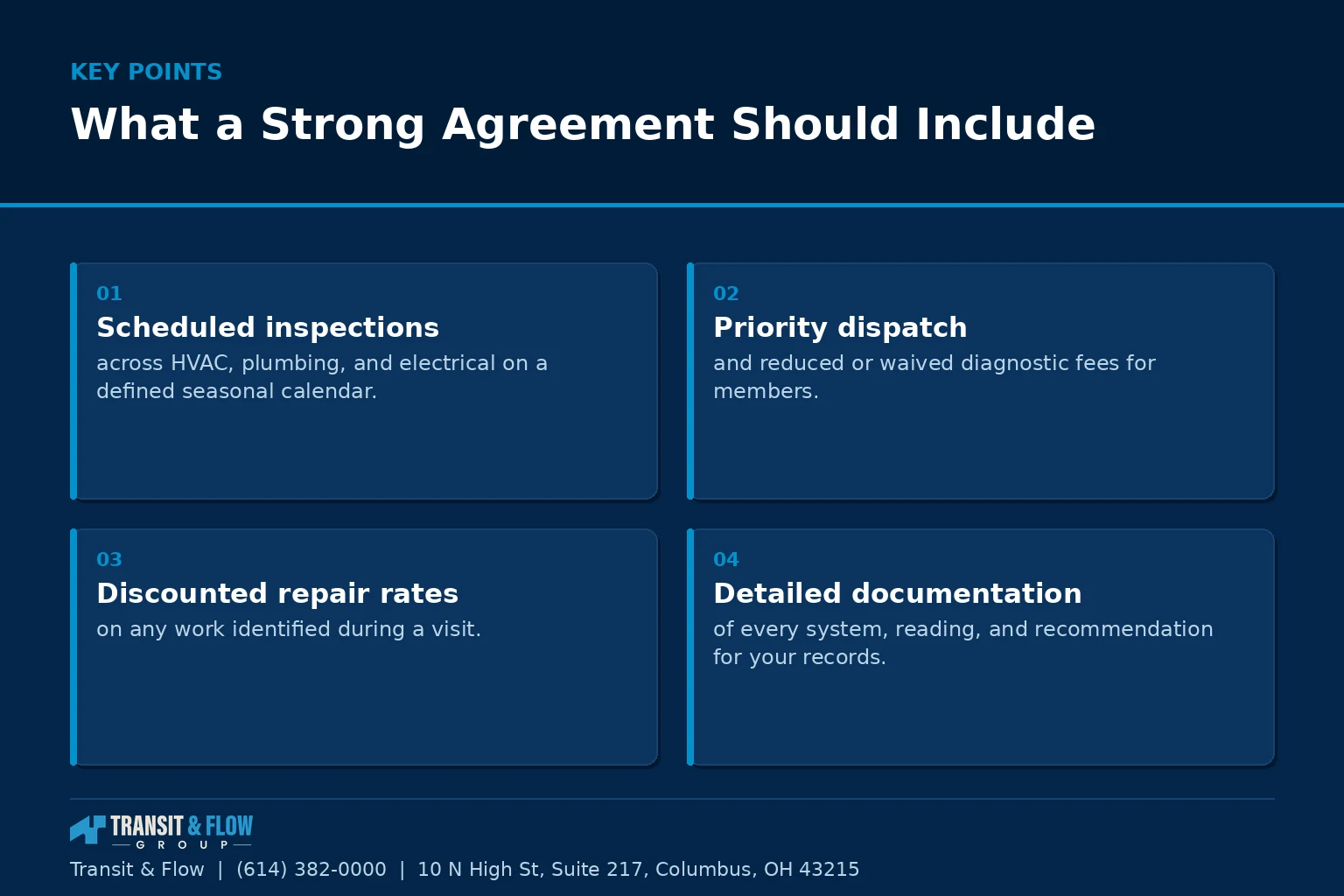
Not all plans are created equal. A quality agreement is transparent about scope, cadence, and what happens when repairs are needed. When you evaluate options, look for these elements:
- Scheduled inspections across HVAC, plumbing, and electrical on a defined seasonal calendar.
- Priority dispatch and reduced or waived diagnostic fees for members.
- Discounted repair rates on any work identified during a visit.
- Detailed documentation of every system, reading, and recommendation for your records.
- Tiered options so a single home and a multi-building portfolio each get a right-sized plan.
- One accountable partner for every trade, so nothing falls through the cracks between vendors.
That last point matters more than most owners expect. Consolidating trades under one agreement removes the finger-pointing that happens when separate contractors each blame the other for an issue.
Documentation, Compliance, and Asset Value
For commercial owners, the paper trail a planned program creates is an asset in itself. Consistent service records support warranty claims, satisfy insurance and safety requirements, and demonstrate diligence during audits or a sale. A building with a documented maintenance history commands more confidence, and often a better price, than one with a folder full of emergency receipts. Even for homeowners, clean records make a future sale smoother and prove the systems were cared for. This is how disciplined maintenance quietly protects the value of the property itself, and it is a big reason so many owners choose to reduce emergency repairs before they ever happen.
Right-Sizing a Plan for Your Property
The best agreement fits the building, not a template. A single-family rental in Pickerington needs a very different cadence than a multi-tenant office in Upper Arlington or a retail strip in Worthington. Our team starts by assessing the age and condition of your systems, your risk tolerance, and your budget, then recommends a plan that covers what matters without paying for what does not. As portfolios grow across New Albany, Powell, and beyond, the plan scales with you, and the per-property cost usually improves. You can review the communities we cover on our service areas page, and dig deeper into seasonal readiness through our related guides.
Make the Smart, Boring Choice
Emergencies are exciting for all the wrong reasons. A preventive maintenance agreement Central Ohio owners can count on is the smart, boring choice that keeps your systems running, your budget steady, and your phone quiet on the coldest and hottest days of the year. Transit & Flow makes it simple to get started: visit our homepage for an instant estimate, or call (614) 382-0000 to talk through the right plan for your home, building, or portfolio. Let us handle the maintenance so you can get back to running your property with confidence.
Transit & Flow Group coordinates projects and partners with properly licensed and insured specialty contractors when licensing is required, and work is performed under the appropriate permits.
What Goes Wrong and Why
Agreements that disappoint owners usually went wrong at signing, not in the field. The scope was loose, the cadence was aspirational, or nobody agreed on what a visit should produce. These are the patterns worth watching for.
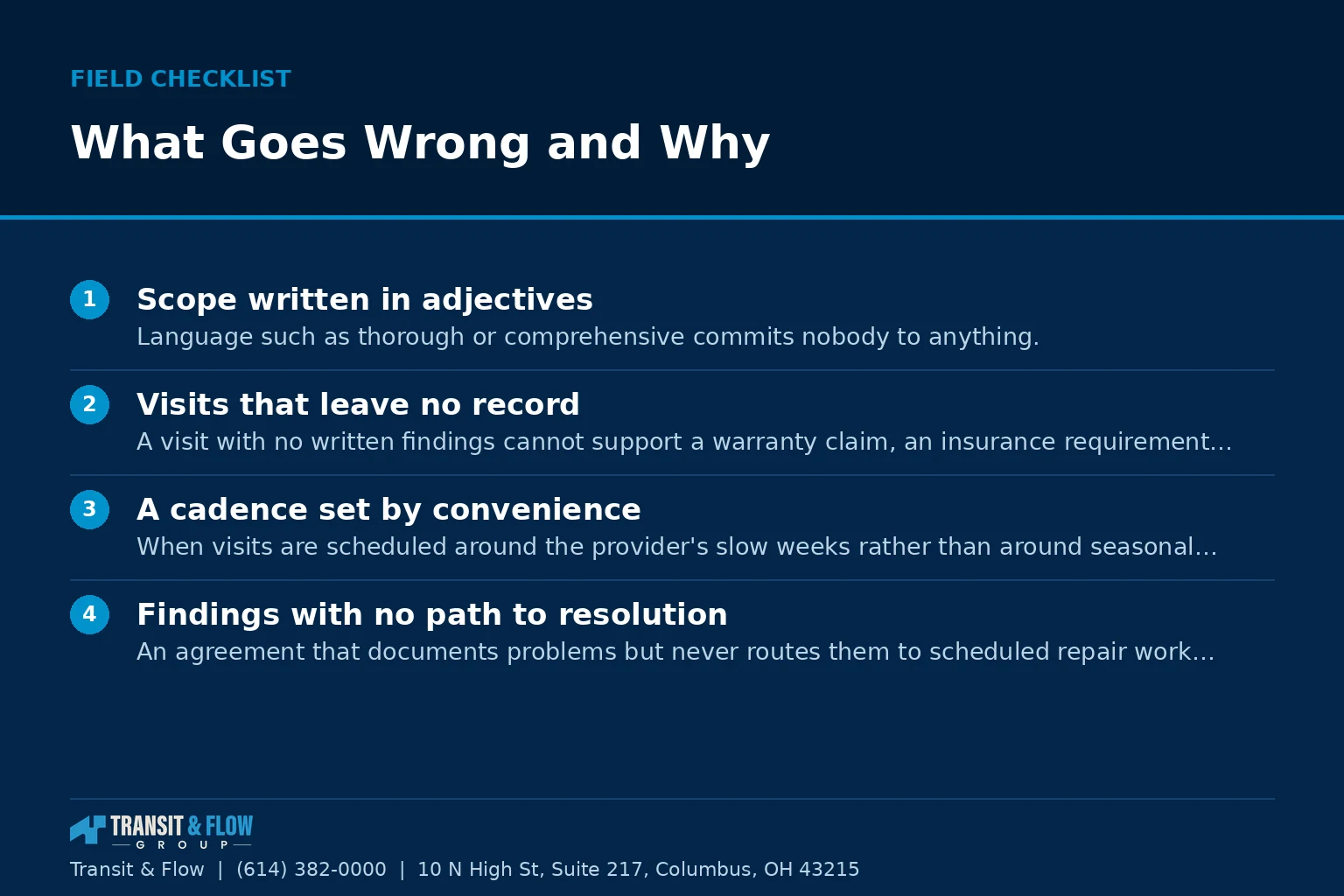
- Scope written in adjectives. Language such as thorough or comprehensive commits nobody to anything. Scope stated as named systems on a named calendar is enforceable.
- Visits that leave no record. A visit with no written findings cannot support a warranty claim, an insurance requirement, or a capital plan, which erases most of the reason to hold the agreement.
- A cadence set by convenience. When visits are scheduled around the provider’s slow weeks rather than around seasonal load, readiness work lands after the season it was meant to prepare for.
- Findings with no path to resolution. An agreement that documents problems but never routes them to scheduled repair work turns into a well-organized list of things nobody fixed.
Two Ways to Structure Coverage
Most owners are really choosing between two structures. Option A keeps separate agreements with a specialist for each trade. Option B places every trade under one agreement with a single accountable partner.
| Structure | Coordination effort | Building record | Best fit |
|---|---|---|---|
| Option A, separate trade agreements | Carried by you, one relationship at a time | Partial records held in several places | A single property with one dominant system and a hands-on owner |
| Option B, one multi-trade agreement | Carried by the partner, across every trade | One history covering the whole property | Any owner with multiple systems, multiple buildings, or limited time |
The recommendation is Option B for anything beyond a single simple property. The consolidated structure wins on the two things that decide whether an agreement pays for itself, which are a complete record of the building and one party who cannot deflect a problem to somebody else.
Central Ohio Timing and Seasonal Load
The calendar in this region is not evenly weighted. Cooling readiness work belongs in early spring, before the first stretch of sustained heat pulls every available technician into emergency dispatch. Heating and freeze protection work belongs in early fall, ahead of the first hard freeze rather than during it. Booked early, both are routine. Booked late, they compete with everyone else in the metro who waited. Shoulder seasons are also when occupant disruption is lowest, which is why a well-built agreement front-loads work there.
Frequently Asked Questions
What does a preventive maintenance agreement actually cover?
A strong agreement is explicit about scope and cadence rather than vague about both. This article describes scheduled inspections across heating and cooling, plumbing, and electrical on a defined seasonal calendar, priority dispatch, reduced or waived diagnostic fees, discounted rates on repairs identified during a visit, and written documentation of every system, reading, and recommendation. It also covers tiered options so a single home and a multi-building portfolio each get a right-sized plan. If a proposed agreement will not state those elements plainly, that is useful information on its own.
Is an agreement worth it for a single home, or only for a portfolio?
Both, for different reasons. A portfolio owner gains predictable spending that strengthens operating income forecasts and makes capital planning more accurate. A homeowner gains the far simpler benefit of not scrambling when the furnace picks the coldest night of the year to quit. The right plan is built around the age and condition of your systems and your tolerance for risk, not around a template, so the shape of the agreement differs even though the logic does not.
How is priority service different from a normal service call?
Priority scheduling puts contract customers ahead of the general queue rather than behind every walk-in request. During peak season, when demand spikes at the same moment across Hilliard, Gahanna, Grove City, and the rest of Central Ohio, that ordering is the difference between a same-day response and a multi-day wait. For a commercial tenant whose storefront depends on cooling, or a landlord whose tenant has no heat, that gap is the whole story. Prevention is the main point of an agreement, but response time is what you notice when something still goes wrong.
Why does maintenance documentation matter beyond the work itself?
The paper trail a planned program creates becomes an asset in its own right. Consistent service records support warranty claims, satisfy insurance and safety requirements, and demonstrate diligence during an audit or a sale. A building with a documented maintenance history inspires more confidence than one with a folder full of emergency receipts. The same holds for a house, where clean records make a future sale smoother and show that the systems were actually cared for.
Does planned maintenance really extend equipment life?
Equipment that is serviced on schedule routinely outlasts neglected equipment by years, and that difference is where most of the value sits. Clean coils and fresh filters reduce energy use, tightened connections prevent electrical faults, and early leak detection stops water damage before it spreads. Each of those is small on its own, and together they push major capital expense further into the future. That is the quiet argument for planned care rather than reactive repair.
What is the advantage of putting every trade under one agreement?
It removes the finger-pointing that happens when separate contractors each blame the other for the same problem. One accountable partner means the heating, plumbing, and electrical systems are inspected against a single record of the building rather than three partial ones. It also removes the hidden cost this article describes, which is your own time spent chasing an available contractor and re-explaining the building history to a stranger. Consolidation matters more than most owners expect until they have lived without it.
Sources
- ENERGY STAR, heating and cooling guidance
- Ohio Department of Commerce, Division of Industrial Compliance, licensing and code enforcement
- U.S. Department of Energy, Energy Saver home energy guidance
Related Transit & Flow Services
Every service below is delivered by the same accountable Transit & Flow team, so one call covers the whole property.
Serving Columbus and every community across Central Ohio. See the full service areas map, or get an instant estimate on the Transit & Flow homepage.
About This Guide
Written and edited by Micheal Parker, founder of Transit & Flow Group. Published August 17, 2026. This guide is checked against the agency and code sources listed above, and it is revised when those sources change.
General contractor of record. Micheal Parker holds City of Columbus General Contractor Registration G12064, issued by the Columbus Department of Building and Zoning Services under Transit & Flow LLC and valid through June 30, 2027. Trade work that falls outside the scope of that registration is performed by licensed trade partners, and the responsible license holder is identified before work begins.
Transit & Flow Group, home and commercial services for Columbus and the surrounding Central Ohio communities. Phone (614) 382-0000. Email solutions@transitflowgroup.com. 10 N High St, Suite 217, Columbus, OH 43215. Contact our team or review the communities we serve.
