

Rooftop units are the most neglected mechanical assets in commercial real estate, and the reason is structural rather than careless. They are out of sight, they are difficult to reach, they usually keep running while degrading, and nobody complains until the space is cold on the coldest morning of the year. That morning is also when every service provider in Central Ohio is fully booked. This playbook covers what to inspect before winter, what belongs in a service agreement, and how to build a replacement plan that is a schedule rather than a reaction. It extends our guidance on budgeting building maintenance.
In This Guide
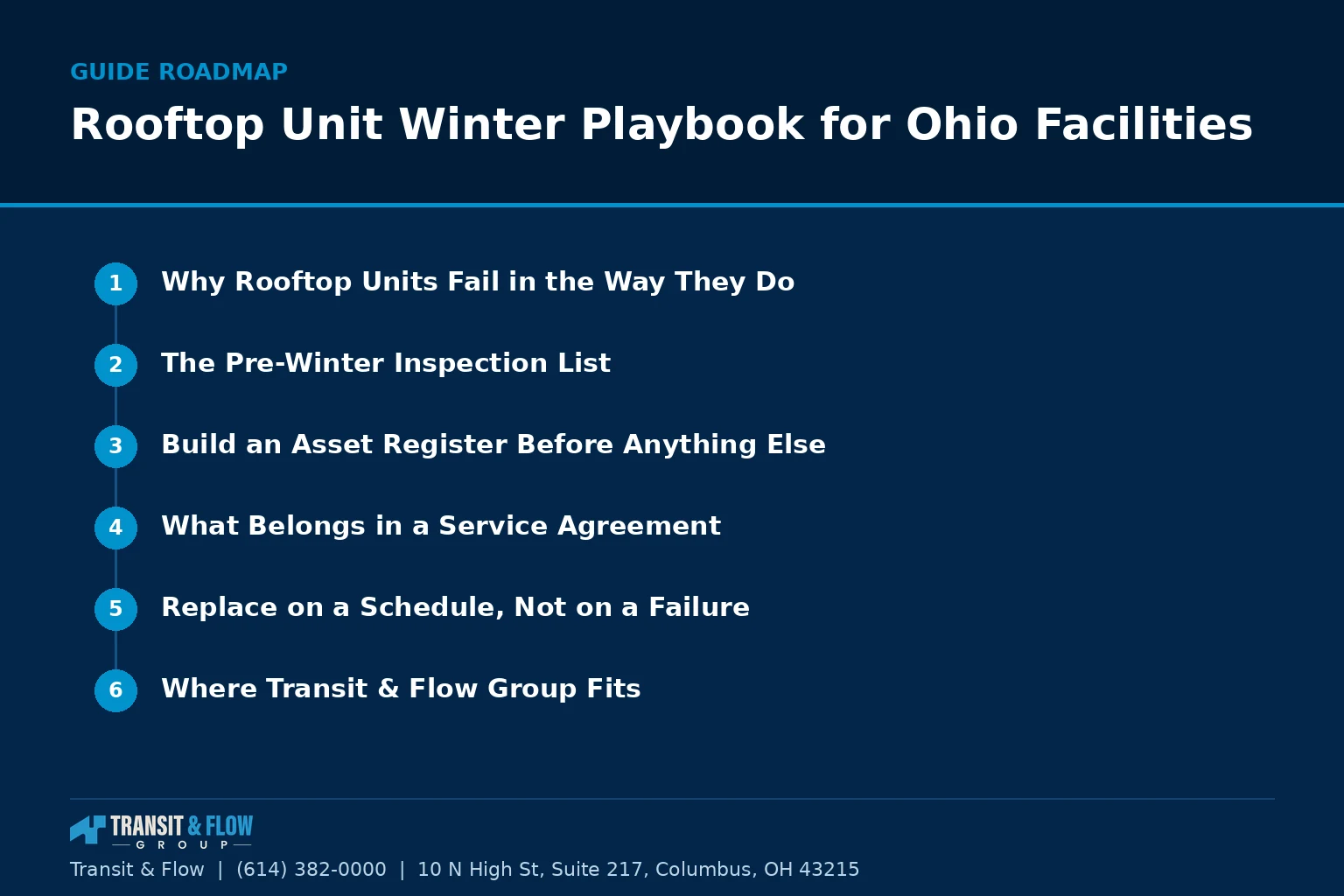
- Why Rooftop Units Fail in the Way They Do
- The Pre-Winter Inspection List
- Build an Asset Register Before Anything Else
- What Belongs in a Service Agreement
- Replace on a Schedule, Not on a Failure
- Where Transit & Flow Group Fits
- Frequently Asked Questions
Transit & Flow Group coordinates projects and partners with properly licensed and insured specialty contractors when licensing is required.
One boundary. Rooftop work involves fall exposure, electrical hazard, refrigerant handling that is federally regulated and requires certification, and gas-fired combustion equipment. This is planning and specification guidance for facility owners and managers. It is not instruction to service equipment. If a gas odor is reported, evacuate and call from outside.
Why Rooftop Units Fail in the Way They Do
A rooftop unit sits fully exposed. Its cabinet, its controls, its curb seal, and its gas train all age under direct weather while the tenant below experiences nothing until performance drops below tolerance. The result is a failure profile with two characteristics that matter for planning. Failures cluster at the seasonal changeover, when equipment that idled through a mild period is asked for full output. And failures cascade, because a unit that has run degraded for two seasons has usually stressed more than one component.
Both characteristics point the same direction. Condition is worth knowing in autumn, not in January, and it is worth knowing per unit rather than as a building average.
The Pre-Winter Inspection List
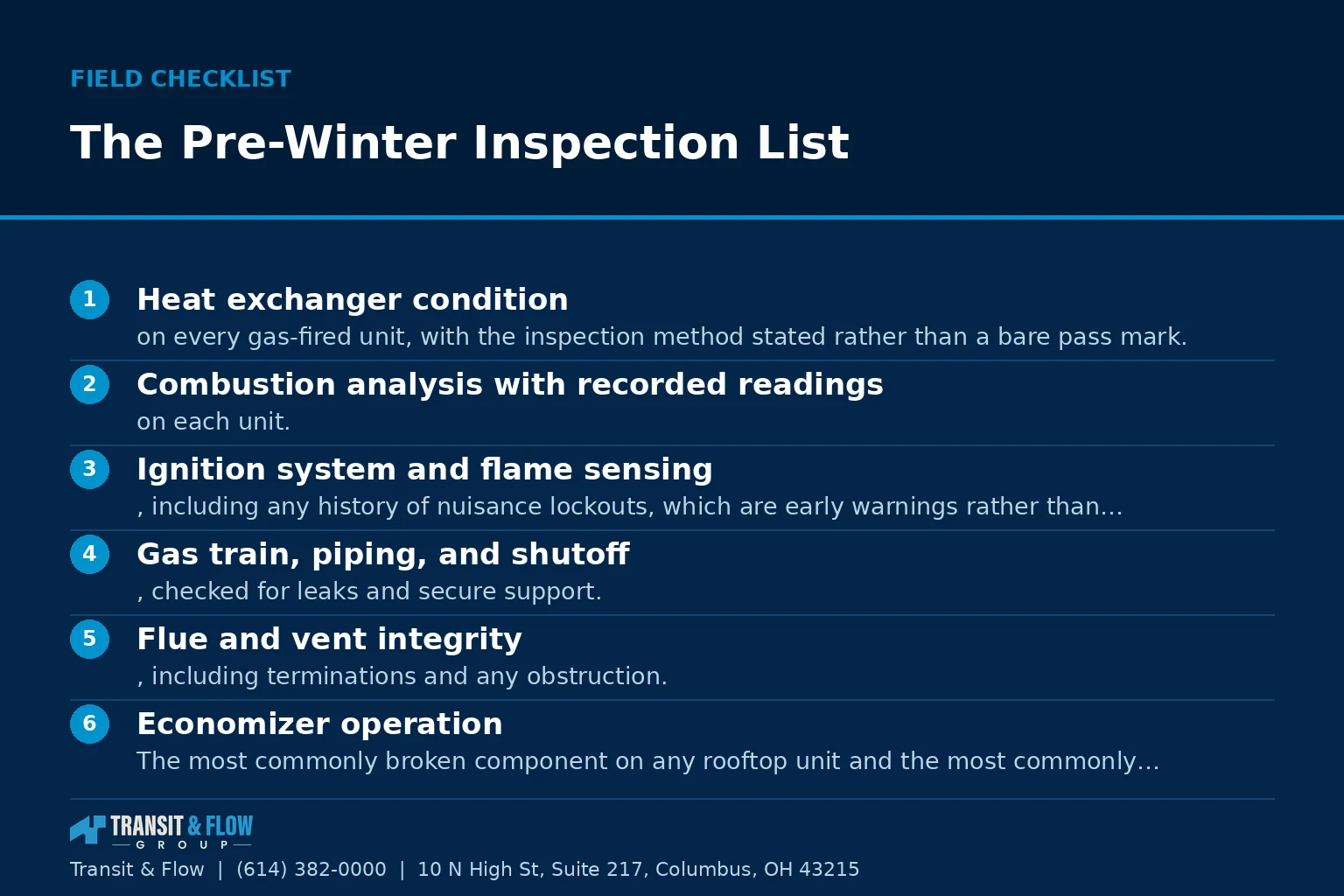
- Heat exchanger condition on every gas-fired unit, with the inspection method stated rather than a bare pass mark.
- Combustion analysis with recorded readings on each unit. These numbers are the year-over-year record that shows deterioration before it becomes an outage.
- Ignition system and flame sensing, including any history of nuisance lockouts, which are early warnings rather than nuisances.
- Gas train, piping, and shutoff, checked for leaks and secure support.
- Flue and vent integrity, including terminations and any obstruction.
- Economizer operation. The most commonly broken component on any rooftop unit and the most commonly ignored. A failed economizer stuck open in winter drives heating cost hard, and a failed one stuck closed wastes free cooling in shoulder seasons.
- Curb and flashing seal, checked for water entry, which damages controls and the roof deck simultaneously.
- Cabinet integrity and panel fasteners, since missing panels change airflow and expose components.
- Belts, bearings, and blower condition, with wear noted rather than only replaced items.
- Filter condition and the correct filter specification for each unit, documented per unit rather than assumed uniform.
- Condensate drainage and freeze protection, including trap condition and heat trace where present.
- Electrical connections, contactors, and disconnects, thermally scanned where practical. Loose connections announce themselves under load before they fail. Where units share aging distribution, an electrical assessment belongs in the same visit.
- Controls, sensors, and thermostat schedules, verified against how the space is actually occupied rather than against how it was occupied when the schedule was written.
- Roof access safety, including ladder condition, hatch, walkway pads, and clearance around each unit.
Build an Asset Register Before Anything Else
Most commercial buildings in Central Ohio cannot answer basic questions about their own rooftop equipment, and every downstream decision depends on those answers. Before scheduling service, build a single row per unit containing the following.
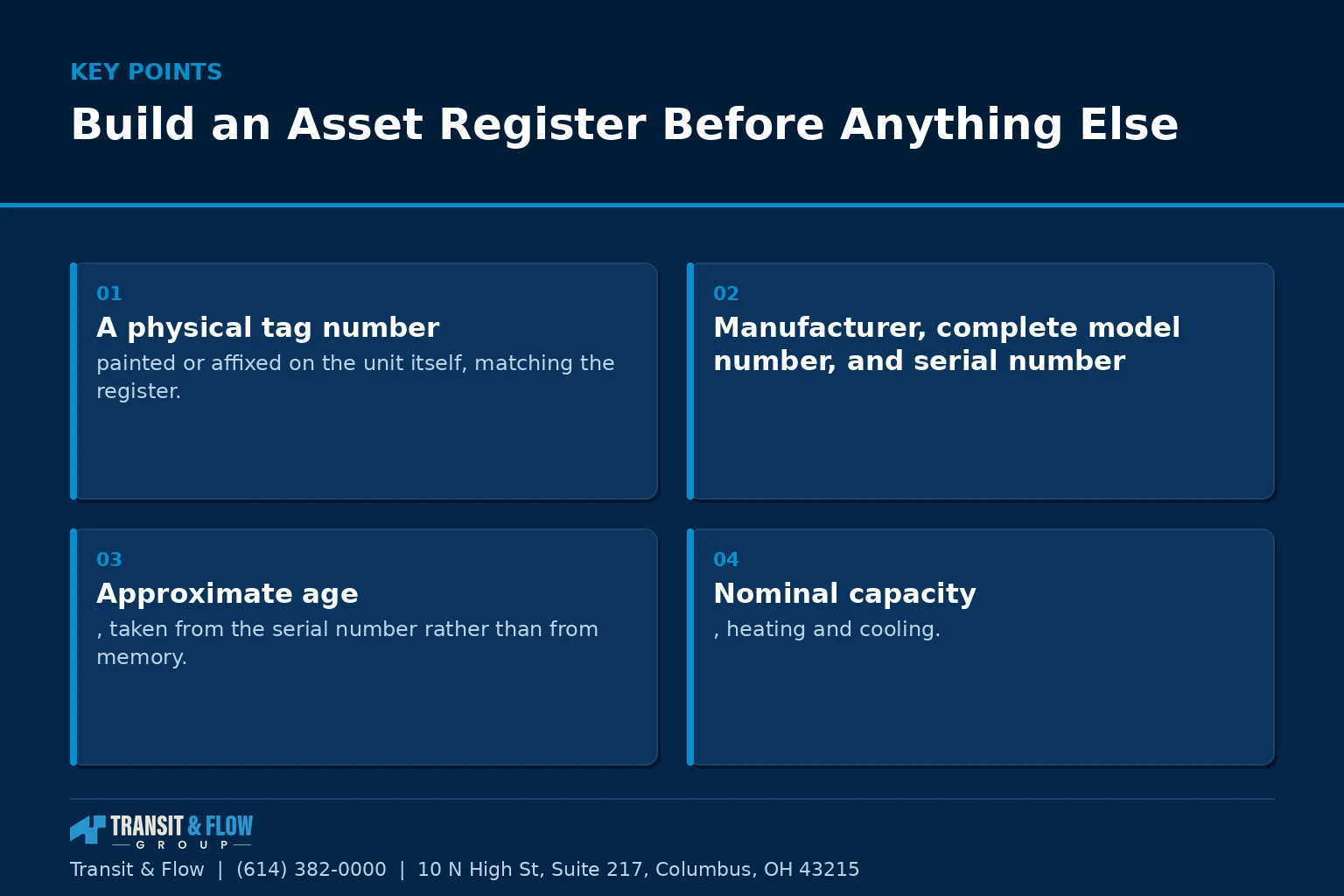
- A physical tag number painted or affixed on the unit itself, matching the register.
- Manufacturer, complete model number, and serial number.
- Approximate age, taken from the serial number rather than from memory.
- Nominal capacity, heating and cooling.
- The zone or tenant space it serves, verified by operating it rather than assumed from a drawing.
- Filter size, quantity, and specification.
- Refrigerant type, which matters because service economics differ sharply between refrigerants as availability changes.
- Service history, including repeat repairs, which are the strongest single predictor of the next failure.
- A condition rating assigned by the inspecting technician, on a consistent scale across the fleet.
- Expected remaining life, stated as a range in years and revised at each annual inspection.
That register turns a fleet of anonymous boxes into a capital plan. It also converts every future service conversation from a debate into a lookup.
What Belongs in a Service Agreement
- Visit frequency and what each visit covers, distinguishing a full seasonal inspection from a filter change visit.
- Written reports with readings per unit, delivered whether or not anything was found. A report that only appears when something breaks is not a maintenance record.
- Response time commitments, stated separately for normal conditions and for a no-heat call.
- After-hours terms, defined before you need them rather than negotiated during an outage.
- What is included versus billed, with filters, belts, and minor components named explicitly.
- Refrigerant handling and leak repair policy, including how repeated charge additions are documented and escalated.
- An annual condition report updating the remaining life estimate on every unit, which is the document that feeds your capital budget.
- Named exclusions. An agreement with no exclusions list has exclusions you have not read yet.
On cost: this article contains no dollar figures on purpose. Service and replacement pricing varies with unit count, capacity, roof access difficulty, crane requirements, curb adaptation, electrical and gas modifications, and tenant occupancy constraints. A published number would mislead a facility owner in either direction. Get a scoped agreement priced against your actual asset register.
Replace on a Schedule, Not on a Failure
Emergency replacement costs more in every dimension that matters. Equipment selection narrows to what is in stock, crane scheduling is whatever is available, the work happens under occupancy with no planning, tenant disruption is unmanaged, and there is no opportunity to correct the curb, the distribution, or the controls while the unit is off. Planned replacement inverts every one of those.
Planned replacement also creates the window to correct the things that quietly limit performance. Curb adapters, distribution defects, and control sequences are cheap to address when the unit is already coming off and expensive to address at any other time. The same logic that applies to distribution defects in a house applies at building scale, with more units and more consequence.
Option A is running each unit to failure and replacing reactively. Option B is using the condition register to replace the worst-rated units on a rolling annual schedule, one or two per year, funded as a recurring capital line. My recommendation is Option B for any building with more than three rooftop units. It converts an unpredictable emergency expense into a budget line, it lets you buy equipment on specification rather than availability, it spreads tenant disruption into planned windows, and it captures the correction work that reactive replacement always skips. Pair it with the lighting and electrical planning already on the capital calendar so roof and electrical work share mobilization.
Where Transit & Flow Group Fits
Transit & Flow Group coordinates commercial heating and cooling projects across Columbus and Central Ohio and partners with properly licensed and insured specialty contractors when licensing is required. Our standard on a facility engagement is that an asset register is built and tagged before service is scoped, that combustion and electrical readings are delivered in writing per unit, and that an annual condition report with remaining life estimates feeds the owner’s capital plan directly. To get a rooftop fleet assessment before winter, request an assessment.
Frequently Asked Questions
When should rooftop units be inspected ahead of winter?
In autumn, before the first sustained cold, and per unit rather than as a building average. Rooftop failures cluster at the seasonal changeover, when equipment that idled through a mild period is suddenly asked for full output, and they tend to cascade because a unit that ran degraded for two seasons has usually stressed more than one component. Knowing condition in October rather than January is what keeps you out of the queue on the morning every service provider in Central Ohio is fully booked.
What should an asset register contain for each rooftop unit?
One row per unit with a physical tag number affixed to the equipment itself, the manufacturer, complete model number, and serial number, the approximate age taken from the serial rather than from memory, nominal heating and cooling capacity, the zone or tenant space it actually serves, filter size, quantity, and specification, refrigerant type, service history including repeat repairs, a condition rating on a consistent scale across the fleet, and an expected remaining life stated as a range in years. Build it before service is scoped. That register turns a fleet of anonymous boxes into a capital plan and converts every future service conversation from a debate into a lookup.
Why does the economizer get singled out?
It is the most commonly broken component on a rooftop unit and the most commonly ignored, because nothing about its failure is visible from inside the space. Stuck open in winter it drives heating cost hard, and stuck closed it wastes free cooling through the shoulder seasons. Neither condition produces a complaint, which is exactly why it survives year after year on units that are otherwise serviced. Ask for its operation to be verified and reported per unit rather than assumed.
What belongs in a rooftop service agreement?
Visit frequency with a clear distinction between a full seasonal inspection and a filter change visit, written reports with readings per unit delivered whether or not anything was found, response time commitments stated separately for normal conditions and for a no heat call, after hours terms defined before you need them, what is included versus billed with filters, belts, and minor components named, a refrigerant handling and leak repair policy covering how repeated charge additions get documented and escalated, and an annual condition report updating remaining life on every unit. Insist on a named exclusions list, because an agreement without one has exclusions you have not read yet.
Is planned replacement genuinely better than running units to failure?
For any building with more than three rooftop units, yes. Emergency replacement narrows equipment selection to whatever is in stock, takes whatever crane scheduling is available, happens under occupancy with no planning, and leaves no window to correct the curb, the distribution, or the control sequences while the unit is off. Replacing the worst rated units on a rolling annual schedule inverts all of that and turns an unpredictable expense into a recurring capital line. It also captures the correction work that reactive replacement always skips.
Can in house building staff handle rooftop maintenance?
This playbook is planning and specification guidance for owners and managers, not instruction to service equipment. Rooftop work involves fall exposure, electrical hazard, refrigerant handling that is federally regulated and requires certification, and gas fired combustion equipment, so the hands on work belongs to qualified licensed technicians. What building staff can own is the register, the schedule, the reporting standard, and the capital plan those feed. If a gas odor is ever reported, evacuate and call from outside.
Sources
- U.S. Department of Energy, Building Technologies Office, commercial rooftop unit performance guidance
- Ohio Construction Industry Licensing Board, HVAC trade licensing
- City of Columbus, Get a Permit, mechanical and electrical permit channels
About This Guide
Written and edited by Micheal Parker, founder of Transit & Flow Group. Published November 11, 2026. This guide is checked against the agency and code sources listed above, and it is revised when those sources change.
General contractor of record. Micheal Parker holds City of Columbus General Contractor Registration G12064, issued by the Columbus Department of Building and Zoning Services under Transit & Flow LLC and valid through June 30, 2027. Trade work that falls outside the scope of that registration is performed by licensed trade partners, and the responsible license holder is identified before work begins.
Transit & Flow Group, home and commercial services for Columbus and the surrounding Central Ohio communities. Phone (614) 382-0000. Email solutions@transitflowgroup.com. 10 N. High St., Suite 217, Columbus, OH 43215. Contact our team or review the communities we serve.
