
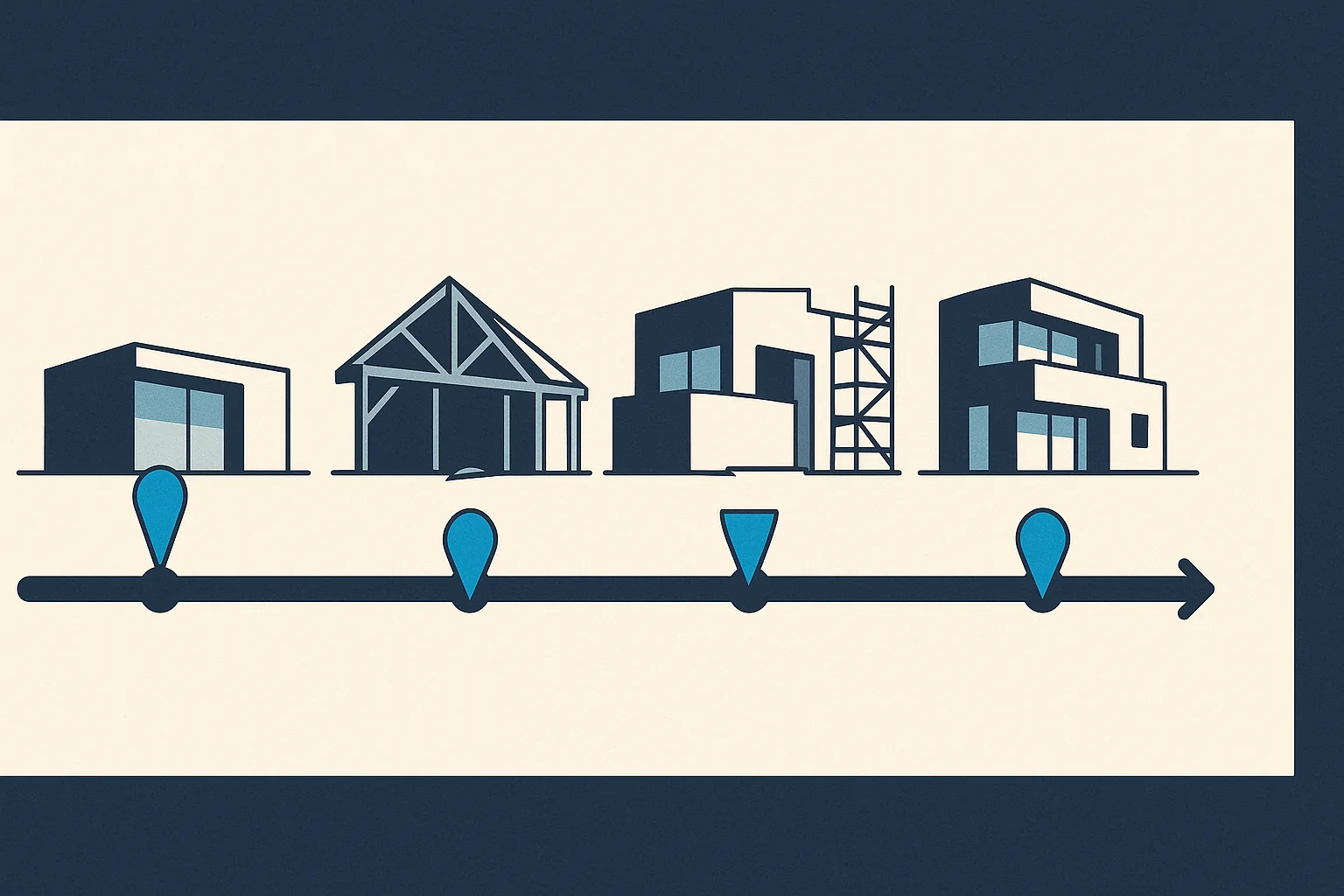

Payment terms tell you more about a contractor than any review ever will. A fair schedule ties money to verifiable progress, protects both parties, and reads the same way whether the project goes smoothly or badly. An unfair one moves your leverage to the other side of the table before any work happens. This article explains how contractor payment schedules are actually structured, what each stage should be tied to, and where the warning signs live. It pairs with our guide to verifying a contractor in Ohio.
In This Guide
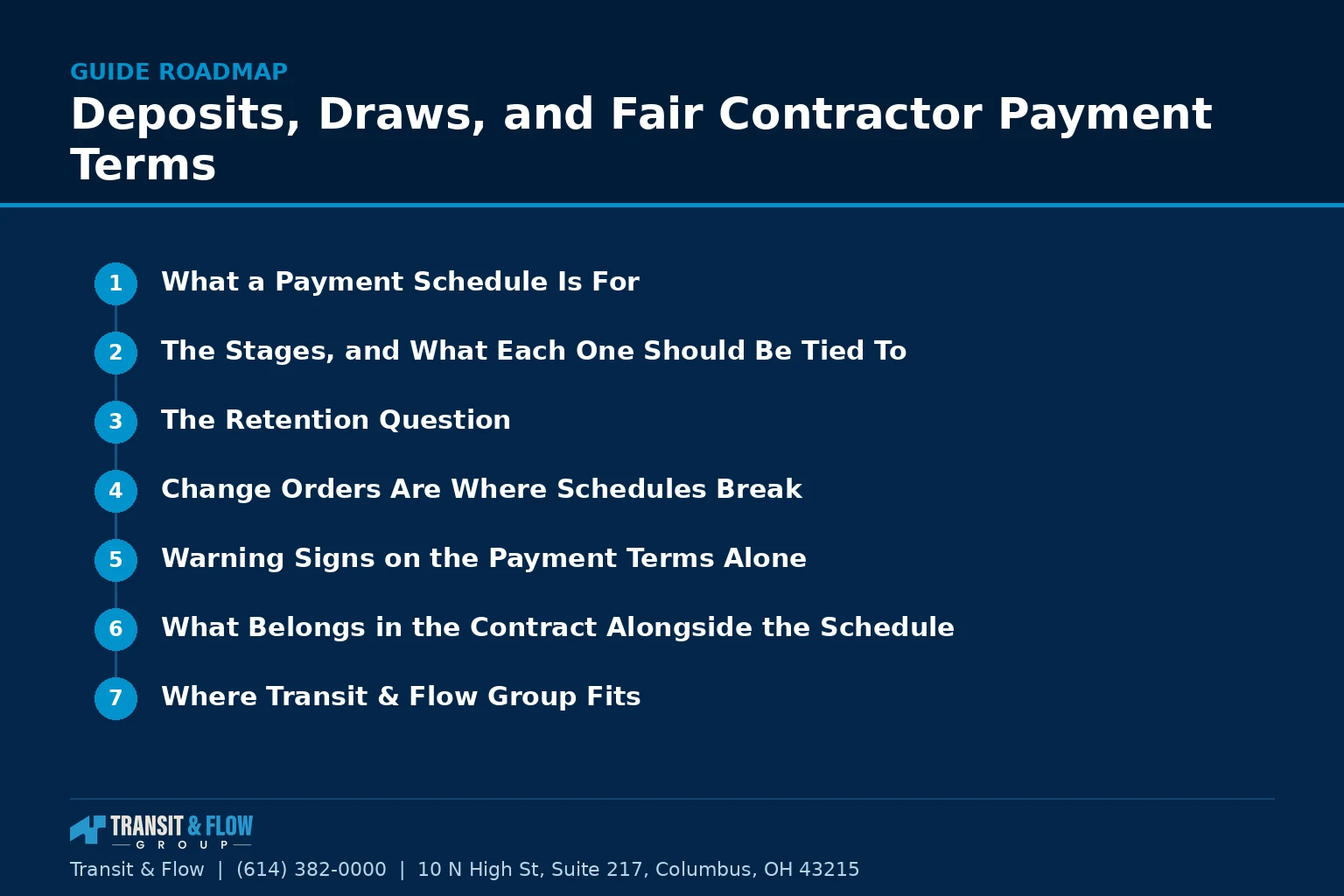
- What a Payment Schedule Is For
- The Stages, and What Each One Should Be Tied To
- The Retention Question
- Change Orders Are Where Schedules Break
- Warning Signs on the Payment Terms Alone
- What Belongs in the Contract Alongside the Schedule
- Where Transit & Flow Group Fits
- Frequently Asked Questions
Transit & Flow Group coordinates projects and partners with properly licensed and insured specialty contractors when licensing is required.
Two boundaries. This article publishes no dollar figures and no percentage rules, because a defensible deposit on a project with custom-ordered equipment looks nothing like a defensible deposit on a labor-only repair, and any published percentage would be used against you by someone. This is also general information, not legal advice. Contract terms and consumer protection provisions carry legal consequences, and a contract worth a meaningful share of your net worth is worth a lawyer’s hour.
What a Payment Schedule Is For
A payment schedule allocates risk over time. The contractor carries the risk of buying material and committing labor before being paid. You carry the risk of paying for work not yet performed. A good schedule keeps both exposures small and roughly balanced at every point in the project. A bad schedule concentrates all of it on one side, and it is almost never the contractor’s side.
The single test that resolves most questions: at every moment in the project, the value of work completed should be close to the money paid. If you are ever far ahead, you have lost your leverage. That is the whole principle, and every rule below is an application of it.
The Stages, and What Each One Should Be Tied To
- The deposit. Its legitimate purpose is securing materials, custom orders, and a place in the schedule. A deposit is more defensible when the contract names what it purchases: specific equipment, a special order with a lead time, a permit fee. A deposit with no stated purpose is a request for trust before any has been earned.
- Material delivery. On projects with significant equipment, a payment triggered by delivery to the site is reasonable, because the contractor’s exposure is real and the material is verifiably present. Tie it to delivery, not to ordering.
- Progress draws. On longer projects, payments tied to defined milestones. The requirement is that each milestone is objectively verifiable by someone standing in the space. Rough-in complete, inspection passed, drywall complete. Not percentage complete, which is an opinion.
- Substantial completion. The point at which the space is usable for its intended purpose with only minor items outstanding. This is a defined moment worth naming in the contract rather than a feeling.
- Final payment. Released after the punch list is complete, required inspections have passed, and any lien waivers and warranty documents are delivered. Final payment is your only remaining leverage on the punch list, which is exactly why it should be the last thing you release.
The Retention Question
On larger residential projects and on most commercial work, a portion of each payment is held back until final completion. Retention exists for one reason: to guarantee the last ten percent of the work gets the same attention as the first ninety. It is the most effective punch list mechanism available.
If you use it, state clearly in the contract what triggers its release and how quickly it is paid once triggered. Retention that is held vaguely or released slowly damages the relationship with a contractor who has performed well, and good contractors are entitled to be paid promptly when they have earned it. The mechanism protects quality. It is not a negotiating tool.
Change Orders Are Where Schedules Break
Most payment disputes do not start with the payment schedule. They start with work that was added verbally, performed, and invoiced later at a number nobody agreed to. Renovation projects uncover conditions and the scope legitimately changes. The failure is procedural, not moral.
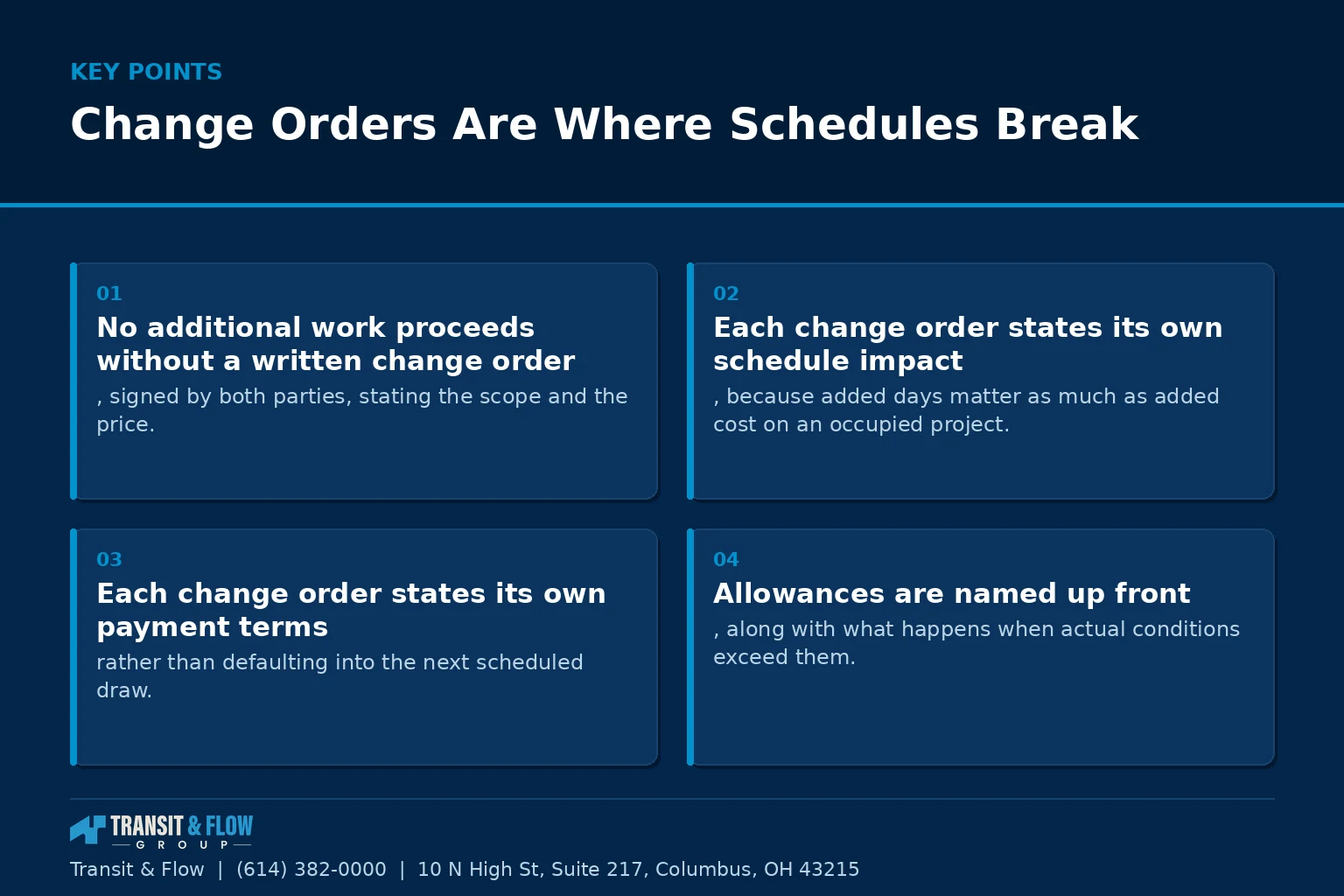
- No additional work proceeds without a written change order, signed by both parties, stating the scope and the price.
- Each change order states its own schedule impact, because added days matter as much as added cost on an occupied project.
- Each change order states its own payment terms rather than defaulting into the next scheduled draw.
- Allowances are named up front, along with what happens when actual conditions exceed them.
- Text or email confirmation counts when it states scope and price and both parties respond. Formality matters less than the record.
- The contract states the procedure itself, so invoking it later is following the agreement rather than raising a conflict.
Warning Signs on the Payment Terms Alone
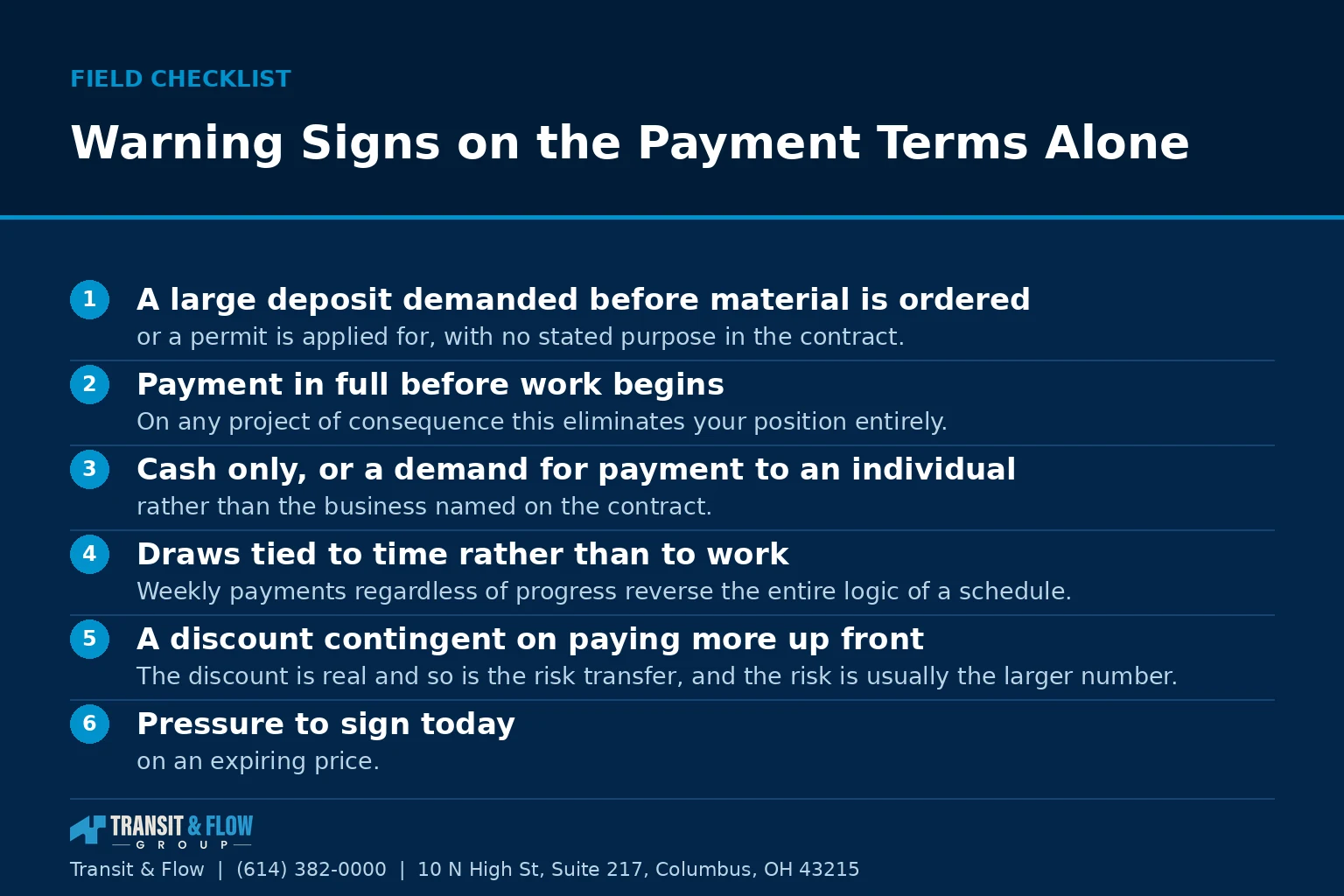
- A large deposit demanded before material is ordered or a permit is applied for, with no stated purpose in the contract.
- Payment in full before work begins. On any project of consequence this eliminates your position entirely.
- Cash only, or a demand for payment to an individual rather than the business named on the contract.
- Draws tied to time rather than to work. Weekly payments regardless of progress reverse the entire logic of a schedule.
- A discount contingent on paying more up front. The discount is real and so is the risk transfer, and the risk is usually the larger number.
- Pressure to sign today on an expiring price. Legitimate proposals carry validity periods measured in weeks. Our article on reading a quote line by line covers what a complete proposal contains.
- No written contract at all on work of any real size, which removes every mechanism described in this article at once.
- Reluctance to provide lien waivers with payments. Where subcontractors and suppliers are involved, waivers are how you confirm the money you paid actually reached them.
What Belongs in the Contract Alongside the Schedule
- The full legal business name, address, and license number, verifiable independently rather than accepted as a forwarded image.
- Proof of insurance sent directly from the insurer or agent, naming you, rather than a certificate handed over by the contractor.
- The scope of work in enough detail that a stranger could determine whether it was performed.
- An explicit exclusions list.
- Permit responsibility, naming who applies, who pays, and who meets the inspector.
- Start and substantial completion dates, with how weather and material delays are handled.
- Warranty terms on workmanship, stated separately from any manufacturer warranty on materials.
- Cleanup, disposal, and site protection.
- A dispute procedure, agreed while everyone is still friendly.
Option A is accepting the payment schedule the contractor proposes, since it is usually standard. Option B is treating the schedule as a negotiable term and tying every stage to a verifiable event before signing. My recommendation is Option B on any project large enough to require a permit. The conversation takes fifteen minutes, a competent contractor will engage with it readily because fair terms protect them too, and the response you get is itself the most useful information in the entire selection process. A contractor who will not tie payment to verifiable progress has told you something no reference check would have.
Where Transit & Flow Group Fits
Transit & Flow Group coordinates residential and commercial projects across Columbus and Central Ohio and partners with properly licensed and insured specialty contractors when licensing is required. Our standard is that every payment stage is tied to a verifiable event, that the change order procedure is written into the agreement before work starts rather than invoked during a dispute, and that exclusions are stated rather than discovered. Our overview of what a general contractor does explains how coordination responsibility is carried. To review a project scope and terms before you sign anything, request an assessment.
Frequently Asked Questions
What is a payment schedule actually for?
It allocates risk over time. The contractor carries the risk of buying material and committing labor before being paid, and you carry the risk of paying for work not yet performed. A good schedule keeps both exposures small and roughly balanced at every point in the project, while a bad one concentrates the exposure on one side, and it is almost never the contractor’s side. The single test that resolves most questions is whether the value of work completed stays close to the money paid at every moment.
What makes a deposit defensible?
A deposit is more defensible when the contract names what it purchases, such as specific equipment, a special order with a lead time, or a permit fee. Its legitimate purposes are securing materials, custom orders, and a place in the schedule. A deposit with no stated purpose is a request for trust before any has been earned. This article deliberately publishes no percentage rule, because a defensible deposit on a project with custom-ordered equipment looks nothing like one on a labor-only repair.
What should each progress draw be tied to?
An objectively verifiable milestone, meaning something a person standing in the space could confirm. Rough-in complete, inspection passed, and drywall complete are milestones. Percentage complete is an opinion, and draws tied to time rather than to work, such as weekly payments regardless of progress, reverse the entire logic of a schedule. On projects with significant equipment, a payment triggered by delivery to the site is reasonable, tied to delivery rather than to ordering.
Why should final payment be released last?
Because it is your only remaining leverage on the punch list. Final payment belongs after the punch list is complete, after required inspections have passed, and after any lien waivers and warranty documents are delivered. Substantial completion, meaning the point at which the space is usable for its intended purpose with only minor items outstanding, is a separate and earlier moment worth naming in the contract rather than leaving to feeling. Retention, where a portion of each payment is held until final completion, exists to make sure the last stretch of work gets the same attention as the first, and the contract should state what triggers its release and how quickly it is paid.
How do change orders cause payment disputes?
Most disputes do not begin with the payment schedule. They begin with work that was added verbally, performed, and invoiced later at a number nobody agreed to. Renovation projects legitimately uncover conditions and the scope changes, so the failure is procedural rather than moral. The remedy is that no additional work proceeds without a written change order signed by both parties stating scope and price, that each one states its own schedule impact and its own payment terms, and that the contract states the procedure itself so invoking it later is following the agreement rather than starting a conflict.
Which payment terms should stop a homeowner from signing?
A large deposit demanded before material is ordered or a permit is applied for, with no stated purpose in the contract. Payment in full before work begins, cash only, or payment demanded to an individual rather than the business named on the contract. A discount contingent on paying more up front, where the risk transfer is usually the larger number, and pressure to sign today on an expiring price, since legitimate proposals carry validity periods measured in weeks. Reluctance to provide lien waivers and the absence of any written contract belong on the same list.
Sources
- Ohio Attorney General, consumer protection and home improvement resources
- Ohio Construction Industry Licensing Board, trade licensing
- City of Columbus, Get a Permit, permit channels
About This Guide
Written and edited by Micheal Parker, founder of Transit & Flow Group. Published November 13, 2026. This guide is checked against the agency and code sources listed above, and it is revised when those sources change.
General contractor of record. Micheal Parker holds City of Columbus General Contractor Registration G12064, issued by the Columbus Department of Building and Zoning Services under Transit & Flow LLC and valid through June 30, 2027. Trade work that falls outside the scope of that registration is performed by licensed trade partners, and the responsible license holder is identified before work begins.
Transit & Flow Group, home and commercial services for Columbus and the surrounding Central Ohio communities. Phone (614) 382-0000. Email solutions@transitflowgroup.com. 10 N High St, Suite 217, Columbus, OH 43215. Contact our team or review the communities we serve.
