


Every renovation of any size produces at least one change order, and the households who are surprised by that fact are the ones who have the worst experience with it. A change order is not a sign that something went wrong. It is the document that keeps a project honest when the scope moves, and the quality of a contractor is visible in how they write one. This article explains what a change order is, what belongs in it, when it should appear, and what its absence tells you. To have a scope reviewed before you sign, contact us.
In This Guide
- What a Change Order Actually Is
- The Three Kinds of Change, Which Deserve Different Reactions
- What Belongs in a Change Order
- How the Process Should Run on a Well Managed Project
- What to Establish Before the Project Starts
- Warning Signs Worth Naming
- On Cost
- Glossary
- The Decision
- Where Transit & Flow Group Fits
- Frequently Asked Questions
Transit & Flow Group coordinates projects and partners with properly licensed and insured specialty contractors when licensing is required.
What a Change Order Actually Is
A change order is a written amendment to the contract. It records that the agreed scope has changed, describes the change, states the effect on price, states the effect on schedule, and is signed by both parties before the changed work is performed. That last clause is the entire point. A change order signed after the work is done is not a change order. It is an invoice with a better title.
The reason the document exists is that a renovation contract prices a scope that was defined before anyone could see inside the walls. When what is behind the drywall differs from what was assumed, one of three things happens. The contractor absorbs the difference, which is unsustainable and eventually shows up as corner cutting elsewhere. The household absorbs it through an informal conversation that nobody wrote down, which is where disputes come from. Or both parties handle it through a written amendment, which is the only version that survives contact with a disagreement six weeks later.
The Three Kinds of Change, Which Deserve Different Reactions
Not all change orders mean the same thing, and a household that treats them identically will either overreact to a normal one or underreact to a serious one.
- Discovered conditions. Something was found that could not reasonably have been seen during estimating. Failed subfloor under a toilet, corroded supply lines inside a wall, unpermitted work by a previous owner, active moisture. These are legitimate and they are the most common category. The right reaction is to look at the documentation, not to look for fault.
- Owner requested changes. The household changed its mind, upgraded a selection, added scope, or asked for something outside the original agreement. These are entirely the household’s to own, and they should be priced and signed with the same formality as any other change. The most common source of budget drift in a residential project is a series of small owner requested changes that nobody totaled.
- Estimating errors. Something that was visible, knowable, and should have been priced was not. A permit that was always going to be required. A fixture that was always going to need a different rough. This is the category worth paying attention to, because it says something about how the estimate was built and it predicts what else may be missing.
A project with two discovered condition change orders is normal. A project with four estimating error change orders in the first three weeks is telling you the bid was not a real bid, and the pattern will continue.
What Belongs in a Change Order
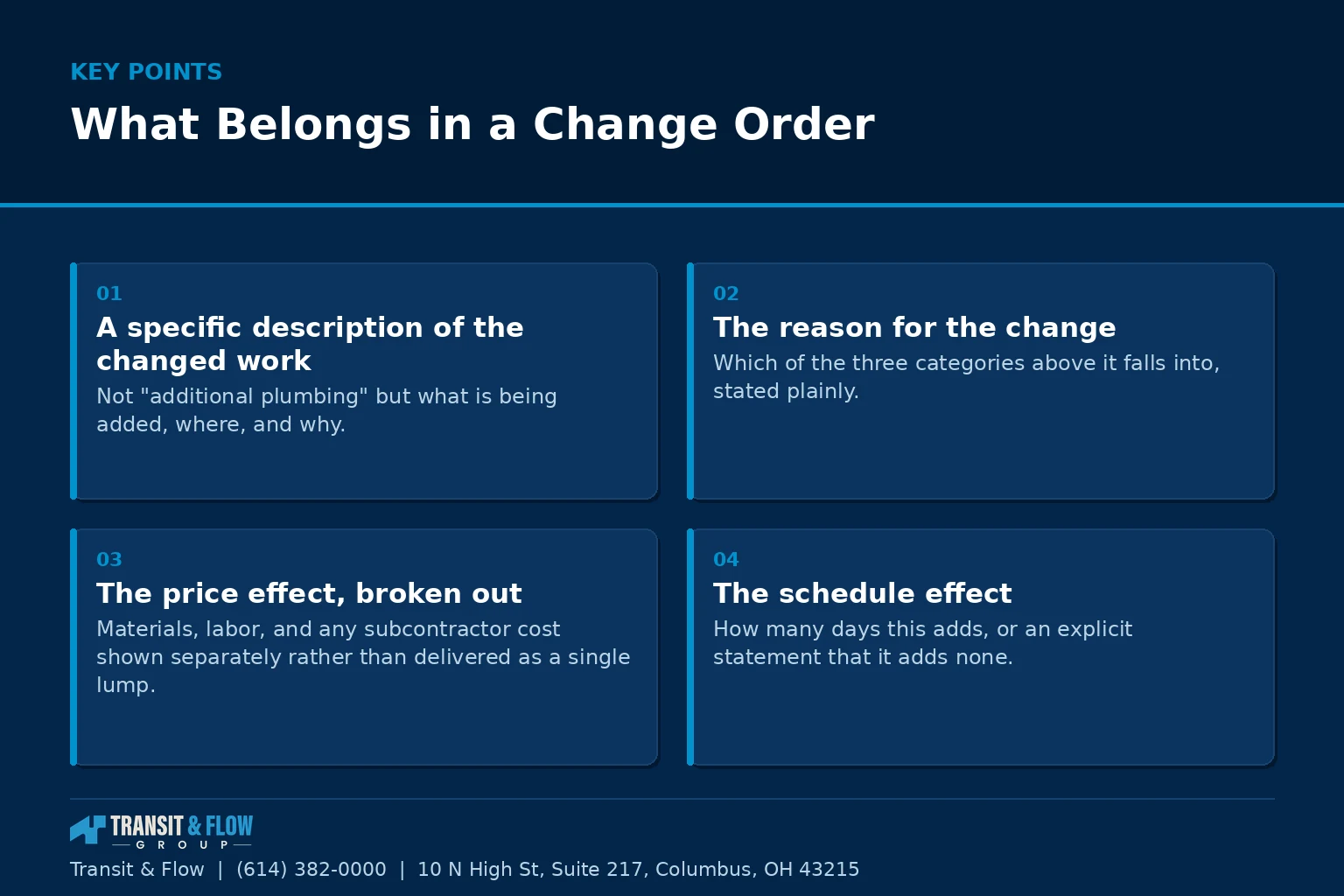
- A specific description of the changed work. Not “additional plumbing” but what is being added, where, and why. If you cannot picture the work from the description, the description is not finished.
- The reason for the change. Which of the three categories above it falls into, stated plainly.
- The price effect, broken out. Materials, labor, and any subcontractor cost shown separately rather than delivered as a single lump. A lump sum on a change order is the single easiest place for margin to be quietly reset.
- The schedule effect. How many days this adds, or an explicit statement that it adds none. Change orders that adjust price but never mention schedule are how a project slides four weeks without any single conversation about it.
- Any effect on other scope. Whether this change removes, replaces, or supersedes something already priced. Credits matter as much as additions, and honest contractors write credit change orders too.
- Photographs where a discovered condition is claimed. If a condition inside a wall is the justification, the condition should be documented before it is covered back up.
- Both signatures and a date. The date should precede the performance of the work.
How the Process Should Run on a Well Managed Project
- The condition is discovered or the request is made, and work in that specific area pauses rather than continuing on assumption.
- The condition is documented, photographed where relevant, and communicated the same day rather than at the next scheduled check in.
- The contractor prepares a written change order with the description, the broken out price, and the schedule effect.
- The household is given the opportunity to ask questions and, where the change is significant, to consider alternatives. A discovered condition usually has more than one acceptable resolution at more than one price.
- Both parties sign, and the signed copy goes to the household before the work proceeds.
- The revised contract total and the revised completion date are restated in writing, so the running total is always visible rather than reconstructed at the end.
- The change order is referenced on the invoice that bills it, so payment applications reconcile to signed documents rather than to memory.
What to Establish Before the Project Starts
The time to agree on how change orders will be handled is before the first one exists. Once a wall is open and a crew is standing in the room, the household’s negotiating position has quietly disappeared and everyone knows it. These terms belong in the original contract.
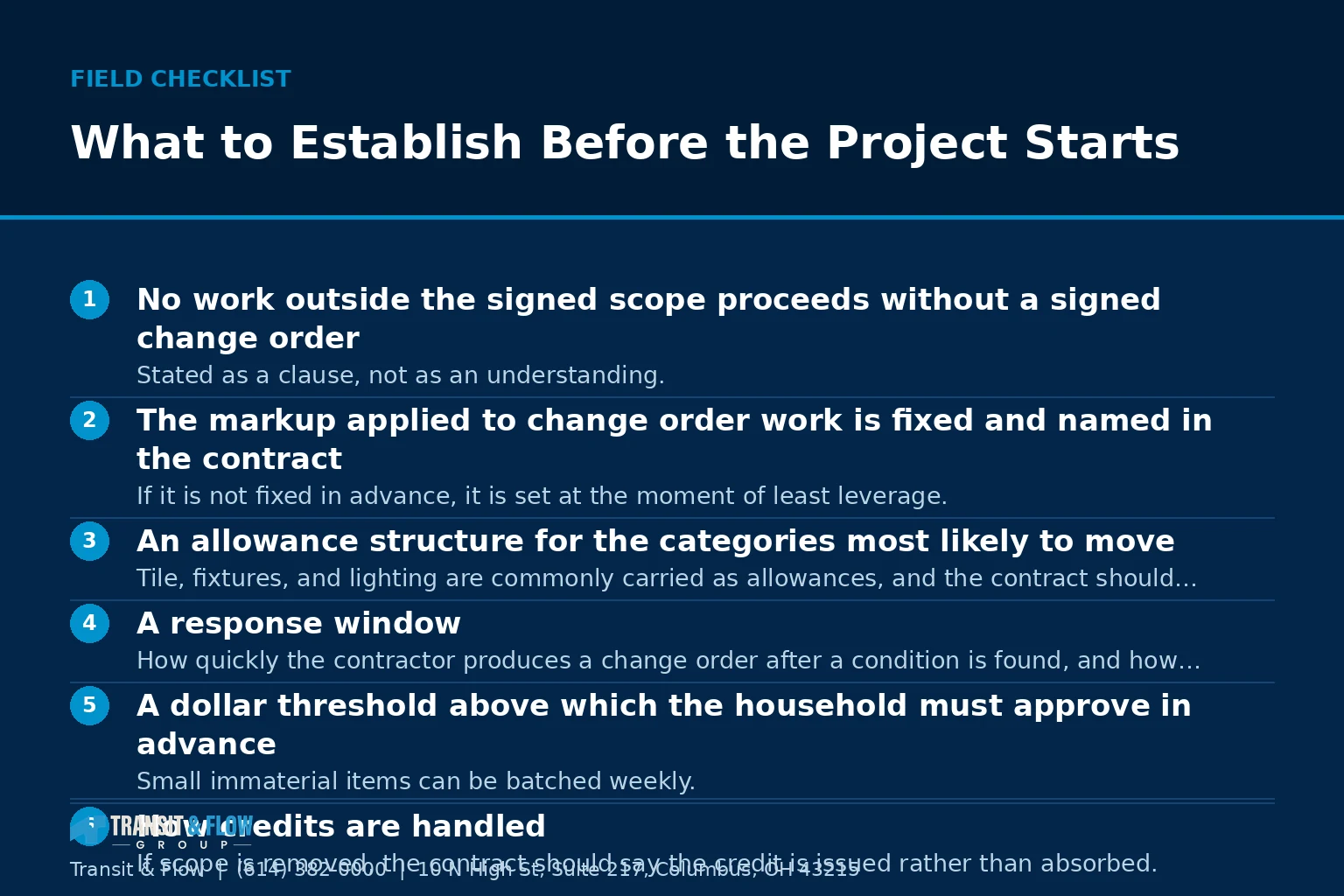
- No work outside the signed scope proceeds without a signed change order. Stated as a clause, not as an understanding.
- The markup applied to change order work is fixed and named in the contract. If it is not fixed in advance, it is set at the moment of least leverage.
- An allowance structure for the categories most likely to move. Tile, fixtures, and lighting are commonly carried as allowances, and the contract should say how an overage or an underage is reconciled.
- A response window. How quickly the contractor produces a change order after a condition is found, and how quickly the household responds. Both directions matter, because a household sitting on a decision is a legitimate source of delay.
- A dollar threshold above which the household must approve in advance. Small immaterial items can be batched weekly. Anything meaningful gets its own signature.
- How credits are handled. If scope is removed, the contract should say the credit is issued rather than absorbed.
- Where the running total lives. A single document, updated after each change, showing original contract, changes to date, and current total.

Warning Signs Worth Naming
Some change order behavior is a red flag on its own. Verbal only changes, with the paperwork promised later. A change order presented after the work has already been performed. A lump sum with no breakdown and no explanation. Refusal to document a discovered condition photographically. A pattern of changes that all move in one direction, with no credits ever appearing. And the most telling one: an unusually low initial bid followed by a rapid sequence of change orders in the first two weeks, which is not bad luck, it is a pricing strategy.
The opposite is also worth naming, because it is what good looks like. A contractor who flags a possible condition during estimating, before the contract is signed, and puts a contingency line in the proposal for it, is showing you exactly how they will behave when it happens.
On Cost
This article contains no dollar figures on purpose. Change order pricing depends entirely on the scope, the trade, and the market conditions on the day, and any number published here would be treated as a benchmark when it is not one. The useful measure is not the size of a change order. It is whether the price was broken out, whether the reason was documented, and whether you signed it before the work happened. Those three tests apply at any dollar amount.
Glossary
- Change order. A written, signed amendment to a construction contract altering scope, price, schedule, or all three.
- Scope of work. The written definition of what the contract includes, and by implication what it excludes.
- Discovered condition. A condition found during construction that could not reasonably have been observed during estimating.
- Allowance. A budgeted placeholder for a selection not yet made, reconciled against the actual cost when the selection is finalized.
- Contingency. A sum carried in the budget for unknowns, distinct from an allowance because it is not tied to a specific selection.
- Credit change order. A change order that reduces the contract total because scope was removed or a selection came in under allowance.
- Markup. The percentage applied over direct cost on change order work, covering overhead and profit.
- Payment application. The document requesting payment for work completed to date, which should reconcile to the contract plus signed change orders.
- Substantial completion. The point at which the work is sufficiently complete for its intended use, which change orders can move.
The Decision
Option A is handling changes as they arise, informally, trusting the relationship and reconciling at the end. Option B is establishing the change order procedure in the contract before work begins, with a fixed markup, a signature threshold, a response window, and a running total document. My recommendation is Option B, firmly. Option A works right up until it does not, and the moment it fails is the moment when both parties are already committed and neither can walk away cheaply. The households who finish a renovation feeling well treated are not the households who had no change orders. They are the households who knew what a change order would look like before the first one arrived. For how payment should be sequenced against milestones, see our article on payment schedules, deposits, and draws, and for how the permit process creates its own fixed points in a schedule, our article on permits and plumbing inspections.
Where Transit & Flow Group Fits
Transit & Flow Group coordinates residential and commercial projects across Columbus and Central Ohio and partners with properly licensed and insured specialty contractors when licensing is required. Our standard on changes is that the markup is named in the original contract, that no work outside the signed scope proceeds without a signed amendment, that discovered conditions are photographed before they are covered, that price is broken out rather than delivered as a lump, and that a running total showing original contract, changes to date, and current total is maintained and shared throughout the project. To have a scope and a contract reviewed before you sign, contact us.
Frequently Asked Questions
Does a change order mean something went wrong?
Not by itself. Every renovation of any size produces at least one, and the households with the worst experience are usually the ones surprised that they exist at all. A renovation contract prices a scope defined before anyone could see inside the walls, so when reality differs from the assumption, a written amendment is the only version of that conversation that survives a disagreement six weeks later. The quality of a contractor shows in how the document is written, not in whether one was needed.
Are all change orders the same?
No, and treating them identically leads households to overreact to a normal one and underreact to a serious one. Discovered conditions are things that could not reasonably have been seen during estimating, such as a failed subfloor, corroded supply lines inside a wall, unpermitted work by a previous owner, or active moisture, and they are the most common category. Owner requested changes belong entirely to the household and are the most common source of quiet budget drift when nobody totals them. Estimating errors cover what was visible and knowable but was not priced, and that category is worth attention because it predicts what else may be missing.
What has to appear in a properly written change order?
A specific description of the changed work rather than a vague label, the reason for the change stated plainly, the price effect broken into materials, labor, and subcontractor cost instead of a single lump, and the schedule effect stated in days or explicitly stated as none. It should also note any effect on other scope, including credits where something is removed, and include photographs where a discovered condition inside a wall is the justification. Both signatures and a date belong on it, with the date preceding the performance of the work.
Is a change order still valid if I sign it after the work is done?
A change order signed after the work is performed is not really a change order. It is an invoice with a better title, and the household has no leverage left at that point. The whole function of the document is that both parties agree to the scope, the price, and the schedule effect before the changed work proceeds. Work in the affected area should pause while the amendment is prepared rather than continuing on assumption.
What should the contract say about changes before work begins?
The time to agree how changes are handled is before the first one exists, because once a wall is open and a crew is standing in the room the household’s negotiating position has quietly disappeared. Put in a clause that no work outside the signed scope proceeds without a signed change order, fix the markup applied to change order work in the contract, and define an allowance structure for the categories most likely to move, such as tile, fixtures, and lighting. Add a response window in both directions, a threshold above which the household approves in advance, a statement that removed scope produces a credit rather than being absorbed, and a single running total document showing original contract, changes to date, and current total.
What behavior around change orders should concern me?
Verbal changes with paperwork promised later, a change order presented after the work has already been performed, a lump sum with no breakdown and no explanation, refusal to document a discovered condition photographically, and a pattern of changes that only ever move in one direction with no credits appearing. The most telling pattern is an unusually low initial bid followed by a rapid sequence of change orders in the first weeks, which is a pricing strategy rather than bad luck. The opposite is what good looks like: a contractor who flags a possible condition during estimating and carries a contingency line for it in the proposal.
Sources
- Ohio Attorney General, consumer protection guidance on home improvement contracts
- Ohio Construction Industry Licensing Board, trade licensing verification
- City of Columbus, Get a Permit, permit and inspection process
- Federal Trade Commission, guidance on hiring a contractor
About This Guide
Written and edited by Micheal Parker, founder of Transit & Flow Group. Published February 12, 2027. This guide is checked against the agency and code sources listed above, and it is revised when those sources change.
General contractor of record. Micheal Parker holds City of Columbus General Contractor Registration G12064, issued by the Columbus Department of Building and Zoning Services under Transit & Flow LLC and valid through June 30, 2027. Trade work that falls outside the scope of that registration is performed by licensed trade partners, and the responsible license holder is identified before work begins.
Transit & Flow Group, home and commercial services for Columbus and the surrounding Central Ohio communities. Phone (614) 382-0000. Email solutions@transitflowgroup.com. 10 N High St, Suite 217, Columbus, OH 43215. Contact our team or review the communities we serve.
