


Gutter guards are sold as a way to never clean gutters again. That is not what any of them do. What the better products actually do is change the maintenance interval and change the kind of debris that accumulates, and the honest question is not whether a guard eliminates maintenance but whether it reduces it enough, on your particular roof, under your particular trees, to justify what it costs and what it complicates.
In This Guide
- What a Gutter Guard Is Actually Trying to Do
- The Main Categories and How Each Behaves
- The Variables That Actually Decide the Answer
- The Claim That Deserves the Most Scrutiny
- What to Confirm Before You Sign
- Sales Practices Worth Recognizing
- On Cost
- Glossary
- The Decision
- Where Transit & Flow Group Fits
- Frequently Asked Questions
Central Ohio makes this question harder than it looks. The tree canopy across older Columbus neighborhoods, Bexley, Clintonville, Upper Arlington, Worthington, delivers a heavy spring seed load, a heavy fall leaf load, and a long shoulder season of small organic debris that behaves nothing like whole leaves. A guard that handles oak leaves beautifully may be defeated entirely by maple seeds and shingle grit. That is the failure most homeowners are surprised by, and it is predictable.
What a Gutter Guard Is Actually Trying to Do
A gutter has one job, which is to receive water from the roof edge and move it to a downspout without letting it spill against the wall or pool at the foundation. Anything that interferes with that flow is a problem, and debris interferes with it in two distinct ways. Debris in the trough displaces capacity and holds moisture against the fascia. Debris at the outlet blocks the downspout entirely, which is the more serious of the two, because a blocked outlet turns the whole run into a shallow trough that overflows at its lowest point.
Every guard design is a compromise between two competing requirements. It has to admit water at the rate the roof delivers it, including during the short high intensity bursts that dominate summer storms in this region, and it has to exclude solids. Those requirements pull in opposite directions. Openings large enough to pass water reliably in a downpour are large enough to pass small debris. Openings fine enough to exclude small debris are fine enough to shed water over the edge when the surface tension breaks or when the screen surface itself is fouled.
Understanding that trade-off is what allows a homeowner to evaluate a proposal instead of choosing based on a demonstration. Every product demonstration you will be shown is designed to display the specific condition that product handles well.
The Main Categories and How Each Behaves
Product names proliferate, but the underlying designs are a short list. What follows describes how each behaves rather than which brand sells it.
| Type | How it works | Handles well | Defeated by |
|---|---|---|---|
| Screen, coarse mesh | Perforated metal or plastic laid over the trough | Whole leaves, twigs, larger debris | Seeds, needles, shingle grit, which pass through and accumulate below |
| Screen, fine micro mesh | Stainless mesh over a rigid frame | Nearly all solid debris including seeds and needles | Surface fouling from pollen and grit, which sheets water over the edge until cleaned |
| Reverse curve, surface tension | Solid cover with a narrow slot at the front edge, water clings around the curve | Whole leaves in moderate volume | High intensity rainfall overshooting the slot, and debris packing into the slot itself |
| Foam or brush insert | Porous insert filling the trough | Large debris resting on top | Organic matter decomposing inside the insert, which retains moisture and eventually grows |
| Louvered or slotted panel | Solid panel with directional openings | Whole leaves and larger debris | Fine debris entering the openings and accumulating out of sight |
| No guard, scheduled cleaning | Periodic manual removal | Everything, when the interval is correct | A neglected interval, and difficult or unsafe access |
Two observations are worth drawing out of that table. First, every category has a defeat condition, and in every case that condition is a real one that occurs in Central Ohio. Second, the failure modes differ in how visible they are. A screen that lets seeds through announces the problem eventually by overflowing. A foam insert quietly holds a wet organic mass against the fascia for years.
The Variables That Actually Decide the Answer
Whether a guard is worth installing on a given house depends on conditions that are specific to that house. These are the ones that carry the most weight.
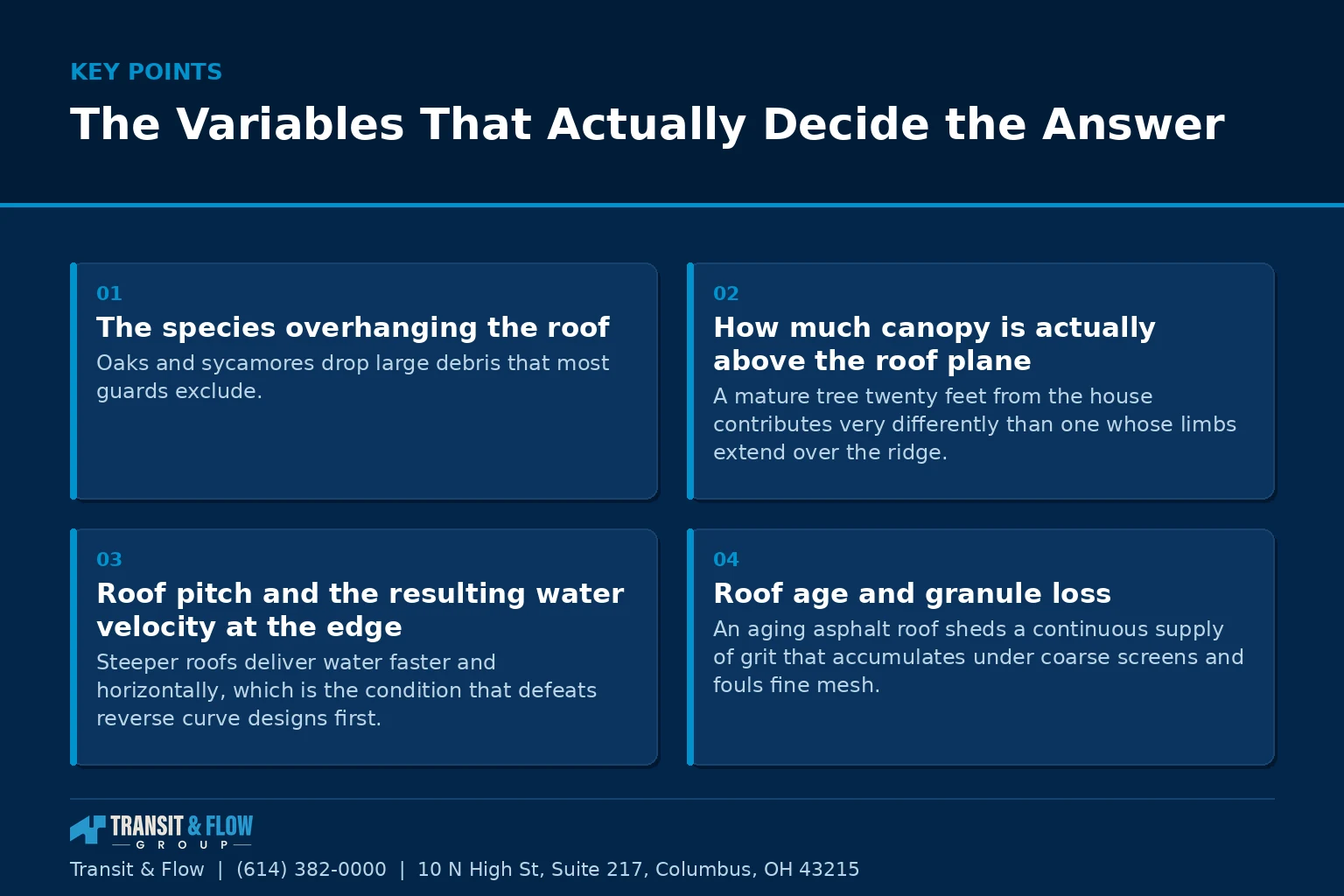
- The species overhanging the roof. Oaks and sycamores drop large debris that most guards exclude. Maples, pines, and locusts drop seeds, needles, and small pods that most guards do not.
- How much canopy is actually above the roof plane. A mature tree twenty feet from the house contributes very differently than one whose limbs extend over the ridge.
- Roof pitch and the resulting water velocity at the edge. Steeper roofs deliver water faster and horizontally, which is the condition that defeats reverse curve designs first.
- Roof age and granule loss. An aging asphalt roof sheds a continuous supply of grit that accumulates under coarse screens and fouls fine mesh.
- Valley concentration. A valley discharges a large drainage area into a short length of gutter, which is the location where guards are most often overtopped.
- Upper roof discharge onto a lower roof. Water arriving from above with velocity is the hardest condition for any surface tension design.
- Gutter and downspout capacity as it already stands. A guard cannot solve a capacity problem, and it will be blamed for one. Capacity is addressed in gutter sizing and downspout placement.
- Access for the maintenance that will still be required. A second or third story run that is difficult to reach changes the value of extending the interval considerably.
- Fascia and hanger condition. Guards add weight and, in some designs, transfer load. A compromised fascia is a reason to address the substrate first.
- Whether the roof covering warranty is affected. Some designs are installed under the first course of shingles. The manufacturer’s published position on that matters.
The Claim That Deserves the Most Scrutiny
The phrase to listen for is any variation of never cleaning gutters again. No guard achieves that, and the more carefully worded product literature does not claim it. What guards achieve is a longer interval and a change in the character of the work, from removing packed wet leaves out of a trough to clearing debris resting on top of a cover and periodically washing a mesh surface.
A related claim worth examining is the ice performance argument. Guards do not prevent ice dams. Ice dams form because heat escaping into the attic melts snow on the upper roof, and that meltwater refreezes at the cold eave. That is an insulation and air sealing condition, not a gutter condition. Some guard designs will hold ice differently than an open gutter will, and a heavy ice load on a guard adds weight to the hanger system, but no guard addresses the mechanism that creates the ice. Any proposal that presents ice dam prevention as a guard benefit has told you something about how it was trained to sell.
What to Confirm Before You Sign
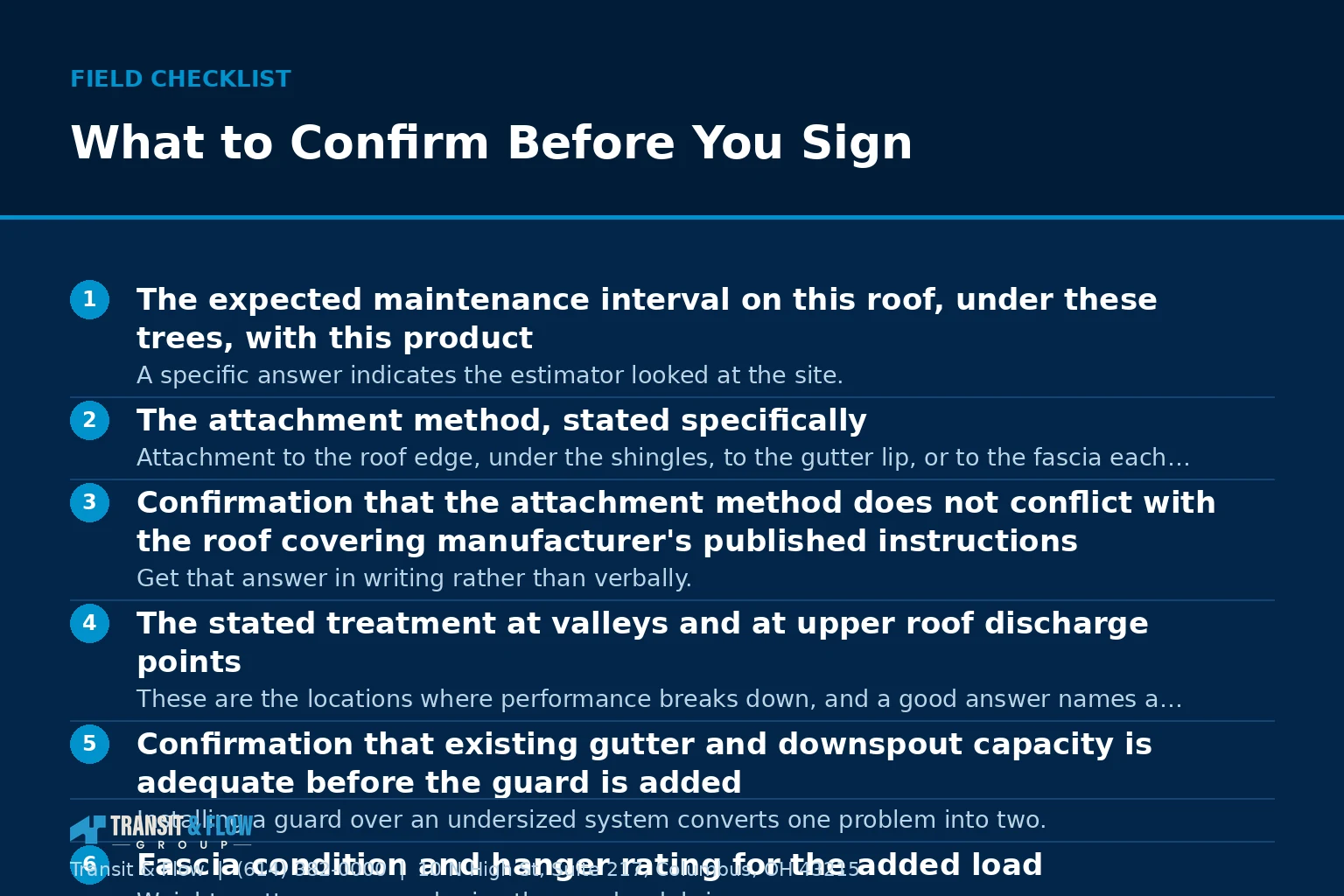
- The expected maintenance interval on this roof, under these trees, with this product. A specific answer indicates the estimator looked at the site. A claim of zero indicates otherwise.
- The attachment method, stated specifically. Attachment to the roof edge, under the shingles, to the gutter lip, or to the fascia each carries different implications for the roof and the hanger system.
- Confirmation that the attachment method does not conflict with the roof covering manufacturer’s published instructions. Get that answer in writing rather than verbally.
- The stated treatment at valleys and at upper roof discharge points. These are the locations where performance breaks down, and a good answer names a specific treatment.
- Confirmation that existing gutter and downspout capacity is adequate before the guard is added. Installing a guard over an undersized system converts one problem into two.
- Fascia condition and hanger rating for the added load. Weight matters more under ice than under debris.
- The actual warranty coverage and the party who performs work under it. A warranty covering only the product is different from one covering clogging performance, and a warranty is only worth the exclusions it survives.
- Whether the guard can be removed and reinstalled for cleaning without damage. Some designs cannot be, and that determines what a future cleaning costs and who can perform it.

Sales Practices Worth Recognizing
Gutter guards are a category with a long history of high pressure retail sales, and the patterns are consistent enough to name. A price that is available only if the contract is signed during the visit is a pressure device, not a discount. A demonstration performed with a watering can pouring water gently onto a sample is not a test of high intensity rainfall behavior. A photograph of a competitor’s failed installation tells you nothing about how this product performs on your roof. An estimate produced without anyone examining the roof edge, the valleys, or the fascia is a price for a product rather than a proposal for a job.
Ohio consumers have specific protections regarding home solicitation sales, including cancellation rights in defined circumstances. The Ohio Attorney General publishes current guidance on those protections, and reviewing it before a scheduled in home presentation is time well spent.
On Cost
This article contains no dollar figures on purpose. Gutter guard pricing varies by product category, by linear footage, by story height and access difficulty, by whether the existing gutters and hangers are being replaced at the same time, and by whether the work is sold through a national dealer network or performed as part of a broader exterior project. A number published here would be quoted back in situations it was never meant to describe. What is useful instead is the comparison structure: evaluate the cost of a guard against the cost of the cleaning interval it actually replaces, over the number of years you expect to own the house, on the specific runs where access is difficult.
Glossary
- Trough. The open channel of the gutter that carries water to the outlet.
- Outlet. The opening in the bottom of the gutter where the downspout connects.
- Micro mesh. A fine woven screen, usually stainless, intended to exclude small debris.
- Reverse curve. A solid cover design that relies on water clinging to a curved surface and entering through a narrow slot.
- Surface tension. The property of water that allows it to follow a curve rather than separating from it, and the mechanism reverse curve designs depend on.
- Fascia. The board at the roof edge that gutters and hangers commonly attach to.
- Hanger. The bracket that supports the gutter and transfers its load to the fascia or roof edge.
- Valley. The intersection where two roof planes meet, concentrating water from both into a narrow path.
- Granule loss. The shedding of the mineral surface from asphalt shingles as they age, producing grit that collects in gutters.
- Ice dam. A ridge of ice at the cold roof edge formed when meltwater from a warmer upper roof refreezes.
The Decision
Option A. Install guards across the full perimeter. This is the option most commonly proposed, and it is the option that generates the most disappointment, because it applies one product to runs with very different conditions and it prices the easy runs at the same rate as the difficult ones.
Option B. Correct capacity first, then guard selectively where access is genuinely difficult and canopy load is genuinely heavy. Verify that gutter size, downspout count, downspout cross section, and discharge destination are correct before adding anything on top. Then apply a guard to the specific runs where the maintenance interval is hardest to keep, and match the product to the debris that actually falls on those runs.
Our recommendation is Option B. A gutter guard is a maintenance tool, not a drainage solution, and layering one over an undersized or poorly placed system reliably produces a homeowner who believes the guard failed when the system was never adequate. Selective application also lets the budget concentrate on the runs where extended intervals have real value, which is usually a much shorter length than the full perimeter. Where guards are chosen, fine mesh generally performs best against the small seed and grit debris that dominates this region, provided the owner accepts that the mesh surface itself requires periodic washing.
Where Transit & Flow Group Fits
We evaluate the drainage system before we evaluate the guard, which means we look at run lengths, outlet count and size, slope, hanger and fascia condition, valley and upper roof discharge locations, and where water leaves the building, and we tell you plainly when the correct answer is to fix capacity and keep cleaning rather than to buy a cover. Our siding and gutters work is scoped as part of the exterior water management system, alongside grading and downspout discharge and the wall assembly discussed in our siding replacement guide. We do not sell through a timed in home presentation, and we do not price a job we have not looked at.
Transit & Flow Group coordinates projects and partners with properly licensed and insured specialty contractors when licensing is required, and work is performed under the appropriate permits.
Frequently Asked Questions
Do gutter guards mean I never have to clean my gutters again?
No product achieves that, and the more carefully worded product literature does not claim it. What guards achieve is a longer maintenance interval and a change in the character of the work, from removing packed wet leaves out of a trough to clearing debris resting on top of a cover and periodically washing a mesh surface. The phrase to listen for is any variation of never cleaning gutters again, because it signals a sales position rather than a product description. A specific stated interval for your roof, under your trees, with that product is the answer worth having.
Which type of gutter guard works best in Central Ohio?
The tree canopy across older Columbus neighborhoods, including Bexley, Clintonville, Upper Arlington, and Worthington, delivers a heavy spring seed load, a heavy fall leaf load, and a long shoulder season of small organic debris that behaves nothing like whole leaves. Coarse screens handle whole leaves and twigs but pass seeds, needles, and shingle grit through to accumulate below. Fine micro mesh excludes nearly all solid debris but can foul at the surface from pollen and grit and sheet water over the edge until it is washed. Where guards are chosen, fine mesh generally performs best against the small seed and grit debris that dominates this region, provided the owner accepts that the mesh surface itself requires periodic washing.
Will a gutter guard prevent ice dams on my roof?
Guards do not prevent ice dams. Ice dams form because heat escaping into the attic melts snow on the upper roof and that meltwater refreezes at the cold eave, which is an insulation and air sealing condition rather than a gutter condition. Some guard designs hold ice differently than an open gutter does, and a heavy ice load on a guard adds weight to the hanger system, but no guard addresses the mechanism that creates the ice. A proposal that presents ice dam prevention as a guard benefit has told you something about how it was trained to sell.
Why does every guard design seem to fail at something?
Every design is a compromise between two requirements that pull in opposite directions. A guard has to admit water at the rate the roof delivers it, including the short high intensity bursts that dominate summer storms in this region, and it also has to exclude solids. Openings large enough to pass water reliably in a downpour are large enough to pass small debris, and openings fine enough to exclude small debris are fine enough to shed water over the edge when surface tension breaks or when the screen itself is fouled. Understanding that trade off is what lets a homeowner evaluate a proposal instead of choosing based on a demonstration, since every demonstration is designed to display the condition that product handles well.
What conditions on my house actually decide whether a guard is worth it?
The species overhanging the roof matters most, because oaks and sycamores drop large debris that most guards exclude while maples, pines, and locusts drop seeds, needles, and small pods that most guards do not. Beyond that, weigh how much canopy sits above the roof plane, roof pitch and the resulting water velocity at the edge, roof age and granule loss, valley concentration, any upper roof discharging onto a lower roof, existing gutter and downspout capacity, access for the maintenance that will still be required, and fascia and hanger condition. Whether the roof covering manufacturer’s published instructions permit the attachment method belongs on the same list. A guard cannot solve a capacity problem, and it will be blamed for one.
What sales practices should I recognize in this category?
Gutter guards have a long history of high pressure retail selling, and the patterns are consistent enough to name. A price available only if the contract is signed during the visit is a pressure device rather than a discount. A demonstration performed with a watering can pouring water gently onto a sample is not a test of high intensity rainfall behavior, and a photograph of a competitor’s failed installation tells you nothing about how the product performs on your roof. An estimate produced without anyone examining the roof edge, the valleys, or the fascia is a price for a product rather than a proposal for a job. Ohio consumers have specific protections regarding home solicitation sales, including cancellation rights in defined circumstances, and the Ohio Attorney General publishes current guidance worth reviewing before a scheduled in home presentation.
Sources
- Ohio Attorney General, consumer protection guidance on home solicitation sales
- Ohio Construction Industry Licensing Board
- U.S. Department of Energy, moisture control
- National Weather Service, regional precipitation data
About This Guide
Written and edited by Micheal Parker, founder of Transit & Flow Group. Published March 14, 2027. This guide is checked against the agency and code sources listed above, and it is revised when those sources change.
General contractor of record. Micheal Parker holds City of Columbus General Contractor Registration G12064, issued by the Columbus Department of Building and Zoning Services under Transit & Flow LLC and valid through June 30, 2027. Trade work that falls outside the scope of that registration is performed by licensed trade partners, and the responsible license holder is identified before work begins.
Transit & Flow Group, home and commercial services for Columbus and the surrounding Central Ohio communities. Phone (614) 382-0000. Email solutions@transitflowgroup.com. 10 N. High St., Suite 217, Columbus, OH 43215. Contact our team or review the communities we serve.
