


The most effective basement waterproofing in Central Ohio is usually performed with a ladder, a shovel, and a length of corrugated pipe. That statement is not a slight against interior systems, which are the correct answer for genuine hydrostatic pressure. It is an observation about arithmetic. A roof delivers an enormous volume of water to a small footprint, and gutters and grading are the two mechanisms that decide whether that volume goes away from the house or against it. This article covers both, in order, and it is the practical companion to our wet basement guide. It supports our landscape and hardscape work.
In This Guide
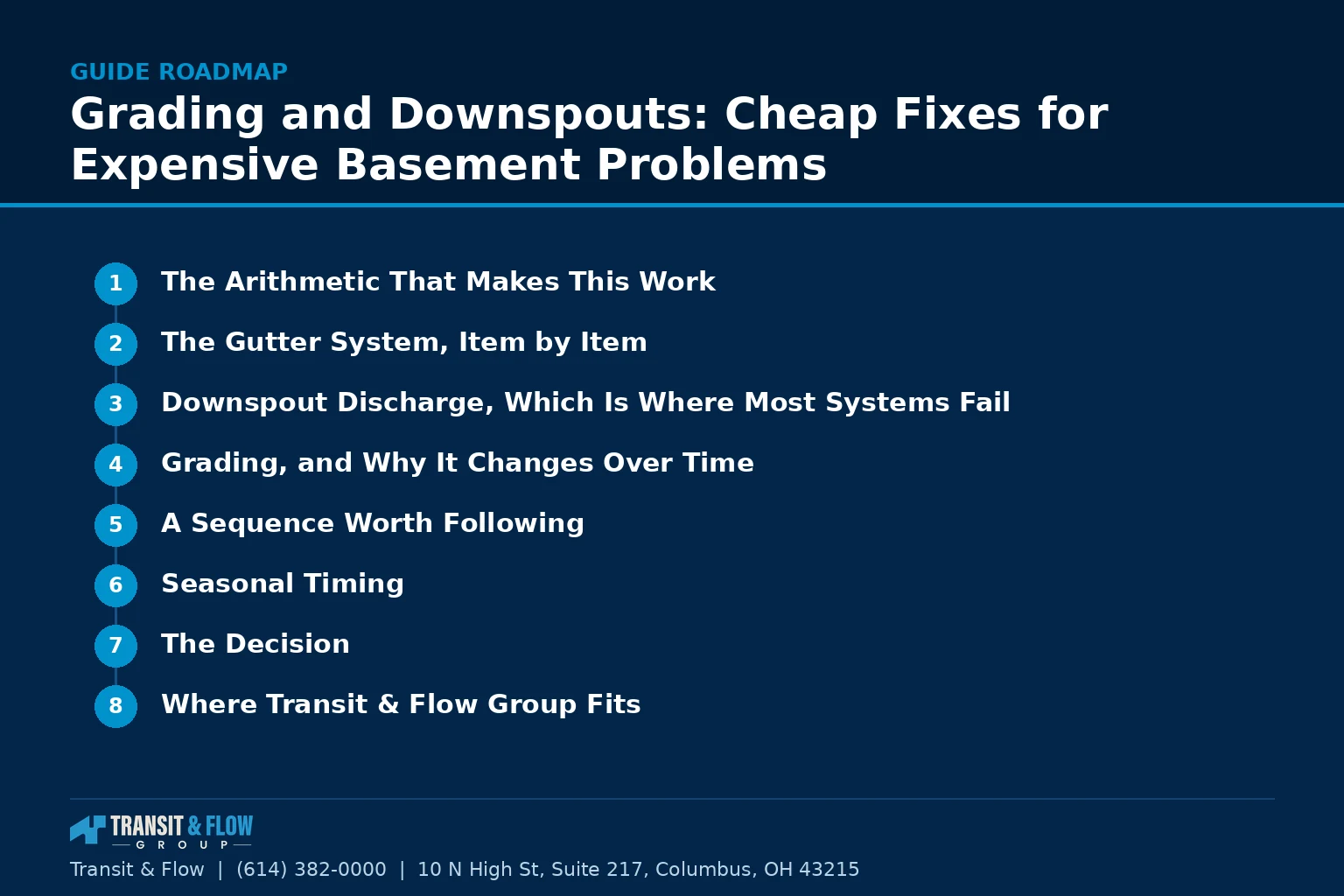
- The Arithmetic That Makes This Work
- The Gutter System, Item by Item
- Downspout Discharge, Which Is Where Most Systems Fail
- Grading, and Why It Changes Over Time
- A Sequence Worth Following
- Seasonal Timing
- On Cost
- Glossary
- The Decision
- Where Transit & Flow Group Fits
- Frequently Asked Questions
Transit & Flow Group coordinates projects and partners with properly licensed and insured specialty contractors when licensing is required.
The Arithmetic That Makes This Work
An inch of rain falling on a typical Central Ohio roof produces water measured in hundreds of gallons, and the gutter system concentrates all of it into a handful of downspouts. That concentration is the whole point of a gutter and it is also the whole risk. Every downspout is a controlled flood pointed at one spot, and whether that spot is six feet from the foundation or six inches determines what happens in the basement.
Now add the soil. Central Ohio’s clay rich soils accept water slowly, so what a downspout delivers does not soak away, it accumulates. And add backfill. The soil immediately around a foundation was excavated and replaced during construction, which makes it looser and more absorbent than the undisturbed soil beyond it. Water preferentially finds that looser ring and travels down it, straight to the footing. This is why the first several feet out from the wall matter more than everything beyond them combined.
Understood this way, the objective is simple to state. Collect the roof water cleanly, carry it well past the backfill zone, and slope the ground so that nothing arriving at the surface travels back toward the house.
The Gutter System, Item by Item
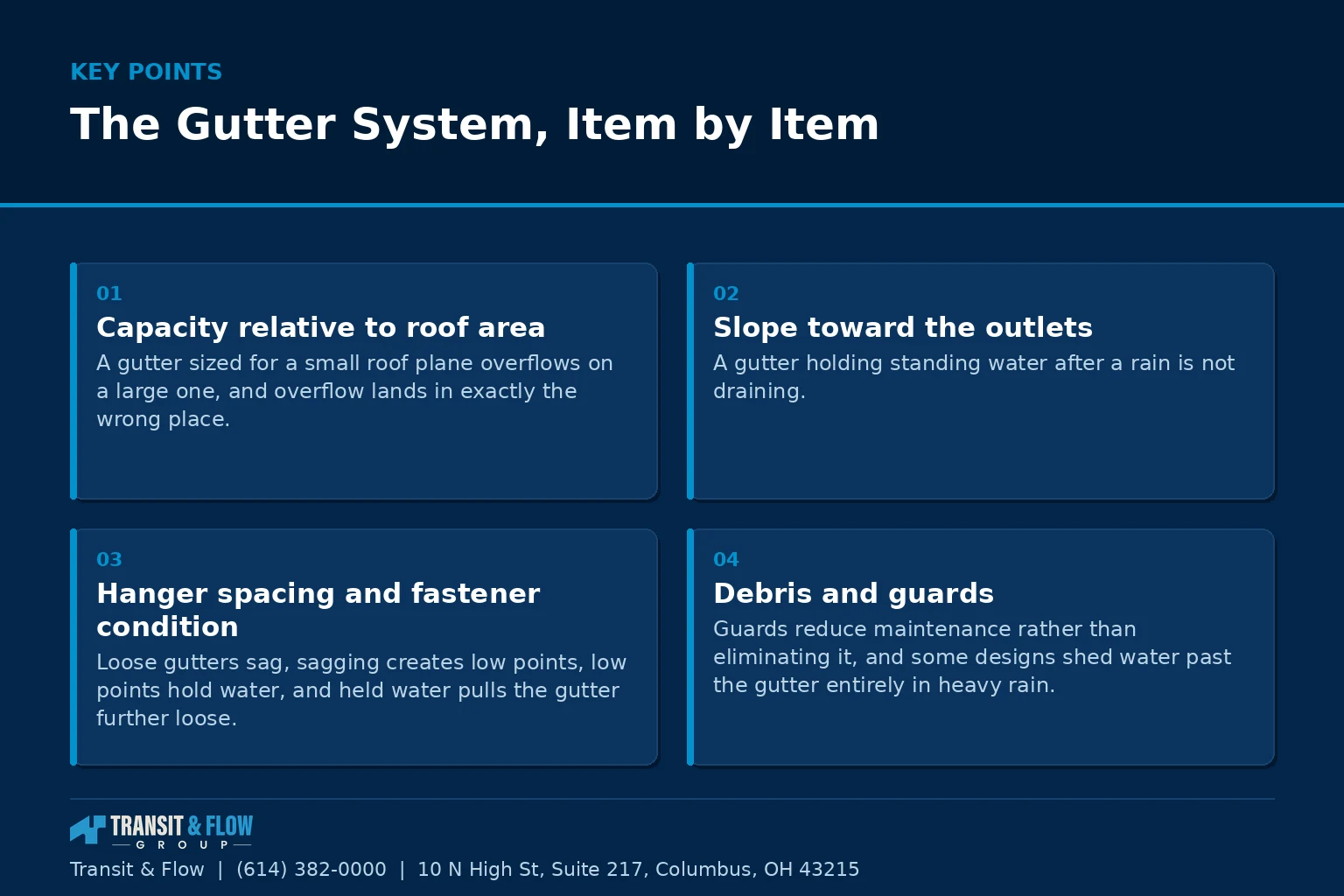
- Capacity relative to roof area. A gutter sized for a small roof plane overflows on a large one, and overflow lands in exactly the wrong place. Long runs, steep roof pitches, and valleys that concentrate flow all raise the requirement.
- Slope toward the outlets. A gutter holding standing water after a rain is not draining. Standing water accelerates corrosion, adds weight to the fasteners, and reduces the capacity available for the next event.
- Hanger spacing and fastener condition. Loose gutters sag, sagging creates low points, low points hold water, and held water pulls the gutter further loose. It is a self accelerating failure.
- Debris and guards. Guards reduce maintenance rather than eliminating it, and some designs shed water past the gutter entirely in heavy rain. Any guard system should be evaluated on how it behaves in a downpour, not only on how it handles leaves.
- Valley and kickout details. Where a roof meets a wall, a kickout diverting water into the gutter is a small piece of metal that prevents a large amount of water running down inside a wall.
- Number and placement of downspouts. Too few downspouts on a long run guarantees overflow at the far end regardless of gutter size. Adding a downspout is frequently cheaper and more effective than replacing a gutter.
- Seam and end cap condition. Failures at seams and end caps deliver water directly to the foundation while the gutter appears to function normally from the ground.
Downspout Discharge, Which Is Where Most Systems Fail
A gutter can be flawless and the system can still be delivering water to the foundation, because the failure is almost always downstream of the gutter. Three configurations dominate Central Ohio housing stock, and each fails in its own way.
| Configuration | How it works | How it fails | Detection |
|---|---|---|---|
| Splash block at the wall | Discharges at grade beside the foundation | Water lands inside the backfill zone and follows it down | Erosion, mulch washout, or a settled depression at the discharge point |
| Surface extension | Carries water several feet out on the surface | Too short, disconnected, crushed, or discharging into a low spot | Walk the extensions during a rain and watch where water actually goes |
| Buried solid line to a remote outlet | Carries water well away underground | Crushed, root intruded, silted, or the outlet is buried under sod | Water backing out at the downspout base during rain, or no flow at the outlet |
| Buried line to a dry well | Discharges to a subsurface storage pit | Pit saturates in clay soil and stops accepting water | Standing water above the pit, or backup at the downspout |
| Tied into a foundation or storm system | Discharges into an existing underground system | The system itself is compromised, and the roof load overwhelms it | Requires camera inspection to evaluate |
The buried line deserves particular attention in older Central Ohio neighborhoods, because it fails invisibly and it can fail badly. A crushed or blocked buried downspout line does not simply stop working. It delivers the roof’s entire output into the soil at the point of the blockage, which is frequently right beside the foundation, and it does so with no visible symptom above ground. Households with unexplained basement water and buried downspout lines should have those lines inspected before anything else is considered.
On termination, two rules cover most situations. Discharge well beyond the backfill zone, meaningfully further than the standard short extension provides. And discharge to a point that drains away, not to a low spot that holds water where it can migrate back. A properly extended downspout that terminates in a depression has moved the problem a few feet, not solved it.
Grading, and Why It Changes Over Time
Backfill settles. That is not a construction defect, it is what disturbed soil does over years as it consolidates. A house that was graded correctly at completion commonly develops a slight trough around the foundation within a decade, and that trough collects roof runoff and directs it downward at the wall. Regrading is therefore not a repair of someone’s mistake. It is periodic maintenance that most households never learn about.
- Establish positive slope away from the wall. The ground should fall away from the foundation across the first several feet, consistently around the perimeter rather than only where it was convenient.
- Use soil, not mulch, to establish the slope. Mulch and decorative stone are permeable and will not create a shedding surface. Slope is built with soil and then covered.
- Maintain clearance between soil and siding. Grade brought too high against the wall creates a different set of problems in the wall assembly, so slope is established by removing material in the low area rather than by piling material against the house.
- Address hardscape separately. Driveways, walks, and patios that have settled toward the house cannot be corrected with soil, and they deliver water with the reliability of a downspout. That is a hardscape scope, not a landscaping one.
- Check window wells. A well without a functioning drain is a container held against the foundation, and a well cover that does not shed water is decoration.
- Watch the neighbor’s water. On tight lots, particularly in older Columbus neighborhoods, the grade between houses frequently directs one property’s runoff along the other’s foundation. This is a real and common source and it requires a swale rather than perimeter work.
- Be careful with beds against the house. Landscape beds with edging that traps water, irrigation aimed at the foundation, and plantings that require frequent watering against the wall all work against everything else on this list.
A Sequence Worth Following
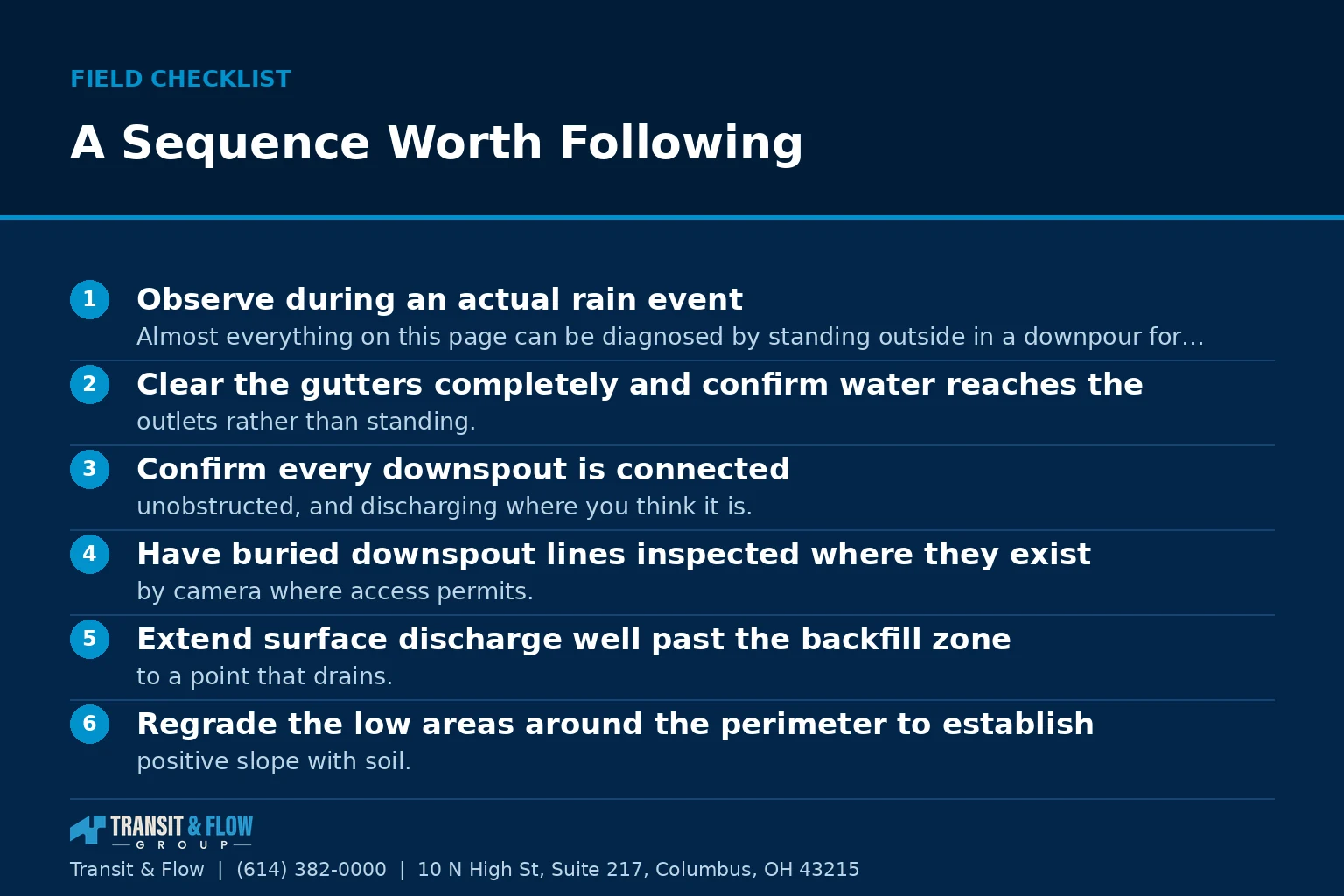
- Observe during an actual rain event. Almost everything on this page can be diagnosed by standing outside in a downpour for ten minutes with a flashlight, and almost nobody does it.
- Clear the gutters completely and confirm water reaches the outlets rather than standing.
- Confirm every downspout is connected, unobstructed, and discharging where you think it is.
- Have buried downspout lines inspected where they exist, by camera where access permits.
- Extend surface discharge well past the backfill zone, to a point that drains.
- Regrade the low areas around the perimeter to establish positive slope with soil.
- Correct settled hardscape and window well drainage as separate scopes.
- Observe through at least one more significant rain before considering anything below grade.
That last step is the discipline that saves money. The exterior work has to be given a chance to demonstrate what it fixed, and one heavy Central Ohio spring rain will tell you more than any proposal will.
Seasonal Timing
Autumn is the pressure test. Leaf fall clogs gutters and outlets precisely as the rain increases, which is why houses that were dry all summer start leaking in November. Gutters should be cleared after the last significant leaf drop, not in the middle of it, and then checked again before winter.
Winter creates ice at the gutter edge and freezes discharge lines, converting a functioning system into a blocked one at the worst possible time. Spring is when the accumulated consequences arrive together, with saturated ground and heavy rain, and it is also when grading work is hardest to perform well because the soil is wet. The practical implication is that late summer and early autumn are the right window for corrective grading and downspout work, so the system is ready before the load arrives.
On Cost
This article contains no dollar figures on purpose. The range across this scope is genuinely enormous, from a gutter cleaning to a full perimeter regrade with hardscape correction, and a published figure would mislead most readers. What is worth stating without numbers is the ratio. The work described on this page sits at the least expensive end of everything in the basement water category, and the systems it may make unnecessary sit at the most expensive end. That ratio is the argument.
Glossary
- Backfill zone. The ring of disturbed soil replaced around a foundation after excavation, which remains looser and more permeable than undisturbed soil.
- Positive grade. Ground sloping away from the foundation so surface water moves away from the house.
- Swale. A shallow shaped depression that intercepts and redirects surface water along a controlled path.
- Dry well. A subsurface pit that receives water and allows it to infiltrate, effective only where the surrounding soil accepts water at a useful rate.
- Kickout flashing. Flashing at the lower end of a roof to wall intersection that diverts water into the gutter rather than down the wall.
- Downspout extension. Surface or buried pipe carrying downspout discharge away from the foundation.
- Window well drain. The drain at the base of a below grade window well connecting to the drainage system.
- Ice dam. Ice accumulating at the roof edge that blocks drainage and forces water back under the roof covering.
- Infiltration rate. The speed at which soil accepts water, which is low in the clay rich soils common across Central Ohio.
The Decision
Option A is treating gutters and grading as landscaping maintenance, handled when convenient and evaluated by appearance. Option B is treating them as the primary water management system of the house, inspected during rain, corrected on a schedule, and completed before any below grade system is priced. My recommendation is Option B, and the reasoning is purely economic. This is the lowest cost intervention in the entire basement water category and it has the highest probability of resolving the problem outright. A household that completes Option B and still has water has learned something valuable and can proceed to an interior system with confidence. A household that skips it and buys the system first has purchased a machine to manage water it was delivering to itself. For the full diagnostic sequence, see our wet basement guide, and for the system that handles what remains, our article on sump pump sizing and backups.
Where Transit & Flow Group Fits
Transit & Flow Group coordinates landscape and hardscape and drainage work across Columbus and Central Ohio and partners with properly licensed and insured specialty contractors when licensing is required. Our standard on basement water is that the exterior water delivery path is evaluated and corrected before any below grade system is proposed, that buried downspout lines are inspected rather than assumed, that grading is established with soil and verified for clearance at the wall, and that the household is asked to observe through a real rain event before further scope is priced. To have gutters, discharge, and grading evaluated around your foundation, contact us.
Frequently Asked Questions
Why do gutters and grading matter more than the basement itself?
Because of arithmetic. An inch of rain on a typical Central Ohio roof produces water measured in hundreds of gallons, and the gutter system concentrates all of it into a handful of downspouts, so every downspout is a controlled flood pointed at one spot. Central Ohio’s clay rich soils accept water slowly, so what arrives does not soak away, it accumulates. The soil immediately around a foundation was excavated and replaced during construction, which leaves it looser and more absorbent than the undisturbed soil beyond it, so water preferentially travels down that ring straight to the footing.
My gutters look fine but the basement still gets wet. What am I missing?
Usually the discharge, because the failure is almost always downstream of the gutter. A splash block at the wall puts water inside the backfill zone by design. Surface extensions get disconnected, crushed, cut too short, or terminate in a low spot that holds water. Buried lines crush, silt up, take root intrusion, or discharge to an outlet that has been buried under sod. Seam and end cap failures also deliver water directly to the foundation while the gutter looks perfectly normal from the ground.
How worried should I be about a buried downspout line?
Enough to have it inspected before considering anything else, especially in older Central Ohio neighborhoods, because it fails invisibly and it fails badly. A crushed or blocked buried line does not simply stop working. It delivers the roof’s entire output into the soil at the point of the blockage, which is frequently right beside the foundation, with no visible symptom above ground. Where access permits, a camera inspection is the way to evaluate it.
Why does grading go bad on a house that was graded correctly?
Backfill settles, which is what disturbed soil does over years as it consolidates rather than a construction defect. A house graded correctly at completion commonly develops a slight trough around the foundation within a decade, and that trough collects roof runoff and directs it down against the wall. Regrading is therefore periodic maintenance rather than a repair of someone’s mistake, which is why most households never learn it exists. Build the slope with soil rather than mulch or decorative stone, since permeable material will not create a shedding surface, and establish it by removing material from the low area rather than piling soil against the house.
What order should I do this work in?
Start by observing during an actual rain event, since almost everything here can be diagnosed by standing outside in a downpour for ten minutes with a flashlight, and almost nobody does it. Then clear the gutters and confirm water reaches the outlets rather than standing, confirm every downspout is connected and discharging where you think it is, and have buried lines inspected where they exist. Then extend surface discharge well past the backfill zone to a point that actually drains, regrade the low areas with soil, and treat settled hardscape and window well drainage as separate scopes. The last step is the one that saves money: observe through at least one more significant rain before considering anything below grade.
When is the best time of year to do this work?
Late summer and early autumn, so the system is ready before the load arrives. Autumn is the pressure test, because leaf fall clogs gutters and outlets precisely as rain increases, which is why houses that were dry all summer start leaking in November, and gutters should be cleared after the last significant leaf drop rather than in the middle of it. Winter creates ice at the gutter edge and freezes discharge lines, turning a functioning system into a blocked one at the worst time. Spring brings the accumulated consequences together with saturated ground, and it is also when grading work is hardest to perform well because the soil is wet.
Sources
- United States Environmental Protection Agency, stormwater and runoff management guidance
- City of Columbus, Get a Permit, permit and inspection process
- Ohio Construction Industry Licensing Board, trade licensing verification
- United States Geological Survey, groundwater and soil information
About This Guide
Written and edited by Micheal Parker, founder of Transit & Flow Group. Published February 21, 2027. This guide is checked against the agency and code sources listed above, and it is revised when those sources change.
General contractor of record. Micheal Parker holds City of Columbus General Contractor Registration G12064, issued by the Columbus Department of Building and Zoning Services under Transit & Flow LLC and valid through June 30, 2027. Trade work that falls outside the scope of that registration is performed by licensed trade partners, and the responsible license holder is identified before work begins.
Transit & Flow Group, home and commercial services for Columbus and the surrounding Central Ohio communities. Phone (614) 382-0000. Email solutions@transitflowgroup.com. 10 N High St, Suite 217, Columbus, OH 43215. Contact our team or review the communities we serve.
