
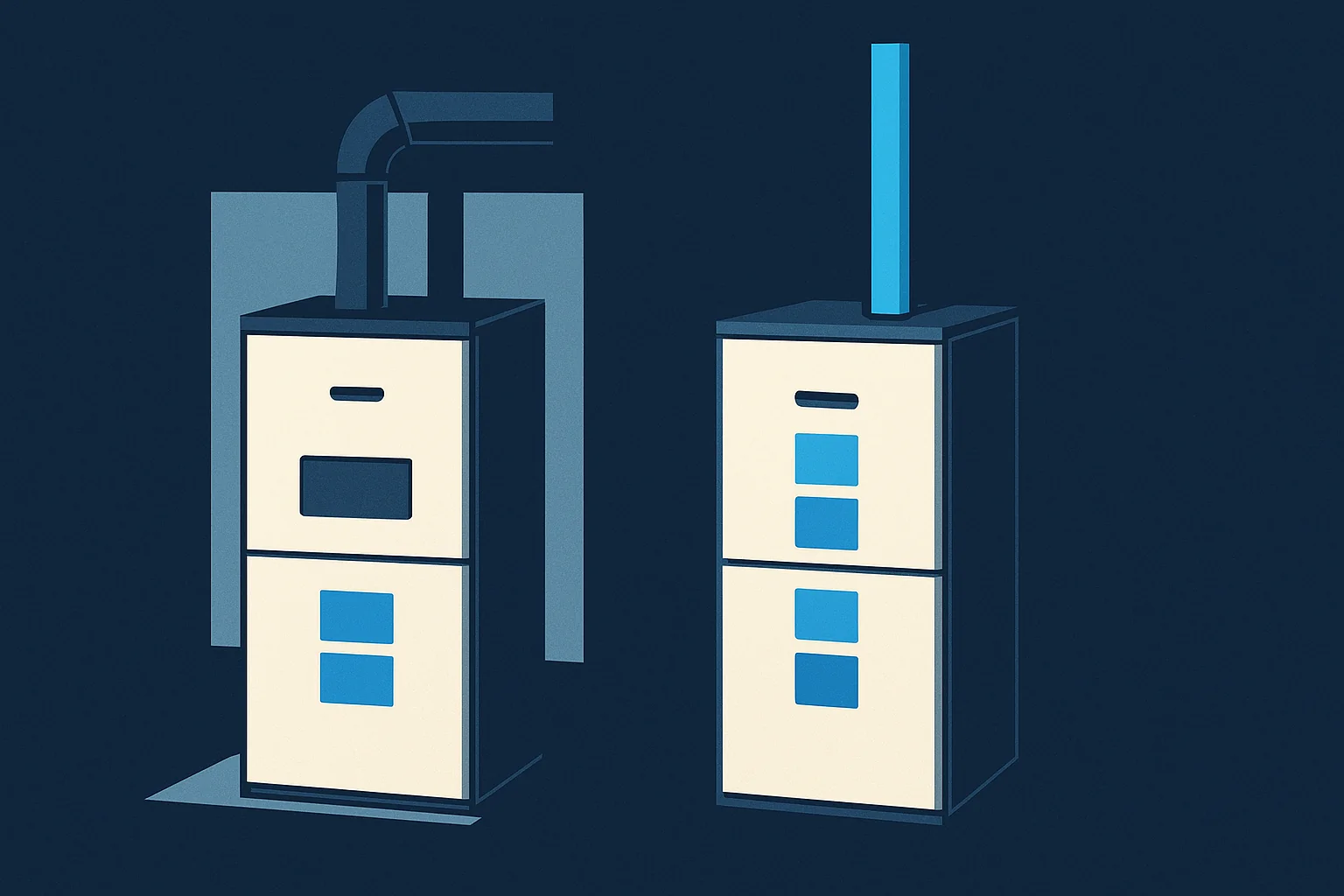

Efficiency ratings are the most quoted and least understood number in a furnace proposal. The rating is real, it is standardized, and it measures something narrower than most buyers assume. Understanding exactly what it captures, and what it deliberately leaves out, is what lets you tell whether the higher-rated unit in front of you is worth the difference in your house. This article goes further than the efficiency section of our furnace replacement guide, and it pairs with our article on furnace sizing.
In This Guide
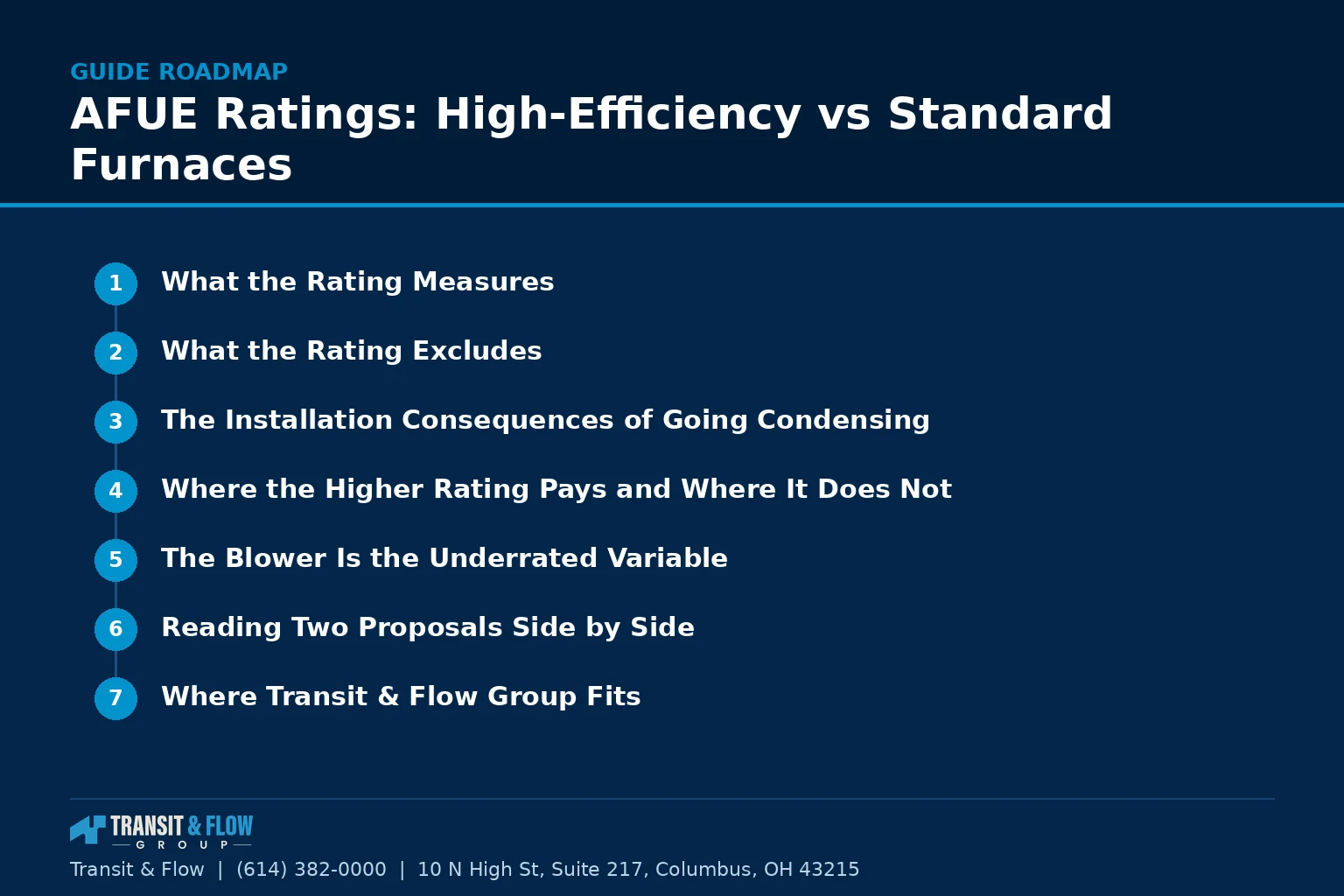
- What the Rating Measures
- What the Rating Excludes
- The Installation Consequences of Going Condensing
- Where the Higher Rating Pays and Where It Does Not
- The Blower Is the Underrated Variable
- Reading Two Proposals Side by Side
- Where Transit & Flow Group Fits
- Frequently Asked Questions
Transit & Flow Group coordinates projects and partners with properly licensed and insured specialty contractors when licensing is required.
One boundary. This is buying guidance. It is not instruction to install, vent, or modify combustion equipment, which in Ohio is licensed, permitted, and inspected work. If you smell gas, leave the building and call from outside.
What the Rating Measures
Annual fuel utilization efficiency, usually written as AFUE, expresses the share of the fuel energy entering the furnace that becomes usable heat delivered by the equipment across a full heating season. A unit rated in the low eighties converts roughly four fifths of the fuel energy into heat and sends the rest out the vent. A condensing unit in the mid nineties converts most of it.
The mechanism behind the difference is worth knowing, because it explains every installation consequence that follows. Burning natural gas produces water vapor. A conventional furnace sends that vapor up the flue still hot, and the energy carried in it leaves with it. A condensing furnace adds a second heat exchanger that cools the exhaust far enough that the vapor condenses back to liquid, releasing the energy it was carrying. That is where the extra efficiency comes from. It is also why a condensing furnace produces liquid water, needs a drain, and cannot vent through a masonry chimney.
What the Rating Excludes
This is the part the sticker does not tell you, and it is where most disappointment originates.
- Duct losses. The rating measures what leaves the equipment, not what arrives in your rooms. Ducts running through an unconditioned attic, crawl space, or garage lose a meaningful share of that heat before it reaches anyone. A high-rated furnace on a leaky duct system in unconditioned space can deliver less usable heat than a lower-rated one on a tight system inside the envelope.
- Electricity used by the blower. The rating covers fuel. The blower motor is a separate and not trivial operating cost, and it is where variable-speed equipment earns back money the fuel rating never counts.
- Sizing. An oversized high-efficiency furnace short cycles, and short cycling degrades real-world performance below the rated figure.
- Installation quality. Combustion setup, airflow setup, and venting execution all move actual performance. The rating assumes a correctly commissioned installation.
- Your envelope. The rating describes the furnace. It says nothing about how much heat your house needs in the first place, which is the larger variable in your gas bill.
The honest summary: the efficiency rating tells you how well the box converts fuel to heat. It does not tell you how much of that heat reaches you, or how much heat you needed.
The Installation Consequences of Going Condensing
These are scope items, not details, and they belong in the proposal in writing.
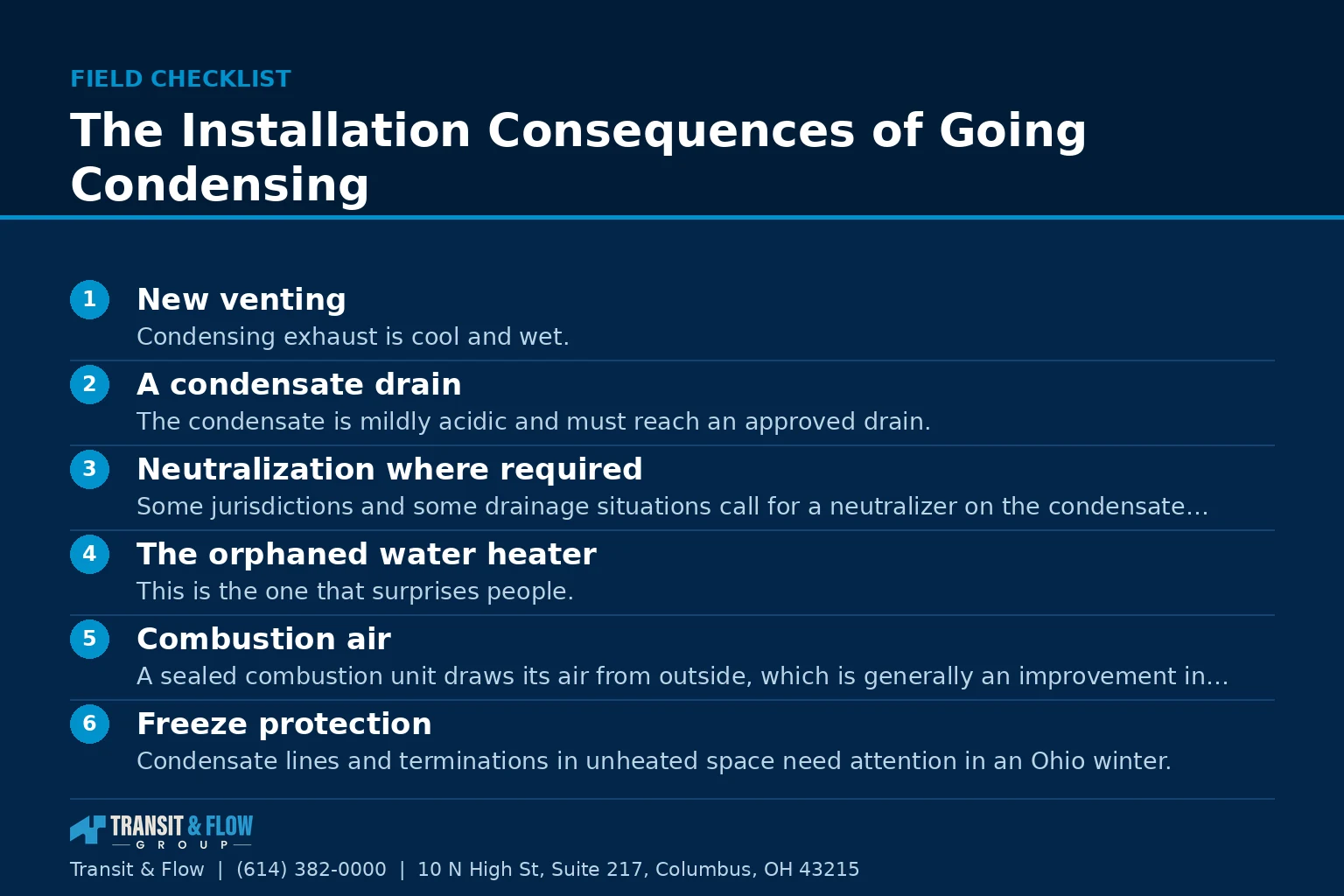
- New venting. Condensing exhaust is cool and wet. It vents through plastic pipe, typically out a sidewall, with a matched intake. The route has to clear windows, doors, walkways, mechanical intakes, and the property line, and it has to be somewhere snow will not bury it.
- A condensate drain. The condensate is mildly acidic and must reach an approved drain. In a basement that usually means a pump, and a pump is a component with a failure mode that will flood a mechanical room if ignored.
- Neutralization where required. Some jurisdictions and some drainage situations call for a neutralizer on the condensate line. Ask directly rather than assume.
- The orphaned water heater. This is the one that surprises people. If your furnace and gas water heater currently share a chimney and the furnace moves to sidewall venting, the water heater is left venting alone into a flue that was sized for both. That can produce poor draft and it is a recognized condition with recognized remedies. It must be evaluated as part of the project and named in the proposal.
- Combustion air. A sealed combustion unit draws its air from outside, which is generally an improvement in a tight house. The intake still has to be routed and terminated correctly.
- Freeze protection. Condensate lines and terminations in unheated space need attention in an Ohio winter.
Where the Higher Rating Pays and Where It Does Not
The savings scale with how much heating you actually buy. That single sentence resolves most of the debate.
- Pays clearly: a larger home, an older or leakier envelope, a long ownership horizon, high heating demand, ducts inside the conditioned envelope, and a mechanical location where sidewall venting is straightforward.
- Pays moderately: a mid-size well-insulated home with a sound duct system and a medium ownership horizon.
- Pays poorly: a small tight home with low heating demand, a short ownership horizon, a difficult venting path that adds significant scope, or a duct system in unconditioned space that has not been addressed.
- Does not pay at all when the duct system is the actual problem and the budget gets spent on the box instead of on distribution. This is the most common way money gets wasted in a furnace replacement.
The Blower Is the Underrated Variable
Homeowners consistently report noticing blower quality more than burner efficiency. A variable-speed blower runs longer at lower speeds, which mixes air between rooms, moves far more of the house air through the filter, holds temperatures steadier, and is dramatically quieter than a single-speed motor cycling on and off at full output. It also uses less electricity across a season despite running more hours.
If a proposal forces a choice between a higher burner rating and a variable-speed blower, the blower is frequently the better purchase for perceived comfort. Ask which motor type each proposal includes, because it is often unstated.
Reading Two Proposals Side by Side
On cost: this article contains no dollar figures and no payback periods on purpose. The difference between two efficiency tiers depends on equipment selection, the venting path in your specific building, whether a condensate pump and drain run are required, what happens to a shared chimney, local gas rates, your actual heating load, and how long you will own the home. Any published payback figure would be wrong for your house. Get two scoped proposals and compare them on the points below.
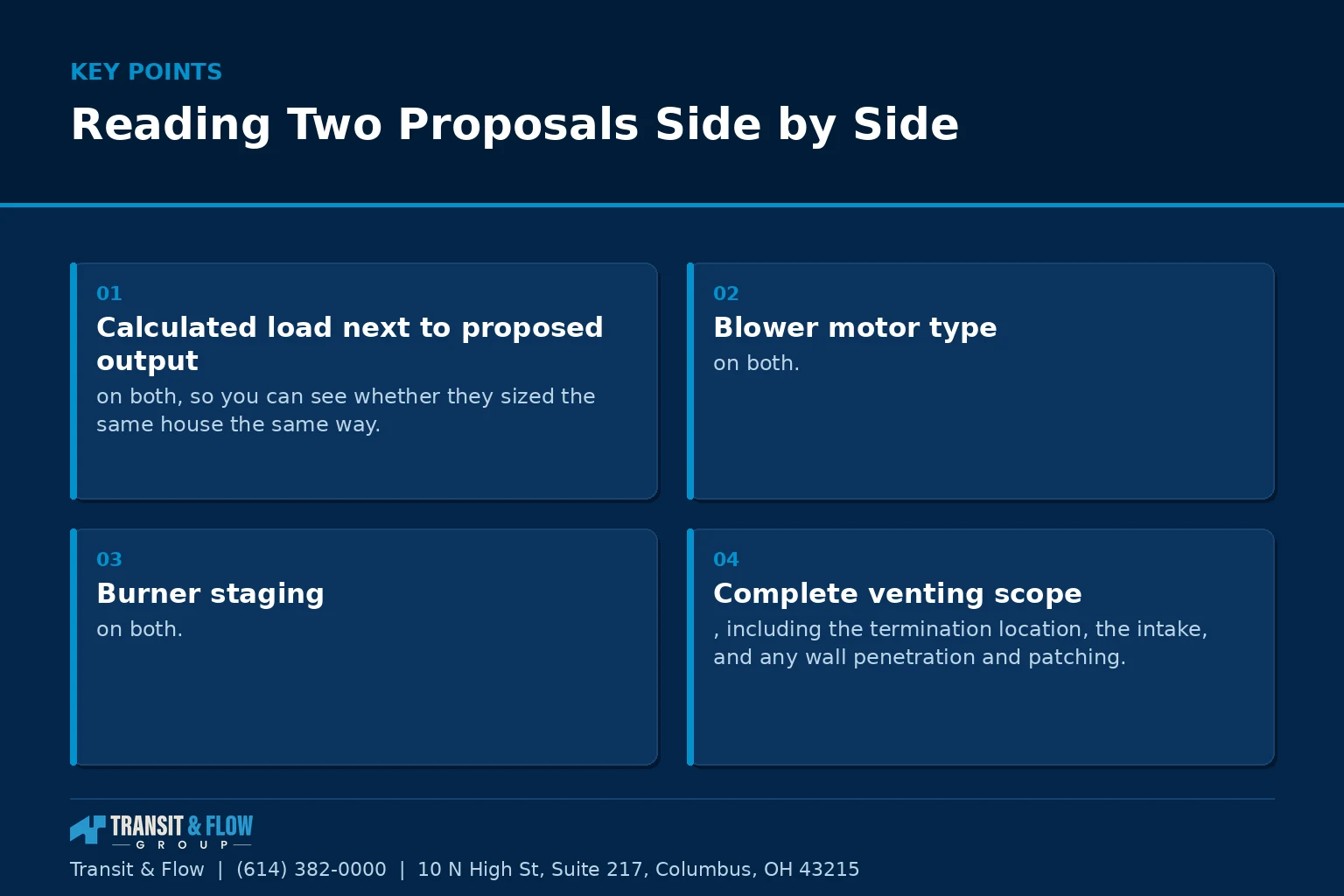
- Calculated load next to proposed output on both, so you can see whether they sized the same house the same way.
- Blower motor type on both. Named explicitly.
- Burner staging on both. Single-stage, two-stage, or modulating.
- Complete venting scope, including the termination location, the intake, and any wall penetration and patching.
- Condensate handling, including pump, drain route, discharge point, and neutralization if applicable.
- The water heater disposition if a chimney is being vacated. If a proposal is silent on this, it is incomplete.
- Duct work included or excluded, itemized. Exclusions are where the two totals actually differ.
- Filter type and location, and whether the cabinet accommodates a media filter.
- Permit and inspection, named, with who pulls it.
- Commissioning readings delivered in writing at completion. This is the item that separates a professional installation from a swap, and almost nobody asks for it.
- Warranty terms on heat exchanger, parts, and labor, all three stated separately.
- Registration requirement, because extended manufacturer coverage frequently depends on registering the equipment within a limited window after installation.
On incentives: utility rebates and tax credits for high-efficiency equipment exist and they change. Program rules, qualifying equipment lists, funding levels, and eligibility all move from year to year and some require pre-approval before installation. Treat any incentive as contingent until you have verified it directly with the administering utility or agency for the current program period. A purchase decision that only works with the incentive is a fragile decision.
Option A is a standard-efficiency unit with a quality installation, a variable-speed blower, and any needed duct correction included. Option B is a high-efficiency condensing unit with full venting scope. My recommendation for most Central Ohio homes is Option B where the duct system is sound or is being corrected in the same project and the venting path is straightforward, and Option A where the budget will not cover both the higher tier and the distribution work. Distribution first, every time. A premium furnace connected to ducts that cannot carry its output is money spent where nobody will feel it.
Where Transit & Flow Group Fits
Transit & Flow Group coordinates heating and cooling projects across Columbus and Central Ohio and partners with properly licensed and insured specialty contractors when licensing is required. Our standard on an efficiency comparison is that both options are scoped completely, including venting route, condensate handling, and the disposition of any water heater left on a vacated chimney, so the two numbers you compare cover the same work. Because sidewall venting and condensate pumps frequently involve electrical and drainage work, one coordinator carries the project. To get two fully scoped options on your house, request an assessment.
Frequently Asked Questions
What does an AFUE rating actually measure?
Annual fuel utilization efficiency expresses the share of the fuel energy entering the furnace that becomes usable heat delivered by the equipment across a full heating season. A unit rated in the low eighties turns roughly four fifths of the fuel energy into heat and sends the rest out the vent, while a condensing unit in the mid nineties converts most of it. The difference comes from a second heat exchanger that cools the exhaust far enough for the water vapor in it to condense, releasing the energy it was carrying. That same mechanism is why a condensing furnace produces liquid water and needs a drain.
Why does a high-efficiency furnace not always lower my gas bill as much as expected?
Because the rating measures what leaves the equipment, not what arrives in your rooms. Ducts running through an unconditioned attic, crawl space, or garage lose a meaningful share of that heat on the way, so a high-rated furnace on a leaky duct system outside the envelope can deliver less usable heat than a lower-rated one on a tight system inside it. The rating also excludes blower electricity, assumes correct sizing, assumes a correctly commissioned installation, and says nothing about how much heat your house needed in the first place. The honest summary is that it tells you how well the box converts fuel, not how much of that heat reaches you.
What extra work does going condensing add to the project?
Enough that it belongs in the proposal in writing rather than treated as detail. Condensing exhaust is cool and wet, so it vents through plastic pipe with a matched intake on a route that has to clear windows, doors, walkways, mechanical intakes, and the property line, and that snow will not bury. The condensate is mildly acidic and has to reach an approved drain, which in a basement usually means a pump, and some jurisdictions or drainage situations call for a neutralizer. Freeze protection for lines and terminations in unheated space also matters in an Ohio winter. The specific requirements come from the adopted code and the manufacturer’s published instructions, applied to your building by a licensed contractor and confirmed with your building department.
What happens to my water heater if the furnace stops using the chimney?
This is the item that surprises people most. If your furnace and gas water heater currently share a chimney and the furnace moves to sidewall venting, the water heater is left venting alone into a flue that was sized for both, which can produce poor draft. It is a recognized condition with recognized remedies, and it has to be evaluated as part of the project and named in the proposal. A proposal that is silent on the water heater disposition when a chimney is being vacated is incomplete.
When is the higher efficiency tier worth it, and when is it not?
The savings scale with how much heating you actually buy, which resolves most of the debate. It pays clearly in a larger home with an older or leakier envelope, high heating demand, a long ownership horizon, ducts inside the conditioned envelope, and a straightforward sidewall venting path. It pays poorly in a small tight home with low heating demand, a short ownership horizon, a difficult venting path that adds significant scope, or a duct system in unconditioned space that has not been addressed. It does not pay at all when the duct system is the actual problem and the budget goes to the box instead of the distribution, which is the most common way money gets wasted in a furnace replacement.
Should I prioritize a higher efficiency rating or a better blower?
Homeowners consistently report noticing blower quality more than burner efficiency. A variable-speed blower runs longer at lower speeds, which mixes air between rooms, moves far more of the house air through the filter, holds temperatures steadier, and is much quieter than a single-speed motor cycling on and off at full output, while using less electricity across a season despite more run hours. If a proposal forces a choice between a higher burner rating and a variable-speed blower, the blower is frequently the better purchase for perceived comfort. Ask which motor type each proposal includes, because it often goes unstated.
Sources
- U.S. Department of Energy, Building Technologies Office, heating equipment efficiency guidance
- Ohio Construction Industry Licensing Board, HVAC trade licensing
- City of Columbus, Get a Permit, mechanical permit channels
About This Guide
Written and edited by Micheal Parker, founder of Transit & Flow Group. Published October 28, 2026. This guide is checked against the agency and code sources listed above, and it is revised when those sources change.
General contractor of record. Micheal Parker holds City of Columbus General Contractor Registration G12064, issued by the Columbus Department of Building and Zoning Services under Transit & Flow LLC and valid through June 30, 2027. Trade work that falls outside the scope of that registration is performed by licensed trade partners, and the responsible license holder is identified before work begins.
Transit & Flow Group, home and commercial services for Columbus and the surrounding Central Ohio communities. Phone (614) 382-0000. Email solutions@transitflowgroup.com. 10 N. High St., Suite 217, Columbus, OH 43215. Contact our team or review the communities we serve.
