
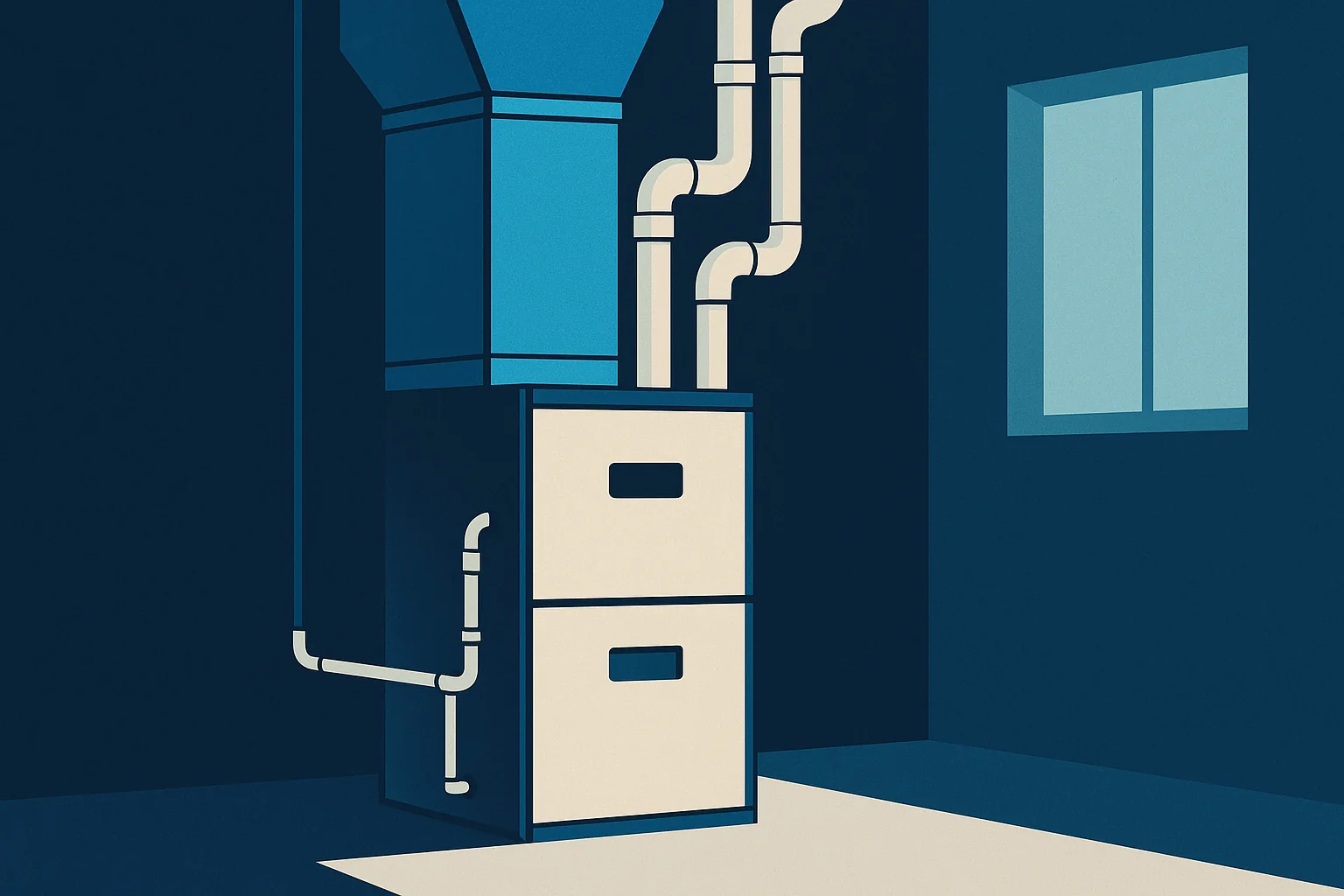

A furnace replacement is one of the few purchases a homeowner makes where the equipment matters less than the installation. Two identical units, same brand, same efficiency rating, installed in two identical houses, will deliver measurably different comfort, different operating cost, and different service lives depending entirely on how they were sized, how they were vented, and what condition the duct system was in on the day they were connected. This guide is written to give you the vocabulary and the decision framework to tell those two installations apart before you sign.
In This Guide
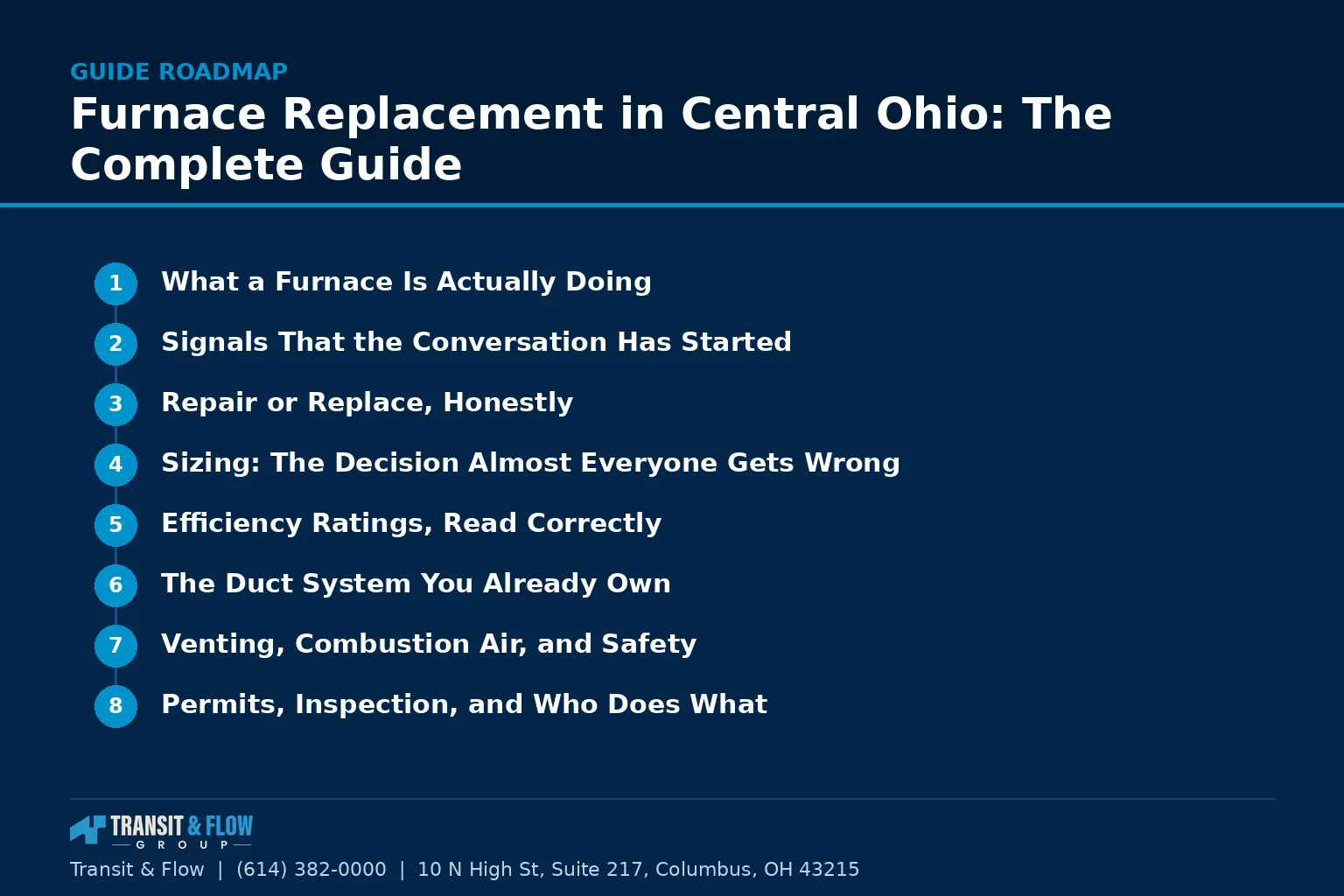
- What a Furnace Is Actually Doing
- Signals That the Conversation Has Started
- Repair or Replace, Honestly
- Sizing: The Decision Almost Everyone Gets Wrong
- Efficiency Ratings, Read Correctly
- The Duct System You Already Own
- Venting, Combustion Air, and Safety
- Permits, Inspection, and Who Does What
- Reading a Furnace Proposal
- A Decision Framework
- What Installation Day Looks Like
- Keeping It Alive
- A Glossary Worth Keeping
- Where Transit & Flow Group Fits
- Frequently Asked Questions
Transit & Flow Group coordinates projects and partners with properly licensed and insured specialty contractors when licensing is required.
One boundary before anything else. This guide covers evaluation, planning, and how to read a proposal. It is not instruction to service, modify, vent, or install heating equipment. A gas furnace burns fuel inside your home and exhausts combustion products through a vent system, and errors in that system produce carbon monoxide. Combustion appliance work in Ohio is licensed, permitted, and inspected for exactly that reason. If you smell gas, leave the building first and call from outside.
What a Furnace Is Actually Doing
A gas furnace performs three separate jobs, and understanding them separately makes every later decision clearer. It burns fuel in a sealed combustion chamber. It transfers that heat through a heat exchanger into the air moving past it, without letting combustion gases mix into that air. And it moves the heated air through your duct system to the rooms that need it, then pulls it back to start again.
The heat exchanger is the component that separates the two air streams, and it is the component whose failure ends a furnace’s life. When a heat exchanger cracks, combustion products can enter the air you breathe. That is why a technician who reports a cracked heat exchanger will red-tag the unit rather than offering to keep an eye on it, and it is why that particular finding effectively ends the repair conversation.
The blower is doing the other half of the job, and it is the half homeowners underestimate. A furnace with adequate heating capacity attached to a duct system that cannot move the air will produce cold rooms, short cycling, and premature component failure. This is why the ductwork section later in this guide is not an upsell. It is the difference between a working installation and an expensive one that disappoints.
Signals That the Conversation Has Started
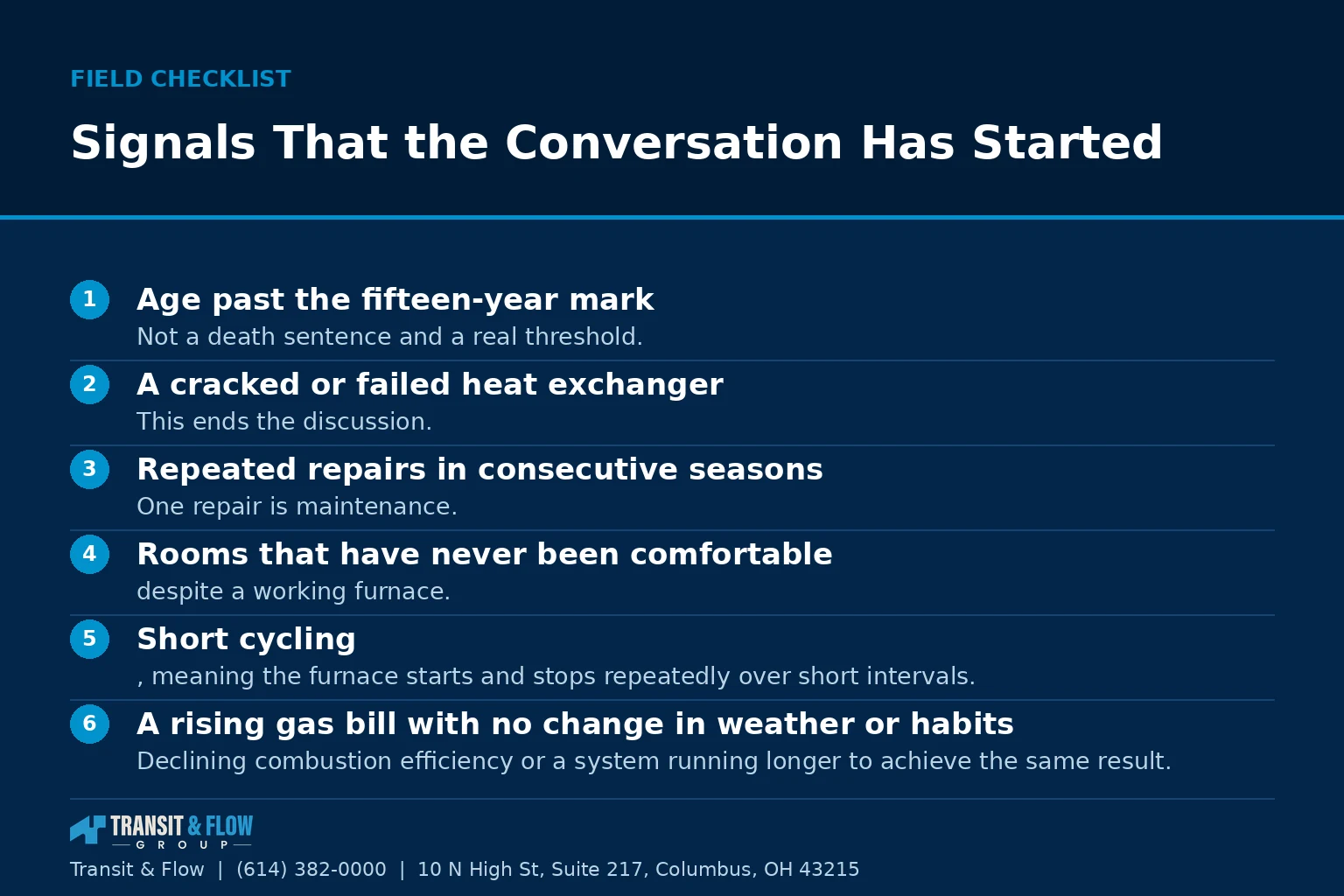
Sorted by what each one actually tells you rather than by urgency alone.
- Age past the fifteen-year mark. Not a death sentence and a real threshold. Beyond it, every repair decision should be weighed against remaining life rather than against the repair cost alone.
- A cracked or failed heat exchanger. This ends the discussion. Replace the unit.
- Repeated repairs in consecutive seasons. One repair is maintenance. Three in two winters is a pattern, and the pattern is the message.
- Rooms that have never been comfortable despite a working furnace. This usually points at distribution rather than at the unit, which means replacing the unit alone will not fix it.
- Short cycling, meaning the furnace starts and stops repeatedly over short intervals. Frequently a symptom of an oversized unit or a restricted duct system, and it shortens equipment life.
- A rising gas bill with no change in weather or habits. Declining combustion efficiency or a system running longer to achieve the same result.
- A yellow or lazy burner flame rather than a crisp blue one, or soot around the unit. Have this looked at promptly.
- Any carbon monoxide alarm activation. Leave, then call. Never reset and resume.
- Unusual noises at startup or shutdown, particularly booming, scraping, or grinding.
- Excessive dust or humidity complaints that appeared alongside heating season, which often point at duct leakage pulling from unconditioned space.
- Parts availability problems. When a technician says a board or a motor is on extended backorder, that is a signal about the remaining practical life of the unit.
- A planned home sale within two years. A heating system at the end of its life becomes a negotiating item, and doing it on your schedule is cheaper than doing it on a buyer’s.
Repair or Replace, Honestly
The rule of thumb circulating online, comparing repair cost against unit age, is a starting point and not a decision. It ignores the three things that actually matter: what else is likely to fail next, what the operating cost difference would be, and how long you intend to own the house.
- Repair when the unit is under a dozen years old, the failure is a discrete component with no history of related failures, the heat exchanger is confirmed sound, and the duct system is in reasonable condition.
- Replace when the heat exchanger has failed, when the unit is past fifteen years and facing a major component repair, when repairs have recurred across seasons, or when you are already opening walls or ceilings for other work and access will never be cheaper.
- The genuinely ambiguous case is a unit between twelve and fifteen years with one significant failure and no other symptoms. Here the deciding factors are how long you plan to stay, whether the duct system needs attention anyway, and whether you can tolerate a mid-winter failure. There is no arithmetic that resolves this. It is a risk preference.
One thing worth naming plainly: a technician recommending replacement is not automatically upselling you, and a technician recommending repair is not automatically honest. What separates a trustworthy recommendation from a sales pitch is whether it comes with a diagnosis you can follow, a written finding you can take to a second opinion, and a willingness to explain what would change the answer. Ask for the finding in writing. Anyone confident in their diagnosis will provide it.
Sizing: The Decision Almost Everyone Gets Wrong
If you take one thing from this guide, take this. The most common error in residential heating is installing a furnace that is too large, and the most common reason is that the new unit was sized by matching the old unit, which was itself oversized when it was installed decades ago. The error compounds across replacements.
An oversized furnace does not heat your home better. It heats it in short violent bursts, satisfies the thermostat quickly, and shuts off. That pattern produces a specific set of complaints: uneven temperatures between rooms, a stuffy feeling because the air never circulates long enough to mix or dehumidify, noticeable temperature swings, more wear from repeated start cycles, and higher operating cost from the inefficiency of constant starting.
The correct method is a room-by-room load calculation using a recognized procedure. It accounts for square footage, ceiling heights, insulation levels in walls and attic, window area and glazing type, orientation, air infiltration, and the local design temperature. It produces a heating requirement in real units, and the equipment is selected to meet that requirement with a modest margin rather than a generous one.
- Ask whether a load calculation was performed for your specific house, and ask to see it.
- Be skeptical of sizing by square footage alone. A rule expressed as heating capacity per square foot ignores insulation, windows, and air sealing, which are the variables that actually differ between two houses of the same size.
- Be more skeptical of sizing by matching the existing unit, especially if the house has had insulation, air sealing, or window work since that unit was installed. Those improvements reduce the load, sometimes substantially.
- Understand input versus output. A furnace consumes fuel at one rate and delivers heat at a lower one. The efficiency rating is the relationship between those two numbers, and the output figure is what must match your calculated load.
- Ask what design temperature was used. Central Ohio has a recognized winter design condition, and sizing to a colder extreme than that guarantees an oversized system to serve a handful of hours a year.
A contractor who performs and shows you a load calculation has separated themselves from most of the field before discussing a single piece of equipment. That is the strongest single signal available to you as a buyer.
Efficiency Ratings, Read Correctly
The efficiency rating on a gas furnace describes what share of the fuel energy becomes usable heat in your home over a heating season. The rest leaves through the vent. A furnace rated in the low eighties sends roughly a fifth of the fuel energy up the flue. A high-efficiency condensing furnace captures much of the heat that would otherwise be lost, which is why it produces liquid condensate and requires a drain.
The honest framing is this. A higher rating reduces fuel consumption for the same delivered heat, and the value of that reduction depends on how much heating your house actually needs, what you pay for gas, and how long you will own the home. It is real, it is measurable, and it is smaller in a well-insulated small home in a mild winter than the marketing implies. It is larger in a big, leaky house through a hard Ohio winter.
- Condensing units require different venting. Exhaust temperatures are low enough that the vent is typically plastic pipe routed through a sidewall rather than up an existing chimney. This is a real scope item, not a detail.
- Condensing units produce acidic condensate that must be drained, and in a basement installation frequently pumped. The drain path, the pump, and where it discharges are all scope.
- Orphaned water heater. If your furnace and water heater currently share a chimney and the furnace moves to sidewall venting, the water heater is left venting alone into a flue that may now be oversized for it. This is a recognized condition with recognized remedies, and it is a question to ask directly rather than discover afterward.
- Blower type matters as much as the burner rating. A variable-speed blower runs longer at lower speeds, which mixes air better, filters more, and is quieter. Many homeowners perceive that difference more strongly than the fuel savings.
- Single-stage, two-stage, and modulating burners describe how finely the furnace can match its output to the actual demand. Finer modulation means longer, gentler runs and more even temperatures, and it costs more.
Option A is a standard-efficiency unit with a quality installation and duct correction. Option B is a high-efficiency modulating unit with a variable-speed blower. My recommendation for most Central Ohio homes is Option B only where the duct system is sound or is being corrected as part of the project, and Option A plus duct correction where the budget will not cover both. A premium furnace connected to a duct system that cannot deliver its output is money spent where it cannot be felt. Fix the distribution first. That ordering is the single most valuable piece of advice in this guide.
The Duct System You Already Own
Ductwork is invisible, unglamorous, and the most common reason a new furnace disappoints its owner. A furnace and its duct system are one machine. Replacing half of a machine and expecting a whole result is optimistic.
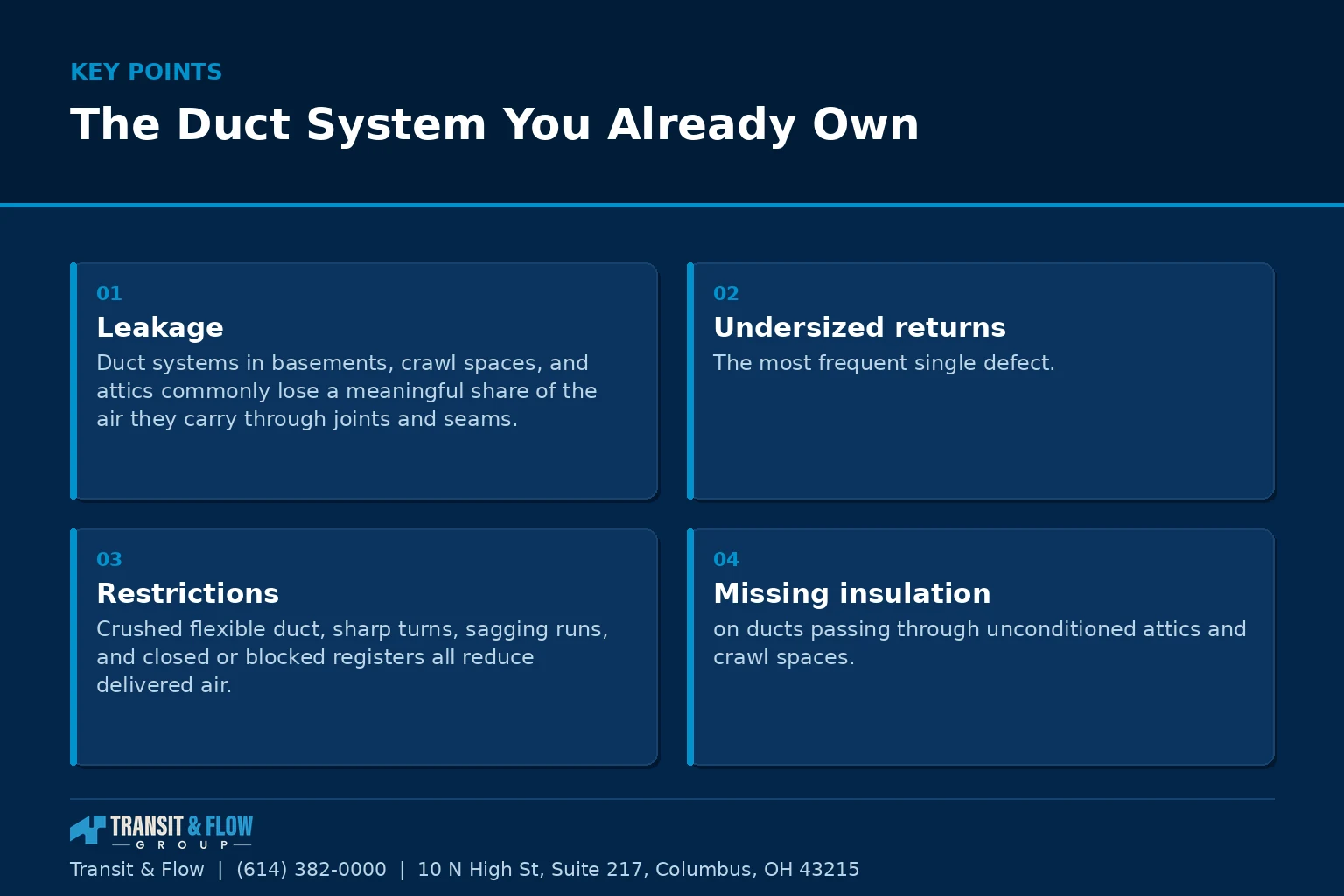
- Leakage. Duct systems in basements, crawl spaces, and attics commonly lose a meaningful share of the air they carry through joints and seams. Air lost into unconditioned space is fuel purchased and thrown away, and in a return duct it pulls dust, humidity, and sometimes combustion air from places you do not want.
- Undersized returns. The most frequent single defect. A system can only deliver what it can pull back. Insufficient return capacity starves the blower, raises temperature rise across the heat exchanger, and shortens equipment life.
- Restrictions. Crushed flexible duct, sharp turns, sagging runs, and closed or blocked registers all reduce delivered air.
- Missing insulation on ducts passing through unconditioned attics and crawl spaces.
- Poor balance. Rooms far from the air handler starved while nearby rooms overheat. Frequently correctable with dampers and modest modification rather than a redesign.
- Legacy conversions. Gravity-era octopus ductwork adapted to forced air over the decades, common in older Central Ohio housing stock, frequently sized for a completely different operating principle.
Ask any contractor proposing a replacement whether they evaluated static pressure across the system and whether the return capacity supports the proposed blower. A contractor who measured is telling you something. A contractor who did not is guessing about the half of the system that determines whether you are satisfied.
Venting, Combustion Air, and Safety
This is the section where the stakes stop being about comfort. A furnace consumes air to burn fuel and must exhaust the products of that combustion completely outside the building. Both halves have to be right.
- Vent material and routing must match the appliance category. A condensing furnace and a standard-efficiency furnace do not vent the same way, and reusing an existing vent without evaluation is not acceptable practice.
- Vent termination clearances from windows, doors, soffits, air intakes, and property lines are specified for a reason, and sidewall terminations in Ohio also have to account for snow accumulation blocking the intake or exhaust.
- Combustion air supply. A furnace in a tight mechanical room or a tightly sealed house may not have adequate air to burn properly. Sealed combustion units draw air directly from outside, which removes this concern.
- Backdrafting. Exhaust fans, a clothes dryer, and a range hood can depressurize a house enough to pull combustion products back down a vent. This is a real, documented condition and it is worth asking your installer whether they tested for it.
- Carbon monoxide alarms on every level and outside sleeping areas, tested. Non-negotiable in any home with a fuel-burning appliance, and the cheapest safety equipment you will ever buy.
- The chimney, if one remains in use. Liner condition and sizing matter, particularly if the furnace is leaving a shared flue and a water heater is staying behind.
Requirements around venting, clearances, combustion air, and appliance categories are set by adopted code, and Ohio jurisdictions do not all adopt the same edition on the same schedule. Nothing in this article should be treated as the current requirement at your address. Confirm specifics with your installing contractor and the building department that will inspect the work.
Permits, Inspection, and Who Does What
- Load calculation and system design before equipment is selected.
- Written proposal naming equipment, scope, inclusions, and exclusions.
- Permit application with the building department for the jurisdiction the property sits in. In Ohio this is typically a mechanical permit, and gas piping work may require its own.
- Removal and disposal of the existing unit, including proper handling of the old equipment.
- Installation, covering the unit, the vent system, gas connection, condensate handling if applicable, electrical connection, thermostat, and any duct transitions or modifications.
- Startup and commissioning. Gas pressure verified, temperature rise measured against the manufacturer’s specified range, airflow confirmed, safeties tested, and combustion analyzed. Ask for these readings in writing.
- Inspection by the jurisdiction, scheduled by whoever the contract says schedules it.
- Documentation handoff. Permit final, manuals, warranty registration confirmation, and the commissioning readings.
Item six is the one to insist on. Commissioning readings are the evidence that the installation was completed rather than merely finished. A contractor who records temperature rise, static pressure, and combustion analysis is documenting their own work against a standard. That paperwork is also what you hand a future technician, or a future buyer.
Reading a Furnace Proposal
On cost: this guide publishes no prices and no ranges on purpose. Furnace projects vary with the calculated load, efficiency tier, blower and burner type, whether venting changes from chimney to sidewall, condensate handling, gas line sizing, electrical work, the extent of duct correction, equipment access, permit and inspection requirements by jurisdiction, and current equipment availability. A published range would be wrong for most houses and would set an expectation that a correct proposal then appears to violate. Get written proposals on your actual house and check each one against the items below.
- The calculated heating load for this house, and the calculation itself provided in writing.
- The output capacity of the proposed unit, and the margin that represents over the calculated load.
- The efficiency rating, the burner staging, and the blower type, with the reasoning for these rather than the tier above and the tier below.
- The venting arrangement for this unit, and whether it changes the existing vent or chimney.
- The disposition of the water heater if the furnace leaves a shared flue.
- Whether static pressure was measured, and whether the return capacity supports the proposed blower.
- The duct modifications included, and the duct deficiencies found but left out of the scope.
- Condensate handling, including a pump and a discharge path where one is needed.
- The adequacy of the gas line, and any gas piping work included in the scope.
- Who pulls the permit, who schedules the inspection, and whether those fees sit inside this price.
- The commissioning readings that will be recorded and handed to you.
- The equipment warranty and the labor warranty, their respective lengths, and the effect of registration on either.
- The explicit exclusions. Drywall repair, electrical upgrades, chimney work, and asbestos or hazardous material handling in older homes are the common gaps.
- The removal and disposal plan for the old equipment.
- The timeline, and the contingency if the equipment is delayed.
A word on incentives. Federal, state, and utility programs for high-efficiency heating equipment exist, and their availability, amounts, and eligibility requirements change with legislation and program funding. No contractor can guarantee you a tax credit, and no article should tell you that you qualify. Verify current terms with the administering agency and your utility, and confirm eligibility with a tax professional before letting an incentive drive the equipment decision.
A Decision Framework
- Heat exchanger cracked. Replace. There is no other answer.
- Unit under a dozen years, discrete failure, sound heat exchanger. Repair, and start a replacement fund.
- Past fifteen years, facing a major repair. Replace. Money into an aging unit buys time, not equipment.
- Rooms have never been comfortable. Diagnose distribution before buying equipment. A new furnace will not fix a duct problem.
- Ducts are in poor condition and the budget is limited. Standard-efficiency unit plus duct correction beats a premium unit on bad ducts, every time.
- Planning solar, a heat pump, or broader electrification within five years. Discuss a dual-fuel or heat pump path now, before committing to a gas-only replacement.
- Selling within two years. Reliable, correctly sized, permitted, documented. Premium efficiency rarely returns its cost at sale.
- Staying fifteen years or more. Efficiency and modulation are worth more here than anywhere else, because you will own every heating season of the payback.
- Currently mid-winter with no heat. Get temporary heat safely, then make this decision with a clear head rather than under pressure in a cold house. Pressure is the most expensive condition to buy in.
What Installation Day Looks Like
- Gas and electrical supply to the unit are shut off and verified.
- The old unit is disconnected and removed, along with the old vent connector.
- Any duct transitions, plenum modifications, or return corrections are fabricated and installed.
- The new unit is set, leveled, and connected to gas, electrical, and duct.
- The vent system is installed and terminated, and condensate drainage is routed if applicable.
- The thermostat is installed and configured.
- Startup: gas pressure set, temperature rise measured against specification, airflow verified, safeties tested, combustion analyzed.
- Walkthrough with you, covering filter location and size, thermostat operation, the shutoff locations, and what normal operation sounds like.
- Site cleanup and removal of the old equipment.
- Inspection is scheduled, and the permit is finaled.
Most single-unit replacements are a one-day job. Projects involving significant duct modification, venting changes, or gas piping can run longer, and a good contractor tells you that before the day rather than during it.
Keeping It Alive
- Filters on a schedule you actually keep. Write the size on the unit. A restricted filter is the most common cause of avoidable failures.
- Annual professional service before heating season, including combustion analysis rather than a visual glance.
- Keep the area around the unit clear, particularly if it draws combustion air from the space.
- Check vent terminations after heavy snow if the unit is sidewall vented. A blocked intake or exhaust will shut the unit down at best.
- Test carbon monoxide alarms at the start of every heating season and replace them at the manufacturer’s stated end of life.
- Keep the paperwork. Permit final, commissioning readings, warranty registration, and service records. This file is worth real money at sale.
A Glossary Worth Keeping
- Heat exchanger. The component separating combustion gases from the air you breathe. Its failure ends a furnace’s life.
- Efficiency rating. The share of fuel energy delivered as usable heat across a heating season.
- Input and output. The rate fuel is consumed versus the rate heat is delivered. Output is what must match your load.
- Load calculation. The room-by-room procedure determining how much heating a specific house actually requires.
- Temperature rise. The difference between return and supply air temperature. Manufacturers specify an acceptable range, and being outside it indicates an airflow problem.
- Static pressure. The resistance the duct system presents to the blower. The diagnostic that reveals duct problems.
- Condensing furnace. A high-efficiency unit that extracts additional heat by condensing exhaust moisture, producing liquid condensate requiring drainage.
- Sealed combustion. A unit drawing combustion air directly from outdoors rather than from the room.
- Modulating burner. A burner that varies output continuously rather than switching between fixed stages.
- Variable-speed blower. A blower that adjusts speed continuously, running longer at lower output for more even temperatures and quieter operation.
- Short cycling. Repeated brief run cycles, usually indicating oversizing or airflow restriction.
- Orphaned water heater. A water heater left venting alone in a flue after a furnace moves to another vent system.
- Backdrafting. Combustion products pulled back into the home instead of exhausting, often caused by household depressurization.
- Commissioning. The measured verification that an installed system performs to specification, documented in writing.
- Dual fuel. A heat pump paired with a gas furnace, switching between them based on outdoor conditions.
Where Transit & Flow Group Fits
Transit & Flow Group coordinates heating and cooling work across Columbus and Central Ohio and partners with properly licensed and insured specialty contractors when licensing is required. Our standard on furnace replacement is that a load calculation is performed and shown to you, that static pressure is measured before a blower is specified, that duct deficiencies are named in writing whether or not they are in the scope, and that commissioning readings are recorded and handed to you along with the permit final. Because a replacement frequently touches the electrical panel and the water heater venting at the same time, one coordinator carries the whole project rather than three companies pointing at each other. To get a written scope on your house, request an assessment.
Frequently Asked Questions
Why is an oversized furnace a problem rather than a safety margin?
An oversized furnace does not heat a home better, it heats it in short violent bursts, satisfies the thermostat quickly, and shuts off. That pattern produces uneven temperatures between rooms, a stuffy feeling because the air never circulates long enough to mix, noticeable temperature swings, more wear from repeated start cycles, and higher operating cost. The usual cause is sizing the new unit by matching the old one, which was often oversized when it was installed decades ago, so the error compounds across replacements. The correction is a room-by-room load calculation performed for your specific house by the contractor, with the calculation shown to you.
What should a homeowner ask about sizing before signing anything?
Ask whether a load calculation was performed for your house specifically, and ask to see it. Be skeptical of sizing expressed as capacity per square foot, because that shortcut ignores insulation, windows, and air sealing, which are the variables that actually differ between two houses of the same size. Be more skeptical of sizing by matching the existing unit, especially if the house has had insulation, air sealing, or window work since that unit went in, because those improvements reduce the load. A contractor who performs and shows a load calculation has separated themselves from most of the field before a single piece of equipment is discussed.
When does a repair stop making sense?
A confirmed cracked or failed heat exchanger ends the conversation, because that component is what keeps combustion gases out of the air you breathe, which is why a technician who finds it will red-tag the unit rather than watch it. Repair generally makes sense when the unit is under a dozen years old, the failure is a discrete component with no history of related failures, the heat exchanger is confirmed sound, and the ducts are in reasonable condition. Replacement makes sense past fifteen years with a major repair pending, after repairs recurring across seasons, or when other work already provides access that will never be cheaper. The genuinely ambiguous case sits between twelve and fifteen years with one significant failure, and that one is a risk preference rather than arithmetic.
Is it better to buy a high-efficiency furnace or fix the ductwork?
Fix the distribution first. A furnace and its duct system are one machine, and a premium unit connected to ducts that cannot deliver its output is money spent where it cannot be felt. Where the duct system is sound or is being corrected as part of the project, a high-efficiency modulating unit with a variable-speed blower is a defensible choice, and where the budget will not cover both, a standard-efficiency unit plus duct correction is the better result. Ask whether static pressure was measured across the system and whether return capacity supports the proposed blower, because a contractor who did not measure is guessing about the half of the system that determines your satisfaction.
What changes when a furnace moves to high-efficiency condensing venting?
Exhaust temperatures are low enough that the vent is typically routed through a sidewall rather than up an existing chimney, which is a real scope item rather than a detail. Condensing units also produce acidic condensate that must be drained and frequently pumped in a basement, so the drain path, the pump, and the discharge point all belong in the written scope. If the furnace and water heater currently share a chimney and the furnace leaves it, the water heater is orphaned in a flue that may no longer suit it, which is a recognized condition to raise before the work rather than discover after. Vent materials, routing, terminations, and combustion air are set by the adopted code and the manufacturer’s published instructions, so confirm the specifics with your installing contractor and the building department that will inspect the work.
What paperwork should a furnace replacement leave behind?
The permit final, the manuals, warranty registration confirmation, and the commissioning readings. Commissioning readings are the evidence that the installation was completed rather than merely finished, covering gas pressure, temperature rise measured against the manufacturer’s specified range, airflow, safety checks, and combustion analysis. A contractor who records those is documenting their own work against a standard, and that file is what you hand a future technician or a future buyer. Combustion appliance work in Ohio is licensed, permitted, and inspected, so the permit and inspection belong in the contract with the responsible party named.
Sources
- U.S. Department of Energy, Building Technologies Office, residential heating systems and efficiency
- U.S. Consumer Product Safety Commission, carbon monoxide and fuel-burning appliance safety
- Ohio Construction Industry Licensing Board, HVAC and hydronics licensing
- City of Columbus, Get a Permit, mechanical permit channels
About This Guide
Written and edited by Micheal Parker, founder of Transit & Flow Group. Published October 21, 2026. This guide is checked against the agency and code sources listed above, and it is revised when those sources change.
General contractor of record. Micheal Parker holds City of Columbus General Contractor Registration G12064, issued by the Columbus Department of Building and Zoning Services under Transit & Flow LLC and valid through June 30, 2027. Trade work that falls outside the scope of that registration is performed by licensed trade partners, and the responsible license holder is identified before work begins.
Transit & Flow Group, home and commercial services for Columbus and the surrounding Central Ohio communities. Phone (614) 382-0000. Email solutions@transitflowgroup.com. 10 N. High St., Suite 217, Columbus, OH 43215. Contact our team or review the communities we serve.
