
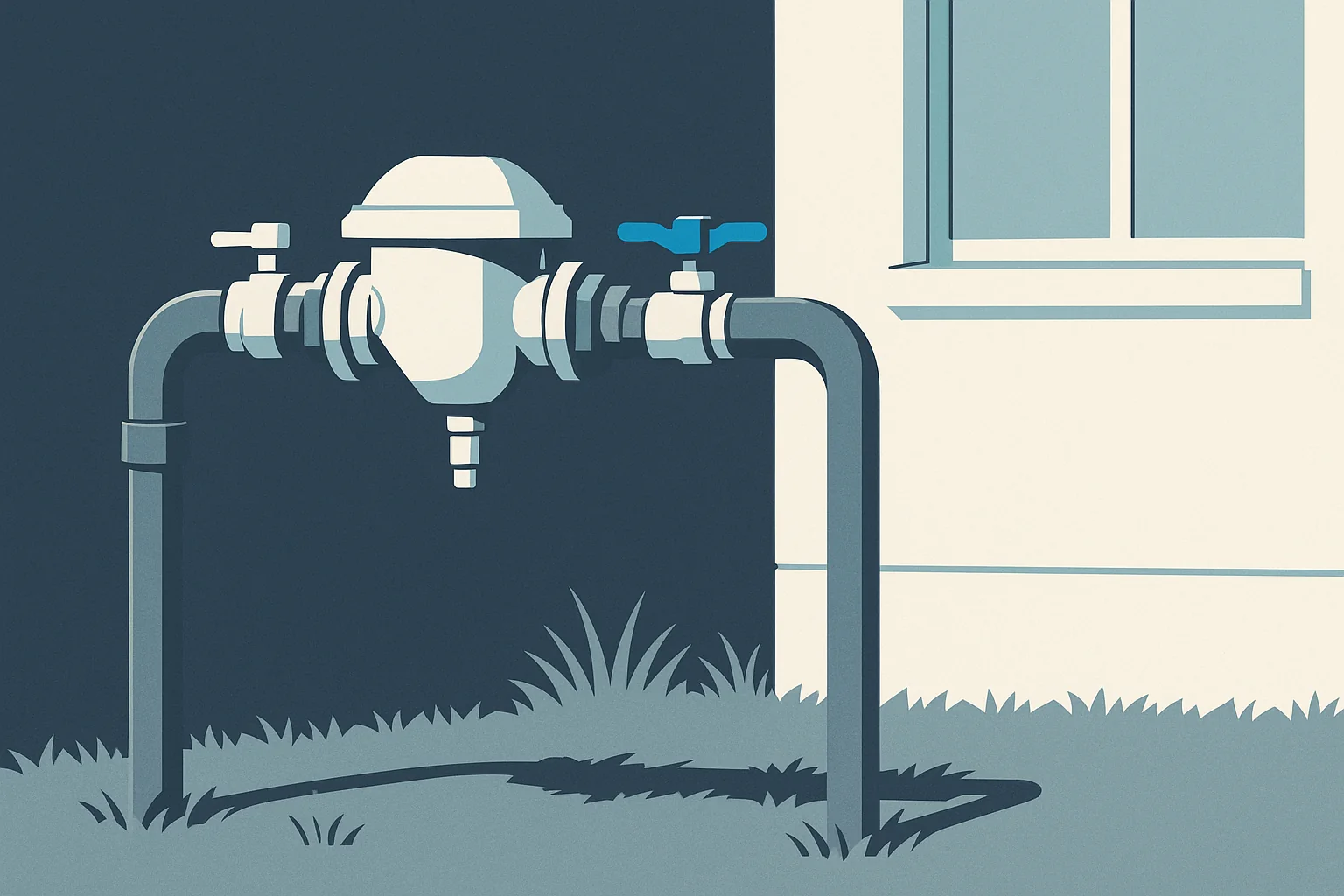

If you received a backflow test notice, it exists because your irrigation system is a cross connection between the public drinking water supply and your yard. A backflow prevention assembly is the physical barrier that keeps yard water out of the drinking water main. Your water purveyor and the adopted plumbing code decide what device is required and how often it is tested, and the obligation to keep it working is yours as the property owner.
In This Guide
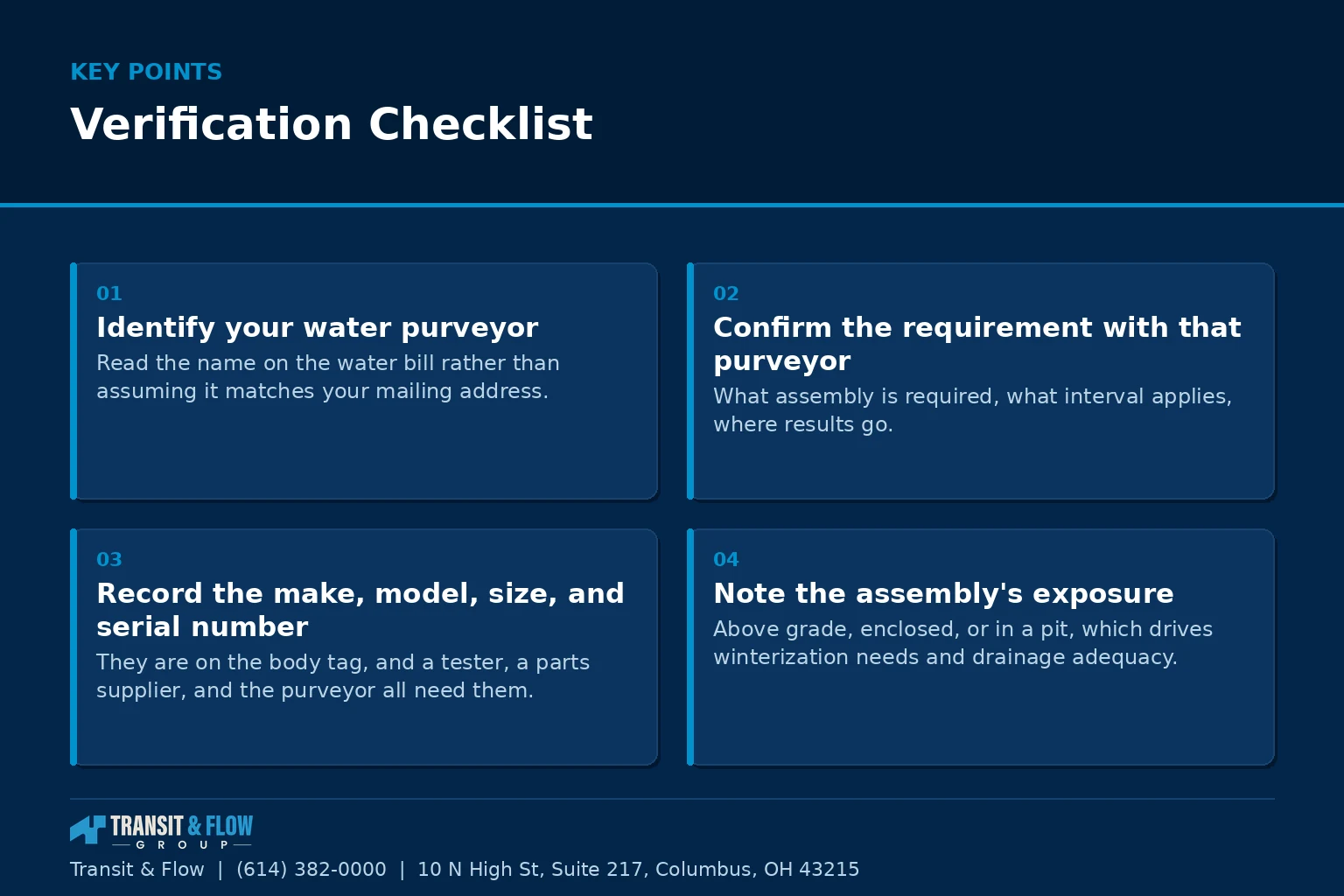
- What a Cross Connection Actually Is
- Backpressure and Backsiphonage, the Two Mechanisms
- Why Irrigation Is Treated as a Hazard Category
- The Families of Backflow Prevention Assemblies
- Who Decides, and Why It Is Not You
- Testing and Certified Testers
- When a Test Fails
- Freeze Damage, the Central Ohio Failure Mode
- Removing or Bypassing a Device
- Permits, Inspection, and New Installations
- Verification Checklist
- The Decision
- Where Transit & Flow Group Fits
- Frequently Asked Questions
Here is what most Central Ohio property owners get wrong. They treat the backflow device as part of the irrigation system, something the sprinkler contractor installed and therefore owns. It is not. It is a piece of the public water system sitting on your property, subject to an obligation that runs against the property regardless of who installed it or whether the irrigation runs this year.
What a Cross Connection Actually Is
A cross connection is any point where the potable supply can contact a non-potable substance. It requires no mistake and no defect. It is created the moment you connect a pipe carrying drinking water to a system that terminates in something other than drinking water.
An irrigation system is the textbook case. Water leaves the meter as treated drinking water, travels through valves and lateral lines, and exits at heads sitting at or below grade in soil, surrounded by fertilizer, herbicide, pet waste, and standing water. The pipe between those two conditions is continuous. Nothing about the geometry prevents water from moving the other direction. Only a device does.
The regulatory question is not whether contamination is likely on your property. It is whether a pathway exists, and on an irrigation system it always does.
Backpressure and Backsiphonage, the Two Mechanisms
Water flows from higher pressure to lower pressure. Normally the main is the higher pressure side. Backflow is what happens when that relationship inverts, and it inverts in exactly two ways.
Backpressure occurs when the downstream system develops pressure higher than the supply. A pump added to the system, a connection to a well or cistern, thermal expansion in a line sitting in the sun, or elevation head on a system running uphill can all push water back toward the main.
Backsiphonage occurs when supply pressure drops and the system pulls backward, the same way a straw draws liquid upward. This is the common one, and it is caused by ordinary events. A water main break down the street. A hydrant flowing at high volume during a structure fire. A utility crew shutting down a section for repair. Any of these can drop pressure in the main below the pressure sitting in your lateral lines, and the water in your soil has somewhere to go.
That is why the requirement is not negotiable property by property. A homeowner cannot promise that no hydrant will ever flow on their street.
Why Irrigation Is Treated as a Hazard Category
Cross connection control programs classify connections by the severity of what could come back, and that classification drives the level of protection required. Irrigation consistently lands in a serious category rather than a nuisance one.
- The termination point is in soil. Submerged outlets are the defining condition of a high hazard connection.
- Chemicals go on the same ground. Fertilizer, herbicide, insecticide, and fungicide, on a normal maintenance schedule.
- Injection equipment may be present. Fertigation deliberately introduces chemicals into the line, raising the classification further.
- Biological contamination is constant. Pet waste, wildlife, and decaying organic matter are ordinary features of a lawn.
- The system sits idle for months. Water standing in lateral lines through a Central Ohio winter stagnates, and stagnation supports bacterial growth.
- The condition cannot be observed. The contaminated side is underground, and nothing about a failure is visible from the surface.
None of that depends on how carefully the property is maintained. Hazard classification describes the connection, not the owner.
The Families of Backflow Prevention Assemblies
Several general families of device exist. Knowing what distinguishes them helps you follow the conversation with your purveyor and read your test report. It does not tell you which one applies to your property, because that determination is not yours to make.
- Air gap. Not a device but a physical separation between outlet and receiving vessel. Absolute protection, since no continuous pipe exists, and impractical for pressurized irrigation.
- Atmospheric vacuum breakers. A simple valve that opens to atmosphere when supply pressure drops. Backsiphonage only, with strict installation limitations.
- Pressure vacuum breakers. A testable assembly built to sit under continuous pressure, again addressing backsiphonage. Elevation above the highest downstream outlet governs whether it works.
- Double check valve assemblies. Two independent check valves in series with test cocks and shutoffs, addressing both mechanisms and testable in place.
- Reduced pressure principle assemblies. Two check valves plus a relief valve that dumps water to atmosphere on failure. That discharge is why they need drainage and cannot sit in a pit that floods.
Which mechanism a family defends against, whether it can be tested in place, where it may be installed, and what hazard level it is approved for are the four variables a purveyor weighs.
Who Decides, and Why It Is Not You
Two authorities set the requirement. The adopted plumbing code establishes baseline cross connection control provisions for the jurisdiction. The water purveyor, the utility that owns the main your service line taps, administers its own program and may impose requirements more stringent than the code minimum. Where the two differ, the more protective one governs.
This is a real problem in Franklin County, because water service and municipal boundaries do not align. A property in a township may buy water from a city. A Columbus mailing address may be served by a different purveyor entirely, and properties in Dublin, Westerville, or Grove City may sit under different program administration than a neighbor a mile away. The building department issuing your permit and the utility billing you are frequently not the same organization, and both have a say.
So no article, contractor, or neighbor can tell you what your property requires. Confirm the assembly type, the installation location, the testing interval, and the reporting process with your purveyor and the building department serving your address.
Testing and Certified Testers
A backflow assembly is a mechanical device with seats, springs, and rubber seals sitting in moving water, and it fails silently. There is no light, no alarm, and no change in irrigation performance when a check valve stops sealing. Periodic testing exists because the failure mode is invisible.
Testing is performed by a tester holding a current certification recognized by the purveyor, using calibrated equipment, with results reported on the form and schedule the purveyor specifies. Confirm the interval, the accepted certification, and the submission process with your purveyor rather than assuming a standard practice applies.
- The obligation runs with the property. Buying a house with an irrigation system means inheriting the testing obligation and any lapse attached to it.
- A dormant system is still a connection. Not running the irrigation this season does not suspend the requirement, because the physical connection remains.
- Certification is verifiable. Get the tester’s certification number and the test kit calibration date before work is scheduled.
- The report goes to the purveyor. A tester who hands you a form and leaves has not finished the job. Confirm submission and keep your copy.
- Non-compliance escalates administratively. Purveyors generally have authority to pursue penalties and, in persistent cases, to terminate water service.
- Records matter at resale. A continuous test history is a small asset in a transaction and a missing one is a small liability.
When a Test Fails
A failed test means the assembly did not perform to the standard the test measures. That is a finding about the device, not about your water. Failure usually traces to debris on a check seat, a worn or hardened seal, a fouled relief valve, or physical damage to the body. Most are repairable with a rebuild kit for the specific make and model, which is cheaper than replacement. Cracked bodies and seized internals generally mean replacement.
What matters procedurally is the clock. A failure typically starts a correction window set by the purveyor, after which the assembly must be repaired or replaced, retested, and the passing result submitted. Ask for that deadline in writing, and schedule the retest when you schedule the repair. Waiting for parts and then finding the tester booked out three weeks is how a repairable failure becomes a compliance problem.
Freeze Damage, the Central Ohio Failure Mode
In this climate, freezing is the leading cause of backflow assembly failure, and it is almost entirely preventable. Many irrigation assemblies sit above grade outdoors, exposed to the full swing of a Central Ohio winter. Water trapped inside expands when it freezes, and the body, the test cocks, and the bonnet are what break.
What makes this worse here than in a colder, steadier climate is freeze and thaw cycling. Central Ohio does not get cold and stay cold. It crosses the freezing point repeatedly from November through March, and each cycle is another expansion event on water that was not fully removed.
Proper winterization means the assembly is drained, not just the lateral lines. Test cocks are opened, shutoffs are set as the manufacturer specifies, and residual water is cleared. Blowing out the zones while leaving water in the assembly body is a common and expensive shortcut, and the damage is usually not found until the next test.
Insulated enclosures help but do not substitute for draining, because an enclosure slows heat loss rather than adding heat. Verify the procedure in the manufacturer’s documentation for your model.
Removing or Bypassing a Device
Facing a repair cost or a freeze break, an owner occasionally concludes that the simplest fix is to remove the assembly or plumb around it. Removing or bypassing a required backflow preventer is not deferred maintenance. It is the deliberate creation of an unprotected cross connection to a public drinking water system.
Purveyors treat it as a serious violation, with authority that typically includes penalties and service termination. If contamination is traced to an unprotected connection on your property, the exposure is not limited to your household, and a claim arising from a knowingly bypassed safety device is difficult to defend.
If the system is genuinely being abandoned, the correct path is a documented disconnection coordinated with the purveyor and the building department, closing the connection on the record. Abandonment in place, pipe still connected, is not disconnection.
Permits, Inspection, and New Installations
On a new installation, the backflow assembly is generally the part that touches the permit process, because it is the part that modifies the potable water system. A plumbing permit and inspection may apply to the connection even where the sprinkler work does not require one, and licensed trade requirements may attach to that portion of the work.
Sequence matters. The purveyor’s requirement is established before installation, not after. An assembly set at the wrong elevation, in a pit without drainage, or of a family not approved for the hazard classification is rework, and rework means reopening a finished lawn.
An initial acceptance test by a certified tester is commonly required before the system is placed in service, and that test frequently closes the permit. An open permit follows the property and surfaces during a sale.
Verification Checklist
Work through this once and the obligation is routine.
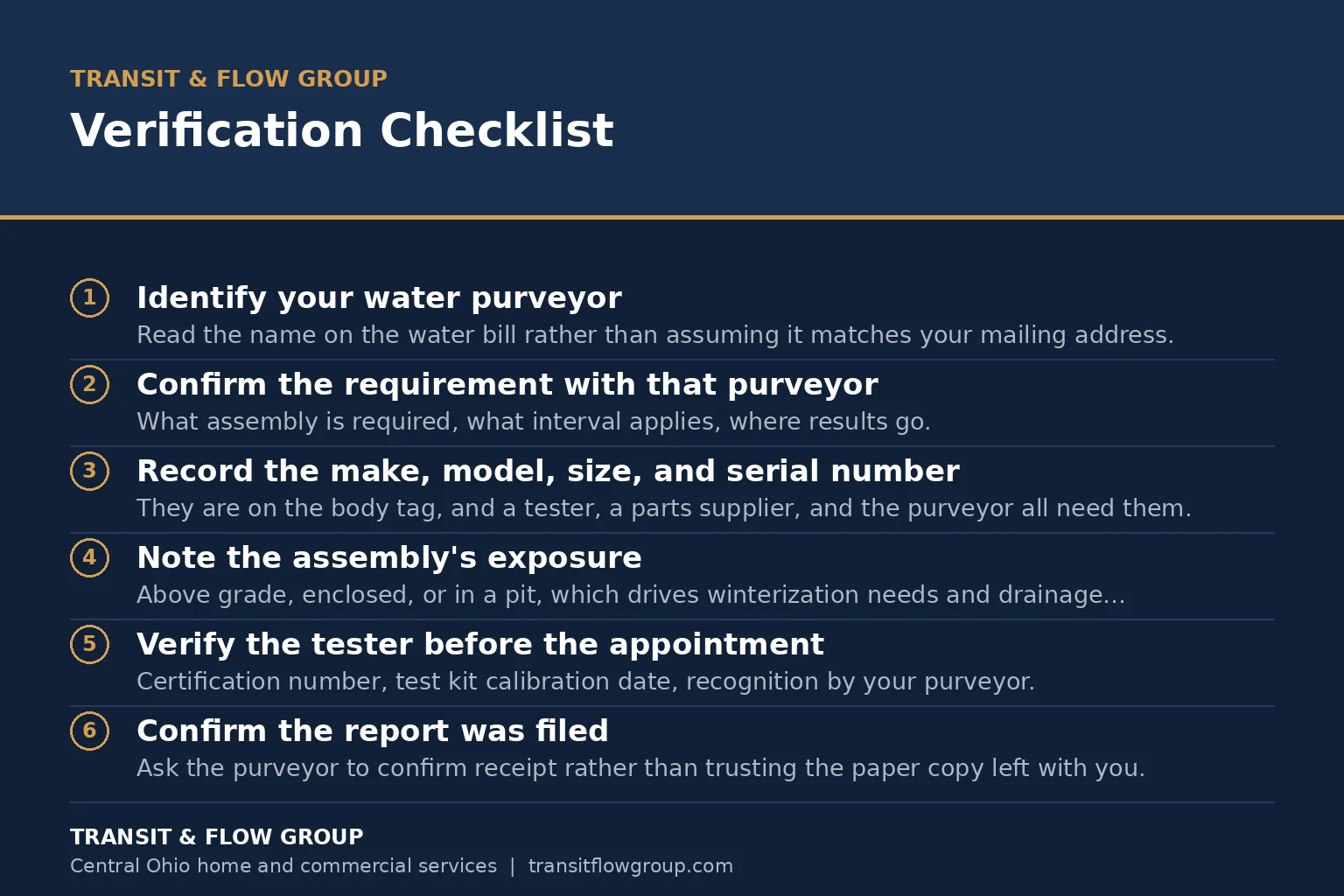
- Identify your water purveyor. Read the name on the water bill rather than assuming it matches your mailing address.
- Confirm the requirement with that purveyor. What assembly is required, what interval applies, where results go.
- Record the make, model, size, and serial number. They are on the body tag, and a tester, a parts supplier, and the purveyor all need them.
- Note the assembly’s exposure. Above grade, enclosed, or in a pit, which drives winterization needs and drainage adequacy.
- Verify the tester before the appointment. Certification number, test kit calibration date, recognition by your purveyor.
- Confirm the report was filed. Ask the purveyor to confirm receipt rather than trusting the paper copy left with you.
- Calendar winterization with the assembly named. Not just the zones, the body and test cocks specifically.
- Check for an open permit on newer systems. Acceptance testing frequently closes it, and an unclosed permit follows the property.
The Decision
Option A. Treat the notice as mail to deal with, call whoever the sprinkler company recommends, and assume the device is fine between notices.
Option B. Confirm the requirement with your water purveyor directly, verify the tester’s certification and that results are submitted, winterize the assembly itself every fall, and keep the test history as a permanent property record.
Recommendation: Option B, and the cost difference between the two is close to zero. Every element of Option B is a scheduling and documentation habit rather than an expense, which is what makes the asymmetry decisive. The downside of Option A is a freeze break found at test time, a correction deadline you did not know about, a lapse that surfaces during a closing, and in the bad case contamination that reaches past your property line. The downside of Option B is two phone calls a year. Fall winterization of the assembly body is the highest value item on that list in this climate, because it prevents the failure that produces most of the others.
Where Transit & Flow Group Fits
We coordinate irrigation and site water projects across Central Ohio, and the backflow assembly is handled as a compliance item with a defined owner rather than an accessory bolted onto a sprinkler bid. The purveyor requirement is confirmed before the assembly is specified, permitting and inspection for the potable connection are scoped in from the start, acceptance testing is scheduled rather than remembered, and winterization scope explicitly includes the assembly. If you have a test notice in hand or an installation coming up, start a conversation with our team. You can also review our irrigation services, our guide to irrigation installation in Central Ohio, our guidance on winterization, our plumbing services, and our article on responsibility gaps.
Transit & Flow Group coordinates projects and partners with properly licensed and insured specialty contractors when licensing is required, and work is performed under the appropriate permits.
Frequently Asked Questions
What is a cross connection
It is any point where the drinking water supply can come into contact with a non potable source. An irrigation system qualifies because its piping ends in soil, fertilizer, and whatever else is on the ground, and that piping is fed by the same supply that serves the house.
How can water flow backward in a pipe
Two mechanisms. Backpressure occurs when downstream pressure exceeds supply pressure. Backsiphonage occurs when supply pressure drops, as during a main break or heavy demand, and the resulting vacuum pulls water back toward the main. Both are documented failure modes.
Which backflow device does my irrigation system need
That is determined by the hazard classification, the site configuration, the adopted plumbing code, and your water purveyor’s cross connection control program. It is not a homeowner preference or a contractor habit. Confirm with the water provider and the authority having jurisdiction.
Do I have to get my backflow device tested
Most cross connection control programs require periodic testing by a certified tester and require the results to be reported. The interval and the reporting process are set by your water purveyor, so confirm the requirement that applies to your address and your device.
What happens if the device fails a test
A failed assembly means the barrier is not performing, and the program that requires the test generally requires repair or replacement within a defined window, followed by a passing test. Continued water service can depend on resolving it.
Why do backflow devices fail in Ohio winters
Because they sit above ground and hold water, and water expands as it freezes. Freeze damage is the leading cause of failure in this climate, which is why proper winterization of the assembly is not an optional part of the seasonal service.
Sources
- Ohio Administrative Code, state rules governing public water systems and cross connection control
- ICC Ohio Codes, the adopted plumbing code text
- Ohio Environmental Protection Agency, drinking water program oversight and purveyor obligations
- United States EPA WaterSense, irrigation efficiency and system guidance
- Ohio Department of Commerce, Division of Industrial Compliance, adopted building and plumbing codes
About This Guide
Written and edited by Micheal Parker, founder of Transit & Flow Group. Published June 26, 2027. This guide is checked against the agency and code sources listed above, and it is revised when those sources change.
General contractor of record. Micheal Parker holds City of Columbus General Contractor Registration G12064, issued by the Columbus Department of Building and Zoning Services under Transit & Flow LLC and valid through June 30, 2027. Trade work that falls outside the scope of that registration is performed by licensed trade partners, and the responsible license holder is identified before work begins.
Reviewed by Micheal Parker, City of Columbus registered general contractor, registration G12064. This guide covers a permit, structural, or life safety subject. It is written as evaluation guidance only. Every determination in it routes to the authority having jurisdiction and to a professional licensed in the applicable trade, and no statement here substitutes for that review.
Transit & Flow Group, home and commercial services for Columbus and the surrounding Central Ohio communities. Phone (614) 382-0000. Email solutions@transitflowgroup.com. 10 N High St, Suite 217, Columbus, OH 43215. Contact our team or review the communities we serve.
