


When you manage a portfolio of commercial buildings, every line on the operating statement is a lever on asset value. Energy is one of the largest controllable expenses in that statement, and it is also one of the most misunderstood. Treating commercial energy efficiency upgrades central ohio owners can actually finance as a strategic capital decision, rather than a discretionary cost, is how disciplined operators lift net operating income and protect long-term value across Columbus and its suburbs.
In This Guide
- Why Energy Efficiency Is a Capital-Allocation Decision
- The Commercial Energy Efficiency Upgrades Central Ohio Buildings Reward Most
- Understanding HVAC Upgrade ROI in Ohio
- Utility Incentives That Shorten Payback
- Tenant Comfort, Retention, and Asset Value
- Building a Portfolio-Wide Efficiency Roadmap
- Ranking the Measures Against Each Other
- Where Efficiency Projects Go Wrong
- What to Verify in an Efficiency Proposal
- Frequently Asked Questions
- Sources
- Related Transit & Flow Services
At the executive level, the question is never simply “should we replace this equipment?” It is “where does this dollar of capital earn its highest return, and how quickly does it come back?” The buildings in your portfolio answer that question every month through their utility bills. The following framework is how experienced facilities leaders and Transit & Flow approach energy investment as a return on capital, not a maintenance chore.
Why Energy Efficiency Is a Capital-Allocation Decision
A well-underwritten efficiency project behaves like any other value-add investment. It reduces recurring operating cost, which flows directly to NOI, which in turn supports valuation at your cap rate. A recurring reduction in annual energy spend, capitalized at your cap rate, converts into a multiple of that annual figure in asset value. That is the frame that turns an HVAC line item into a boardroom conversation. Meaningful building energy savings columbus operators can bank are not incremental. They compound across a hold period and improve the story you tell buyers and lenders at disposition.
The discipline is in the underwriting. Every upgrade should carry a defensible payback period, a projected internal rate of return, and a clear assumption set for utility rates and occupancy. Transit & Flow builds those numbers with you before a single tool comes out of the truck, so capital committees see the same rigor they expect from a leasing or repositioning decision.
The Commercial Energy Efficiency Upgrades Central Ohio Buildings Reward Most
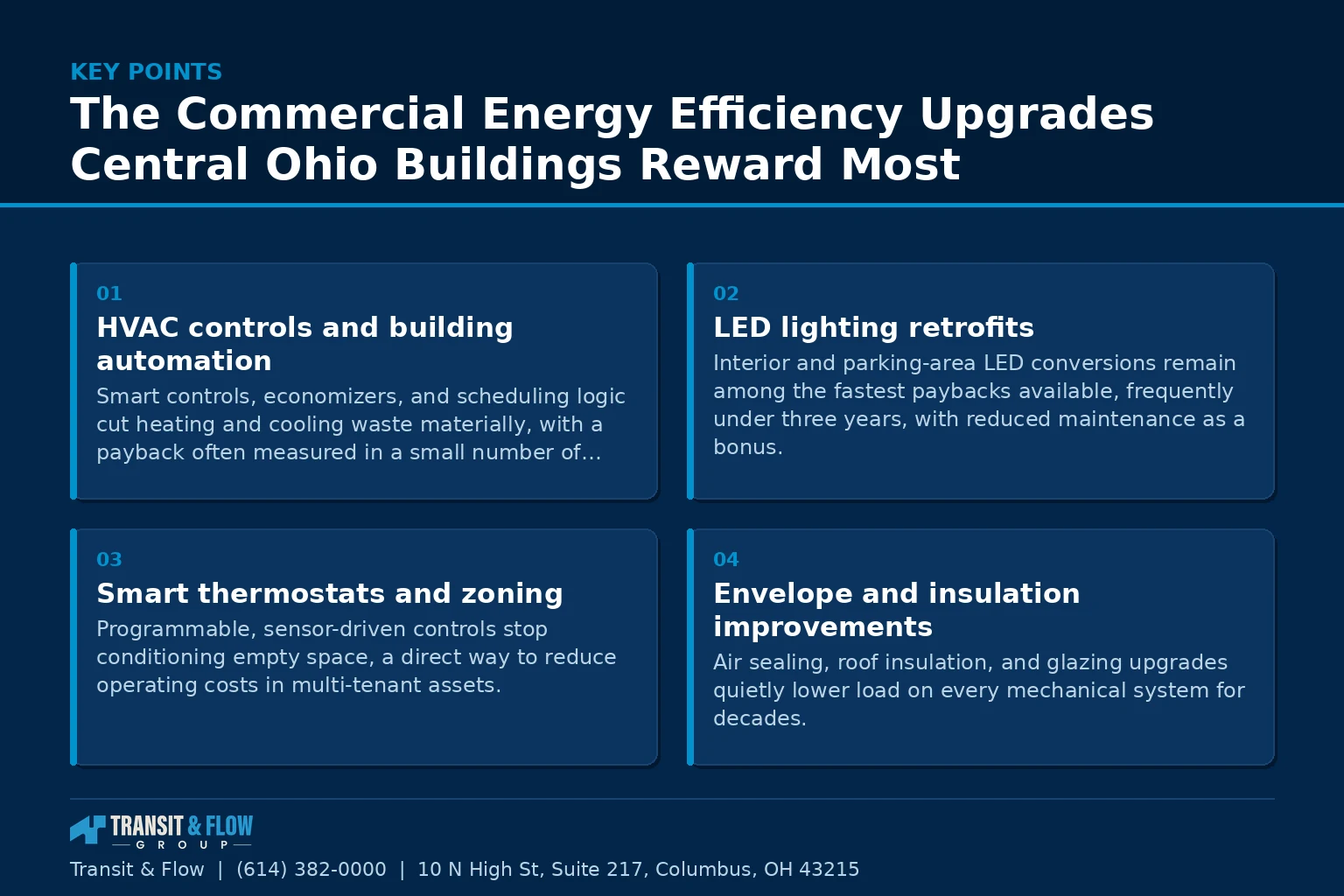
Not every efficiency measure deserves your capital. The strongest returns in Central Ohio buildings tend to cluster in a short list of proven moves. When you rank commercial energy efficiency upgrades central ohio portfolios can execute today, these consistently rise to the top:
- HVAC controls and building automation: Smart controls, economizers, and scheduling logic cut heating and cooling waste materially, with a payback often measured in a small number of years.
- LED lighting retrofits: Interior and parking-area LED conversions remain among the fastest paybacks available, frequently under three years, with reduced maintenance as a bonus.
- Smart thermostats and zoning: Programmable, sensor-driven controls stop conditioning empty space, a direct way to reduce operating costs in multi-tenant assets.
- Envelope and insulation improvements: Air sealing, roof insulation, and glazing upgrades quietly lower load on every mechanical system for decades.
- High-efficiency water heating: Condensing and heat-pump water heating trims a steady, overlooked consumption line in offices, retail, and multifamily.
Understanding HVAC Upgrade ROI in Ohio
Mechanical systems drive the largest share of building energy use, which is why hvac upgrade roi ohio owners should scrutinize deserves the most attention. A rooftop unit or boiler nearing the end of its service life is not just a reliability risk, it is an efficiency liability running at a fraction of modern performance. Replacing aging equipment with high-efficiency systems and pairing that hardware with intelligent controls typically delivers the strongest blended return of any measure in the building.
The nuance is timing. Replacing a functional unit purely for efficiency rarely pencils on its own, but replacing at end of life, when a capital event is coming regardless, converts a mandatory spend into a value-creating one. Transit & Flow helps you map each asset’s equipment age against a capital plan so upgrades land at the right moment rather than during an emergency failure that forces a rushed, premium-priced decision.
Utility Incentives That Shorten Payback
Payback math improves substantially when you capture available incentives. AEP Ohio and Columbia Gas of Ohio maintain commercial and industrial programs that offset the cost of qualifying lighting, HVAC, controls, and custom projects. These rebates can trim a meaningful share off project cost, effectively shortening payback and lifting IRR on the same scope of work. Confirm the current offset per the program documentation each utility publishes, because terms and qualifying measures change. Federal incentives for qualifying equipment can layer on top. The catch is that many programs require pre-approval before work begins, so coordination matters. Transit & Flow tracks current program terms and sequences the paperwork so you do not leave committed dollars on the table.
Tenant Comfort, Retention, and Asset Value
Efficiency is not only about the utility bill. Consistent temperatures, quiet modern equipment, and reliable systems are what tenants actually experience day to day, and comfort drives renewals. A tenant who never files a hot-or-cold complaint is a tenant who is easier to retain, and retention is the cheapest occupancy you will ever buy. Efficient, well-documented buildings also support ESG reporting and green-certification goals that increasingly influence institutional buyers and lenders. The result is a building that costs less to run, holds tenants longer, and commands more attention at sale.
Building a Portfolio-Wide Efficiency Roadmap
The operators who win treat efficiency as a program, not a series of one-off repairs. That means benchmarking every asset, prioritizing by payback, sequencing projects against your capital calendar, and measuring results so the next round of underwriting gets sharper. Executing commercial energy efficiency upgrades central ohio wide is far simpler with a single accountable partner across HVAC, electrical, plumbing, and controls, because one team owns the data, the scope, and the outcome. For deeper background, explore our related guides, and confirm coverage for your buildings on our service areas page spanning Columbus, Dublin, Westerville, Hilliard, Gahanna, Grove City, Upper Arlington, Worthington, New Albany, Powell, and Pickerington.
If you are ready to turn energy spend into measurable value, Transit & Flow can help you underwrite, prioritize, and execute the upgrades that pay back fastest. Get an instant estimate on the Transit & Flow homepage or call our team to start building an efficiency roadmap tailored to your portfolio.
Ranking the Measures Against Each Other
Capital committees think in horizons and triggers, not equipment categories. Here is how the common measures sort on that basis.
| Measure | Payback horizon | Best trigger point | Secondary benefit |
|---|---|---|---|
| LED lighting retrofit | Shortest of the common measures | Any time, though tenant improvement work makes access cheaper | Lower relamping and maintenance labor |
| Controls and building automation | Short to moderate | Alongside a mechanical replacement, so the controls match the equipment | Better data for the next underwriting cycle |
| Smart thermostats and zoning | Short | Multi-tenant assets with uneven occupancy patterns | Fewer comfort complaints per tenant |
| High-efficiency water heating | Moderate | End of service life on existing equipment | Reduced reliability risk on a quiet system |
| Envelope and insulation work | Longest of the common measures | Roof replacement or facade work already scheduled | Lower load on every mechanical system for decades |
Notice that the longest-payback measure carries the longest-lived benefit. Envelope work rarely wins on payback alone, but it wins decisively when it rides along with capital work already funded.
Where Efficiency Projects Go Wrong
The projects that disappoint rarely fail on the engineering. They fail on sequence, assumptions, and measurement.
The most common error is installing efficient equipment into an unaddressed envelope. New mechanical capacity sized against the building’s current leakage locks in that leakage for the life of the equipment. When envelope work is on the roadmap at all, it belongs in the sizing conversation, not after it.
The second is optimistic assumption sets. A payback model built on flat utility rates and full occupancy will always look better than the building performs. Underwrite the same project against a conservative rate path and a realistic occupancy curve, and the ranking of measures often changes.
The third is incentive sequencing. Many utility programs require pre-approval before work begins, which means a project mobilized quickly can forfeit an offset that was already in the model. Confirm the current program terms with the utility and secure approval before scheduling, since program rules and qualifying measures change.
The fourth is skipping measurement. Without a documented baseline, the second round of projects gets underwritten on the same guesses as the first. Benchmarking each asset before work starts is what makes the next capital request defensible.
What to Verify in an Efficiency Proposal
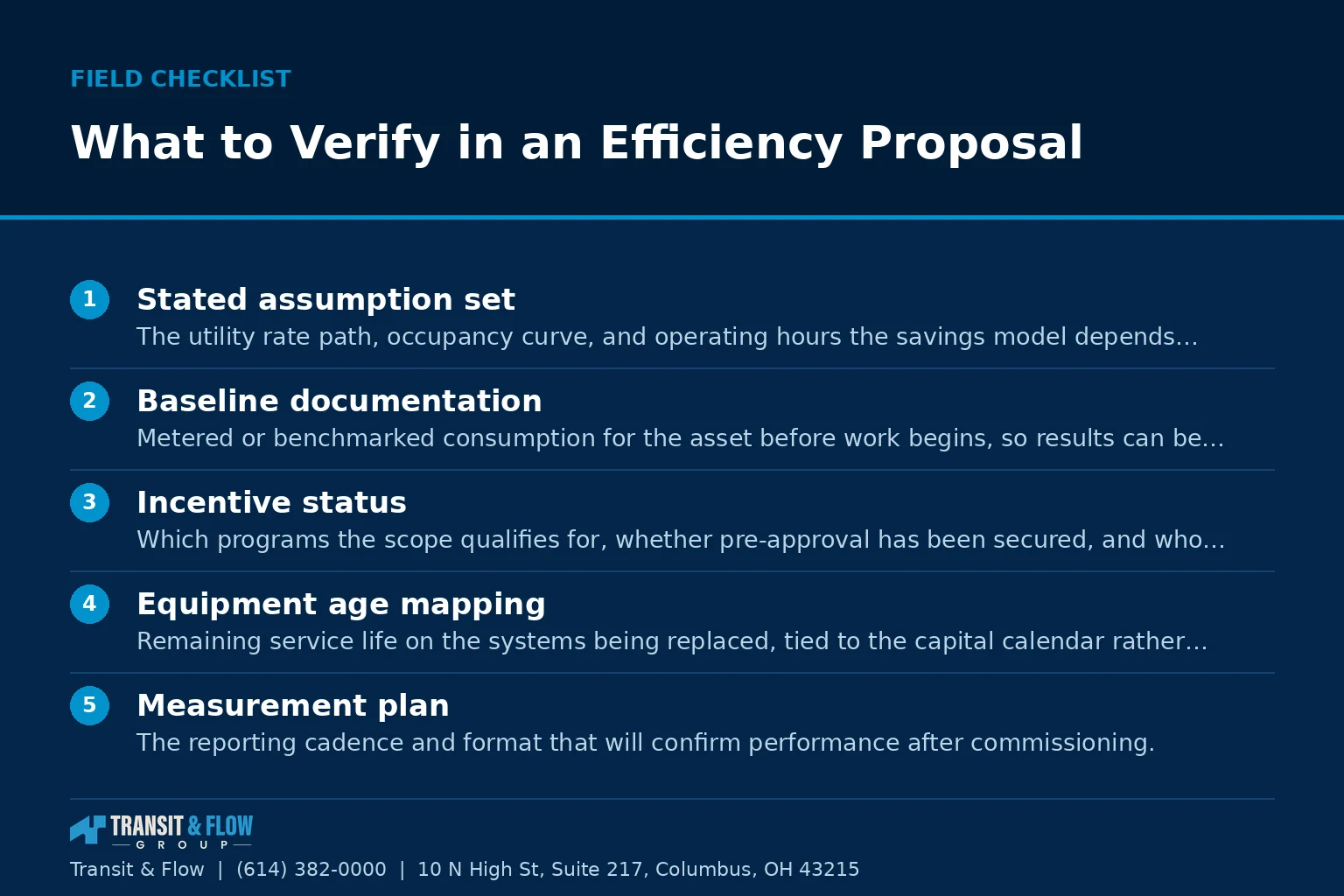
- Stated assumption set. The utility rate path, occupancy curve, and operating hours the savings model depends on, written down rather than implied.
- Baseline documentation. Metered or benchmarked consumption for the asset before work begins, so results can be measured rather than asserted.
- Incentive status. Which programs the scope qualifies for, whether pre-approval has been secured, and who holds responsibility for the filing.
- Equipment age mapping. Remaining service life on the systems being replaced, tied to the capital calendar rather than to the proposal date.
- Measurement plan. The reporting cadence and format that will confirm performance after commissioning.
Transit & Flow Group coordinates projects and partners with properly licensed and insured specialty contractors when licensing is required, and work is performed under the appropriate permits.
Frequently Asked Questions
How do I decide whether an efficiency upgrade is worth the capital?
Underwrite it the way you would any other value-add investment. A defensible project carries a payback period, a projected internal rate of return, and a stated assumption set for utility rates and occupancy. Because the savings reduce recurring operating cost, they flow to net operating income and support valuation at your cap rate, which is what turns a mechanical line item into a capital committee conversation. If a proposal cannot produce those numbers before work starts, it is not ready for a decision.
Which upgrades tend to deliver the strongest returns in Central Ohio buildings?
A short list recurs across the portfolios we work with. HVAC controls and building automation, interior and parking-area LED conversions, sensor-driven thermostats and zoning, envelope and insulation improvements, and high-efficiency water heating consistently rank near the top. Lighting retrofits are usually the fastest payback and carry reduced maintenance as a secondary benefit, while envelope work quietly lowers load on every mechanical system for decades. Rank them against your own utility data rather than against a generic list.
When is the right moment to replace aging HVAC equipment?
Timing is the whole nuance. Replacing a functional unit purely for efficiency rarely pencils on its own, but replacing at end of service life, when the capital event is coming regardless, converts a mandatory spend into a value-creating one. Mapping each asset’s equipment age against the capital plan lets the upgrade land deliberately instead of during an emergency failure, which forces a rushed decision at a premium. That mapping is worth doing across the portfolio before any single building becomes urgent.
Do utility incentives actually change the math on a project?
They can shorten payback and lift the return on the same scope of work, which is why they belong in the underwriting rather than in the footnotes. AEP Ohio and Columbia Gas of Ohio maintain commercial and industrial programs covering qualifying lighting, HVAC, controls, and custom projects, and federal incentives for qualifying equipment can layer on top. The important operational detail is that many programs require pre-approval before work begins, so sequencing the paperwork ahead of the schedule matters. Verify current terms with the utility, since program rules change.
What is the benefit of efficiency work beyond the utility bill?
Tenants experience consistent temperatures, quiet modern equipment, and reliable systems, and that experience drives renewals. A tenant who never files a hot-or-cold complaint is easier to retain, and retention is the cheapest occupancy available. Efficient, well-documented buildings also support ESG reporting and green-certification goals that increasingly influence institutional buyers and lenders. The combined effect shows up at disposition, not only on the monthly statement.
How should an owner approach efficiency across a whole portfolio?
Treat it as a program rather than a series of one-off repairs. Benchmark every asset, prioritize by payback, sequence projects against the capital calendar, and measure results so the next round of underwriting is sharper than the last. Coordinating HVAC, electrical, plumbing, and controls through a single accountable partner keeps the data, the scope, and the outcome under one owner. That continuity is what makes the second and third rounds of projects better than the first.
Sources
- U.S. Department of Energy, Energy Saver, insulation
- ENERGY STAR, certified heating and cooling equipment
- U.S. Department of Energy, Energy Saver home energy guidance
Related Transit & Flow Services
Every service below is delivered by the same accountable Transit & Flow team, so one call covers the whole property.
Serving Columbus and every community across Central Ohio. See the full service areas map, or get an instant estimate on the Transit & Flow homepage.
About This Guide
Written and edited by Micheal Parker, founder of Transit & Flow Group. Published August 12, 2026. This guide is checked against the agency and code sources listed above, and it is revised when those sources change.
General contractor of record. Micheal Parker holds City of Columbus General Contractor Registration G12064, issued by the Columbus Department of Building and Zoning Services under Transit & Flow LLC and valid through June 30, 2027. Trade work that falls outside the scope of that registration is performed by licensed trade partners, and the responsible license holder is identified before work begins.
Transit & Flow Group, home and commercial services for Columbus and the surrounding Central Ohio communities. Phone (614) 382-0000. Email solutions@transitflowgroup.com. 10 N High St, Suite 217, Columbus, OH 43215. Contact our team or review the communities we serve.
