

Every commercial real estate leader eventually learns the same lesson: the buildings that hold their value are the ones that are never allowed to slip. In a portfolio, disciplined commercial facilities maintenance Central Ohio owners rely on is not a line item to be squeezed. It is one of the most reliable levers you have to protect net operating income, extend asset life, and keep tenants renewing. This playbook frames maintenance the way a portfolio executive should: as an investment in value, not a grudging expense.
In This Guide
- How Commercial Facilities Maintenance Central Ohio Owners Trust Protects NOI
- The Real Cost of Deferred Maintenance
- Preventive Programs Beat Reactive Repairs
- Vendor Consolidation Across the Portfolio
- Response-Time SLAs and Uptime
- Capital Planning and Single-Partner Accountability
- Building a Program That Scales
- What Goes Wrong and Why
- Reactive, Preventive, and Managed Programs Compared
- Central Ohio Timing and the Maintenance Calendar
- Frequently Asked Questions
- Sources
- Related Transit & Flow Services
How Commercial Facilities Maintenance Central Ohio Owners Trust Protects NOI
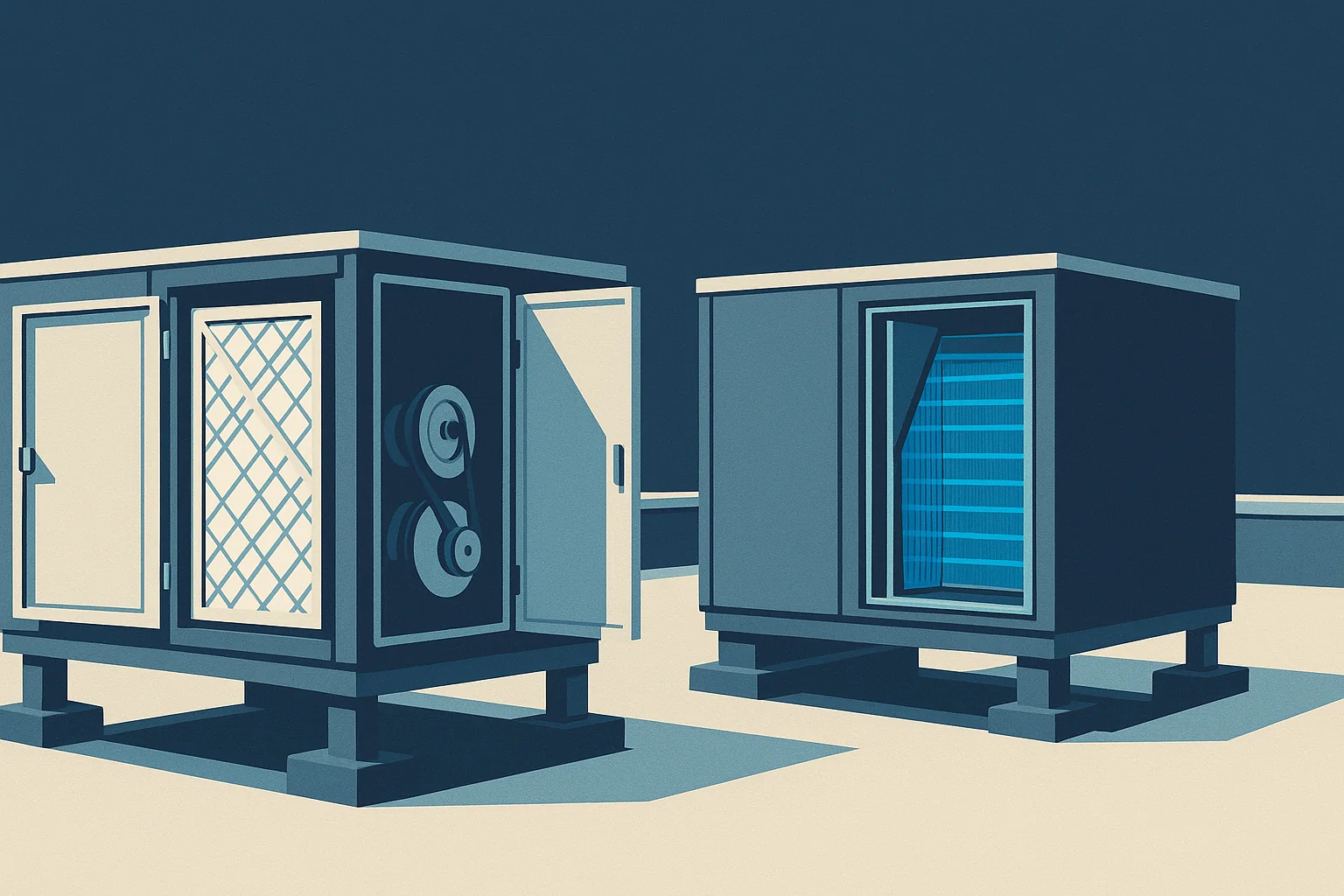
Net operating income is a simple equation with unforgiving inputs. Every dollar of avoidable operating cost, every hour of tenant downtime, and every premature capital replacement flows straight through to valuation at your cap rate. A single deferred rooftop unit that fails in August does not just cost a repair. It costs emergency labor at premium rates, a frustrated tenant, and often a lease concession at renewal. Treating property maintenance across your Columbus commercial holdings as a strategic function, rather than a reactive scramble, is how sophisticated owners defend both current cash flow and long-term asset value across Dublin, Westerville, Hilliard, and the wider metro.
The Real Cost of Deferred Maintenance
Deferred maintenance is the quiet killer of returns. It rarely shows up on a monthly report until it arrives all at once, usually at the worst possible moment. A minor roof membrane issue becomes water intrusion, mold remediation, and damaged tenant improvements. A neglected HVAC compressor fails during peak occupancy. The pattern is always the same: small, predictable expenses that were skipped compound into large, unpredictable ones. Underwriters and buyers know this too. When it is time to refinance or sell, a documented maintenance history supports your valuation, while a backlog of deferred work becomes a negotiating weapon in the buyer’s hands.
Preventive Programs Beat Reactive Repairs
The difference between a well-run portfolio and a troubled one is usually the shift from reactive to preventive. A structured preventive program means scheduled inspections, filter and belt changes, coil cleanings, electrical panel checks, plumbing and backflow testing, and seasonal readiness work performed on a calendar, not on a crisis. This is where protect NOI maintenance becomes measurable. Equipment that is maintained on schedule runs more efficiently, consumes less energy, and lasts years longer than equipment run to failure. Consider building your program around a few core commitments:
- Scheduled multi-trade inspections tied to each asset’s equipment list and age
- Documented preventive tasks for HVAC, plumbing, and electrical systems
- Seasonal readiness cycles ahead of Central Ohio’s summer peak and winter freeze
- A shared record of every visit, part, and recommendation for capital planning
- Clear response-time expectations for both routine and emergency work
Vendor Consolidation Across the Portfolio
Most facilities directors inherit a sprawling vendor list: one company for HVAC, another for plumbing, a third for electrical, plus a rotating cast of handymen. That fragmentation is expensive in ways that never appear on a single invoice. It means more contracts to manage, inconsistent quality, finger-pointing when a problem crosses trades, and no single party accountable for the outcome. Consolidating to a disciplined multi-trade partner changes the equation. Facilities management in Ohio becomes far simpler when one accountable team understands your entire portfolio, carries the history of every building, and answers for the result. Fewer invoices, consistent standards, and better pricing at scale all follow naturally.
Response-Time SLAs and Uptime
For commercial tenants, uptime is the product. A retailer with no cooling, an office with a failed elevator lobby, or a medical suite with a plumbing backup is a tenant actively calculating whether to renew. Response-time service level agreements turn vague promises into operational discipline. When you set clear expectations, priority dispatch for emergencies, defined windows for routine work, and honest communication throughout, you convert maintenance from a source of tenant friction into a reason tenants stay. That retention is worth more to your NOI than almost any rent increase, because avoided vacancy and turnover costs drop straight to the bottom line.
Capital Planning and Single-Partner Accountability
The most valuable thing a strong maintenance partner delivers is not a repair. It is foresight. When one team maintains your HVAC, plumbing, and electrical systems across every property, they can tell you which rooftop units are approaching end of life, which panels need upgrading, and where to spend capital next year for the greatest return. That intelligence turns capital planning from guesswork into strategy. It lets you sequence major replacements before they fail, budget with confidence, and avoid the emergency premiums that wreck a reactive operation. Single-partner accountability across trades means one throat to choke and one team building the institutional memory of your assets. For a look at how this connects to energy performance, vendor strategy, and seasonal readiness, our related guides go deeper on each lever, and you can confirm coverage for your buildings on our service areas page spanning Columbus and suburbs from Gahanna and Grove City to Upper Arlington, Worthington, New Albany, Powell, and Pickerington.
Building a Program That Scales
A maintenance program only protects value if it scales with your portfolio and holds a consistent standard across every door. That means standardized processes, clean documentation, and a partner who can flex from a single suburban office building to a diversified regional portfolio without dropping quality. The best commercial facilities maintenance Central Ohio operators can hire looks the same in a Dublin flex building as it does in a Westerville retail center: predictable, documented, and accountable. When you achieve that consistency, maintenance stops being a cost you tolerate and becomes a discipline that compounds asset value year after year.
If you are ready to treat commercial facilities maintenance Central Ohio owners depend on as the NOI lever it truly is, Transit & Flow brings HVAC, plumbing, and electrical under one accountable partner built for portfolio scale. Get an instant estimate on the Transit & Flow homepage or reach out to our commercial team, and let us help you protect the value of every asset you own across Central Ohio.
Transit & Flow Group coordinates projects and partners with properly licensed and insured specialty contractors when licensing is required, and work is performed under the appropriate permits.
What Goes Wrong and Why
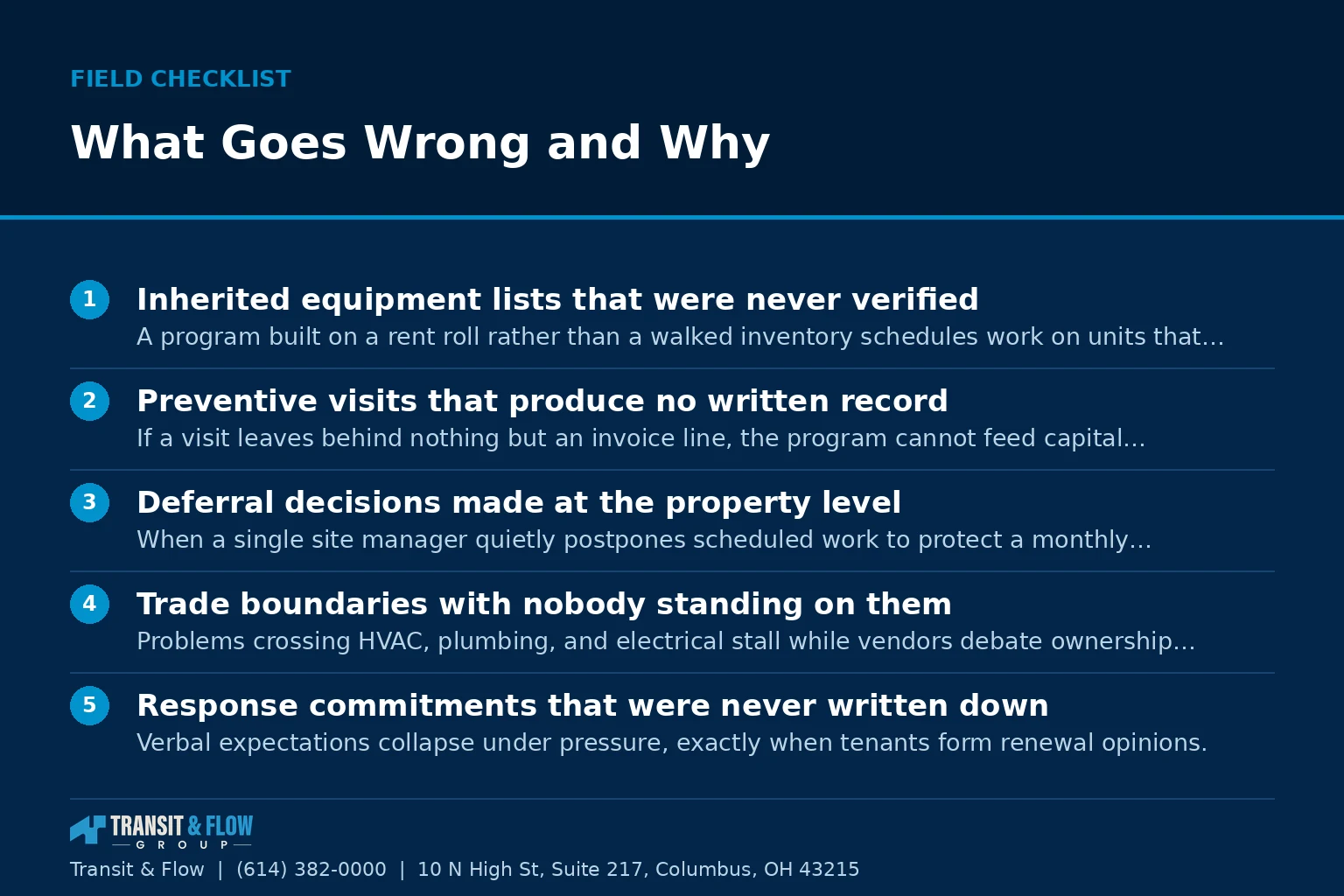
Maintenance programs rarely fail because a technician did poor work. They fail upstream, in how the program was designed, staffed, and recorded. The failure patterns repeat across portfolios, and each one is visible long before it produces an emergency invoice.
- Inherited equipment lists that were never verified. A program built on a rent roll rather than a walked inventory schedules work on units that no longer exist and skips units nobody documented.
- Preventive visits that produce no written record. If a visit leaves behind nothing but an invoice line, the program cannot feed capital planning and cannot prove itself at refinance or sale.
- Deferral decisions made at the property level. When a single site manager quietly postpones scheduled work to protect a monthly number, the portfolio absorbs the risk without ever seeing the decision.
- Trade boundaries with nobody standing on them. Problems crossing HVAC, plumbing, and electrical stall while vendors debate ownership, and stalled problems get expensive.
- Response commitments that were never written down. Verbal expectations collapse under pressure, exactly when tenants form renewal opinions.
Reactive, Preventive, and Managed Programs Compared
Most portfolios sit somewhere on a spectrum between pure reaction and a fully managed program. The distinction is not how much gets spent. It is what triggers the work, who holds the record, and whether the program produces information you can underwrite against.
| Posture | What triggers work | Operating cost pattern | Capital planning value |
|---|---|---|---|
| Reactive | A failure, a tenant complaint, or an inspection finding | Volatile, weighted toward emergency labor and after-hours dispatch | Minimal, because failures set the sequence instead of you |
| Preventive | A published calendar tied to equipment age and duty cycle | Steadier and more forecastable, with fewer premium events | Useful, once visit records are consistently captured |
| Managed multi-trade | The same calendar, plus condition findings routed across trades by one accountable team | Forecastable and benchmarked across the portfolio | Strong, because one history covers every asset and every system |
For most owners with more than a handful of doors, the managed multi-trade posture is the right target. Preventive scheduling alone still leaves the coordination burden with your team. Move to preventive scheduling first, prove the calendar holds for a full seasonal cycle, then consolidate accountability.
Central Ohio Timing and the Maintenance Calendar
Central Ohio gives you two hard deadlines a year, and a program that misses either one spends the season recovering. Cooling readiness work belongs in early spring, well ahead of the first sustained heat, because that is when parts and skilled labor are still available on normal terms. Heating and freeze protection work belongs in early fall, before the first hard freeze pushes every operator in the metro into the same queue. Shoulder seasons are also when tenant disruption is lowest. Site work such as drainage review and exterior sealing follows the same logic.
Frequently Asked Questions
How does deferred maintenance actually reduce net operating income?
It reduces it in more places than the repair invoice. A deferred item rarely announces itself on a monthly report, then arrives all at once, usually at the worst moment, and by then it carries emergency labor at premium rates rather than scheduled labor. The same failure often brings tenant disruption, and a disrupted tenant tends to negotiate at renewal. Because operating cost flows straight through to valuation at your cap rate, the effect does not stop at the repair.
What does a real preventive maintenance program include?
It means work performed on a calendar rather than in response to a crisis. In practice that is scheduled multi-trade inspections tied to each asset’s equipment list and age, documented preventive tasks for HVAC, plumbing, and electrical systems, and seasonal readiness cycles timed ahead of the Central Ohio summer peak and winter freeze. It also means a shared record of every visit, part, and recommendation, so the program feeds capital planning instead of disappearing into invoices. Clear response-time expectations for both routine and emergency work round it out.
Why does vendor consolidation matter across a portfolio?
Most facilities directors inherit a sprawling list, one company for HVAC, another for plumbing, a third for electrical, plus a rotating cast of handymen. That fragmentation costs money in ways that never appear on any single invoice, through more contracts to manage, inconsistent quality, and finger-pointing when a problem crosses trades. Consolidating to a disciplined multi-trade partner puts one accountable team behind the outcome and one history behind every building. Fewer invoices, consistent standards, and better terms at scale follow from that.
How do response-time service level agreements affect tenant retention?
For a commercial tenant, uptime is the product. A retailer without cooling, an office with a failed elevator lobby, or a medical suite with a plumbing backup is a tenant actively weighing whether to renew. Response-time agreements convert vague promises into operational discipline through priority dispatch for emergencies, defined windows for routine work, and honest communication throughout. Retention earned that way is worth more to net operating income than almost any rent increase, because avoided vacancy and turnover costs drop straight to the bottom line.
What does a maintenance partner contribute to capital planning?
Foresight, which is more valuable than any individual repair. When one team maintains HVAC, plumbing, and electrical systems across every property, it can tell you which rooftop units are approaching end of life, which panels warrant evaluation for upgrade, and where next year’s capital is likely to earn the most. That turns capital planning from guesswork into sequencing, so major replacements happen before failure rather than after. It also removes the emergency premiums that define a reactive operation.
What makes a maintenance program scale across a growing portfolio?
Consistency held to the same standard at every door. That requires standardized processes, clean documentation, and a partner able to flex from a single suburban office building to a diversified regional portfolio without losing quality. Done well, the program looks the same in a Dublin flex building as it does in a Westerville retail center, predictable, documented, and accountable. At that point maintenance stops being a cost you tolerate and becomes a discipline that compounds asset value.
Sources
- Ohio Department of Commerce, Division of Industrial Compliance, licensing and code enforcement
- U.S. Department of Energy, Energy Saver home energy guidance
- ENERGY STAR, heating and cooling guidance
Related Transit & Flow Services
Every service below is delivered by the same accountable Transit & Flow team, so one call covers the whole property.
Serving Columbus and every community across Central Ohio. See the full service areas map, or get an instant estimate on the Transit & Flow homepage.
About This Guide
Written and edited by Micheal Parker, founder of Transit & Flow Group. Published July 29, 2026. This guide is checked against the agency and code sources listed above, and it is revised when those sources change.
General contractor of record. Micheal Parker holds City of Columbus General Contractor Registration G12064, issued by the Columbus Department of Building and Zoning Services under Transit & Flow LLC and valid through June 30, 2027. Trade work that falls outside the scope of that registration is performed by licensed trade partners, and the responsible license holder is identified before work begins.
Transit & Flow Group, home and commercial services for Columbus and the surrounding Central Ohio communities. Phone (614) 382-0000. Email solutions@transitflowgroup.com. 10 N. High St., Suite 217, Columbus, OH 43215. Contact our team or review the communities we serve.
