

The repair-or-replace question almost never gets answered honestly, because the two people you are most likely to ask both have a stake in the answer. This article is a structured way to reach your own decision using information you can independently verify. It goes deeper than the summary in our furnace replacement guide, and it is written for the homeowner standing in a basement being told a number.
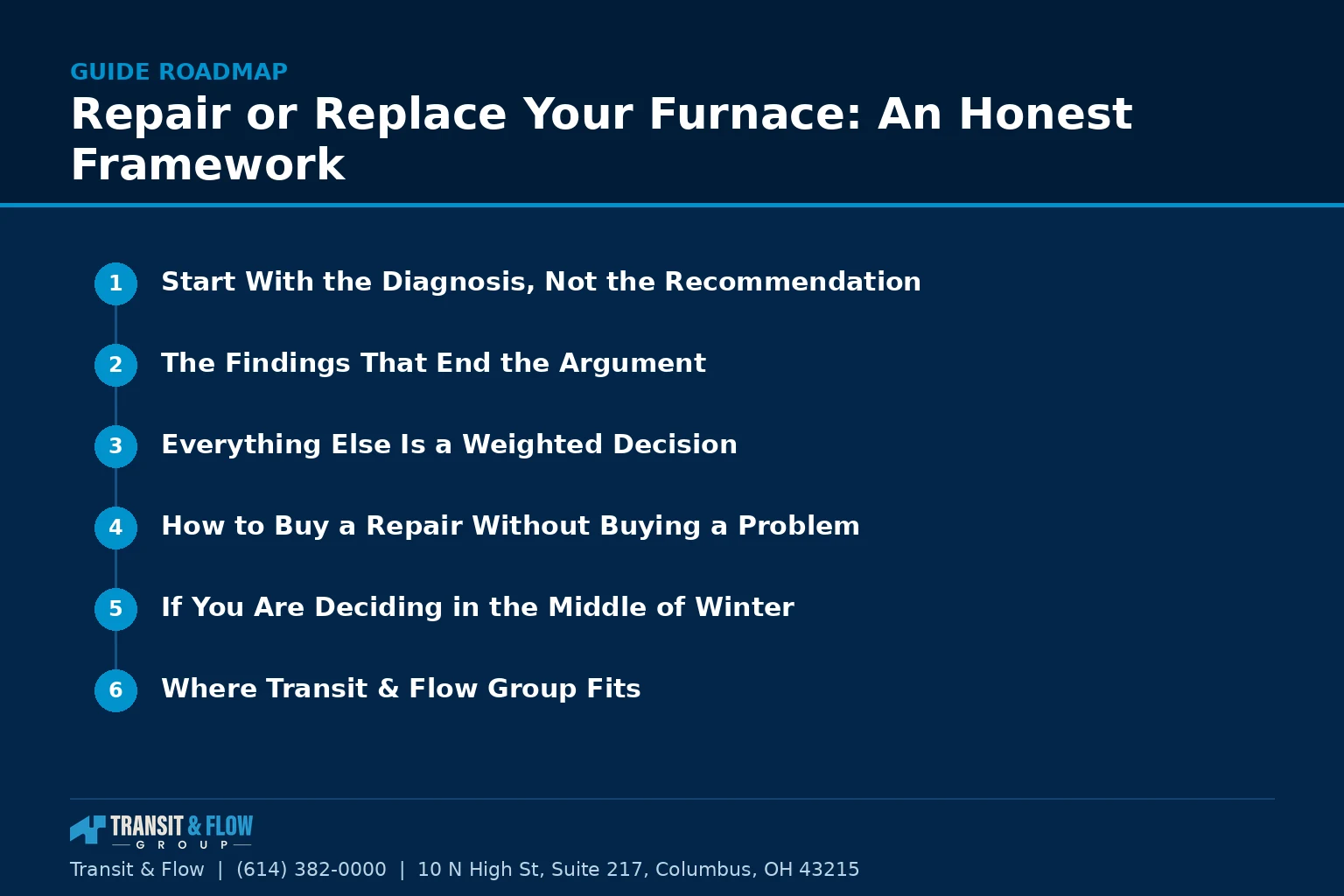
In This Guide
- Start With the Diagnosis, Not the Recommendation
- The Findings That End the Argument
- Everything Else Is a Weighted Decision
- How to Buy a Repair Without Buying a Problem
- If You Are Deciding in the Middle of Winter
- Where Transit & Flow Group Fits
- Frequently Asked Questions
Transit & Flow Group coordinates projects and partners with properly licensed and insured specialty contractors when licensing is required.
One boundary. This is a purchasing and evaluation framework, not service instruction. Gas heating equipment burns fuel inside your home. Diagnosis, repair, and replacement are licensed, permitted, and inspected work. If a carbon monoxide alarm sounds, leave the building and call from outside.
Start With the Diagnosis, Not the Recommendation
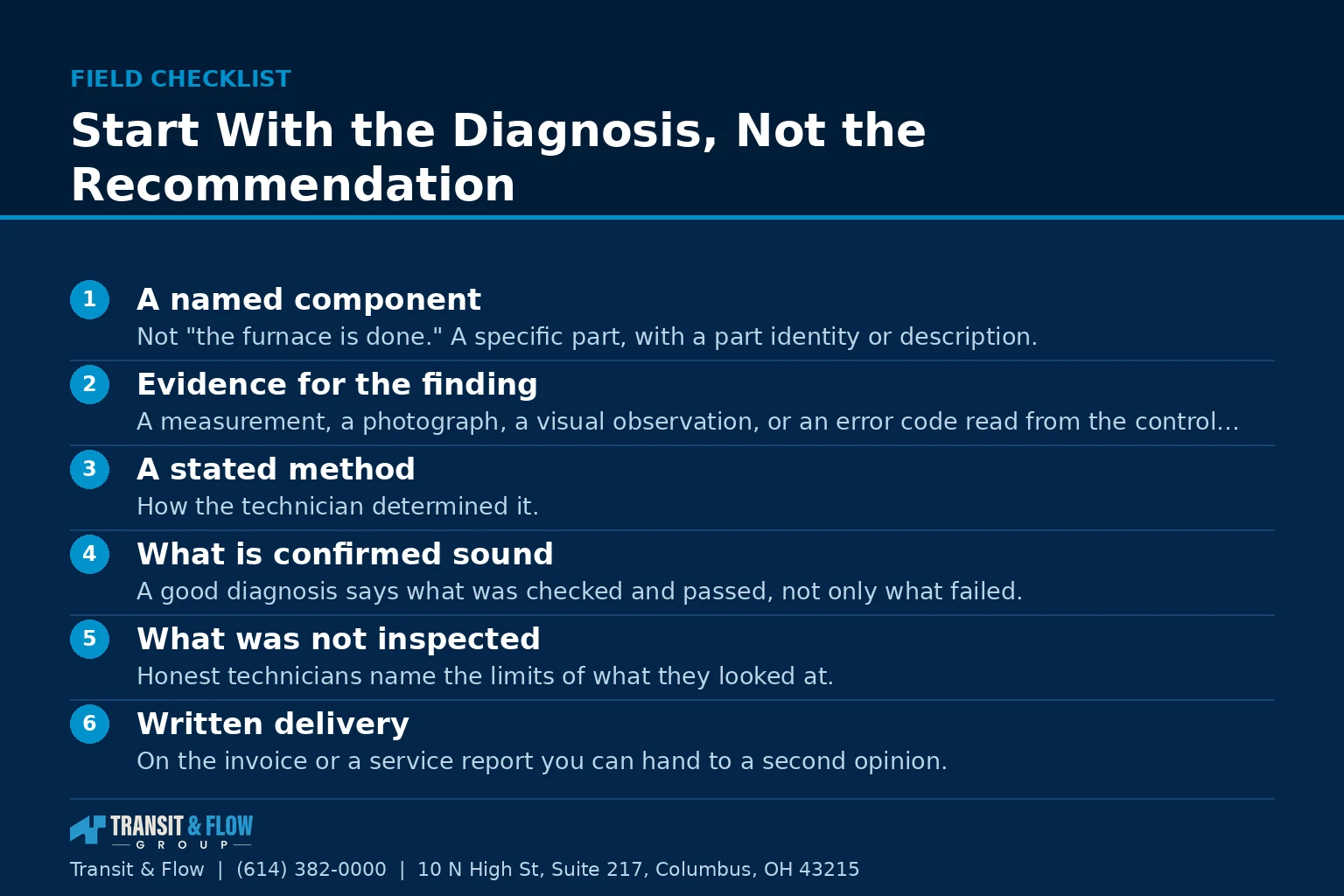
A recommendation without a diagnosis behind it is a sales position. Before you weigh anything, you need to know what actually failed and how that conclusion was reached. A defensible diagnosis has a shape, and you can check for it without knowing anything about furnaces.
- A named component. Not “the furnace is done.” A specific part, with a part identity or description.
- Evidence for the finding. A measurement, a photograph, a visual observation, or an error code read from the control board.
- A stated method. How the technician determined it. A heat exchanger finding in particular should be supported by a described inspection method rather than asserted.
- What is confirmed sound. A good diagnosis says what was checked and passed, not only what failed.
- What was not inspected. Honest technicians name the limits of what they looked at.
- Written delivery. On the invoice or a service report you can hand to a second opinion.
If any of the first three are missing, your next call is for a second opinion, not for a price. A second diagnostic visit is one of the highest-return expenditures available to a homeowner facing an equipment decision, and almost nobody makes it.
The Findings That End the Argument
A small number of findings settle the question by themselves. These are not judgment calls.
- A confirmed cracked or breached heat exchanger. Replace. This is the barrier between combustion gases and the air in your house.
- A red tag from the technician or the gas utility. The appliance is out of service until corrected, and the correction is frequently replacement.
- Parts that no longer exist. When a control board or a specific motor is discontinued with no aftermarket equivalent, the unit has reached the end of its practical life regardless of how it is running.
- Combustion readings outside acceptable limits that cannot be corrected by adjustment or cleaning.
- Corrosion through the cabinet or the vent connector serious enough that the structure holding the equipment together is failing.
Everything Else Is a Weighted Decision
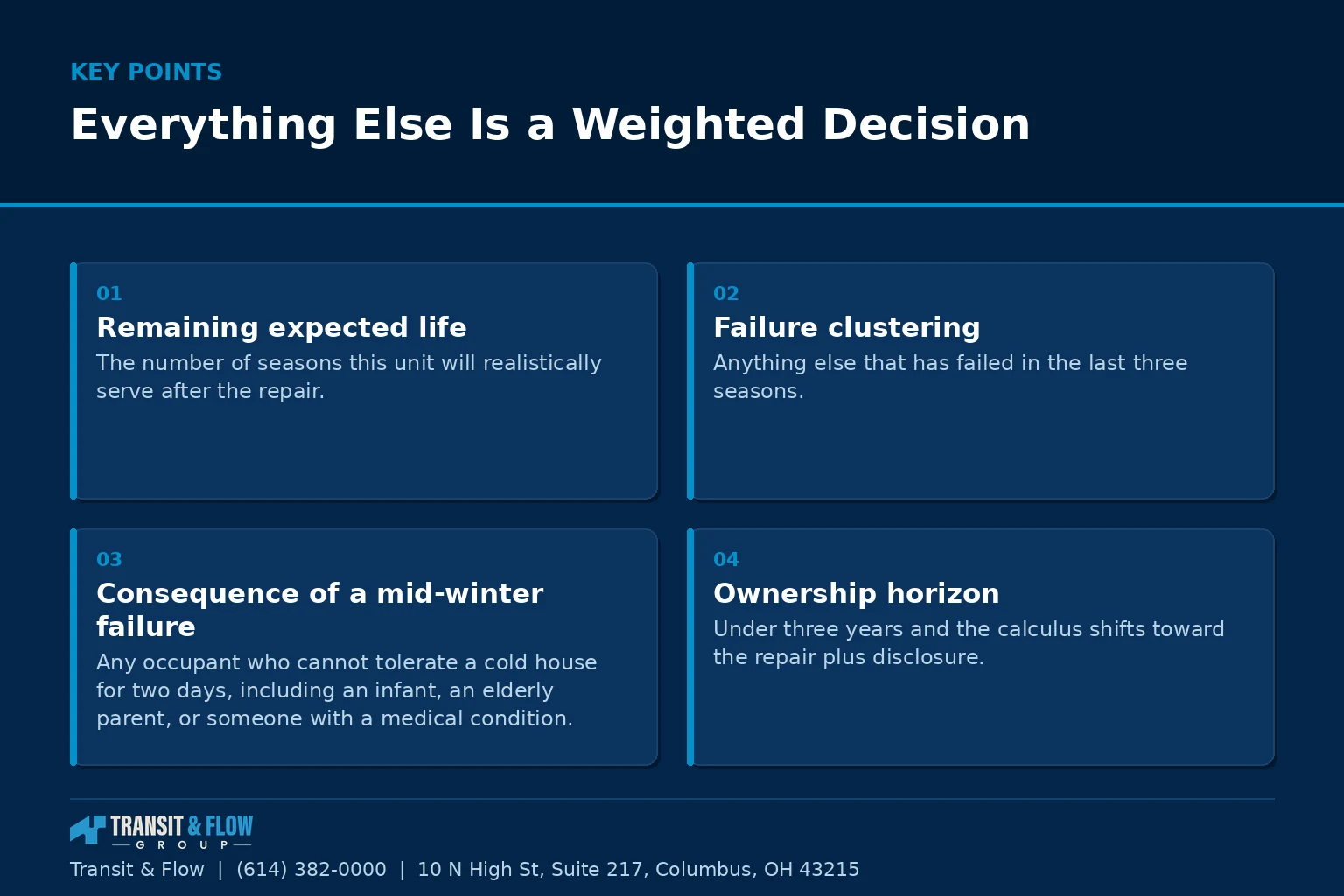
Outside those findings, the choice is a weighting exercise. Score each factor honestly and the answer usually declares itself.
- Remaining expected life. The number of seasons this unit will realistically serve after the repair. A repair that buys two winters on a unit past its expected service life is renting, not owning.
- Failure clustering. Anything else that has failed in the last three seasons. Components in a furnace age together. The second failure predicts the third far better than the first predicted the second.
- Consequence of a mid-winter failure. Any occupant who cannot tolerate a cold house for two days, including an infant, an elderly parent, or someone with a medical condition. This factor is routinely underweighted and it is often the one that matters most.
- Ownership horizon. Under three years and the calculus shifts toward the repair plus disclosure. Over seven and it shifts toward replacement.
- Comfort performance today. If the house has never heated evenly, replacing the unit alone will not solve it, and the repair-or-replace question is the wrong question. The right one is about distribution.
- Operating cost trend. Whether gas bills have climbed while weather and habits held steady. That is efficiency loss, and it is a recurring cost that a repair does not reverse.
- Access and disruption. Any other work already planned that would make replacement less disruptive if done at the same time. Finishing a basement, replacing a water heater, or opening a mechanical room.
- Financial position. An unplanned replacement in January on a credit card is a different transaction from a planned one in September. This is a legitimate factor and it belongs in the analysis openly rather than as an unspoken pressure.
Option A is repairing and planning a replacement on your own schedule within two years. Option B is replacing now. My recommendation for most Central Ohio households is Option A whenever the heat exchanger is confirmed sound and the failure is a single discrete component, because a planned replacement in the shoulder season is a calmer, better-scoped, more competitively bid project than an emergency one. Option B becomes correct the moment the failure clusters, the consequence of an outage is high, or the diagnosis is uncertain.
How to Buy a Repair Without Buying a Problem
- Ask what warranty covers the repair itself, on parts and on labor, and get the duration in writing.
- Ask whether the repair is credited toward replacement if the unit fails again within a defined window. Many contractors offer this and few volunteer it.
- Ask what else the technician expects to fail next and on what basis. The answer tells you whether you are looking at a repair or an installment plan.
- Ask whether any manufacturer warranty is still active. Heat exchangers in particular often carry long coverage periods, and coverage frequently survives changes in ownership on registered equipment.
- Get the model and serial recorded on your own copy. You will need it for warranty, for parts, and for the next technician.
On cost: this article contains no dollar figures on purpose. Repair pricing varies with the component, parts availability, whether the visit is after hours, the accessibility of the equipment, and the local labor market. A published range would set an expectation your actual situation would not match. Get a written diagnosis with a written price on your specific unit, and get a second one if the first is not defensible.
If You Are Deciding in the Middle of Winter
- Restore safe heat first, by repair or by temporary means, and separate that from the long-term decision. Deciding while cold produces bad decisions.
- Do not sign a replacement agreement during the diagnostic visit unless the unit is red-tagged and you have no heat. Same-day pressure is a sales technique, not an engineering necessity.
- Get a second proposal even under time pressure. Most contractors can produce one within a day or two in heating season.
- Ask what temporary safe heating is appropriate for your situation, and follow the manufacturer instructions on anything you use. Never use a cooking appliance or an unvented combustion device as a heat source.
- Confirm carbon monoxide alarms are working on every level before anything else, particularly if you are running alternate heat.
Where Transit & Flow Group Fits
Transit & Flow Group coordinates heating and cooling work across Columbus and Central Ohio and partners with properly licensed and insured specialty contractors when licensing is required. Our standard on a repair-or-replace call is a written diagnosis naming the component, the evidence, and what was confirmed sound, delivered in a form you can take to a second opinion. Because heating decisions frequently surface questions about electrical capacity and water heater venting at the same time, one coordinator carries all of it. To get a documented diagnosis on your system, request an assessment.
Frequently Asked Questions
What makes a furnace diagnosis defensible rather than a sales position?
It has a shape you can check without knowing anything about furnaces. A defensible diagnosis names a specific component rather than declaring the furnace done, gives evidence for the finding such as a measurement, a photograph, or an error code, and states the method used to reach it. It also says what was checked and confirmed sound, names what was not inspected, and arrives in writing on an invoice or service report. If the component, the evidence, or the method is missing, your next call is for a second opinion rather than for a price.
Which findings settle the repair or replace question outright?
A small number of them, and they are not judgment calls. A confirmed cracked or breached heat exchanger, a red tag from the technician or the gas utility, discontinued parts with no aftermarket equivalent, combustion readings outside acceptable limits that adjustment or cleaning cannot correct, and corrosion serious enough that the cabinet or vent connector is structurally failing all point to replacement. Each of those is a determination for a licensed heating professional, made against the manufacturer’s published instructions and the adopted code, not something to judge from the basement stairs. Everything outside that short list is a weighted decision.
Should I sign a replacement agreement during the diagnostic visit?
Not unless the unit has been red-tagged and you have no heat. Same-day pressure is a sales technique rather than an engineering necessity, and most contractors can produce a second proposal within a day or two even in heating season. Restore safe heat first, by repair or by temporary means, and keep that separate from the long-term decision. Decisions made while the house is cold are reliably worse than the same decisions made warm.
Is a second diagnostic visit worth the trouble?
It is one of the highest-return steps available to a homeowner facing an equipment decision, and almost nobody takes it. A written diagnosis from the first technician is exactly what makes the second visit useful, because the second technician can confirm or contradict a specific named finding rather than starting over. That is also why the first diagnosis should be delivered in a form you can hand to someone else. If the first report will not survive being read by a second professional, that is the answer to your question.
Why does this article publish no repair prices?
Because a published range would set an expectation your situation would not match. Repair pricing moves with the component involved, parts availability, whether the visit is after hours, how accessible the equipment is, and the local labor market. What you need instead is a written diagnosis with a written price on your specific unit, and a second one if the first is not defensible. That gives you a real number rather than an average that describes nobody.
What should I do first if the furnace fails in the middle of winter?
Confirm that carbon monoxide alarms are working on every level before anything else, particularly if you are running alternate heat. If an alarm sounds, leave the building and call from outside. Ask a licensed professional what temporary safe heating is appropriate for your situation and follow the manufacturer’s instructions for anything you use, and never treat a cooking appliance or an unvented combustion device as a heat source. Once safe heat is restored, separate that from the long-term decision and get a second proposal before committing.
Sources
- U.S. Consumer Product Safety Commission, home heating and carbon monoxide safety
- Ohio Construction Industry Licensing Board, HVAC trade licensing
- City of Columbus, Get a Permit, mechanical permit channels
About This Guide
Written and edited by Micheal Parker, founder of Transit & Flow Group. Published October 23, 2026. This guide is checked against the agency and code sources listed above, and it is revised when those sources change.
General contractor of record. Micheal Parker holds City of Columbus General Contractor Registration G12064, issued by the Columbus Department of Building and Zoning Services under Transit & Flow LLC and valid through June 30, 2027. Trade work that falls outside the scope of that registration is performed by licensed trade partners, and the responsible license holder is identified before work begins.
Transit & Flow Group, home and commercial services for Columbus and the surrounding Central Ohio communities. Phone (614) 382-0000. Email solutions@transitflowgroup.com. 10 N. High St., Suite 217, Columbus, OH 43215. Contact our team or review the communities we serve.
