
Ready for a real number on your roof?
Trace your roof on our satellite tool and get an instant price, then we confirm it with a free measure-verification.
If you’re staring at a roof that’s curling, leaking, or simply old, the first question is almost always the same: what is this going to cost? The honest answer is that roof replacement is priced from your specific roof, not from a chart, but that doesn’t mean you should go in blind. This guide explains exactly what drives the price of a roof replacement in Central Ohio, what general market ranges look like in 2026, and how to get a real number for your home in a few minutes rather than waiting on a sales appointment.
What the data shows
Nationally, asphalt shingle roof replacement recoups about 68% of its cost at resale, based on an average project cost of $31,871 against $21,501 in added resale value, according to the 2025 Cost vs. Value Report from the Journal of Light Construction. (JLC 2025 Cost vs. Value Report)
Build My Roofing Estimate | Book a Roof Assessment | Call (614) 382-0000
The short answer
Most Central Ohio homeowners spend somewhere in the range of $9,000 to $16,000 to replace a typical asphalt shingle roof on a 2,000-square-foot home with tear-off included, and the full range across all home sizes and material choices runs wider, roughly $8,000 to $20,000 or more for larger, steeper, or premium-material roofs. On a per-square basis, installed asphalt roofing generally lands around $4.50 to $8.00 per square foot in 2026, tear-off included. These are current general market figures for Ohio, not a Transit & Flow quote, and where your roof falls inside that range depends on the specific factors below.
The single most useful thing to understand is that a roof isn’t priced by square footage alone. Two homes with identical footprints can differ by thousands of dollars once pitch, complexity, material, and what’s found under the old shingles come into play.
What actually drives the price
Roof size, measured in squares
Roofers price in “squares,” where one square equals 100 square feet of roof surface, not floor area. A 2,000-square-foot home often has 20 to 30 squares of actual roof surface once overhangs and pitch are factored in. Size is the foundation of the estimate, but it’s only the starting point.
Pitch and complexity
A steep roof costs more than a shallow one, because it’s slower and more dangerous to work on and often requires additional safety measures. Complexity compounds this: every valley, dormer, chimney, skylight, and hip adds cutting, flashing, and labor. A simple gable roof with two planes is the most economical shape to replace. A roof with multiple levels, dormers, and intersecting planes takes more time and materials for the same square footage, and the price reflects that.
Material tier
Material is where homeowners have the most control over cost. In rough order of price:
Basic three-tab asphalt shingles are the lowest-cost option and the shortest-lived. Architectural (dimensional) asphalt shingles are the standard choice for most Central Ohio homes, offering a better look and typically a 30 to 50 year warranty at a moderate price. Premium designer asphalt shingles sit at the top of the asphalt range. Metal roofing generally runs two to three times the cost of asphalt but can last 50 years or more, making it a long-horizon value choice rather than a low-upfront one.
Tear-off and layers
Removing the old roof is real labor, and removing two layers costs more than one. Ohio code generally limits a roof to two layers of shingles, so if you already have two layers, a full tear-off down to the deck is required rather than an overlay. Tear-off also matters because it’s the only way to inspect and address what’s underneath.
Decking and hidden conditions
Once the old roofing is off, the crew can see the roof deck (the plywood or board sheathing). Rotted or damaged decking has to be replaced, and this is one of the most common sources of a price adjustment between the estimate and the final invoice, because no one can see under the shingles until they’re removed. A reputable roofer tells you the per-sheet cost of decking replacement up front, so a surprise here is a documented rate, not a made-up number.
Flashing, ventilation, and water-prevention details
The parts of a roof that actually prevent leaks are often the parts homeowners never think about: new flashing around chimneys and walls, pipe boots, ridge venting, drip edge, and ice-and-water shield in the vulnerable areas. In Central Ohio’s freeze-thaw climate, ice-and-water shield along eaves and valleys matters, because ice damming is a real regional risk. A quote that leaves these details out to look cheaper isn’t a bargain; it’s a roof that leaks sooner.
General 2026 market ranges, in context
To make the numbers concrete, here is roughly how the pieces stack up in the current Ohio market. Treat these as general market context to help you plan, not as a Transit & Flow quote, because your actual price depends on the factors above and is confirmed by an on-site assessment.
| Factor | General market context (2026, Ohio) |
|---|---|
| Installed asphalt, per square foot | ~$4.50 to $8.00, tear-off included |
| Typical 2,000 sq ft home, asphalt | ~$9,000 to $16,000 |
| Full range across sizes/materials | ~$8,000 to $20,000+ |
| Architectural shingles | Standard choice, 30 to 50 year warranty |
| Metal roofing | ~2 to 3x asphalt, 50+ year lifespan |
| Decking replacement | Priced per sheet, only known after tear-off |
We do not publish a firm final price online, because roofing depends heavily on what your specific roof and its decking reveal. What we do is give you a preliminary online estimate based on the details you enter, then confirm scope and price with an on-site assessment. Final scope and price are subject to verification once our team inspects the roof, the decking, and the flashing details in person.
Choosing a material: what each tier really buys you
Since material is your biggest lever on both cost and lifespan, it’s worth understanding what each option actually delivers for a Central Ohio home.
Three-tab asphalt shingles are the entry point: lowest cost, a flat uniform look, and the shortest lifespan, often around 15 to 20 years. They’re a reasonable choice for a rental, a property you plan to sell soon, or a tight budget, but for a long-term home they’re frequently a false economy, since you may replace them again well before a better shingle would have needed it.
Architectural (dimensional) shingles are the sweet spot for most Central Ohio homeowners. They cost more than three-tab but deliver a dimensional, higher-end appearance, better wind resistance, and warranties commonly in the 30 to 50 year range. For a home you’re keeping, this tier usually offers the best balance of upfront cost and long-term value, which is why it’s the default recommendation for most replacements.
Premium designer asphalt shingles sit at the top of the asphalt range, mimicking the look of slate or wood shake at a fraction of those materials’ cost and weight. They’re an appearance-and-value upgrade for homeowners who want a distinctive look without moving to a specialty material.
Metal roofing is the long-horizon play. It runs roughly two to three times the cost of asphalt up front, but it can last 50 years or more, sheds snow well, and holds up to Central Ohio’s weather extremes. For a homeowner planning to stay in the home for decades, metal can be the lower lifetime cost despite the higher upfront number, the same long-term-value logic that applies to a tankless water heater or any durable-goods decision.
The right choice isn’t universal, it’s a function of how long you’re staying, your budget, and the look you want. A good assessment walks you through these tradeoffs for your specific roof rather than defaulting to one answer.
How to read a roof quote (and spot a bad one)
Once you start collecting quotes, the challenge shifts from “what does a roof cost” to “why are these two quotes so different.” Often the answer is that they’re not quoting the same roof. A trustworthy roof quote itemizes the things that actually matter, and the gaps are where corners get cut.
A complete quote should specify: the material and manufacturer, not just “shingles”; whether tear-off is included and how many layers; the per-sheet rate for decking replacement if rot is found, so a hidden condition becomes a documented rate rather than a surprise; the flashing, drip edge, ridge venting, and ice-and-water shield being installed, the leak-prevention details that a cheap quote quietly omits; the workmanship warranty; and whether permits and disposal are included. A quote that’s dramatically lower than the others is often lower because it leaves these out, and the difference shows up later as a leak or a change order.
The point isn’t that the highest quote is best, it’s that you can only compare quotes fairly when they cover the same scope. Understanding what belongs in a proper quote is what lets you tell a genuine value from a number that’s low because it’s incomplete.
What to expect during the install
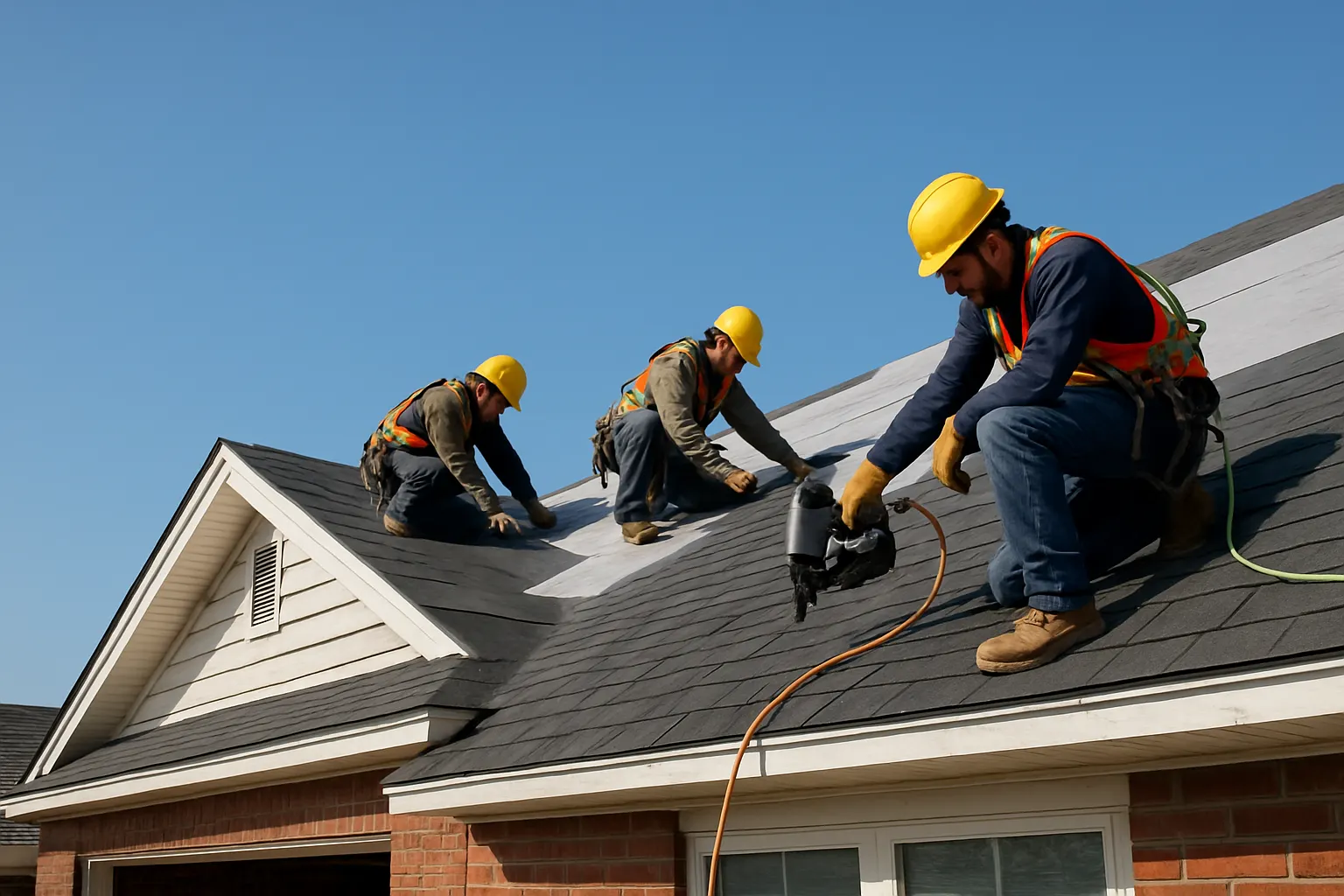
A roof replacement is a disruptive but fast project. Here’s the general arc so you know what you’re signing up for. Materials are delivered and the crew protects landscaping and the area around the house. The old roof is torn off down to the deck, which is loud and generates debris that’s contained and hauled away. The deck is inspected and any rotted sheathing is replaced. Underlayment, ice-and-water shield, and flashing go down, then the new shingles, then ridge venting and finishing details. The site is cleaned, including a magnetic sweep for stray nails, and the work passes any required inspection. For most homes this is a one to few day process depending on size, complexity, and weather. Central Ohio weather is the main variable that can push a schedule, since roofing can’t safely proceed through rain.
Repair or replace? How to tell
Not every roof problem is a replacement. A few missing shingles after a windstorm, an isolated leak around a single penetration, or localized flashing failure can often be repaired. Replacement becomes the better value when the signs point to whole-roof wear rather than a spot problem:
Shingles that are curling, cupping, or losing granules across the whole roof rather than in one area. A roof at or past 20 years for standard asphalt. Multiple leaks, or leaks that return after repair. Widespread damage after a major storm, especially hail. Two existing layers, where code requires a tear-off anyway. Daylight visible through the roof deck in the attic, or sagging.
If you’re not sure which camp you’re in, that’s exactly what an assessment is for. Paying for a full replacement when a repair would do is as much a mistake as patching a roof that’s genuinely done.
The Central Ohio climate factor
Central Ohio roofs work harder than roofs in milder regions. Freeze-thaw cycles each winter stress shingles, flashing, and any gap where water can get in and freeze. Hot, humid summers and the region’s severe summer storms bring wind and hail that strip or bruise shingles. That combination is why local roofs often reach the end of their useful life on the earlier side of a shingle’s rated lifespan, and why regional installation details, ice-and-water shield placement, proper ventilation to manage attic heat and moisture, and quality flashing, matter more here than a spec sheet suggests. A roof installed for the Central Ohio climate lasts longer than one installed to a generic minimum.
Permits and local considerations
Roofing work in Central Ohio may require a permit and inspection depending on the municipality, and requirements vary between Columbus and the surrounding suburbs and townships. Permits and inspections may be required for your project, and a reputable roofer handles that paperwork as part of the job rather than leaving it to you. Ohio code’s general two-layer limit is the most common code factor homeowners encounter, since it determines whether an overlay is even an option or a full tear-off is required.
Insurance and storm damage
Homeowner’s insurance typically covers sudden storm damage, such as hail and wind, minus your deductible, but it does not cover age-related wear, that’s considered a maintenance responsibility. If your roof was damaged in a specific storm event, document it, and an assessment can help you understand whether an insurance claim is appropriate. If the roof is simply old, that’s an out-of-pocket replacement, though financing options are commonly available to spread the cost. Financing is always subject to credit approval and is offered as information, not a guarantee.
How to get an accurate number for your roof
You have two honest paths to a real number. The fast one is our Estimate Builder: answer a few questions about your home’s size, roof shape, current material, and what’s prompting the replacement, and you’ll get a preliminary online estimate range in a few minutes, no sales appointment required to see a number. The precise one is an on-site assessment, where our team measures the roof, checks the decking and flashing conditions the online tool can’t see, and confirms scope and price. Most homeowners start with the Estimate Builder to get oriented, then book the assessment to lock in the details.
What we won’t do is quote you a firm final price sight unseen, because roofing prices that don’t account for your decking and flashing conditions are guesses dressed up as quotes.
Frequently asked questions
How long does a roof replacement take?
Most single-family asphalt roof replacements are completed in one to a few days depending on size, complexity, and weather. Metal and premium materials, or roofs needing significant decking work, can take longer. Our team gives you a realistic timeline as part of the assessment.
How much does decking replacement add?
It depends on how much of the deck is rotted or damaged, which can only be known after tear-off. A reputable roofer gives you the per-sheet rate up front, so any decking cost is a documented rate applied to actual conditions, not a surprise.
Is a permit required to replace my roof?
Permits and inspections may be required and vary by municipality across Central Ohio. Our team pulls the permit and schedules any required inspection as part of the job.
Should I repair or replace?
Isolated damage can often be repaired; whole-roof wear, age past 20 years for asphalt, repeated leaks, or two existing layers point to replacement. An assessment gives you an honest answer rather than a default to the bigger job.
Will my insurance pay for a new roof?
Insurance typically covers sudden storm damage minus your deductible, but not age-related wear. Document any storm event, and an assessment can help you understand your options.
What warranty comes with a new roof?
All workmanship is backed by a 1-year labor warranty on labor, parts, and equipment covered per manufacturer terms..
Get your number
You don’t have to wait on a sales pitch to find out what your roof will cost. Build a preliminary online estimate in a few minutes, or call (614) 382-0000 to book an on-site assessment. See our roof replacement service page for what’s included, and if you suspect the damage is isolated, start with roof repair instead.
Reviewed by the Transit & Flow Group service team. Last reviewed July 2026. Cost figures reflect general 2026 Ohio market data and are not a Transit & Flow Group quote; your price is confirmed by an on-site assessment.
Sources for general market cost context:
– DTE Roofing, “How Much Does a Roof Replacement Cost in Columbus, OH? (2026)”: https://www.dteroofingllc.com/blog/roof-replacement-cost-columbus-ohio
– This Old House, “The Cost of a Roof Replacement in Ohio”: https://www.thisoldhouse.com/roofing/roof-replacement-cost-ohio
Frequently Asked Questions
How much does a roof replacement cost in Central Ohio?
Most Central Ohio roof replacements run about $6,000 to $15,000 or more, depending on roof size, pitch, and material. Architectural asphalt shingle is the most common choice; designer shingle and standing-seam metal cost more.
What affects the price of a new roof?
The biggest factors are roof size in squares, pitch and complexity, the material you choose, how many existing layers must be torn off, and any decking repairs found during the job.
How long does a roof replacement take?
A typical residential asphalt roof is completed in one to two days, weather permitting. Larger or steeper roofs and metal systems can take longer.
Can I get an instant roof estimate online?
Yes. Our satellite roof tool measures your roof from aerial imagery and gives an instant Central Ohio price range, which we then measure-verify on a free inspection.
More Resources
- Are Gutter Guards Worth It? A 2026 Central Ohio Cost Guide
- Contractor Registration and Permits in Central Ohio
- Do You Need a Permit? A Central Ohio Home Improvement Guide
- Signs You Need a Sump Pump: A Central Ohio Homeowner’s Guide
- Tank vs Tankless Water Heater in Central Ohio: How to Choose in 2026
- The Facilities Manager’s Guide to Vendor Consolidation
- Tub to Shower Conversion Cost: A 2026 Central Ohio Guide
- Why Is My Drain Backing Up? How to Tell What’s Really Wrong