
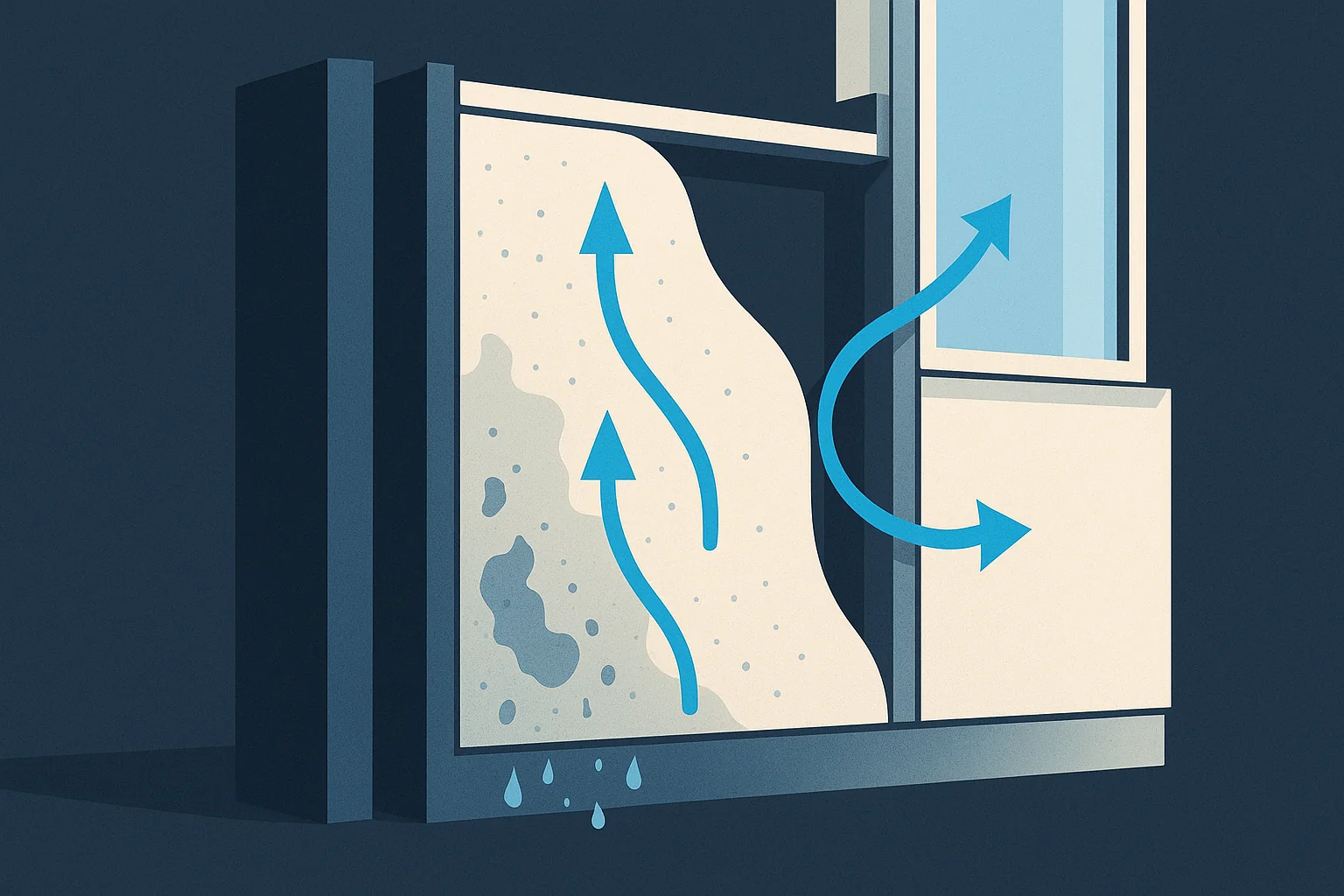

Most Central Ohio households replacing siding are choosing among three categories, whatever the brand names on the samples say. Vinyl, fiber cement, and engineered wood account for the overwhelming majority of residential replacements in this region, and the differences between them are frequently described in the wrong terms. Sales conversations tend to compare warranties and appearance. The variables that actually determine which one is right for a given house are how each material handles freeze and thaw cycling, what it demands of the installer, and what maintenance the household is realistically going to perform.
In This Guide
- What Ohio Weather Actually Tests
- Vinyl
- Fiber Cement
- Engineered Wood
- The Comparison in the Terms That Matter
- Failure Modes Worth Understanding Before You Choose
- What Distinguishes One Proposal From Another
- On Cost
- Glossary
- The Decision
- Where Transit & Flow Group Fits
- Frequently Asked Questions
This is a comparison, not a recommendation of one product over another in the abstract. All three are legitimate choices, and all three fail in predictable ways when installed poorly. Our siding replacement guide covers the wall assembly work that matters more than material selection, and this article assumes that work is being done correctly regardless of which of the three you choose.
What Ohio Weather Actually Tests
Three conditions do most of the differentiating in this climate. The first is repeated freeze and thaw cycling rather than sustained cold, which stresses any material that takes on moisture. The second is a wide annual temperature range, which drives expansion and contraction and therefore makes fastening and gap detail decisive. The third is sustained summer humidity, which slows the drying of any assembly that gets wet.
Add convective storms producing hail and wind driven rain, and the practical question becomes how each material behaves when it is moving constantly, occasionally struck, and periodically wet.
Vinyl
Vinyl is a formed polymer panel hung on the wall rather than fastened tight to it, which is the single most misunderstood thing about it. It is designed to move. Panels lock together and hang from nailing hems with intentional play, and installations that fasten it tightly produce the waviness that gives the category its reputation. That is an installation outcome, not a material defect.
Its strengths are cost, low maintenance, color that runs through the material rather than sitting on it, and immunity to rot and insects. Its weaknesses are impact resistance, particularly in cold weather when the material is at its most brittle, susceptibility to heat distortion from reflected sunlight, and a visual character that some households simply do not want. Insulated vinyl, which bonds a rigid foam backing to the panel, addresses the impact and rigidity concerns and adds some thermal value, at higher cost.
Fiber Cement
Fiber cement is a composite of cement, sand, and cellulose fiber formed into planks or panels. It is dimensionally stable, does not burn, is not attractive to insects, and holds a paint finish for a long service cycle. It reads visually as painted wood, which is the appearance most households in this region are actually after.
Its demands are on the installer. Cut edges have to be treated, clearances to grade, roofing, decking, and horizontal surfaces have to be maintained per the manufacturer’s published instructions, fastening has to be correct in type and placement, and joints have to be detailed as specified. Where those items are handled, it performs for a long time. Where they are not, moisture enters at the edges and the material’s stability becomes irrelevant. It is also heavy, which affects labor, and it will eventually need repainting, which is a real cost on a long cycle rather than a maintenance free claim.
Engineered Wood
Engineered wood siding is wood strands or fibers bound with resins, treated, and factory finished or primed. It is lighter than fiber cement, easier and faster to install, and cuts with standard woodworking tools, which reduces labor cost and installation risk. It carries a wood appearance convincingly and is more dimensionally stable than solid wood.
Its dependency is the integrity of the coating and the sealed edges. The material’s moisture resistance is engineered into the product and maintained by the finish, so anything that breaches the finish, including unsealed field cuts, damaged edges, or deferred refinishing, opens a path. Clearance requirements matter here as much as with fiber cement, and contact with soil, mulch, or a roof surface is the condition that most reliably produces a problem.
The Comparison in the Terms That Matter
| Consideration | Vinyl | Fiber cement | Engineered wood |
|---|---|---|---|
| Movement with temperature | Significant, must hang loose by design | Minimal | Low |
| Impact resistance | Lowest, and lower still in cold | Highest | High |
| Moisture vulnerability | Material itself is unaffected | At untreated cut edges and closed clearances | At coating breaches and unsealed edges |
| Installation sensitivity | High, fastening determines appearance | High, clearances and edge treatment determine durability | Moderate to high, edge sealing determines durability |
| Weight and labor | Lightest, fastest | Heaviest, slowest | Moderate |
| Recurring maintenance | Washing | Repainting on a long cycle | Refinishing and edge inspection on a moderate cycle |
| Repairability of a damaged panel | Panels can be replaced, matching fades over time | Individual planks replaceable, paint match required | Individual planks replaceable, finish match required |
| Appearance character | Reads as vinyl at close range | Reads as painted wood | Reads as wood |
| Fire behavior | Combustible | Noncombustible | Combustible, treated |
| Typical cost position | Lowest | Highest | Between the two |
Failure Modes Worth Understanding Before You Choose
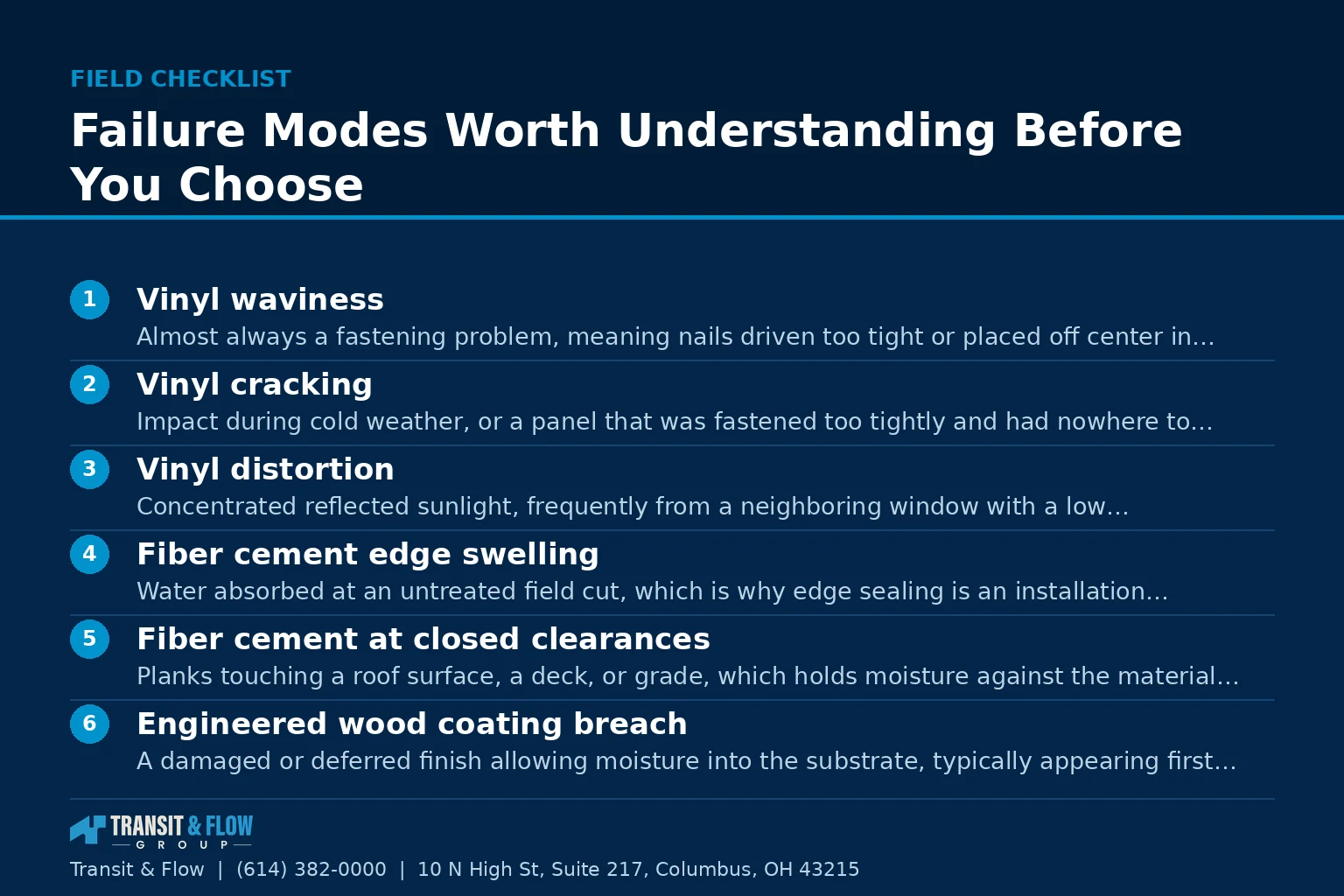
Each category fails in a characteristic way, and knowing the pattern is more useful than a durability rating.
- Vinyl waviness. Almost always a fastening problem, meaning nails driven too tight or placed off center in the slot, preventing the panel from moving as designed.
- Vinyl cracking. Impact during cold weather, or a panel that was fastened too tightly and had nowhere to go during a temperature swing.
- Vinyl distortion. Concentrated reflected sunlight, frequently from a neighboring window with a low emissivity coating, which is a documented and localized phenomenon.
- Fiber cement edge swelling. Water absorbed at an untreated field cut, which is why edge sealing is an installation requirement rather than a best practice.
- Fiber cement at closed clearances. Planks touching a roof surface, a deck, or grade, which holds moisture against the material continuously.
- Engineered wood coating breach. A damaged or deferred finish allowing moisture into the substrate, typically appearing first at the bottom course or at cut ends.
- Any material at a bad flashing detail. The most common failure across all three has nothing to do with the cladding, as covered in our guide to reading siding damage.
What Distinguishes One Proposal From Another
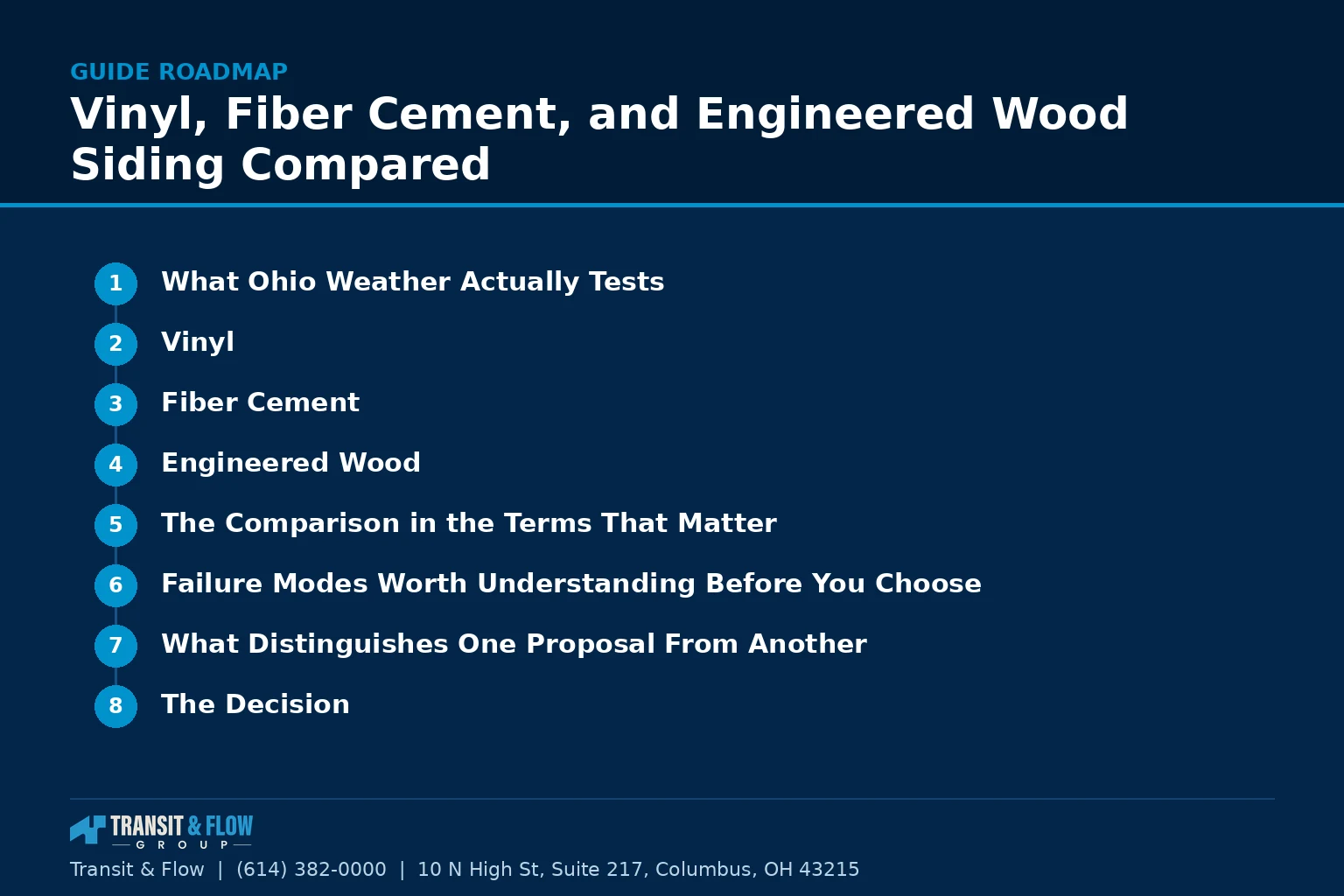
- The clearances required by the manufacturer’s published instruction. Ask for the figure and confirm whether the site conditions allow it.
- The treatment applied to field cut edges. This has a specific and verifiable answer for fiber cement and engineered wood.
- The fastener type and spacing specified for the product. Installation outside the published instruction is the most common warranty exclusion.
- The crew’s experience with this specific material. The three categories install differently, and a crew’s fluency is not transferable between them.
- The finish maintenance cycle, and who performs it. The honest answer for two of the three categories is that repainting or refinishing is eventually required.
- The process for replacing a damaged panel later. Availability of a matching product in ten years is a legitimate thing to establish now.
- The color restrictions the warranty imposes. Some product lines limit which colors are warranted on which substrates or exposures.
On Cost
This article contains no dollar figures on purpose. Material pricing shifts, and the installed cost of a siding project is driven more by wall area, access, opening count, trim complexity, and what is found behind the existing cladding than by which of these three products is selected. Publishing a per square figure would invite a comparison that ignores the larger variables. The durable economic observation is that the cost ordering among these three is stable, with vinyl lowest, fiber cement highest, and engineered wood between them, and that the gap between a good installation and a poor one exceeds the gap between the materials.
Glossary
- Nailing hem. The slotted upper edge of a vinyl panel through which fasteners pass, designed to allow the panel to move.
- Clearance. The required gap between siding and an adjacent surface such as grade, roofing, or decking.
- Field cut. A cut made on site rather than at the factory, exposing untreated material at the edge.
- Edge sealing. Treating a field cut so the exposed edge resists moisture absorption.
- Course. A single horizontal run of siding across a wall.
- Exposure. The visible height of each course once installed.
- Factory finish. A coating applied under controlled conditions before delivery, generally more durable than a field applied finish.
- Thermal distortion. Warping caused by concentrated heat, most often from reflected sunlight.
- Substrate. The base material of a product beneath its finish layer.
The Decision
Option A. Vinyl, in its insulated form where budget allows. This is the right answer for households prioritizing lowest installed cost and lowest ongoing maintenance, for rental and investment property, and for houses where the appearance expectation is functional rather than architectural. Accept that impact performance is the weak point and that the material reads as vinyl at close range.
Option B. Fiber cement. This is the right answer for households with a long tenure horizon who want a painted wood appearance, who value impact and fire performance, and who accept a repainting cycle as a known future cost. It requires a crew that is genuinely fluent in the material, which is a real constraint on contractor selection.
Engineered wood sits between them and is the right answer where the wood appearance matters, the budget will not reach fiber cement, and the household will actually maintain the finish. Our recommendation for a long tenure owner occupied home in Central Ohio is Option B, because the impact and dimensional performance suit the climate and the appearance holds up over the horizon that justifies the spend. For a shorter tenure, a rental, or a budget constrained full replacement, Option A with insulated vinyl is the sounder allocation, and we would rather see a household put the difference into the barrier and flashing work behind the cladding than into a premium material installed over an uncorrected wall.
Where Transit & Flow Group Fits
Transit & Flow Group specifies material against the house and the household rather than against a preferred product line, and we put the manufacturer’s clearance and edge treatment requirements into the scope in writing so they are not decided in the field on the last day of a job. We also match crews to material, because fluency with one of these three categories does not transfer to the others. Transit & Flow Group coordinates projects and partners with properly licensed and insured specialty contractors when licensing is required, and work is performed under the appropriate permits. To discuss an exterior project, get in touch, or review our siding and gutter services.
Frequently Asked Questions
Which of these three siding materials is best for a Central Ohio house?
None of them is best in the abstract, and all three are legitimate choices that fail in predictable ways when installed poorly. The useful comparison is not warranty length or appearance but how each material handles freeze and thaw cycling, what it demands of the installer, and what maintenance the household will realistically perform. For a long tenure owner occupied home, fiber cement suits the climate and holds its appearance over the horizon that justifies the spend. For a shorter tenure, a rental, or a budget constrained full replacement, insulated vinyl is often the sounder allocation.
Why does vinyl siding end up looking wavy?
Almost always because of fastening. Vinyl is designed to hang on the wall rather than be pulled tight to it, with panels locking together and hanging from slotted nailing hems that allow intentional movement. Nails driven too tight or placed off center in the slot prevent that movement, and the panel buckles during a temperature swing. That is an installation outcome rather than a material defect, which is why the category’s reputation is largely a reputation about installers.
Is fiber cement maintenance free?
No, and any proposal that implies it is has skipped something. Fiber cement is dimensionally stable, does not burn, and is not attractive to insects, but it holds a paint finish that will eventually need renewing on a long cycle, which is a real future cost. Its durability also depends on the installer treating cut edges, maintaining the clearances the manufacturer’s published instructions require to grade, roofing, decking, and horizontal surfaces, and fastening and detailing joints as specified. Where those items are handled it performs for a long time, and where they are not, moisture enters at the edges and the material’s stability stops mattering.
What makes engineered wood siding vulnerable?
Its moisture resistance is engineered into the product and maintained by the finish, so the coating and the sealed edges are the whole dependency. Anything that breaches the finish opens a path, including unsealed field cuts, damaged edges, and deferred refinishing, and problems usually appear first at the bottom course or at cut ends. Clearance requirements matter here as much as with fiber cement, and contact with soil, mulch, or a roof surface is the condition that most reliably produces trouble. Confirm the required clearances and edge treatment against the manufacturer’s published instructions rather than against site habit.
Does the installer matter more than the material?
In this comparison, yes. The gap between a good installation and a poor one exceeds the gap between the three materials, and the most common failure across all of them has nothing to do with the cladding at all. It is a bad flashing detail. That is also why the barrier and flashing work behind the cladding deserves budget before a premium material does, since a premium product installed over an uncorrected wall buys very little.
What should I confirm before accepting a siding proposal?
Ask what the manufacturer’s published instruction requires for clearances and whether site conditions allow it, how field cut edges will be treated, and what fastener type and spacing is specified, since installation outside the published instruction is the most common warranty exclusion. Confirm the crew’s experience with that specific material, because fluency with one of the three categories does not transfer to the others. Establish the finish maintenance cycle and who performs it, how a damaged panel gets replaced years from now, and what color restrictions the warranty imposes. Get those answers in the written scope rather than settled in the field on the last day of the job.
Sources
- City of Columbus, permits
- Ohio Construction Industry Licensing Board
- U.S. Department of Energy, moisture control guidance
- Ohio Attorney General, consumer protection
About This Guide
Written and edited by Micheal Parker, founder of Transit & Flow Group. Published March 7, 2027. This guide is checked against the agency and code sources listed above, and it is revised when those sources change.
General contractor of record. Micheal Parker holds City of Columbus General Contractor Registration G12064, issued by the Columbus Department of Building and Zoning Services under Transit & Flow LLC and valid through June 30, 2027. Trade work that falls outside the scope of that registration is performed by licensed trade partners, and the responsible license holder is identified before work begins.
Transit & Flow Group, home and commercial services for Columbus and the surrounding Central Ohio communities. Phone (614) 382-0000. Email solutions@transitflowgroup.com. 10 N High St, Suite 217, Columbus, OH 43215. Contact our team or review the communities we serve.
