


Damaged siding is one of the few building problems a homeowner can genuinely assess from the ground with nothing but attention. The cause is usually written on the wall in a recognizable pattern, and the pattern matters, because it determines whether the correct response is a repair, a replacement, a claim, or an investigation of what is happening behind the cladding.
In This Guide
- The Question Behind Every Observation
- Hail
- Woodpeckers
- Moisture
- Age and Ultraviolet Exposure
- Reading the Pattern
- How to Document What You Are Seeing
- After a Storm, a Word About Who Knocks
- On Cost
- Glossary
- The Decision
- Where Transit & Flow Group Fits
- Frequently Asked Questions
This article is about interpreting what you are looking at. It is written to help a household describe a condition accurately and decide who to call, not to establish a diagnosis or a scope. What you observe from the ground is evidence, not a conclusion.
The Question Behind Every Observation
Whatever the visible damage, one question governs the response. Is the wall behind the siding wet?
Cosmetic damage to a cladding layer is an appearance and maintenance question with a flexible timeline. Damage that indicates water is reaching the sheathing is a building envelope question with a short one, because the cost of that condition compounds while it is ignored. Most of the interpretation that follows is really about sorting observations into those two buckets. Our siding replacement guide covers what happens once that sorting is done.
Hail
Hail damage has a distinctive signature. It is directional, concentrating on the elevations facing the storm, usually the south and west in this region though it varies by event. On vinyl it appears as cracks, chips, or holes, frequently with a clean circular or crescent character, and it is often more visible on the lower half of a panel. On fiber cement and engineered wood it may appear as chipping, divots, or coating damage that is easier to see in low angle light than at midday.
Two things distinguish hail from other causes. The first is that it appears on multiple materials at once, so gutters, downspouts, window screens, mailboxes, and any metal on the property will typically show it too. Checking those surfaces is a faster confirmation than studying the siding. The second is that it is concentrated by direction rather than distributed evenly.
Where storm damage is suspected, the useful sequence is to document it with dated photographs, note the date of the storm event, and contact your insurance carrier directly to understand the claim process before engaging a contractor who solicits after a storm. Coverage determinations belong to your carrier and your policy, not to a contractor at your door.
Woodpeckers
Woodpecker damage is unmistakable once you know it. It appears as clean, roughly round holes, often in clusters or in a rough line, typically high on a wall and frequently under an eave or on a gable. The holes go through the cladding rather than denting it.
The important point is that woodpecker activity is usually a symptom of something else. Birds drill for insects, for nesting cavities, or to drum on a resonant surface. Repeated, concentrated drilling in one location often means insects are present in or behind the material, which makes the holes a signal worth investigating rather than just patching. Patching without understanding why that location was selected tends to produce the same holes in the same place the following season.
Some woodpecker species are federally protected, which means deterrence and exclusion are the appropriate approaches and any control measure should be verified against current federal and state wildlife rules before it is undertaken.
Moisture
Moisture damage is the category that matters most and announces itself least dramatically. It is not directional the way hail is and not localized the way bird damage is. It follows water paths, which means it concentrates below and around specific features rather than across a whole elevation.
Look beneath windows, at the bottom course above grade, at inside corners, where a roof edge meets a wall, below any penetration such as a hose bib or a dryer vent, and at the lower ends of roof to wall intersections where a kick out flashing should be diverting water into the gutter. Damage clustered at these locations is a flashing story, not a cladding story.
The observations that indicate moisture include swelling or thickening at plank edges and bottom courses, coating failure that starts at an edge rather than in the field of a panel, persistent dark staining that does not wash off, soft or spongy response when a wall is pressed, visible growth on the surface, and interior evidence such as staining or trim separation on the corresponding wall inside. Any of these warrants opening a small area to see the condition of the sheathing rather than resurfacing over it.
Age and Ultraviolet Exposure
Age related deterioration is distributed and gradual, and its most reliable signature is that it differs by elevation. South and west walls take substantially more ultraviolet and thermal load, so a house whose sunny elevations look tired while the north wall looks reasonable is showing age rather than a defect.
The visible markers are chalking, meaning a powdery residue that transfers to a hand drawn across the surface, uniform fading with color still intact in protected areas under trim or behind downspouts, brittleness in vinyl that shows up as cracking during ordinary handling, and coating that has thinned across a whole elevation rather than failing at specific points. None of these is urgent, and all of them are inputs to a replacement timeline rather than a repair decision.
Reading the Pattern
| What you observe | Distribution | Most likely cause | Urgency |
|---|---|---|---|
| Cracks, chips, or holes on one or two elevations | Directional, matching a storm | Hail or wind driven debris | Prompt, document and contact your carrier |
| Clean round holes in clusters, high on the wall | Localized, often under eaves | Woodpecker activity, possibly indicating insects | Moderate, investigate the underlying attraction |
| Swelling and staining below windows and penetrations | Follows water paths | Flashing or barrier failure | High, open and inspect the sheathing |
| Damage at the bottom course near grade or mulch | Along the lowest run | Closed clearance holding moisture against the material | High |
| Waviness across large areas | Whole elevations | Fastening error preventing designed movement | Low structurally, cosmetic and worth documenting |
| Melted or warped area in a defined patch | Small, sharply bounded | Concentrated reflected sunlight | Low, cosmetic |
| Chalking and uniform fade on sunny elevations | By orientation | Age and ultraviolet exposure | Low, informs a replacement timeline |
| Loose or displaced panels after wind | Scattered, often at edges and corners | Wind event or fastening failure | Prompt, the wall is exposed where panels are missing |
How to Document What You Are Seeing
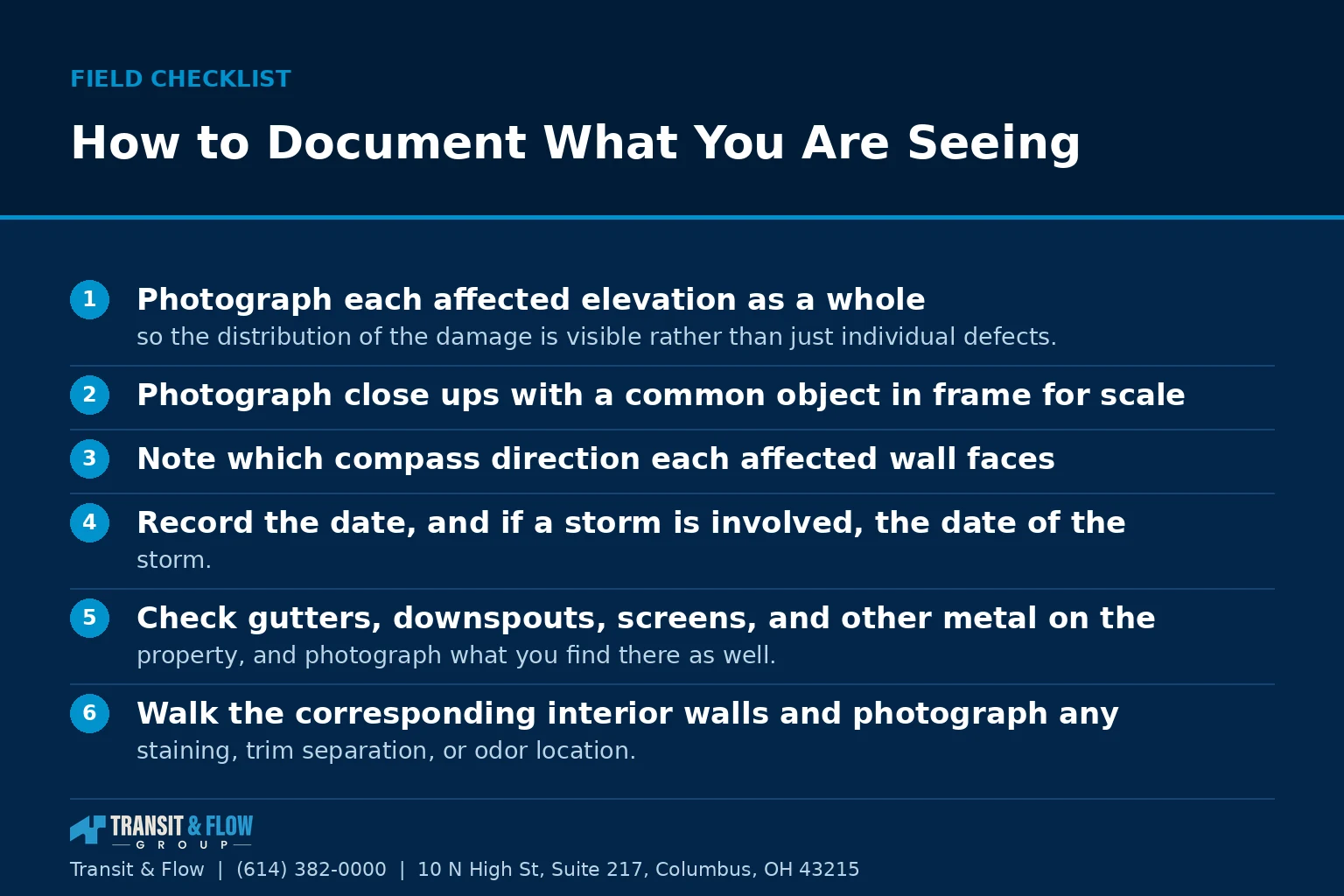
- Photograph each affected elevation as a whole, so the distribution of the damage is visible rather than just individual defects.
- Photograph close ups with a common object in frame for scale.
- Note which compass direction each affected wall faces.
- Record the date, and if a storm is involved, the date of the storm.
- Check gutters, downspouts, screens, and other metal on the property, and photograph what you find there as well.
- Walk the corresponding interior walls and photograph any staining, trim separation, or odor location.
- Keep the record in one place, since it is the basis for any conversation with a carrier or a contractor.
After a Storm, a Word About Who Knocks
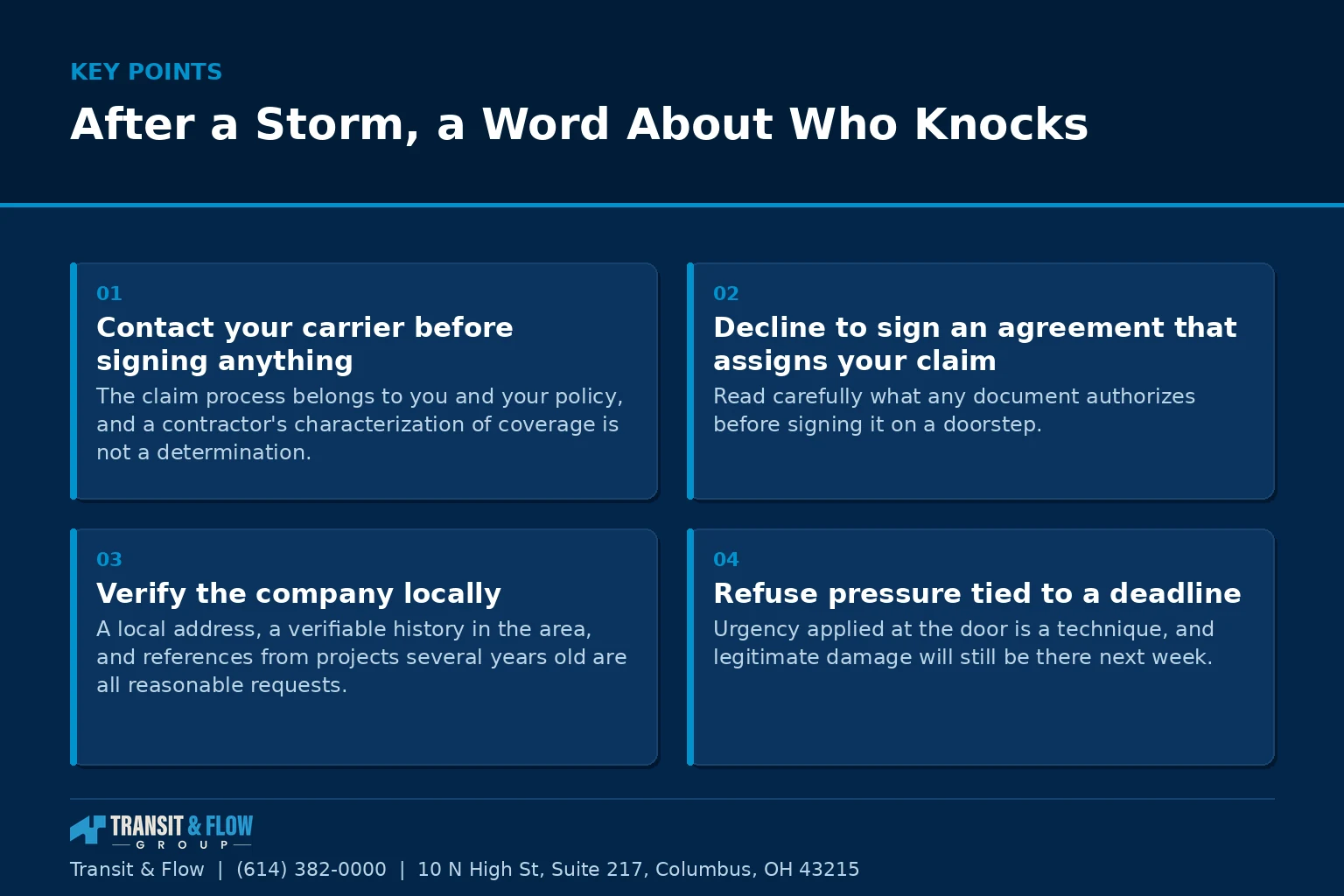
Storm events reliably produce door to door solicitation in Central Ohio neighborhoods, and while some of those companies are legitimate, the category attracts operators who are not. A few practices are worth holding to regardless of who is at the door.
- Contact your carrier before signing anything. The claim process belongs to you and your policy, and a contractor’s characterization of coverage is not a determination.
- Decline to sign an agreement that assigns your claim. Read carefully what any document authorizes before signing it on a doorstep.
- Verify the company locally. A local address, a verifiable history in the area, and references from projects several years old are all reasonable requests.
- Refuse pressure tied to a deadline. Urgency applied at the door is a technique, and legitimate damage will still be there next week.
- Be cautious about offers involving your deductible. Proposals to absorb or waive it raise legal questions worth avoiding entirely.
- Get the scope in writing before any payment. Deposit practices and change order handling are covered in our article on change orders.
On Cost
This article contains no dollar figures on purpose. What a siding condition costs to address depends on whether the wall behind it is sound, how much area is affected, whether a matching product is still available, and whether a claim is involved. A figure published here would be wrong for most situations and would encourage a decision before the cause is understood. The economically useful point is the one this article is built around. Correctly identifying whether the wall behind the cladding is wet is what separates a maintenance expense from a structural one, and it is the determination worth making first.
Glossary
- Elevation. One face of a building, referred to by the direction it faces.
- Course. A single horizontal run of siding across a wall.
- Chalking. A powdery surface residue produced as a finish degrades under ultraviolet exposure.
- Sheathing. The structural panel layer attached to the framing behind the barrier and cladding.
- Water resistive barrier. The layer behind the cladding that directs incidental water outward and downward.
- Kick out flashing. A diverter at the lower end of a roof to wall intersection that sends water into the gutter rather than behind the cladding.
- Clearance. The required gap between siding and an adjacent surface such as grade, roofing, or decking.
- Deductible. The portion of a covered loss the policyholder is responsible for under an insurance policy.
- Supplement. An additional claim item submitted to a carrier after the initial scope, typically for conditions found later.
The Decision
Option A. Address the visible damage directly with a targeted repair, replacing affected panels and matching as closely as the available product allows. This is appropriate where the pattern clearly indicates a surface cause such as hail or impact, where the affected area is limited, and where an inspection confirms the wall behind it is dry.
Option B. Treat the damage as an indicator and open a small area to inspect the barrier and sheathing before committing to any repair scope. This costs a small amount of exploratory work and delays the repair by days. It also determines whether you are buying a cosmetic fix or covering an active problem.
Our recommendation is Option B wherever the damage pattern is clustered around windows, penetrations, roof to wall intersections, or the bottom course, since those distributions point to water rather than to impact. For genuinely directional storm damage on otherwise sound walls, Option A with photographic documentation and a carrier conversation is the efficient path. The distinction is the pattern, which is exactly why it is worth reading carefully before anyone quotes anything.
Where Transit & Flow Group Fits
Transit & Flow Group assesses exterior damage by pattern before proposing scope, and we will tell a household plainly when a condition is cosmetic and does not warrant the work someone else has quoted. Where the pattern points to water behind the cladding, we open and inspect before pricing a repair, because a proposal written without that step is a guess. We do not solicit door to door after storms, and we do not make coverage determinations, which belong to a carrier. Transit & Flow Group coordinates projects and partners with properly licensed and insured specialty contractors when licensing is required, and work is performed under the appropriate permits. To have a condition assessed, get in touch, or review our siding and gutter services.
Frequently Asked Questions
How can I tell whether siding damage is cosmetic or a sign of a bigger problem?
The distribution of the damage is the most useful clue. Damage that is directional and concentrated on the elevations that faced a storm generally points to impact, and damage distributed evenly across sunny elevations generally points to age and ultraviolet exposure. Damage that clusters below windows, at inside corners, below penetrations such as a hose bib or dryer vent, at roof to wall intersections, or along the bottom course follows water paths instead, and that pattern is the one worth treating as urgent. What you see from the ground is evidence rather than a conclusion, so the finding should be confirmed by someone who can inspect the wall assembly.
What does hail damage on siding actually look like?
On vinyl it tends to show up as cracks, chips, or holes, often with a clean circular or crescent character and often on the lower half of a panel. On fiber cement and engineered wood it can appear as chipping, divots, or coating damage that reads more clearly in low angle light than at midday. The two signatures that separate hail from other causes are that it concentrates by direction rather than spreading evenly, and that it marks multiple materials at once. Checking gutters, downspouts, window screens, mailboxes, and other metal on the property is usually a faster confirmation than studying the siding itself.
Why do woodpeckers keep returning to the same spot on my siding?
Birds drill for insects, for nesting cavities, or to drum on a resonant surface, and repeated concentrated drilling in one location often means something in or behind the material is attracting them. That makes the holes a signal worth investigating rather than simply patching, because patching without understanding why that spot was chosen tends to produce the same holes in the same place the following season. Some woodpecker species are federally protected, so deterrence and exclusion are the appropriate approaches, and any control measure should be verified against current federal and state wildlife rules before it is undertaken.
What should I do first after a storm damages my siding?
Document before you do anything else. Photograph each affected elevation as a whole so the distribution is visible, then take close ups with a common object in frame for scale, and note which compass direction each affected wall faces. Record the date, and the date of the storm if one is involved. Check gutters, downspouts, screens, and other metal on the property and photograph those as well, then walk the corresponding interior walls and photograph any staining or trim separation. Contact your insurance carrier directly to understand the claim process, because coverage determinations belong to your carrier and your policy.
Someone knocked on my door after the storm offering a free inspection. Should I sign?
Storm events reliably produce door to door solicitation in Central Ohio, and while some of those companies are legitimate, the category attracts operators who are not. Contact your carrier before signing anything, since a contractor’s characterization of coverage is not a determination. Read carefully what any document authorizes, and decline agreements that assign your claim. Verify the company locally through a local address, a verifiable history in the area, and references from projects several years old. Urgency applied at the door is a technique, and legitimate damage will still be there next week.
Is it worth opening up a small area of siding before agreeing to a repair?
Where the damage pattern is clustered around windows, penetrations, roof to wall intersections, or the bottom course, our recommendation is yes. Those distributions point to water rather than to impact, and opening a small area to inspect the water resistive barrier and sheathing is what determines whether you are buying a cosmetic fix or covering an active problem. It costs a small amount of exploratory work and delays the repair by days. For genuinely directional storm damage on otherwise sound walls, a targeted repair with photographic documentation and a carrier conversation is the efficient path instead.
Sources
- Ohio Department of Insurance
- Ohio Attorney General, consumer protection
- U.S. Fish and Wildlife Service
- Ohio Construction Industry Licensing Board
- U.S. Department of Energy, moisture control guidance
About This Guide
Written and edited by Micheal Parker, founder of Transit & Flow Group. Published March 10, 2027. This guide is checked against the agency and code sources listed above, and it is revised when those sources change.
General contractor of record. Micheal Parker holds City of Columbus General Contractor Registration G12064, issued by the Columbus Department of Building and Zoning Services under Transit & Flow LLC and valid through June 30, 2027. Trade work that falls outside the scope of that registration is performed by licensed trade partners, and the responsible license holder is identified before work begins.
Transit & Flow Group, home and commercial services for Columbus and the surrounding Central Ohio communities. Phone (614) 382-0000. Email solutions@transitflowgroup.com. 10 N High St, Suite 217, Columbus, OH 43215. Contact our team or review the communities we serve.
