

An electrical panel that is running past its comfortable limits does not announce it the way a furnace or a water heater does. There is no noise, no leak, no obvious failure. Instead there is a set of small, easily rationalized signals that a household absorbs into normal life until something forces the issue. This guide catalogs those signals, sorts them by how urgently each one deserves attention, and explains which ones point at the panel itself versus a single circuit. It is part of our electrical panel guide.
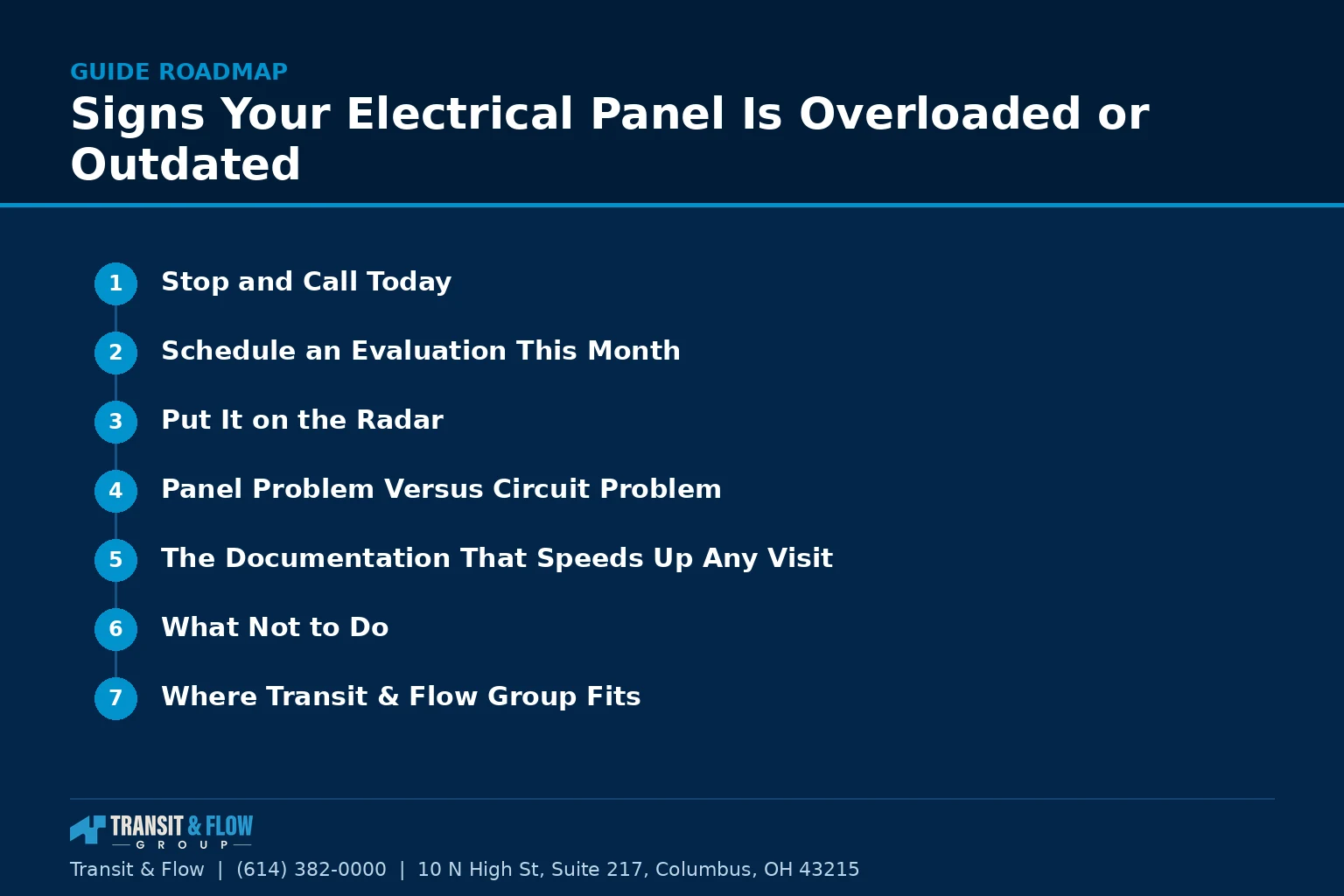
In This Guide
- Stop and Call Today
- Schedule an Evaluation This Month
- Put It on the Radar
- Panel Problem Versus Circuit Problem
- The Documentation That Speeds Up Any Visit
- What Not to Do
- Where Transit & Flow Group Fits
- Frequently Asked Questions
Transit & Flow Group coordinates projects and partners with properly licensed and insured specialty contractors when licensing is required.
Before the list, one boundary. Everything here is written for observation and decision-making. None of it is instruction to perform electrical work or to remove a panel cover. The bus bars inside a panel remain energized even with the main breaker off, and the failure modes are fire and electrocution. Observe, photograph the outside, and call a licensed electrician.
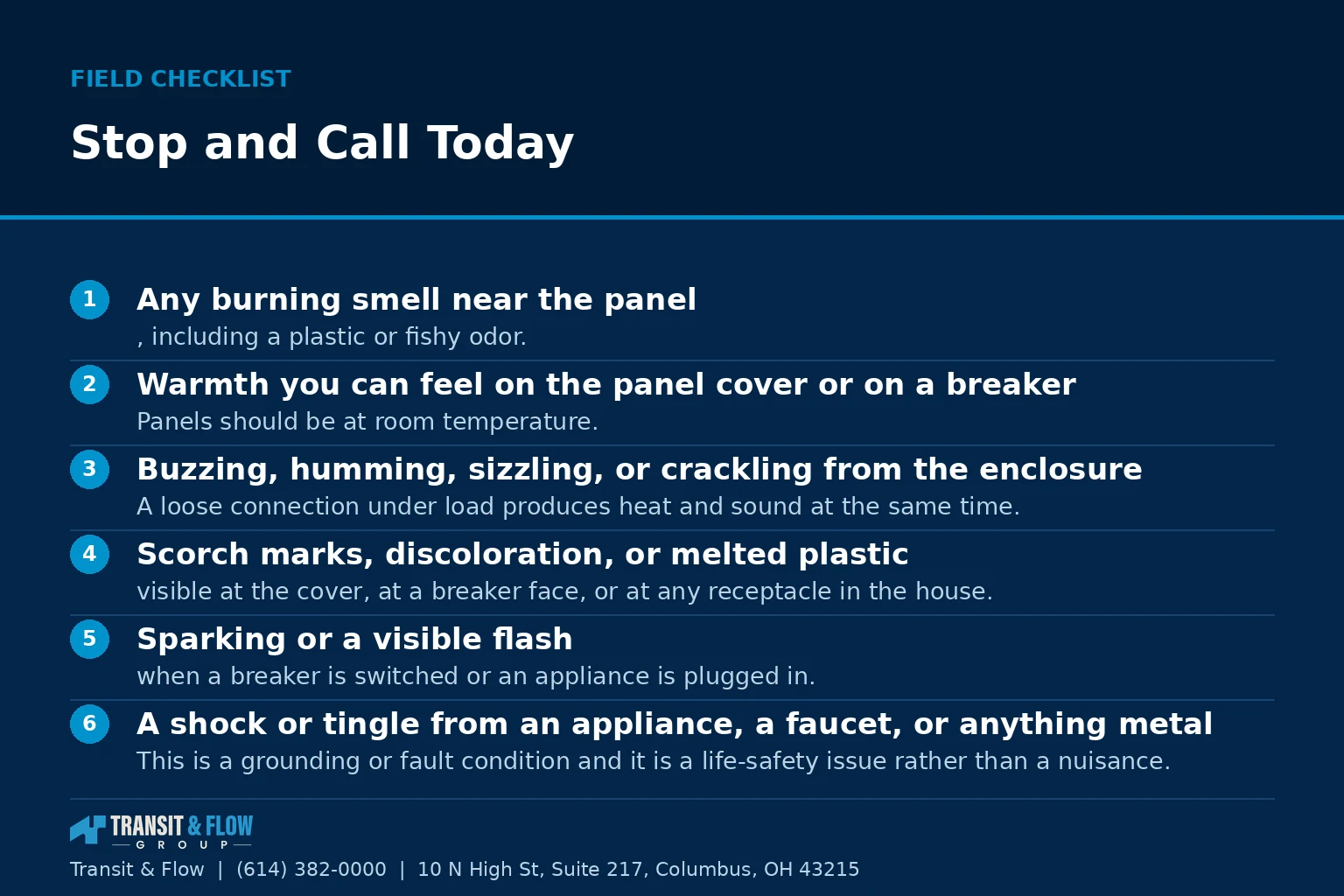
Stop and Call Today
These are not planning items. Each indicates active heat, arcing, or a failed connection.
- Any burning smell near the panel, including a plastic or fishy odor. Overheating thermoplastic has a distinctive smell and there is no benign explanation for it at a panel.
- Warmth you can feel on the panel cover or on a breaker. Panels should be at room temperature.
- Buzzing, humming, sizzling, or crackling from the enclosure. A loose connection under load produces heat and sound at the same time.
- Scorch marks, discoloration, or melted plastic visible at the cover, at a breaker face, or at any receptacle in the house.
- Sparking or a visible flash when a breaker is switched or an appliance is plugged in.
- A shock or tingle from an appliance, a faucet, or anything metal. This is a grounding or fault condition and it is a life-safety issue rather than a nuisance.
- A breaker that will not reset, or that resets and trips immediately and repeatedly.
- Water in or on the panel, or any evidence the enclosure has been wet.
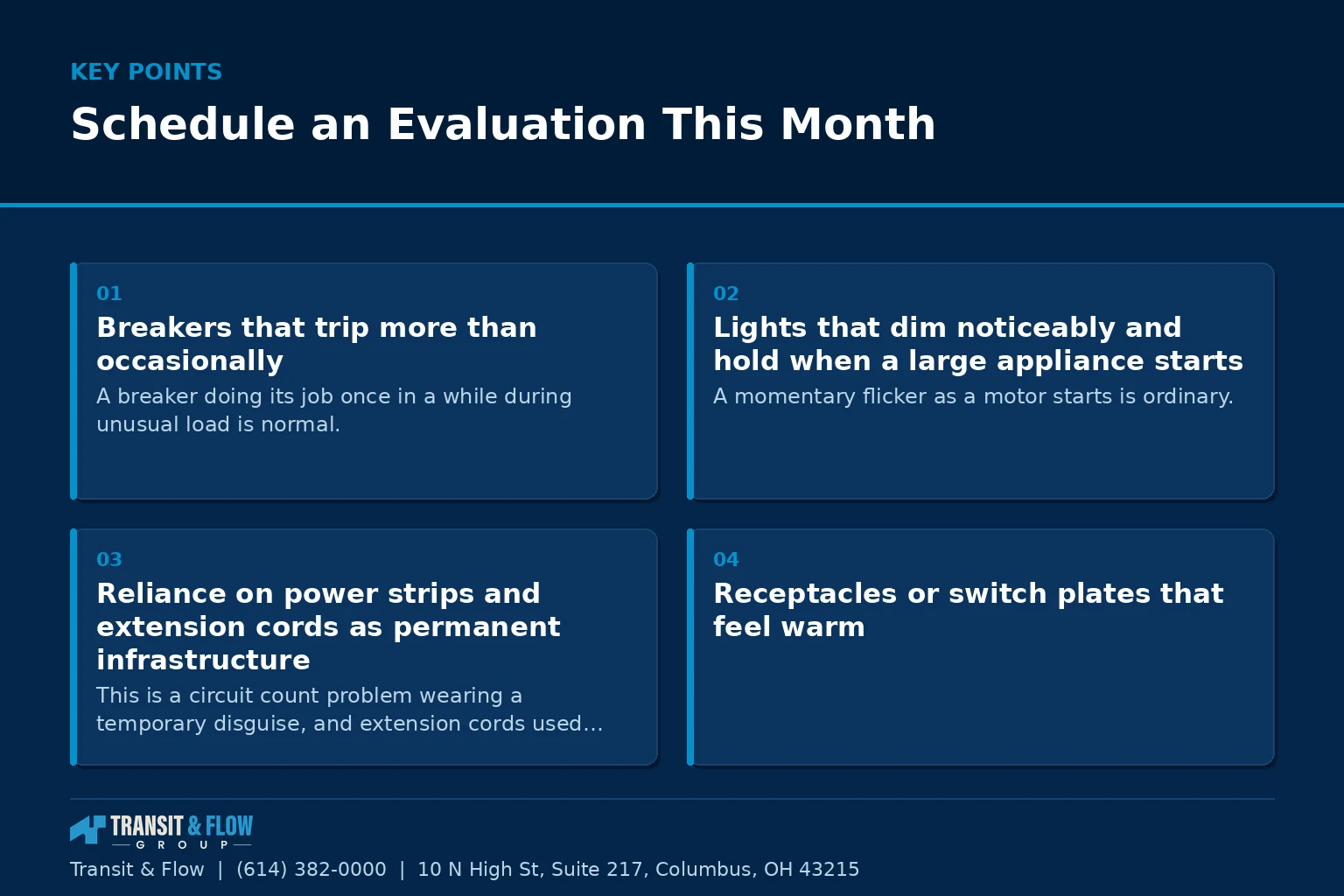
Schedule an Evaluation This Month
These are the partial-condition signals. Nothing is failing right now, and the system is telling you it is working harder than it should.
- Breakers that trip more than occasionally. A breaker doing its job once in a while during unusual load is normal. A breaker tripping monthly is reporting a real condition, and the answer is diagnosis rather than a larger breaker.
- Lights that dim noticeably and hold when a large appliance starts. A momentary flicker as a motor starts is ordinary. A visible drop that persists for a second or more suggests a loose connection, an undersized service, or a utility side issue.
- Reliance on power strips and extension cords as permanent infrastructure. This is a circuit count problem wearing a temporary disguise, and extension cords used permanently are themselves a recognized fire risk.
- Receptacles or switch plates that feel warm.
- Two-prong receptacles still in service in rooms where you plug in modern electronics. This indicates ungrounded circuits, which is both a safety and an equipment issue.
- A panel with no open spaces and any project on your horizon.
- Frequent bulb failures on one circuit, which can indicate a loose neutral or a voltage problem rather than bad bulbs.
- Ground fault devices in bathrooms or kitchens that trip constantly, or that do not trip when tested. Both are real findings.
- Circuits that were added over the years with no directory update. Undocumented modifications are the most common source of surprises when a panel is finally opened.
Put It on the Radar
- A service rated at 60 or 100 amps in a household that has added significant load since the panel was installed.
- A fuse panel still in service. Not automatically unsafe, and almost always undersized for how a modern household uses power.
- A panel manufactured by Federal Pacific, Zinsco, Challenger, or Bulldog Pushmatic. These legacy products carry documented histories of failing to trip reliably or of bus and breaker connection problems. Have it evaluated and expect replacement to be the recommendation.
- Anything planned that adds major load, including a vehicle charger, a heat pump, an electric water heater, an electric range, a hot tub, or a finished basement.
- A panel behind storage, shelving, or a door that does not open fully. Working clearance is a code requirement and a practical necessity for anyone who has to reach it in an emergency.
- Buying a home built before roughly 1980 with no documented electrical work. Have it evaluated during the inspection period, when the finding still has negotiating value.
Panel Problem Versus Circuit Problem
This distinction saves homeowners from buying the wrong solution, and you can usually make it yourself from the pattern.
- One circuit trips, everything else is fine. Circuit problem. Either the circuit is overloaded by what is plugged into it, or there is a fault in the wiring or a device. Replacing the panel will not change this.
- Trips happen only when two specific appliances run together. Circuit problem, and frequently a load distribution issue solvable by adding a dedicated circuit.
- Different circuits trip at different times with no pattern. Now the panel is in question, particularly if the panel is a flagged legacy product.
- Whole-house dimming under load. Points at the service, the main connections, or the utility side, not at a branch circuit.
- Half the house loses power while the other half stays on. Points at a lost leg, a main connection failure, or a utility issue. Call the utility and an electrician the same day.
- Nothing trips but you have run out of places to plug things in. Space and circuit count problem. Often a subpanel rather than a service upgrade.
The Documentation That Speeds Up Any Visit
- A photograph of the panel with the cover closed and the door open, showing the directory.
- The main breaker rating, read off the largest breaker.
- The manufacturer name from the panel door or cover.
- A count of total spaces and filled spaces.
- A written log of every trip: date, which breaker, and what was running at the time.
- A list of everything you plan to add in the next five years.
- The year the house was built and anything you know about past electrical work.
Item five is the one that changes outcomes. A pattern of trips tied to a specific combination of appliances is a diagnosis handed to the electrician before they arrive.
What Not to Do
- Do not install a larger breaker to stop nuisance tripping. The breaker protects the wire, not the appliance. A larger breaker on the same wire removes the protection and leaves the overload.
- Do not use a penny, a bypass, or an oversized fuse. Same reasoning, older technology, same fire.
- Do not remove the panel cover. The main lugs stay energized with the main off.
- Do not treat repeated tripping as a personality quirk of the house. It is data.
- Do not run permanent extension cords or daisy-chained power strips. If a room needs more power, it needs a circuit.
- Do not ignore a shock, however small. There is no minor version of that finding.
Where Transit & Flow Group Fits
Transit & Flow Group coordinates electrical work across Columbus and Central Ohio and partners with properly licensed and insured specialty contractors when licensing is required. Our standard on panel evaluations is that the diagnosis distinguishes a circuit problem from a panel problem before anyone proposes equipment, and that the load calculation is shown to you rather than summarized. Where a project touches heating and cooling, one coordinator carries it. If your panel is showing you anything on this page, request an assessment.
Frequently Asked Questions
Which panel warning signs mean I should call the same day?
Anything indicating active heat, arcing, or a failed connection. That includes a burning, plastic, or fishy odor near the panel, warmth you can feel on the cover or on a breaker, buzzing or sizzling from the enclosure, scorch marks or melted plastic, sparking when a breaker is switched, a breaker that will not reset or trips immediately and repeatedly, water in or on the enclosure, and any shock or tingle from an appliance or anything metal. None of those have a benign explanation at a panel. Observe from outside, photograph the closed cover, and call a licensed electrician.
Is it safe to open the panel and look inside myself?
No. Everything in this article is written for observation and decision making, not as instruction to perform electrical work or to remove a panel cover. The bus bars and main lugs inside a panel stay energized even with the main breaker off, and the failure modes are fire and electrocution. Photograph the outside of the panel and the directory behind the door, and leave the cover to a licensed electrician.
How do I tell a panel problem from a single circuit problem?
The pattern usually tells you, and knowing the difference keeps you from buying the wrong solution. One circuit tripping while everything else is fine is a circuit problem, as is tripping that only happens when two specific appliances run together, and replacing the panel will not change either. Different circuits tripping at different times with no pattern brings the panel itself into question, especially with a flagged legacy product. Whole house dimming under load, or half the house losing power while the other half stays on, points at the service or the utility side and warrants a call to both the utility and an electrician the same day.
Does a breaker that trips regularly just need a bigger breaker?
No, and this is the most consequential mistake on the list. The breaker protects the wire, not the appliance, so a larger breaker on the same wire removes the protection while leaving the overload in place. The same reasoning rules out a penny, a bypass, or an oversized fuse in a fuse panel. A breaker doing its job once in a while under unusual load is ordinary, but one tripping monthly is reporting a real condition, and the response is diagnosis by a licensed electrician.
My panel is a Federal Pacific. Should I be concerned?
It is worth having evaluated. Panels manufactured by Federal Pacific, Zinsco, Challenger, and Bulldog Pushmatic carry documented histories of failing to trip reliably or of bus and breaker connection problems, which is why they appear on the radar list rather than the emergency list. That is a reason to schedule an evaluation and to expect replacement to be the recommendation, not a reason to panic. A licensed electrician makes the call on your specific equipment, and any replacement work goes through your local building department’s permit process.
What should I have ready before an electrician arrives?
A short packet speeds up any visit and often improves the answer. Photograph the panel with the cover closed and the door open so the directory is visible, note the main breaker rating off the largest breaker, note the manufacturer name from the door or cover, and count total and filled spaces. Add the year the house was built and anything you know about past electrical work, plus a list of what you plan to add over the next several years. The single most useful item is a written trip log recording the date, which breaker, and what was running, because a pattern tied to a specific combination of appliances is diagnostic information handed over before anyone arrives.
Sources
- U.S. Consumer Product Safety Commission, residential electrical hazards and product safety
- Ohio Construction Industry Licensing Board, electrical trade licensing
- City of Columbus, Get a Permit, permit application channels
About This Guide
Written and edited by Micheal Parker, founder of Transit & Flow Group. Published October 4, 2026. This guide is checked against the agency and code sources listed above, and it is revised when those sources change.
General contractor of record. Micheal Parker holds City of Columbus General Contractor Registration G12064, issued by the Columbus Department of Building and Zoning Services under Transit & Flow LLC and valid through June 30, 2027. Trade work that falls outside the scope of that registration is performed by licensed trade partners, and the responsible license holder is identified before work begins.
Transit & Flow Group, home and commercial services for Columbus and the surrounding Central Ohio communities. Phone (614) 382-0000. Email solutions@transitflowgroup.com. 10 N High St, Suite 217, Columbus, OH 43215. Contact our team or review the communities we serve.
