
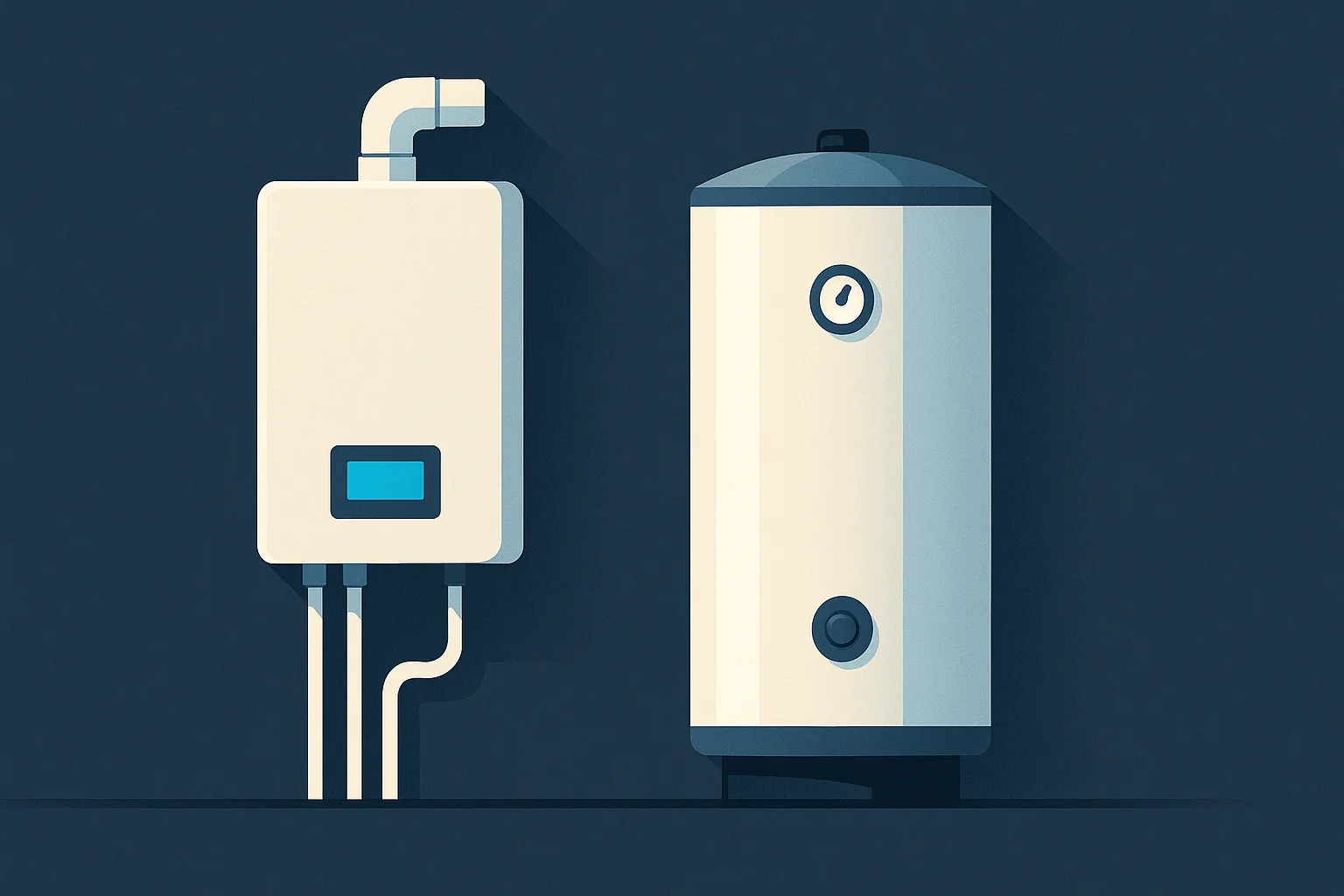

After two decades on job sites and in mechanical rooms across Franklin County, I can tell you the water heater question comes up every fall, right when the ground temperature drops and incoming water gets colder. If you are weighing tankless vs tank water heater central Ohio options before winter, this guide breaks down the real trade-offs in plain language, without the sales pitch. The right answer depends on your household, your home, and your budget, not on whatever unit is on the truck that day.
In This Guide
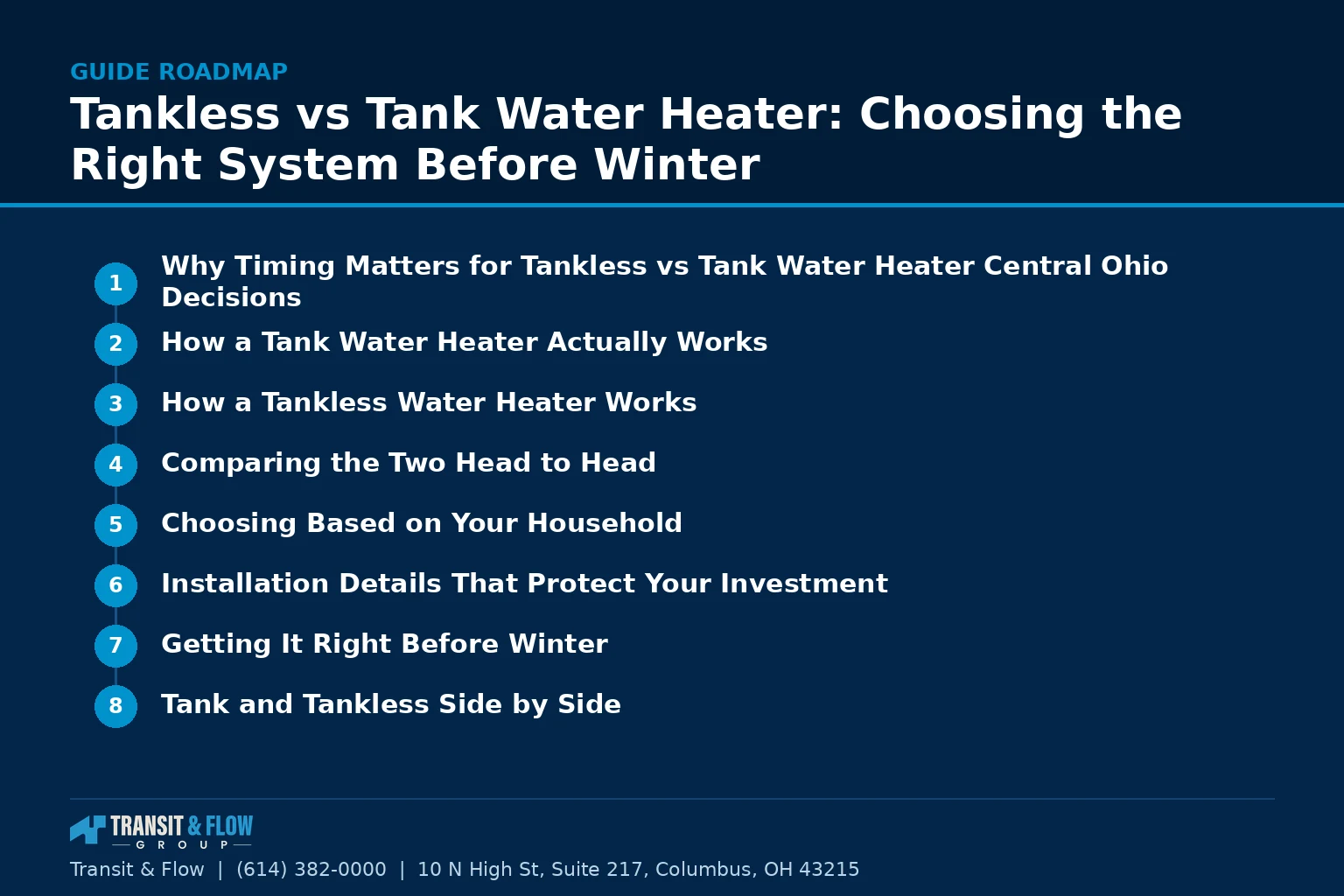
- Why Timing Matters for Tankless vs Tank Water Heater Central Ohio Decisions
- How a Tank Water Heater Actually Works
- How a Tankless Water Heater Works
- Comparing the Two Head to Head
- Choosing Based on Your Household
- Installation Details That Protect Your Investment
- Getting It Right Before Winter
- Tank and Tankless Side by Side
- Option A or Option B, and What We Recommend
- Sources
- Related Transit & Flow Services
- Frequently Asked Questions
Why Timing Matters for Tankless vs Tank Water Heater Central Ohio Decisions
Central Ohio winters put more strain on a water heater than most homeowners realize. When groundwater entering your home drops toward the mid-40s, your system has to work substantially harder to reach the same shower temperature. A unit that felt adequate in July can feel undersized in January. That is exactly why we push homeowners in Dublin, Westerville, and Hilliard to make this call in early fall rather than during a December cold snap, when a failed heater means cold showers and rushed, more expensive decisions. Planning ahead gives you time to size the system correctly and schedule a clean installation.
How a Tank Water Heater Actually Works
A conventional tank heater stores 40 to 80 gallons of hot water and keeps it heated around the clock so it is ready when you open a tap. The technology is proven, the upfront cost is lower, and installation in an existing home is usually straightforward because the connections already match. The trade-offs are real, though. You pay to keep that water hot even while you sleep, which is called standby loss, and once you drain the tank during back-to-back showers or a big laundry day, you wait for it to recover. Most quality tanks last 8 to 12 years in our water conditions, and hard water in parts of Gahanna and Grove City can shorten that if the unit is not flushed regularly.
How a Tankless Water Heater Works
A tankless water heater, sometimes called an on-demand unit, heats water only as it flows through the system, so there is no storage tank losing heat all day. For the right household, a tankless water heater Ohio installation delivers endless hot water, a smaller footprint, and a longer service life, often 18 to 20 years. The upfront investment is higher, and installation is more involved because gas units frequently need a larger gas line and dedicated venting, while electric units can require an electrical service upgrade. Done correctly, though, a tankless unit rewards you with lower operating costs and years of reliable performance.
Comparing the Two Head to Head
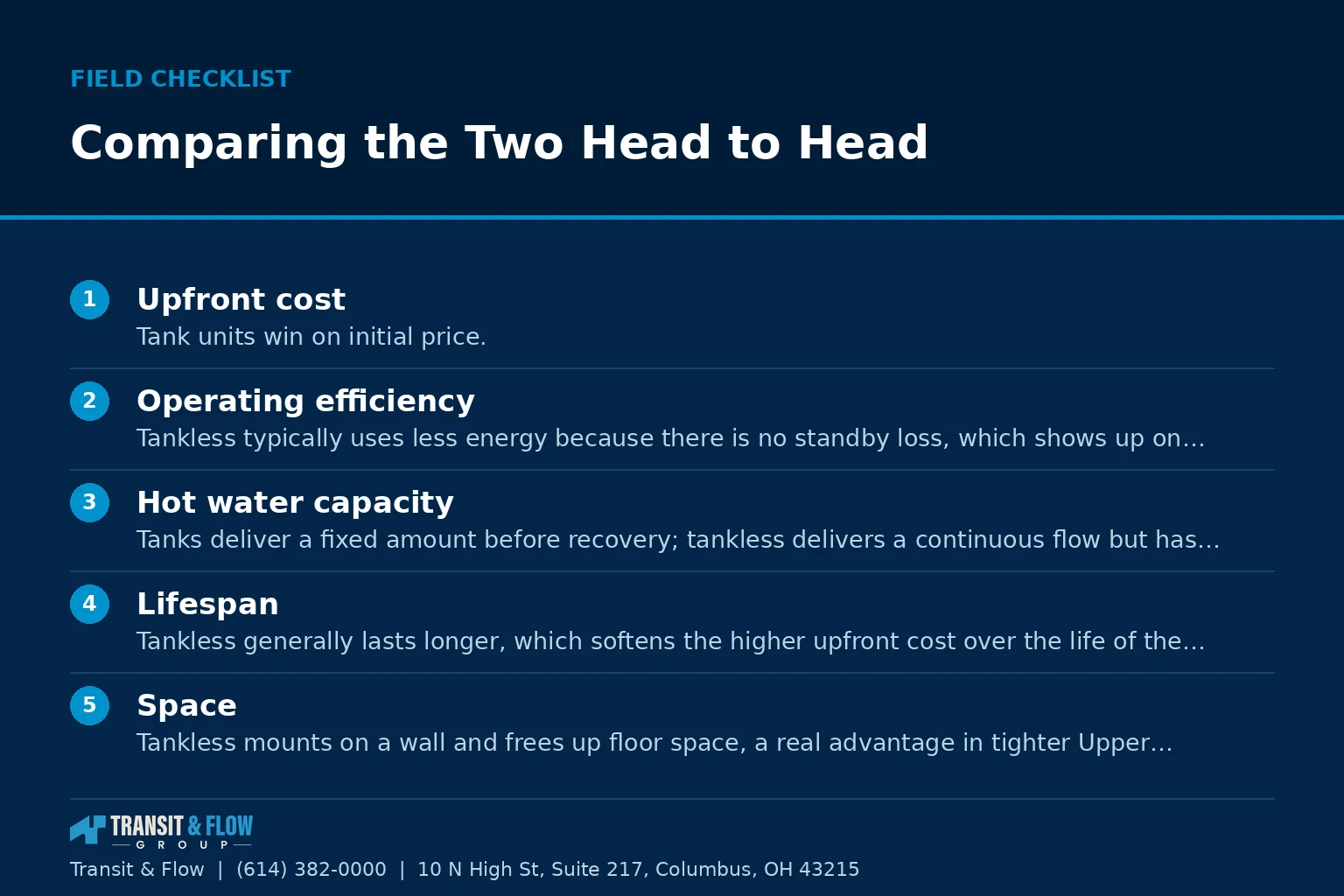
When we walk homeowners through a water heater replacement Columbus project, the decision usually comes down to a handful of practical factors. Here is how they stack up:
- Upfront cost: Tank units win on initial price. Tankless costs more to buy and install, especially when gas or electrical upgrades are required.
- Operating efficiency: Tankless typically uses less energy because there is no standby loss, which shows up on your utility bills over time.
- Hot water capacity: Tanks deliver a fixed amount before recovery; tankless delivers a continuous flow but has a limit on how many fixtures it can serve at once.
- Lifespan: Tankless generally lasts longer, which softens the higher upfront cost over the life of the unit.
- Space: Tankless mounts on a wall and frees up floor space, a real advantage in tighter Upper Arlington and Worthington basements and utility closets.
Choosing Based on Your Household
The best water heater is the one matched to how your home actually uses hot water. A smaller household with one or two bathrooms in Powell or Pickerington often gets excellent value from a properly sized tank, or from a single tankless unit that easily keeps up. For a tankless vs tank water heater central Ohio choice, a large family running multiple showers, a dishwasher, and laundry at the same time needs careful sizing either way, and sometimes the right answer is a high-recovery tank or a larger tankless unit with the flow rate to match peak demand. If you are renovating, adding a bathroom, or finishing a basement in New Albany, the long-term efficiency and space savings of tankless often tip the scale. There is no universally best water heater, only the best one for your situation, and an honest assessment beats a one-size answer every time.
Installation Details That Protect Your Investment
This is where quality workmanship separates a system that performs from one that frustrates you. Gas tankless units need adequate gas volume and correct venting, or they will short-cycle and underperform. Electric tankless can demand a significant panel upgrade that has to be planned, not improvised. Water quality matters too. Our region’s hard water calls for periodic flushing on both tank and tankless systems, and skipping it is the fastest way to shorten a unit’s life. Proper sizing, code-compliant venting, correct combustion air, and clean connections are not extras. They are the difference between a heater that lasts two decades and one that fails early. For more seasonal maintenance advice, our related guides cover water heating, plumbing, and winter readiness in depth.
Getting It Right Before Winter
Whether you land on tank or tankless, the goal is the same: dependable hot water through the coldest months, installed by a crew that treats your home like their own. Transit & Flow handles water heater replacement and new installations across the region, and our licensed team will assess your usage, water quality, gas and electrical capacity, and space before recommending anything. We serve homeowners throughout the metro, and you can confirm coverage for your neighborhood on our service areas page. That is how a tankless vs tank water heater central Ohio decision should be made, on facts about your home rather than guesswork.
Tank and Tankless Side by Side
Laying the two systems next to each other makes the trade-offs easier to hold in your head while you evaluate a quote.
| Factor | Storage tank | Tankless | Household it tends to favor |
|---|---|---|---|
| Upfront investment | Lower, and the existing connections usually match | Higher, and often paired with gas or electrical work | Tank, when the budget is the binding constraint |
| Standby loss | Present, since stored water is held hot around the clock | None, because water is heated only as it flows | Tankless, in homes with long idle stretches |
| Hot water delivery | A fixed volume, then a recovery period | Continuous, within a flow rate limit | Tankless, for back to back showers |
| Expected service life | Shorter in our water conditions | Longer when flushed on the published schedule | Tankless, for owners planning to stay |
| Installation complexity | Usually a direct swap | Venting, combustion air, gas volume, or panel capacity may all need attention | Tank, when the mechanical room limits options |
| Space | Occupies floor area | Wall mounted, freeing floor area | Tankless, in tight basements and utility closets |
Option A or Option B, and What We Recommend
Most Central Ohio homeowners land in one of two situations, and the honest recommendation differs between them.
- Option A, a high recovery storage tank. The existing venting and connections already suit it, the mechanical room is tight, or the plan is to sell within a few years. Replacement is fast, disruption is minimal, and the money stays available for other work on the house.
- Option B, a properly sized tankless unit. The household runs simultaneous fixtures, the owner intends to stay long enough to recover the higher install cost through lower operating cost and longer life, and the home can accommodate the venting and fuel or electrical capacity the manufacturer’s published instructions require.
Our recommendation: if you are staying in the home and the venting and capacity requirements can be met cleanly, choose Option B. The lifespan advantage and the absence of standby loss compound over the years you own the house, and endless hot water solves the peak demand problem that pushes families toward ever larger tanks. If any of those conditions do not hold, Option A is the better decision and not a compromise. Whichever direction you lean, confirm that the proposed installation satisfies the adopted code and the manufacturer’s published instructions, and let the building department or a licensed professional make any determination about venting, combustion air, or electrical service capacity.
Do not wait for a cold-morning failure to force the choice. Get an instant estimate right on the Transit & Flow homepage, or call our team at (614) 382-0000 to schedule a straightforward, no-pressure water heater assessment. We will help you pick the right system and get it installed cleanly before winter arrives.
Sources
- U.S. Department of Energy, Energy Saver, water heating
- ENERGY STAR, certified heating and cooling equipment
- U.S. Consumer Product Safety Commission, carbon monoxide safety
Related Transit & Flow Services
Every service below is delivered by the same accountable Transit & Flow team, so one call covers the whole property.
- Water Heater Services
- Water Heater Replacement
- Plumbing Services
- Leak Detection
- Water Damage Restoration
- Electrical Panel Upgrades
Serving Columbus and every community across Central Ohio. See the full service areas map, or get an instant estimate on the Transit & Flow homepage.
Transit & Flow Group coordinates projects and partners with properly licensed and insured specialty contractors when licensing is required, and work is performed under the appropriate permits.
Frequently Asked Questions
Is a tankless water heater always the better choice?
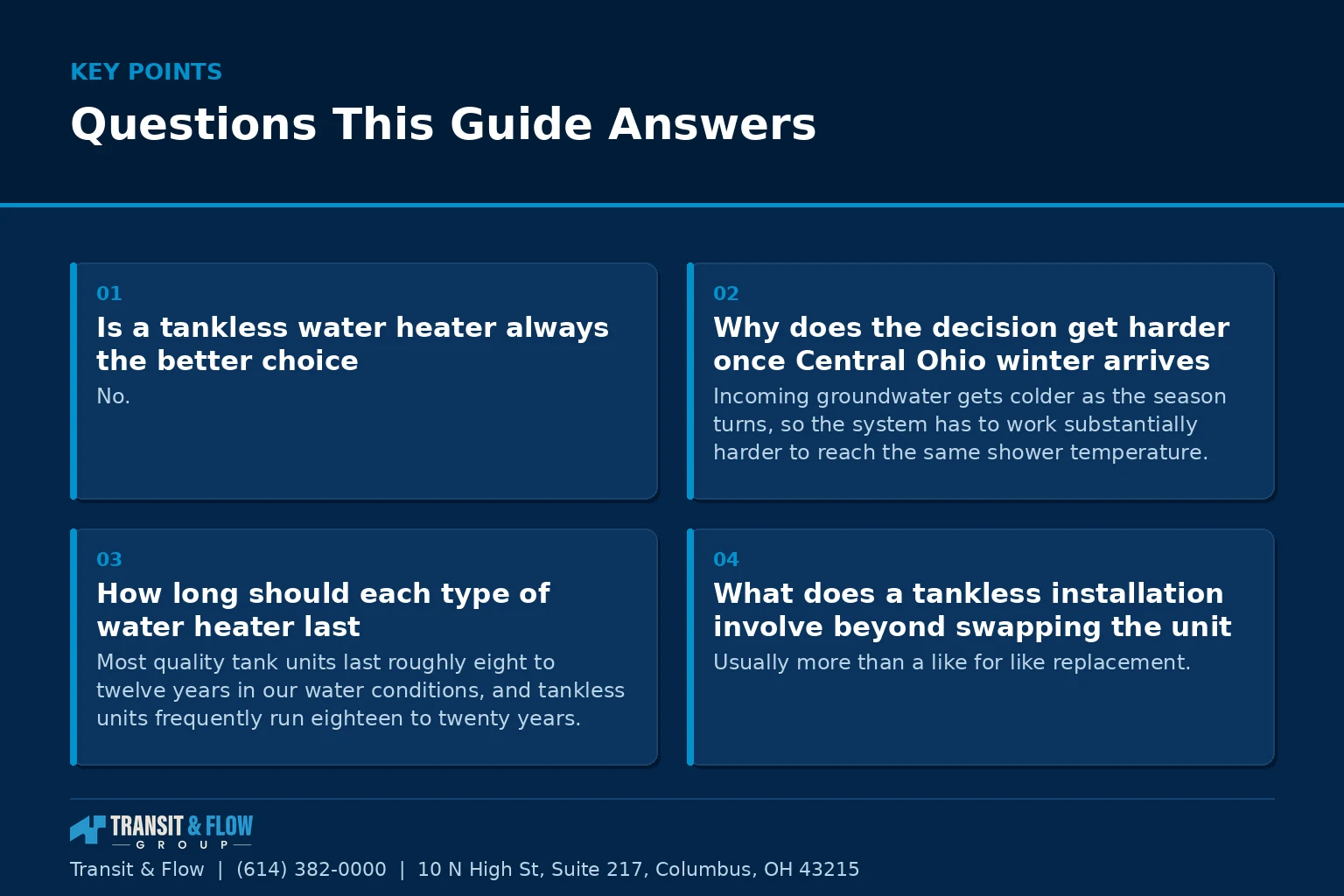
No. There is no universally best water heater, only the best one for a specific household. A properly sized tank often delivers excellent value in a smaller home with one or two bathrooms, while a home running multiple showers, a dishwasher, and laundry at the same time needs careful sizing whichever type you choose. The honest comparison weighs upfront cost, operating efficiency, hot water capacity, expected lifespan, and available space against how your household actually uses hot water.
Why does the decision get harder once Central Ohio winter arrives?
Incoming groundwater gets colder as the season turns, so the system has to work substantially harder to reach the same shower temperature. A unit that felt adequate in July can feel undersized in January. That is why the call is better made in early fall than during a December cold snap, when a failed heater forces a rushed and more expensive decision. Planning ahead leaves room to size the system correctly and schedule a clean installation.
How long should each type of water heater last?
Most quality tank units last roughly eight to twelve years in our water conditions, and tankless units frequently run eighteen to twenty years. Those are general service life ranges rather than guarantees, and the actual outcome depends on water quality, maintenance history, and whether the unit was sized and installed correctly in the first place. Hard water in parts of Gahanna and Grove City can shorten either one when the system is not flushed on schedule.
What does a tankless installation involve beyond swapping the unit?
Usually more than a like for like replacement. Gas tankless units frequently need a larger gas line and dedicated venting, and electric units can require an electrical service or panel upgrade. Those requirements come from the manufacturer’s published installation instructions and the adopted code, and they should be confirmed for your specific home by a licensed plumbing or electrical contractor before you commit to a system. Correct sizing, code compliant venting, and adequate combustion air are what separate a heater that lasts two decades from one that fails early.
Does hard water affect a water heater in this region?
Yes, and it affects both types. Sediment and scale accumulate in tank and tankless systems alike, and our region’s water calls for periodic flushing on either one. Skipping that maintenance is the fastest way to shorten a unit’s life. Follow the flushing interval in the manufacturer’s published instructions for your specific model rather than a general rule of thumb.
When is the right time to schedule an assessment?
Early fall, before the first hard cold stretch. A heater that fails in December becomes an emergency replacement with whatever unit is available that day, which is the opposite of a considered decision. Booking while there is still schedule flexibility lets a contractor evaluate your usage, water quality, gas and electrical capacity, and available space before anything is recommended.
About This Guide
Written and edited by Micheal Parker, founder of Transit & Flow Group. Published August 14, 2026. This guide is checked against the agency and code sources listed above, and it is revised when those sources change.
General contractor of record. Micheal Parker holds City of Columbus General Contractor Registration G12064, issued by the Columbus Department of Building and Zoning Services under Transit & Flow LLC and valid through June 30, 2027. Trade work that falls outside the scope of that registration is performed by licensed trade partners, and the responsible license holder is identified before work begins.
Transit & Flow Group, home and commercial services for Columbus and the surrounding Central Ohio communities. Phone (614) 382-0000. Email solutions@transitflowgroup.com. 10 N. High St., Suite 217, Columbus, OH 43215. Contact our team or review the communities we serve.
