
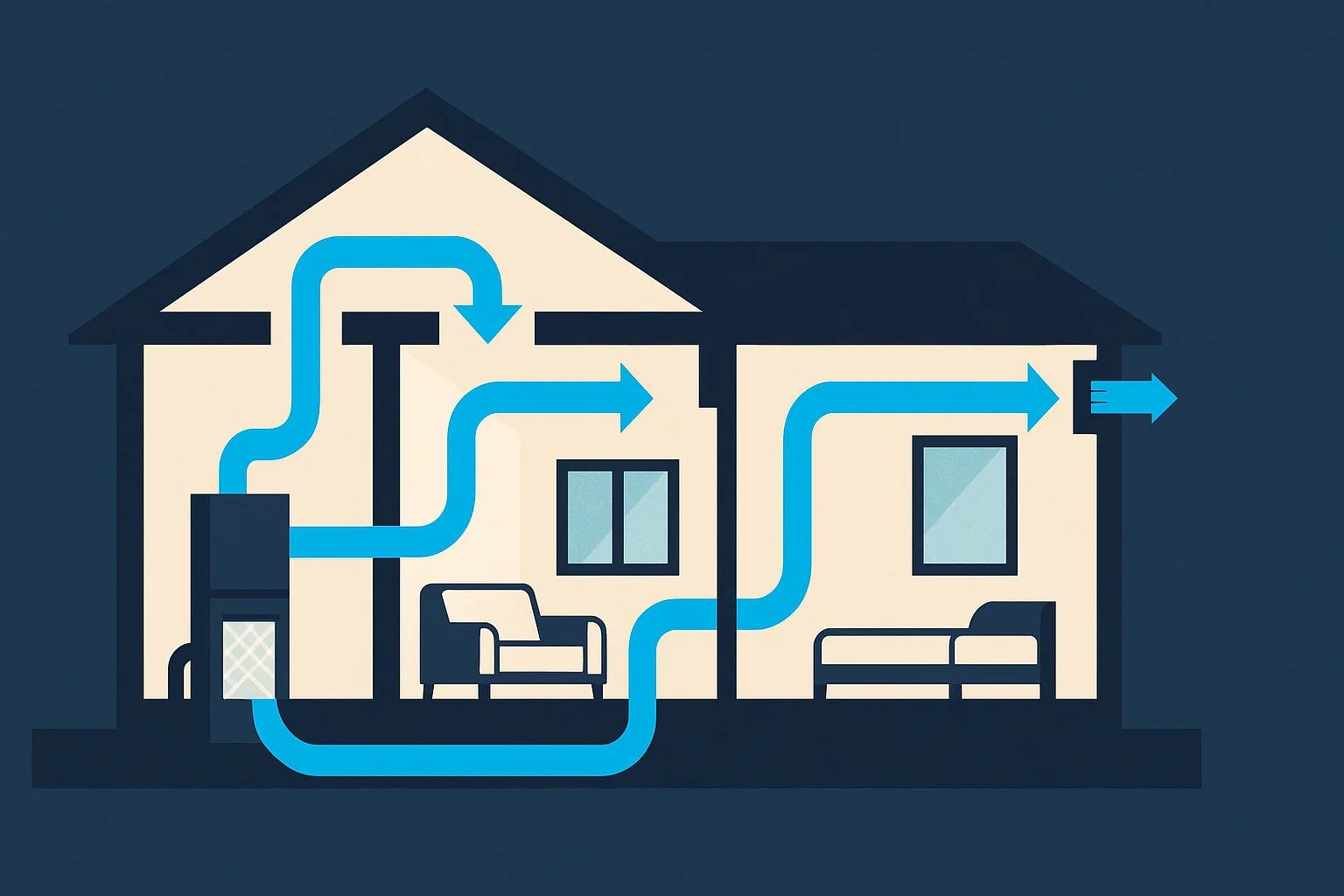

If you are shopping for an air purifier, buy nothing yet. Indoor air quality is a source control problem first, a ventilation problem second, and a filtration problem third, and almost every product on the market sells the third step as if it were the first. A filter only captures what is already in the air. Removing what put it there is cheaper, more permanent, and often free.
In This Guide
- The Source Control Hierarchy
- Where the Air in Your House Actually Gets Contaminated
- Why an Ohio Winter Concentrates the Problem
- Humidity Is the Master Variable
- Ventilation Is the Deliberate Answer to a Tight House
- What a Filter Can and Cannot Remove
- Filter Selection Is an HVAC System Decision
- Portable Versus Whole Home
- Carbon Monoxide and Radon Are Testing Items, Not Product Decisions
- Sequencing Improvements for Actual Return
- The Decision
- Where Transit & Flow Group Fits
- Frequently Asked Questions
Here is what most Central Ohio homeowners get wrong. They treat indoor air as one condition with one fix, so they buy a device and expect it to handle combustion byproducts, humidity, mold, cooking particulate, and off gassing from a new sofa at once. Those are five unrelated problems, and only two of them respond to filtration at all.
The Source Control Hierarchy
Industrial hygiene has used the same ordering for decades, and it applies to a house as cleanly as to a factory. Eliminate the source. If you cannot eliminate it, isolate it. If you cannot isolate it, exhaust it where it is generated. If you cannot exhaust it, dilute it with outdoor air. Only then do you filter what remains.
Every step down that list costs more and delivers less certainty than the step above it. Sealing the door between an attached garage and the house eliminates an entire category of contaminant in an afternoon. A filtration system trying to clean up what that door lets in runs continuously, costs money every month, and never fully wins. The market inverts this order because there is no product to sell at the top of it.
Where the Air in Your House Actually Gets Contaminated
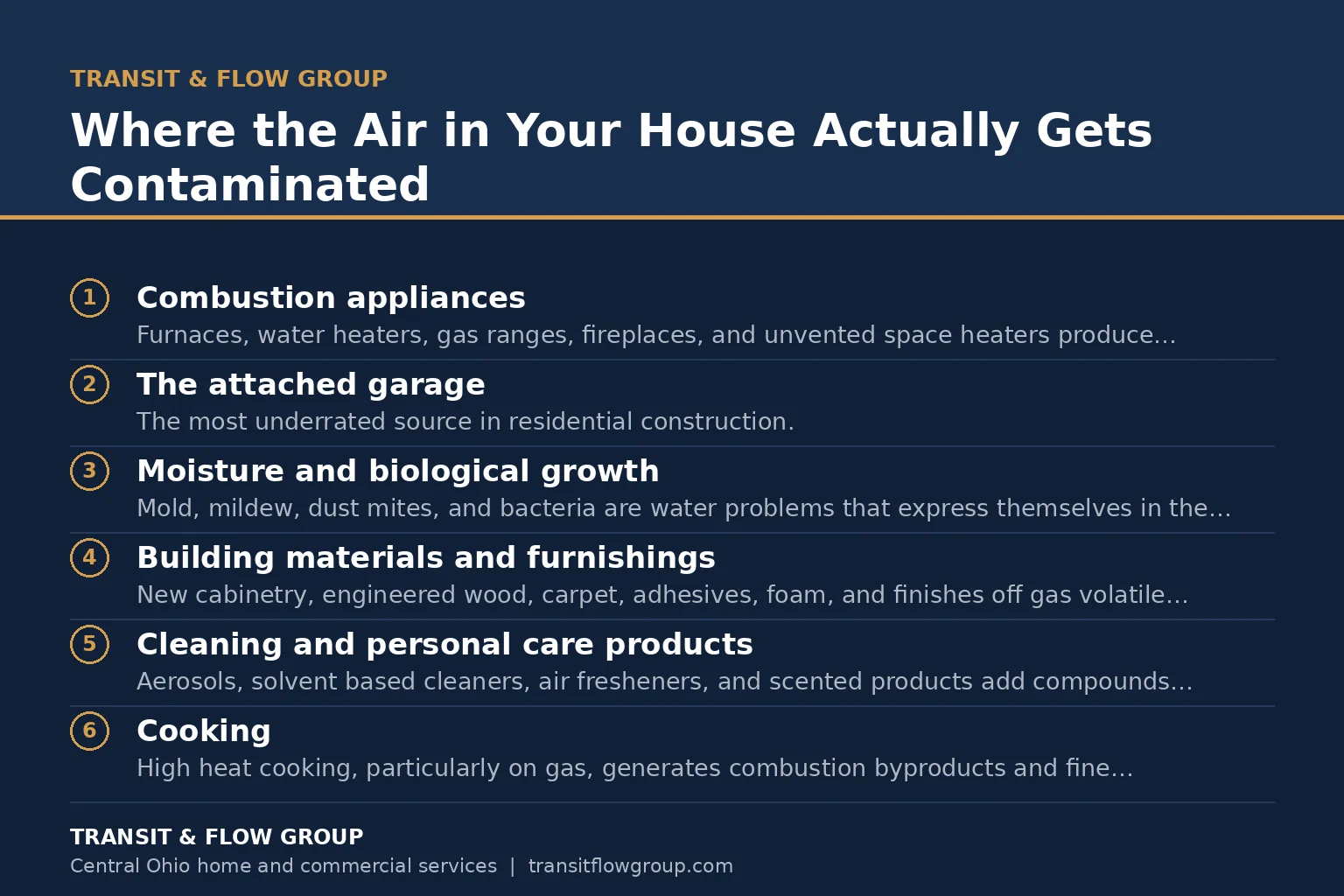
Before you can control sources you have to name them. In a typical Central Ohio single family home, this list covers nearly everything behind an air quality complaint.
- Combustion appliances. Furnaces, water heaters, gas ranges, fireplaces, and unvented space heaters produce combustion byproducts. A properly vented appliance sends those outdoors. A blocked flue, a disconnected vent, a cracked heat exchanger, or an appliance backdrafting under negative pressure sends them into the living space instead.
- The attached garage. The most underrated source in residential construction. Vehicle exhaust, gasoline, solvents, paint, pesticides, and equipment fuel sit in a space sharing a wall, a ceiling, and usually a leaky door with the house. Pressure differences pull that air inward more often than homeowners assume.
- Moisture and biological growth. Mold, mildew, dust mites, and bacteria are water problems that express themselves in the air. Wherever a persistent moisture source meets an organic surface, growth follows, and no filter addresses the colony itself.
- Building materials and furnishings. New cabinetry, engineered wood, carpet, adhesives, foam, and finishes off gas volatile organic compounds, heavily at first and at a declining rate over months. This is why a freshly renovated room smells like one.
- Cleaning and personal care products. Aerosols, solvent based cleaners, air fresheners, and scented products add compounds deliberately. Some react with other indoor chemistry to produce secondary compounds that were in neither original product.
- Cooking. High heat cooking, particularly on gas, generates combustion byproducts and fine particulate. A range hood that recirculates instead of venting outdoors moves the problem around rather than removing it.
- Soil gas entry. Air moves from the ground into the house through foundation cracks, sump openings, and slab penetrations, carrying whatever is in the soil. In Ohio, radon is why this matters.
- Occupants, pets, and activity. People and animals shed dander and skin cells, generate moisture, and stir settled dust back into suspension. Hobbies involving solvents or sanding add their own load.

Why an Ohio Winter Concentrates the Problem
From November through March, a Columbus house closes up. Windows stay shut, exhaust fans get used less because nobody wants to dump heated air outdoors, and the natural air exchange that came free in October disappears. The sources do not go away. The dilution does.
The heating season adds sources of its own. The furnace runs for months, which means combustion equipment operates continuously in a house that is simultaneously more sealed. The stack effect that drives warm air out the top pulls replacement air in at the bottom, which is exactly where the basement, the crawlspace, the soil, and often the attached garage are.
This is why indoor air complaints in Central Ohio cluster in January rather than July. It is also why every efficiency improvement to an older home, new windows, air sealing, added insulation, quietly raises the importance of ventilation. A tighter house is better thermally and worse for dilution unless you add ventilation back deliberately.
Humidity Is the Master Variable
More indoor air problems trace back to humidity than to any other factor, and it is the only variable that causes trouble in both directions. Ohio delivers both extremes in the same calendar year, which is what makes it hard.
Too Much Moisture
Excess moisture fuels the entire biological category. Mold and mildew need water, dust mites need humid air, and condensation on cold surfaces creates wet spots where none are visible. Central Ohio summers are humid and spring rainfall keeps basement and crawlspace assemblies damp for months. Musty odors, window condensation, and a clammy basement are the symptoms.
Too Little Moisture
Winter air in Ohio is cold and dry, and heating it makes it drier still. Very dry indoor air irritates skin, dries wood flooring, trim, and furniture to the point of shrinkage and cracking, and increases static. Homeowners often respond by running a humidifier hard enough to create condensation problems, which trades a dryness complaint for a mold complaint.
The right approach is measurement rather than intuition. An inexpensive hygrometer in the main living space and a second in the basement will tell you more in two weeks than any amount of guessing. Address the water source before adding equipment, and treat a dehumidifier or humidifier as a control on a known condition rather than a default purchase.
Ventilation Is the Deliberate Answer to a Tight House
Older Central Ohio housing stock leaked enough to ventilate itself by accident, badly and unpredictably, but enough that nobody thought about it. Newer and well retrofitted homes do not. Once a house is sealed, dilution stops being automatic and becomes something you provide.
Ventilation comes in two forms. Spot ventilation removes contaminants where they are produced: a range hood ducted outdoors, and bathroom exhaust fans that terminate outside. Whole house ventilation supplies a controlled amount of outdoor air continuously or on a schedule, through a dedicated system rather than whatever gaps the house happens to have.
Energy and heat recovery ventilators exist to solve the Ohio version of this problem, bringing outdoor air in while transferring heat, and sometimes moisture, between the incoming and outgoing streams. That reduces the winter penalty for ventilating. Sizing is an engineering decision tied to the house, not a catalog pick.
One correction worth making first: verify that your bath fans and range hood actually vent outdoors and that the dampers are not stuck. A meaningful share of homes have exhaust fans terminating into an attic, which converts a ventilation device into a moisture delivery system aimed at the roof deck.
What a Filter Can and Cannot Remove
Filtration is a real tool with a narrow job. The boundary is worth knowing.
- Particulate matter. Filters are good at this. Dust, pollen, dander, textile fibers, cooking particulate, and smoke particles are physical objects a media filter can intercept, with efficiency rising as the media gets finer.
- Mold spores. Filterable as particles, but capturing spores does nothing about the colony producing them or the moisture feeding it. Filtration treats the symptom only.
- Gases and vapors. Standard media filters do not remove them. Volatile organic compounds, formaldehyde, and odors pass straight through. Activated carbon adsorbs some, has finite capacity, and needs replacement on a schedule most homeowners never follow.
- Carbon monoxide. Not removed by residential filtration in any practical sense. A source control and detection item, full stop.
- Radon. A gas entering from the soil. Filtration is not the mitigation strategy. Sealing entry points and depressurizing beneath the slab is.
- Humidity. A filter has no effect. Only ventilation, dehumidification, humidification, and moisture source control move this.
Filter Selection Is an HVAC System Decision
This is the mistake that costs real money. A denser filter captures more and resists airflow more. Residential duct systems are frequently undersized already, and dropping a high efficiency filter into a marginal system reduces airflow across the coil and heat exchanger.
The consequences are not theoretical. Low airflow causes coil freezing in cooling mode, high limit cycling in heating mode, reduced capacity, and shortened equipment life. The homeowner experiences a comfort problem or an unexpected repair, and rarely connects it to the filter upgrade made eighteen months earlier.
The workable path is a deeper filter cabinet with more media surface area rather than a denser one inch filter, because surface area buys efficiency without the same pressure penalty. Whether your system accommodates that depends on the equipment, the duct layout, and the space at the air handler. This is a measurement, not an opinion, and any contractor recommending a filter upgrade should be able to speak to static pressure in your system.
Portable Versus Whole Home
| Factor | Portable unit | Whole home system |
|---|---|---|
| Coverage | One room, with the door closed | Every space on the duct system |
| Dependence on HVAC | None | Cleans only while the fan runs |
| Cost to enter | Low, and reversible | Higher, and involves the equipment |
| Best use case | A bedroom, office, or localized source | Baseline particulate reduction |
| Failure mode | Undersized, or filters never changed | Airflow restriction, or low fan runtime |
| Gas removal | Carbon media only, limited capacity | Same limit, more media to replace |
These are not competitors. A whole home filter sets the baseline and a portable unit raises it in the room that matters most, typically a bedroom. Running the HVAC fan continuously or on a timed circulation setting is what makes the whole home approach work, because a duct filter only works while air moves through it.
Carbon Monoxide and Radon Are Testing Items, Not Product Decisions
Carbon monoxide detection is life safety equipment and belongs in every home with fuel burning appliances or an attached garage. Detectors on every sleeping level, tested on a schedule, replaced at the manufacturer’s stated end of life, which is a real limit because sensors degrade. Combustion appliance inspection, meaning venting, draft, and heat exchanger condition, is the source control half and belongs in a heating season maintenance visit.
Radon is an Ohio specific testing topic, and Ohio geology makes elevated results common enough that testing is the default rather than the exception. You cannot smell it, detect it with a consumer air quality monitor, or reason your way to an answer from a neighbor’s result, because levels vary house to house on the same street. Test. Kits are inexpensive and widely available, and if the result warrants it, mitigation is a well established engineered system installed by licensed specialists. Do not buy an air purifier as a substitute for testing.
Sequencing Improvements for Actual Return
- Install and verify carbon monoxide detection. Life safety before comfort, and the cheapest item on this list.
- Test for radon. Inexpensive and definitive. It either removes a worry or identifies a real one, and no other step tells you as much per dollar.
- Have combustion appliances inspected. Venting, draft, and heat exchanger condition. Source control on the highest consequence source in the house.
- Seal and isolate the attached garage. Weatherstrip the common door, seal penetrations in the shared wall and ceiling, and stop storing fuel, solvents, and pesticides where they can migrate indoors.
- Find and fix moisture sources. Grading, downspout extensions, foundation drainage, plumbing leaks, and crawlspace ground cover. Central Ohio clay soil holds water against foundations, and spring rainfall tests all of it at once.
- Verify exhaust ventilation. Confirm bath fans and the range hood vent outdoors, move air, and get used. Cheap to check, common to find broken.
- Measure humidity and control the extreme you have. Two hygrometers and two weeks of data before any equipment purchase.
- Reduce chemical sources. Fewer aerosols and scented products, low emission finishes during renovation, and extra ventilation while new materials are curing.
- Address filtration within what the system can move. Upgrade media only after someone confirms the system can handle it, and raise fan runtime so the filter sees air.
- Add mechanical ventilation if the house is tight. The correct answer for a well sealed home, and an engineering decision rather than a shelf purchase.
The Decision
Option A. Buy a well reviewed air purifier or a whole home air cleaning product, install it, and see whether the symptom improves.
Option B. Spend the first few hundred dollars on diagnosis instead. Carbon monoxide detectors, a radon test, a combustion safety inspection, two hygrometers, and an hour finding where moisture and garage air get in. Then buy filtration for what is genuinely left.
Recommendation: Option B, without qualification. Option A only works if your problem happens to be airborne particulate and your HVAC system happens to have capacity for a better filter. If the actual cause is a backdrafting water heater, a wet crawlspace, garage air migrating through a leaky common wall, or elevated radon, a purifier will not touch it and the money is gone. The sequence above is ordered by consequence and by cost per unit of certainty, and its top four items together cost less than most whole home air cleaning products. Diagnose, then buy.
Where Transit & Flow Group Fits
We coordinate air quality work across Central Ohio in the order that produces results, which means diagnosis and source control come before anyone quotes equipment. That covers combustion appliance safety, moisture correction, garage and envelope isolation, ventilation design for tight houses, and filtration sized to what the existing system can move. If you want the sequence handled properly rather than a product sold to you, start a conversation with our team. You can also review our heating and cooling services, our guidance on basement and crawlspace moisture in Central Ohio, our article on attic insulation and air sealing, and our explanation of how responsibility gaps cost homeowners.
Transit & Flow Group coordinates projects and partners with properly licensed and insured specialty contractors when licensing is required, and work is performed under the appropriate permits.
Frequently Asked Questions
Will an air purifier fix my indoor air quality
Rarely on its own. Filtration removes some particles from the air that reaches it, and it does nothing about the source producing them or about gases it was not designed to capture. Source control and ventilation address the cause, filtration addresses the remainder.
Why does air quality get worse in an Ohio winter
Because the house closes up. The same sources continue producing while the natural exchange with outdoor air drops, so concentrations rise. Winter is when a house reveals whether it has a ventilation strategy or just leaks.
What are the most overlooked sources in a house
Attached garages, combustion appliances that are not venting properly, moisture that supports biological growth, and stored chemicals. An attached garage in particular shares air with the house more than most owners assume.
Does humidity affect air quality
It is arguably the master variable. Too much supports biological growth and dust mites, too little irritates airways and damages finishes. Managing humidity within a reasonable band addresses several air quality complaints at once.
Can I just install a higher rated filter
Not without checking the system. A denser filter restricts airflow, and an HVAC system that cannot move air through it loses capacity and can be damaged. Filter selection has to match what the equipment and the duct system can actually handle.
Should I test for radon in Ohio
Radon is a recognized concern across much of Ohio, and testing is the only way to know what a specific house has. Testing is inexpensive relative to the question it answers, and it replaces speculation with a number.
Sources
- U.S. Environmental Protection Agency, indoor air quality fundamentals and residential sources
- U.S. EPA, Improving Indoor Air Quality, the source control, ventilation, and filtration hierarchy
- U.S. EPA, Mold, moisture control and biological growth in buildings
- ASHRAE, ventilation and indoor air quality standards
- ENERGY STAR, home sealing and HVAC guidance
About This Guide
Written and edited by Micheal Parker, founder of Transit & Flow Group. Published July 16, 2027. This guide is checked against the agency and code sources listed above, and it is revised when those sources change.
General contractor of record. Micheal Parker holds City of Columbus General Contractor Registration G12064, issued by the Columbus Department of Building and Zoning Services under Transit & Flow LLC and valid through June 30, 2027. Trade work that falls outside the scope of that registration is performed by licensed trade partners, and the responsible license holder is identified before work begins.
Transit & Flow Group, home and commercial services for Columbus and the surrounding Central Ohio communities. Phone (614) 382-0000. Email solutions@transitflowgroup.com. 10 N. High St., Suite 217, Columbus, OH 43215. Contact our team or review the communities we serve.
