


Water heaters do not usually give notice. They work, and then a basement floor is wet and the decision gets made in an afternoon under conditions that favor whoever can arrive fastest rather than whoever is right. That outcome is avoidable, because tanks do signal their decline, and the signals are readable months before the failure. This article covers what actually determines lifespan in Central Ohio, the warning signs of the final year, and how to plan a replacement on your own schedule. It pairs with our article on diagnosing a water heater that is not keeping up.
In This Guide
- What Actually Determines Lifespan
- The Final Year Signals
- Why Planned Replacement Wins
- Maintenance That Actually Extends Life
- Where Transit & Flow Group Fits
- Frequently Asked Questions
Transit & Flow Group coordinates projects and partners with properly licensed and insured specialty contractors when licensing is required.
One boundary. This is planning and observation guidance. Water heater service involves scalding water, a pressurized vessel, and either combustion or high-current electrical work, all of which are licensed, permitted activities in Ohio. Never adjust or cap a temperature and pressure relief valve. If you smell gas, leave the building and call from outside.
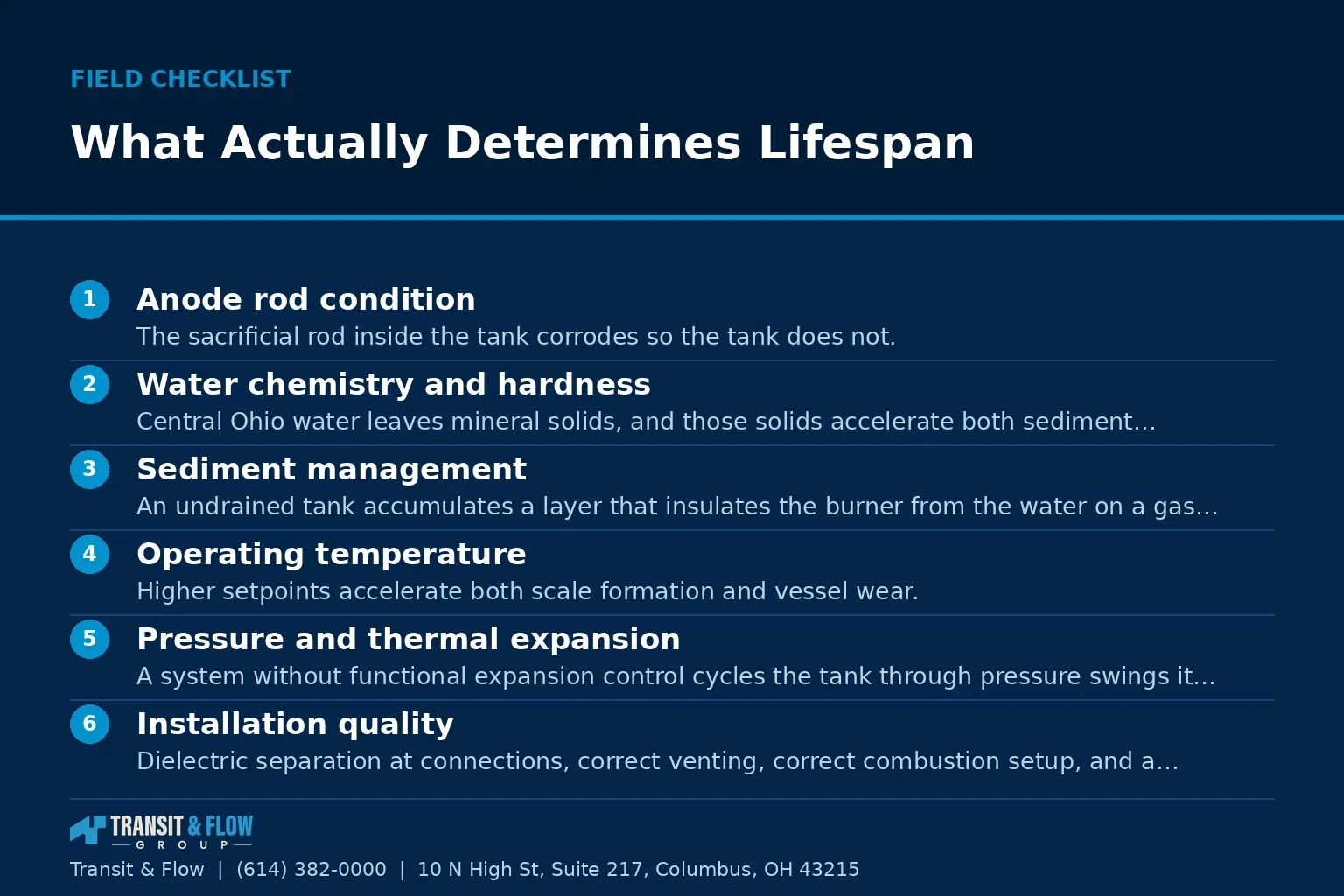
What Actually Determines Lifespan
A tank water heater fails when the steel vessel corrodes through. Everything else is a repairable component. So the question of lifespan is really the question of how fast the vessel is being consumed, and that is driven by a short list of factors that vary enormously between two identical units installed on the same street.
- Anode rod condition. The sacrificial rod inside the tank corrodes so the tank does not. Once it is consumed, the vessel starts. Replacing a depleted anode is the single highest-leverage maintenance act available on a water heater, and it is performed on a small minority of units.
- Water chemistry and hardness. Central Ohio water leaves mineral solids, and those solids accelerate both sediment accumulation and localized corrosion.
- Sediment management. An undrained tank accumulates a layer that insulates the burner from the water on a gas unit, driving the steel above it hotter than intended. Heat accelerates corrosion.
- Operating temperature. Higher setpoints accelerate both scale formation and vessel wear.
- Pressure and thermal expansion. A system without functional expansion control cycles the tank through pressure swings it was not designed to absorb. On a closed system, a failed expansion tank is a genuine lifespan factor and it is invisible until it is not.
- Installation quality. Dielectric separation at connections, correct venting, correct combustion setup, and a level, supported base all show up in how the unit ages.
- Duty cycle. A tank serving a large household with a recirculation loop is working far harder than an identical tank in a two-person home.
The practical consequence: age alone is a weak predictor. Age combined with anode history, water hardness, and expansion control is a strong one. Ask which of those are known about your unit before treating a number of years as the answer.
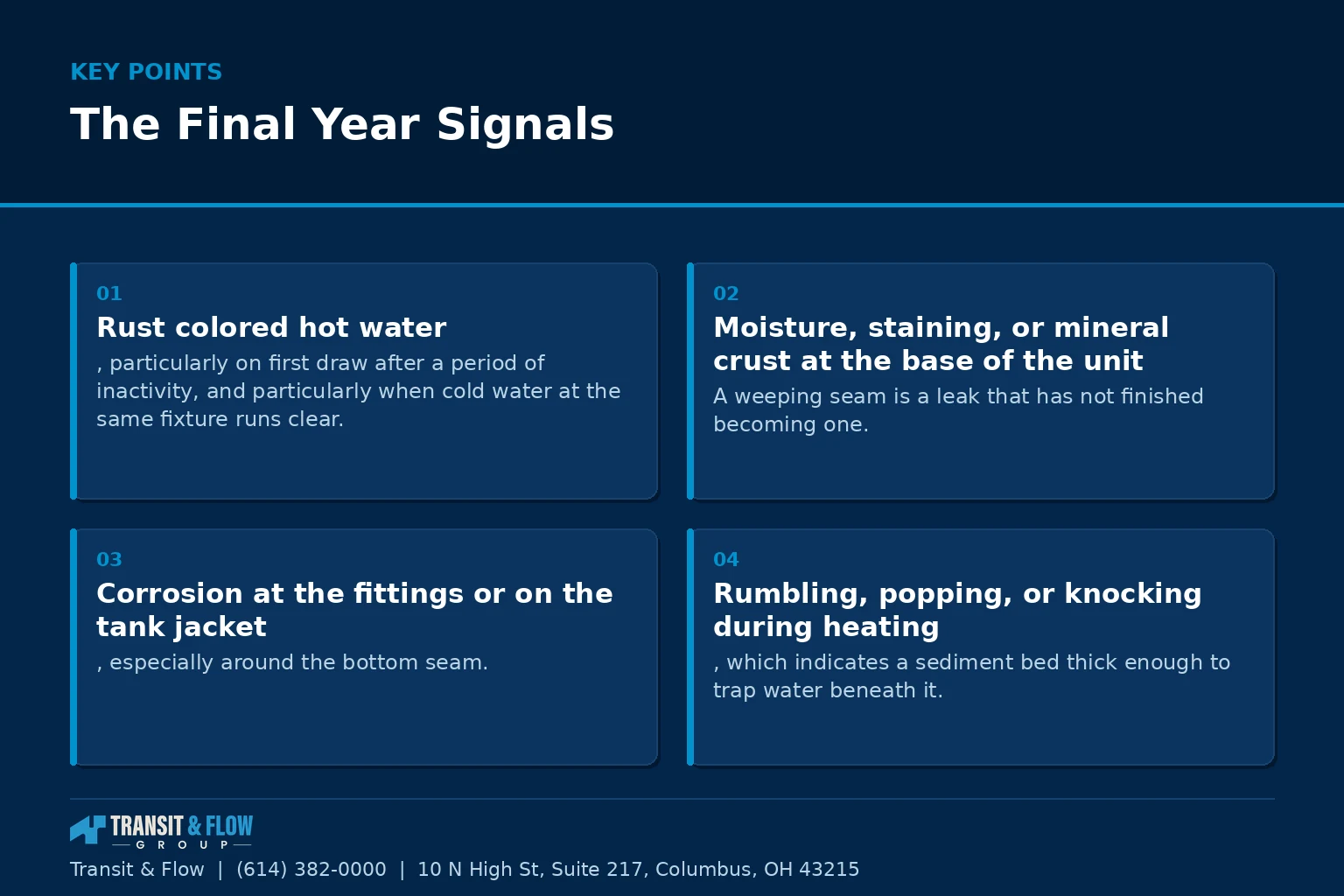
The Final Year Signals
- Rust colored hot water, particularly on first draw after a period of inactivity, and particularly when cold water at the same fixture runs clear. That combination points at the tank rather than at the supply.
- Moisture, staining, or mineral crust at the base of the unit. A weeping seam is a leak that has not finished becoming one.
- Corrosion at the fittings or on the tank jacket, especially around the bottom seam.
- Rumbling, popping, or knocking during heating, which indicates a sediment bed thick enough to trap water beneath it.
- Recovery that has slowed noticeably without a household change to explain it.
- Water that never gets as hot as it used to, after the thermostat and any mixing valve have been checked.
- Discharge from the relief valve, which is either a pressure problem or a temperature problem and is never a nuisance to be ignored or capped.
- Any repair that costs a meaningful share of replacement on a unit already past the middle of its expected life. That is an economic signal rather than a mechanical one and it is the one people rationalize away most often.
Two or more of those together on a unit of age is a planning trigger. One of them alone is a reason to get a documented inspection rather than a reason to panic.
Why Planned Replacement Wins
An emergency replacement is decided in a few hours, under water damage pressure, from whatever is on the truck. A planned replacement is decided over a week or two with every variable open. The difference in outcome is not small.
- Capacity gets sized to the household you have now, rather than matched to the unit being carried out.
- Fuel type and technology get evaluated rather than defaulted, including whether the current configuration is still the right one.
- Venting is scoped deliberately, which matters enormously when a shared chimney is involved.
- Expansion control, the relief valve discharge line, and any pan and drain get corrected while the unit is out, which is the only cheap moment to do it.
- Location and clearances can be reconsidered, including moving the unit if the current position is poor.
- Proposals can be compared on scope rather than on availability.
- The work happens on a day you chose, without a wet floor and without emergency scheduling.
- Water damage does not occur at all, which is frequently the largest number in the entire event.
On cost: this article contains no dollar figures on purpose. Replacement scope varies with capacity, fuel, venting path, whether a chimney is being vacated, expansion control, pan and drain requirements, permit requirements, access to the mechanical space, and the condition of the connections found once the old unit is out. A published figure would mislead you. Get a scoped proposal on your actual installation.

Maintenance That Actually Extends Life
- Anode rod inspection on a stated interval, with replacement when consumed. This is the item that moves lifespan more than anything else on the list.
- Periodic flushing to manage sediment, performed correctly, since an aggressive flush on a heavily scaled older tank can reveal a weakness rather than create one.
- Relief valve verification as part of annual service, by someone qualified to do it.
- Expansion tank check, since a waterlogged expansion tank provides no protection while looking entirely normal.
- Combustion and venting inspection annually on gas units, with readings recorded.
- A pan and drain where the unit sits above finished space, which converts a future failure from a damage event into an inconvenience.
- A leak sensor at the base, which is inexpensive and buys you the hours that matter.
Option A is running the water heater until it fails and replacing it under emergency conditions. Option B is inspecting at a defined age, tracking the signals above, and scheduling replacement in the year the evidence points to. My recommendation is Option B for any unit past the middle of its expected life, and it is close to mandatory where the unit sits above finished living space. The cost difference between the two paths is rarely in the equipment. It is in the water damage, the restricted selection, and the corrections that never get made when the decision is made in an afternoon.
Where Transit & Flow Group Fits
Transit & Flow Group coordinates water heater projects across Columbus and Central Ohio and partners with properly licensed and insured specialty contractors when licensing is required. Our standard is that an inspection states the anode condition, the expansion control status, and the relief valve discharge arrangement in writing, so a replacement year can be planned rather than discovered. Because replacement regularly touches plumbing and gas venting shared with heating equipment, one coordinator carries the project. To get a documented condition assessment, request an assessment.
Frequently Asked Questions
How long should a water heater last?
Age alone is a weak predictor, which is why a single number is not much use. A tank fails when the steel vessel corrodes through, so the real question is how fast that vessel is being consumed. Anode rod condition, water hardness, sediment management, operating temperature, functional expansion control, installation quality, and duty cycle all move that rate, and they vary enormously between two identical units installed on the same street. Age combined with anode history, water hardness, and expansion control is a strong predictor. Ask which of those are known about your unit before treating a number of years as the answer.
What are the warning signs that a water heater is near the end?
Rust colored hot water on first draw when the cold water at the same fixture runs clear, moisture, staining, or mineral crust at the base, corrosion at the fittings or around the bottom seam, rumbling or popping during heating, recovery that has slowed with no household change to explain it, water that never reaches its former temperature after the thermostat and any mixing valve have been checked, and discharge from the relief valve. Two or more of those together on a unit of age is a planning trigger. One alone is a reason to get a documented inspection rather than a reason to panic.
Why does the anode rod matter so much?
The anode is a sacrificial rod inside the tank that corrodes so the steel vessel does not. Once the rod is consumed, the vessel begins to go, and that is the failure that ends the water heater’s life. Replacing a depleted anode is the single highest-leverage maintenance act available on a tank water heater, and it is performed on a small minority of units. Ask whether the anode condition has ever been inspected and recorded on your unit, because it changes the lifespan conversation more than any other single input.
Why is a planned replacement better than waiting for the failure?
An emergency replacement is decided in a few hours, under water damage pressure, from whatever is on the truck. A planned replacement is decided over a week or two with every variable open. That means capacity gets sized to the household you have now rather than matched to the unit being carried out, fuel type and venting get evaluated rather than defaulted, expansion control and the relief valve discharge line and any pan and drain get corrected while the unit is out, and proposals can be compared on scope rather than on availability. The largest difference is usually the water damage that never happens at all.
What maintenance actually extends the life of a tank?
Anode rod inspection on a stated interval with replacement when consumed, periodic flushing performed correctly to manage sediment, relief valve verification during annual service by someone qualified to do it, an expansion tank check since a waterlogged one provides no protection while looking entirely normal, and combustion and venting inspection annually on gas units with readings recorded. A pan and drain where the unit sits above finished space converts a future failure from a damage event into an inconvenience, and an inexpensive leak sensor at the base buys you the hours that matter. Flushing in particular should be done by someone qualified, because an aggressive flush on a heavily scaled older tank can reveal a weakness.
The relief valve is dripping. Is that something to worry about?
Yes, and it is never a nuisance to be ignored or capped. Discharge from a temperature and pressure relief valve is reporting either a pressure problem or a temperature problem, and both need a qualified professional to identify. Never adjust or cap that valve. Water heater service involves scalding water, a pressurized vessel, and either combustion or high-current electrical work, all of which are licensed and permitted activities in Ohio. If you smell gas at any point, leave the building and call from outside.
Sources
- U.S. Department of Energy, Building Technologies Office, water heating guidance
- Ohio Construction Industry Licensing Board, plumbing trade licensing
- City of Columbus, Get a Permit, plumbing permit channels
About This Guide
Written and edited by Micheal Parker, founder of Transit & Flow Group. Published November 18, 2026. This guide is checked against the agency and code sources listed above, and it is revised when those sources change.
General contractor of record. Micheal Parker holds City of Columbus General Contractor Registration G12064, issued by the Columbus Department of Building and Zoning Services under Transit & Flow LLC and valid through June 30, 2027. Trade work that falls outside the scope of that registration is performed by licensed trade partners, and the responsible license holder is identified before work begins.
Transit & Flow Group, home and commercial services for Columbus and the surrounding Central Ohio communities. Phone (614) 382-0000. Email solutions@transitflowgroup.com. 10 N. High St., Suite 217, Columbus, OH 43215. Contact our team or review the communities we serve.
