
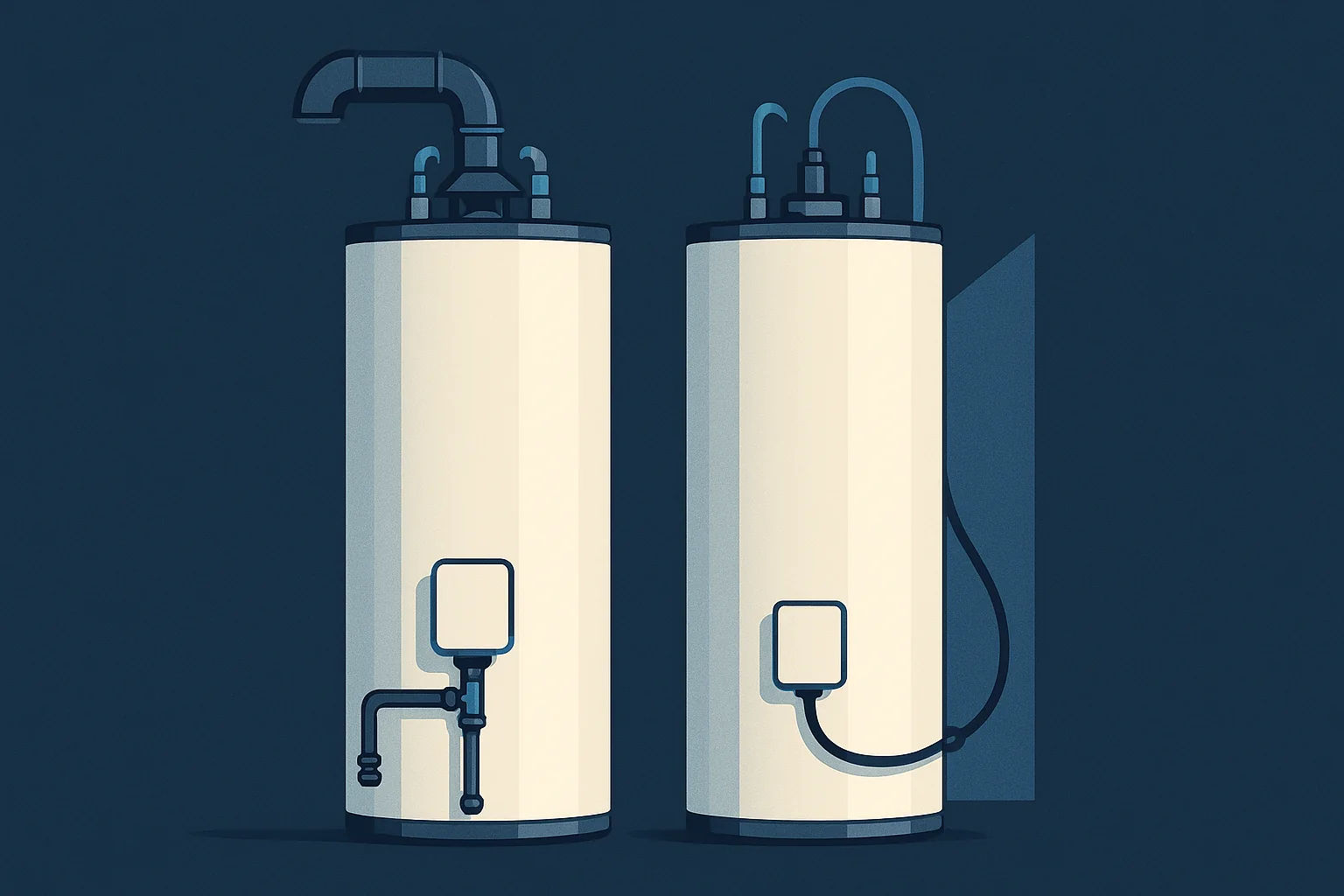

The fuel question gets decided badly more often than any other water heater decision, because it usually gets decided by default. The old unit was gas, so the new unit is gas. In a Central Ohio home that default is right a good share of the time and expensively wrong the rest of it, and the difference turns on venting, on electrical capacity, and on where the unit actually sits. This article lays out how to make the comparison properly. It supports our water heater service work.
In This Guide
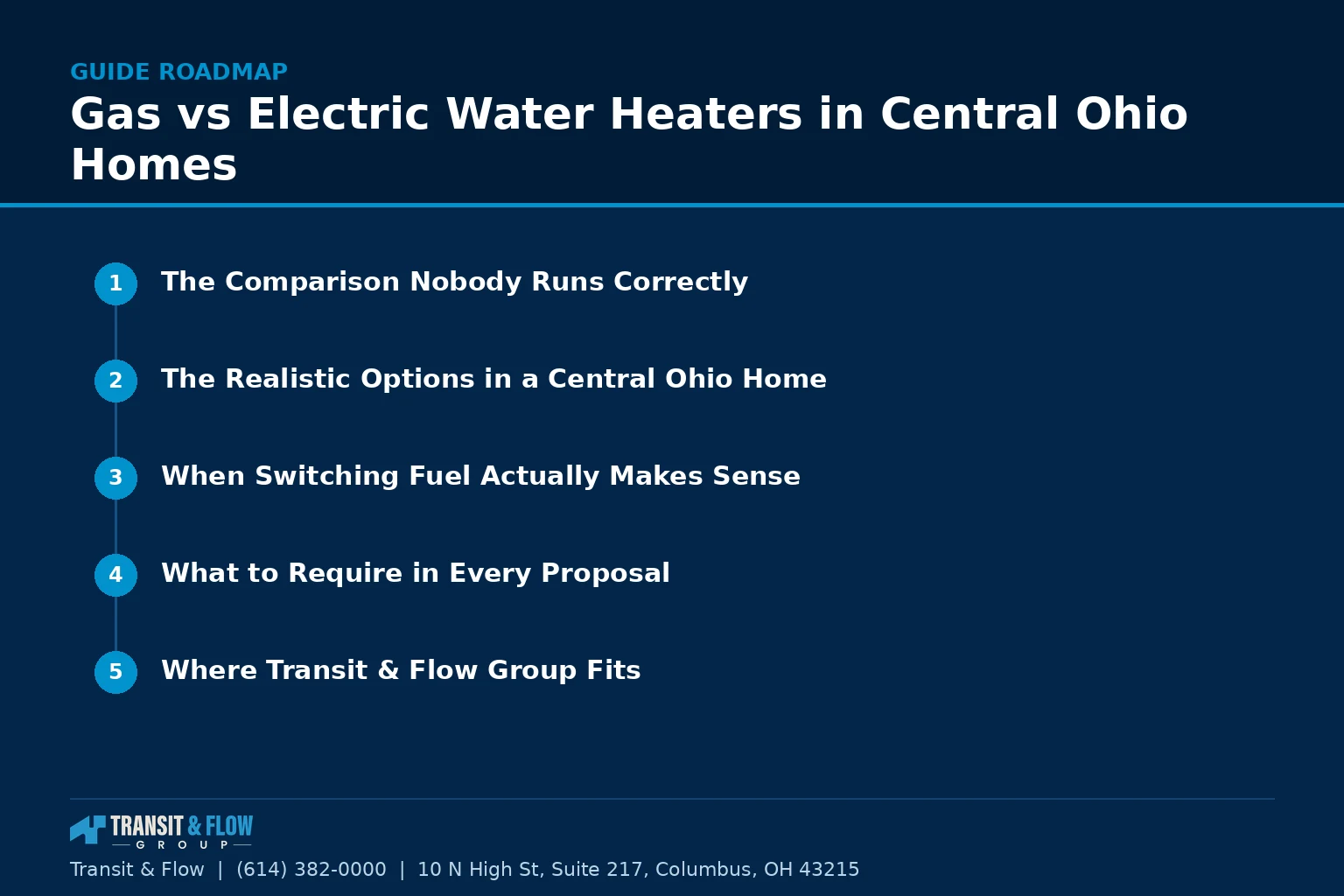
- The Comparison Nobody Runs Correctly
- The Realistic Options in a Central Ohio Home
- When Switching Fuel Actually Makes Sense
- What to Require in Every Proposal
- Where Transit & Flow Group Fits
- Frequently Asked Questions
Transit & Flow Group coordinates projects and partners with properly licensed and insured specialty contractors when licensing is required.
One boundary. Water heater installation involves gas piping, combustion venting, or high-current electrical circuits, all of which are licensed and permitted activities in Ohio. This article helps you specify and evaluate. It is not installation instruction. If you smell gas, leave the building and call from outside. Never adjust or cap a temperature and pressure relief valve.
The Comparison Nobody Runs Correctly
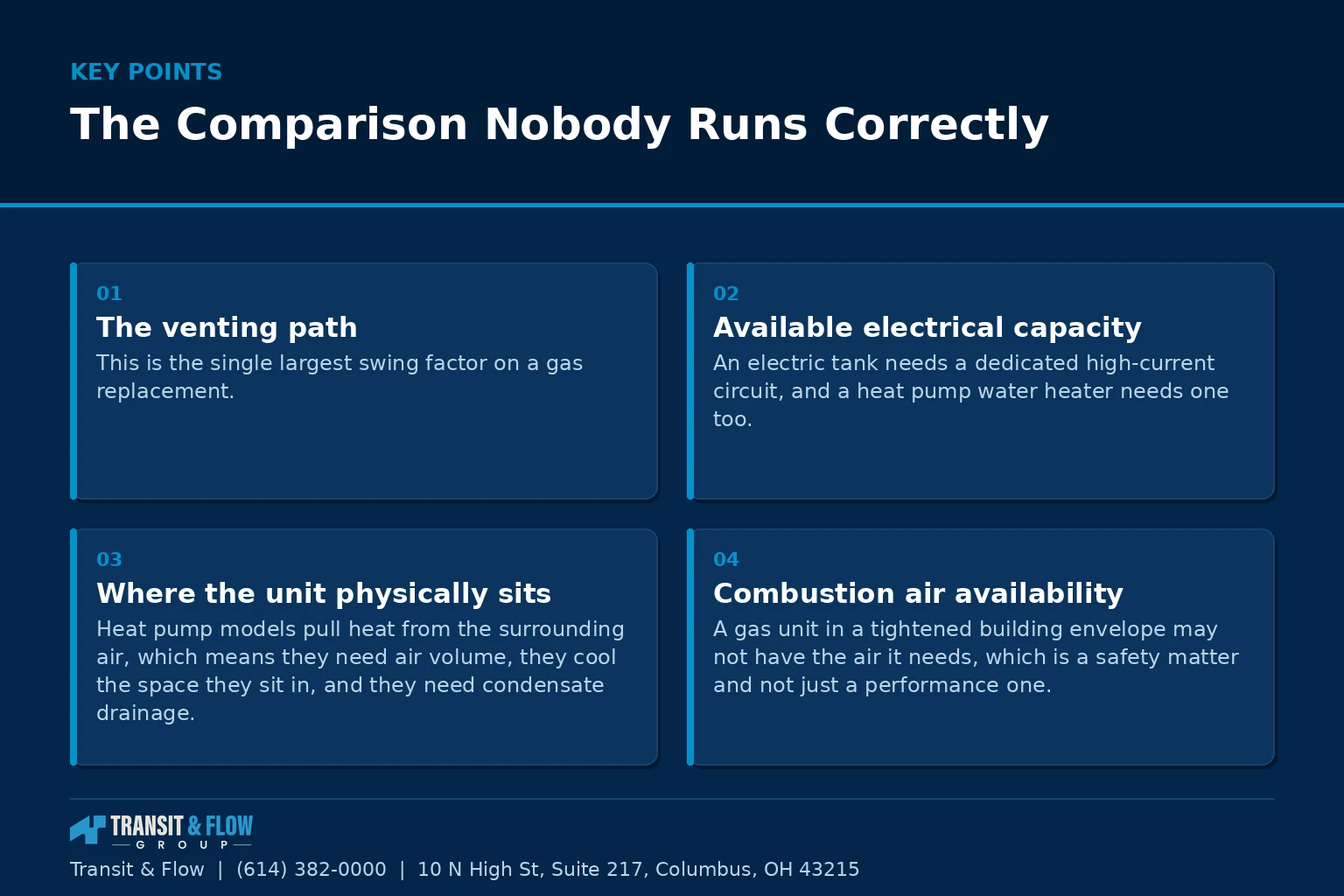
Most fuel comparisons stop at operating cost, which is the least reliable number in the entire analysis because it depends on utility rates that move, on household usage that varies enormously, and on efficiency figures measured under test conditions rather than in your basement. The variables that actually decide the outcome are structural, and they are knowable before anyone quotes anything.
- The venting path. This is the single largest swing factor on a gas replacement. A unit venting into a shared masonry chimney alongside a furnace behaves very differently once that furnace is replaced with a condensing model, because the water heater is then orphaned on a flue sized for two appliances. That situation forces a decision whether you wanted one or not.
- Available electrical capacity. An electric tank needs a dedicated high-current circuit, and a heat pump water heater needs one too. Whether your panel has the room is a question with a factual answer, and it is worth getting before falling in love with an option.
- Where the unit physically sits. Heat pump models pull heat from the surrounding air, which means they need air volume, they cool the space they sit in, and they need condensate drainage. A large unfinished basement is close to ideal. A tight mechanical closet is not.
- Combustion air availability. A gas unit in a tightened building envelope may not have the air it needs, which is a safety matter and not just a performance one.
- Recovery expectations. Gas units generally recover faster than standard electric ones of the same capacity, which changes what capacity you need rather than only what you pay.
- What happens in an outage. Gas units with standing pilots or millivolt controls may continue operating without power. Most modern units, gas or electric, will not.
The Realistic Options in a Central Ohio Home
- Atmospheric vent gas tank. The traditional configuration, venting into a chimney or a dedicated flue by natural draft. Simple, familiar, and dependent on a flue that is sized and lined correctly. The orphaned appliance problem lives here.
- Power vent gas tank. Uses a fan to push exhaust out through a sidewall, which removes the chimney from the equation entirely. It needs an electrical outlet nearby, it makes noticeable noise, and the vent termination has clearance requirements that constrain where it can go.
- Standard electric tank. No combustion, no venting, no gas piping, no carbon monoxide consideration at all. Slower recovery, which usually means specifying more capacity. The simplest installation on this list by a wide margin.
- Heat pump water heater. An electric unit that moves heat rather than generating it, which makes it dramatically more efficient than a standard electric unit. It requires air volume, cools and dehumidifies its space, needs condensate drainage, and is taller than a conventional tank. In the right basement it is a strong choice. In the wrong closet it is a mistake.
- Tankless gas. Endless hot water and a small footprint, at the price of a larger gas supply line in many homes, a dedicated vent, and a maintenance requirement that Central Ohio water hardness makes real rather than theoretical.
When Switching Fuel Actually Makes Sense
- The gas unit is orphaned on a shared chimney after a furnace replacement, or is about to be. Correcting the venting is a real scope item, and once you are paying for it, the fuel question is genuinely open.
- The flue or chimney liner needs work regardless. Same logic. The cost of staying with gas is not zero in this case, and the comparison should reflect that.
- The unit sits in a space with poor combustion air. Removing combustion from a tight space removes a category of risk entirely.
- The basement is large, unfinished, and already humid. A heat pump water heater dehumidifies while it works, which is a benefit rather than a side effect in that specific setting.
- The panel already has capacity, which turns the largest objection to electric into a non-issue.
- The unit is being relocated anyway, since the venting and gas piping are being disturbed regardless.
Conversely, if the existing gas venting is sound and independent, the panel is full, and the mechanical space is tight, staying with gas is usually the correct answer and the analysis should end quickly.
What to Require in Every Proposal
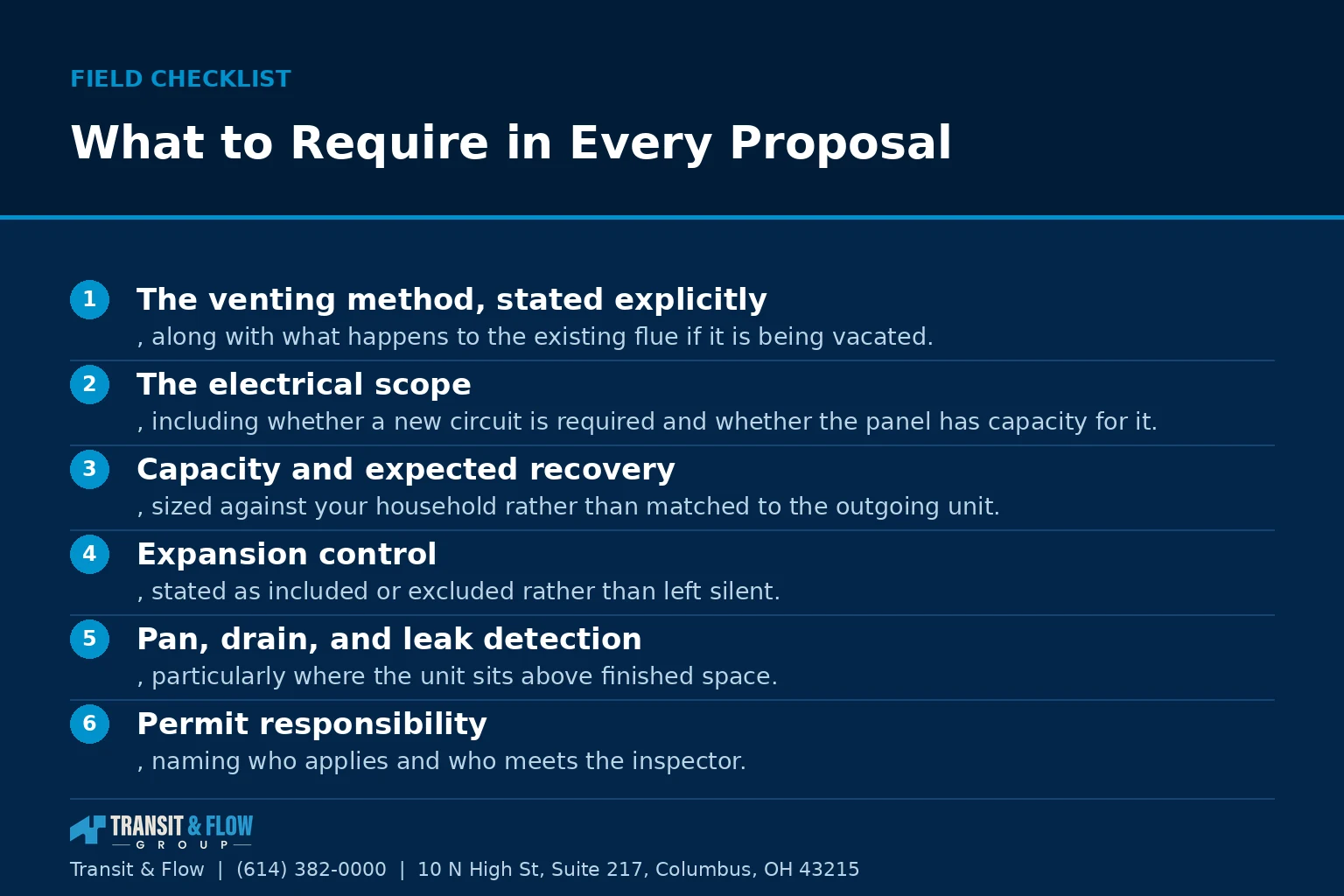
- The venting method, stated explicitly, along with what happens to the existing flue if it is being vacated. An abandoned flue serving another appliance is not a detail.
- The electrical scope, including whether a new circuit is required and whether the panel has capacity for it.
- Capacity and expected recovery, sized against your household rather than matched to the outgoing unit.
- Expansion control, stated as included or excluded rather than left silent.
- Pan, drain, and leak detection, particularly where the unit sits above finished space.
- Permit responsibility, naming who applies and who meets the inspector.
- Condensate handling on any condensing or heat pump equipment.
- Maintenance requirements, since a tankless or heat pump unit carries obligations a standard tank does not.
On cost: this article contains no dollar figures on purpose. Installed price swings with venting path, gas line sizing, electrical scope, panel capacity, condensate routing, permit requirements, access to the mechanical space, and whether a chimney is being vacated. Two homes on the same street can differ by a wide margin on identical equipment. Get scoped proposals on your actual installation, and get them for more than one configuration.
Option A is replacing like for like, which is fast and eliminates surprises. Option B is scoping two configurations, the like for like replacement and the strongest alternative for your specific space, and deciding on the total picture. My recommendation is Option B whenever the venting is being touched or the unit is being relocated, and Option A when the existing venting is independent and sound. The evaluation costs one extra conversation during a planned replacement and it is unavailable during an emergency one, which is the strongest argument for reading our guidance on planning replacement before failure.
Where Transit & Flow Group Fits
Transit & Flow Group coordinates water heater projects across Columbus and Central Ohio and partners with properly licensed and insured specialty contractors when licensing is required. Our standard is that the venting path and the electrical scope are stated in writing before equipment is selected, and that any orphaned appliance created by a fuel change is identified and addressed in the same scope rather than discovered later. Because these projects regularly cross plumbing, electrical, and heating trades, one coordinator carries the project. To get a configuration comparison on your actual installation, request an assessment.
Frequently Asked Questions
Should I just replace my gas water heater with another gas water heater?
Often yes, but not by default, and the default is how this decision usually gets made badly. If the existing gas venting is sound and independent, the panel is full, and the mechanical space is tight, staying with gas is usually correct and the analysis should end quickly. The question genuinely opens up when the venting is being disturbed, when the flue or liner needs work anyway, or when the unit is being relocated. Those are the moments when comparing configurations costs one extra conversation rather than a second project.
What actually decides the gas versus electric question?
Structural variables, not operating cost. Operating cost is the least reliable number in the analysis because it depends on utility rates that move, household usage that varies enormously, and efficiency figures measured under test conditions rather than in your basement. What decides it is the venting path, whether the panel has capacity for a dedicated high-current circuit, where the unit physically sits, whether there is adequate combustion air, how fast you need recovery, and what you expect during an outage. All of those are knowable before anyone quotes anything.
What is the orphaned water heater problem?
It happens when a gas water heater shares a masonry chimney with a furnace and that furnace is replaced with a condensing model that vents out a sidewall. The water heater is then left alone on a flue that was sized for two appliances, and that changes how it drafts. It is a recognized condition, and it forces a decision whether you wanted one or not. Have it identified and addressed in the same scope by the licensed contractor doing the work rather than discovered afterward.
Is a heat pump water heater a good fit for a Central Ohio basement?
It depends almost entirely on the space. A heat pump unit moves heat rather than generating it, which makes it dramatically more efficient than a standard electric tank, but it needs air volume, it cools and dehumidifies the room it sits in, it needs condensate drainage, and it is taller than a conventional tank. A large unfinished basement that already runs humid is close to ideal, because the dehumidification is a benefit rather than a side effect. A tight mechanical closet is the wrong place for one.
What are the realistic options besides a standard gas tank?
Five configurations cover most Central Ohio homes. An atmospheric vent gas tank is the traditional setup and depends on a correctly sized and lined flue. A power vent gas tank uses a fan to push exhaust out a sidewall, which removes the chimney from the equation but needs an outlet nearby, makes noticeable noise, and has termination clearances that constrain placement. A standard electric tank has no combustion, venting, or gas piping at all and is the simplest installation by a wide margin, though slower recovery usually means specifying more capacity. Heat pump and tankless gas round out the list, each with its own space and maintenance requirements.
What should every water heater proposal state?
Enough that you can compare two proposals on the same work. Require the venting method stated explicitly along with what happens to an existing flue if it is being vacated, the electrical scope including whether a new circuit is needed and whether the panel has capacity, and capacity and expected recovery sized against your household rather than matched to the outgoing unit. Also require expansion control named as included or excluded, pan and drain and leak detection where the unit sits above finished space, condensate handling on any condensing or heat pump equipment, and maintenance obligations. Permit responsibility should be named, including who applies and who meets the inspector.
Sources
- U.S. Department of Energy, Building Technologies Office, water heating technology guidance
- Ohio Construction Industry Licensing Board, plumbing and HVAC trade licensing
- City of Columbus, Get a Permit, plumbing, mechanical, and electrical permit channels
About This Guide
Written and edited by Micheal Parker, founder of Transit & Flow Group. Published November 20, 2026. This guide is checked against the agency and code sources listed above, and it is revised when those sources change.
General contractor of record. Micheal Parker holds City of Columbus General Contractor Registration G12064, issued by the Columbus Department of Building and Zoning Services under Transit & Flow LLC and valid through June 30, 2027. Trade work that falls outside the scope of that registration is performed by licensed trade partners, and the responsible license holder is identified before work begins.
Transit & Flow Group, home and commercial services for Columbus and the surrounding Central Ohio communities. Phone (614) 382-0000. Email solutions@transitflowgroup.com. 10 N. High St., Suite 217, Columbus, OH 43215. Contact our team or review the communities we serve.
