

Venting is the part of a water heater installation that homeowners never look at and inspectors always do, and it is where the difference between a competent installation and a dangerous one is most visible. A gas water heater produces combustion byproducts including carbon monoxide, and the vent system is the only thing standing between those byproducts and the living space. This article explains what the vent system is doing, what a correct installation looks like, and what to check on the one you already have. It supports our water heater service work.
In This Guide
- What the Vent System Is Actually Doing
- The Orphaned Water Heater
- What a Correct Installation Includes
- What You Can Look At Yourself
- What a Real Venting Inspection Produces
- Where Transit & Flow Group Fits
- Frequently Asked Questions
Transit & Flow Group coordinates projects and partners with properly licensed and insured specialty contractors when licensing is required.
Read this first. If a carbon monoxide alarm sounds, get everyone outside immediately, call from outside, and call emergency services if anyone has a headache, nausea, dizziness, or confusion. Do not open windows first and do not silence the alarm and go back to bed. If you smell gas, leave the building and call from outside. Venting work is a licensed, permitted activity in Ohio. This article is for specifying and evaluating work, not for performing it.
What the Vent System Is Actually Doing
Burning natural gas produces heat, water vapor, carbon dioxide, and, when combustion is incomplete, carbon monoxide. The vent system carries all of it outside. On a conventional atmospheric unit it does this using nothing but the buoyancy of hot gas, which is why the details matter so much. There is no fan forcing the issue. The system works because the physics are arranged correctly, and it stops working when they are not.
Three conditions have to hold at once. The vent has to be sized and pitched so the gases rise. The appliance has to have enough combustion air to burn cleanly in the first place. And nothing else in the house can be pulling harder on the mechanical space than the vent is pushing. When the third condition fails, exhaust reverses into the room, which is the failure mode called backdrafting and it is the reason our article on carbon monoxide safety treats competing exhaust fans as a real hazard rather than a technicality.
The Orphaned Water Heater
This deserves its own section because it is the most common venting defect created in Central Ohio homes, and it is almost always created by a well-intentioned upgrade.
Many older homes vent a furnace and a water heater into the same masonry chimney. That chimney was sized for the combined output of both appliances. When the furnace is replaced with a high-efficiency condensing model, that furnace vents out a sidewall through plastic pipe and stops using the chimney. The water heater is now alone on a flue sized for two appliances, producing a fraction of the heat that flue needs to establish draft. Exhaust cools, condenses, and lingers instead of rising. The chimney liner deteriorates from acidic condensate, and the appliance may backdraft into the basement.
The correction is straightforward and it is a scope item with a real cost: reline the chimney to the correct size for the single remaining appliance, convert the water heater to power venting through a sidewall, or change fuel. What is not acceptable is leaving it. If a furnace was replaced in your home and the water heater still vents into the old chimney, that is worth having assessed. Our fuel comparison article covers how this situation reopens the fuel question.
What a Correct Installation Includes
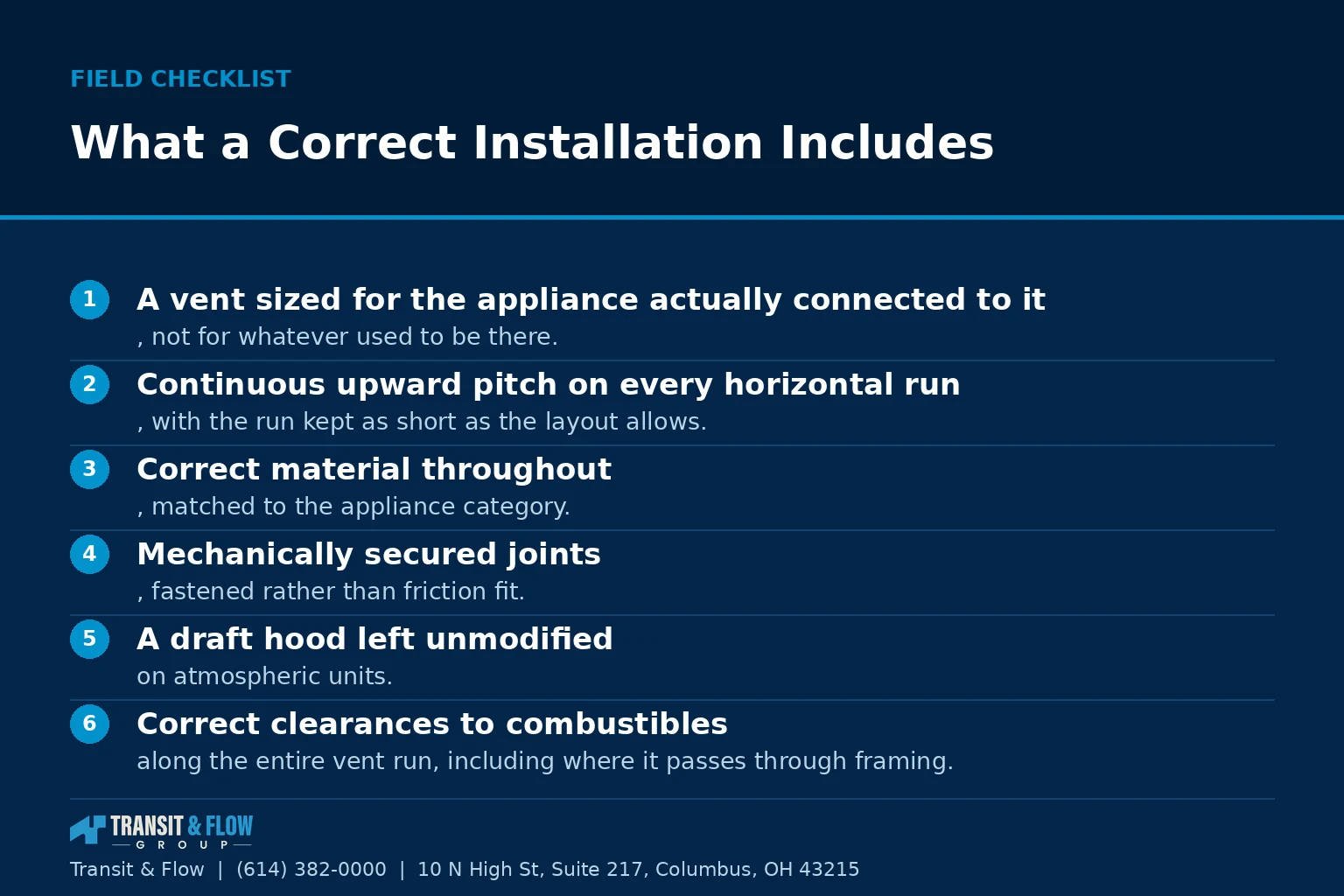
- A vent sized for the appliance actually connected to it, not for whatever used to be there.
- Continuous upward pitch on every horizontal run, with the run kept as short as the layout allows. Sagging vent connector is a common and consequential defect.
- Correct material throughout, matched to the appliance category. Condensing equipment and atmospheric equipment do not share vent materials, and mixing them is a serious error.
- Mechanically secured joints, fastened rather than friction fit.
- A draft hood left unmodified on atmospheric units. It is a designed component, not an obstruction.
- Correct clearances to combustibles along the entire vent run, including where it passes through framing.
- An intact, correctly sized chimney liner where a masonry chimney is used.
- Verified combustion air, sized for the appliance and the room volume, including provisions where the unit sits in a closet or a tightened basement.
- Compliant termination location on a power vented unit, with required clearance from windows, doors, intakes, and the property line.
- A permit and an inspection, which is the independent check on all of the above and the reason to insist on it.
What You Can Look At Yourself
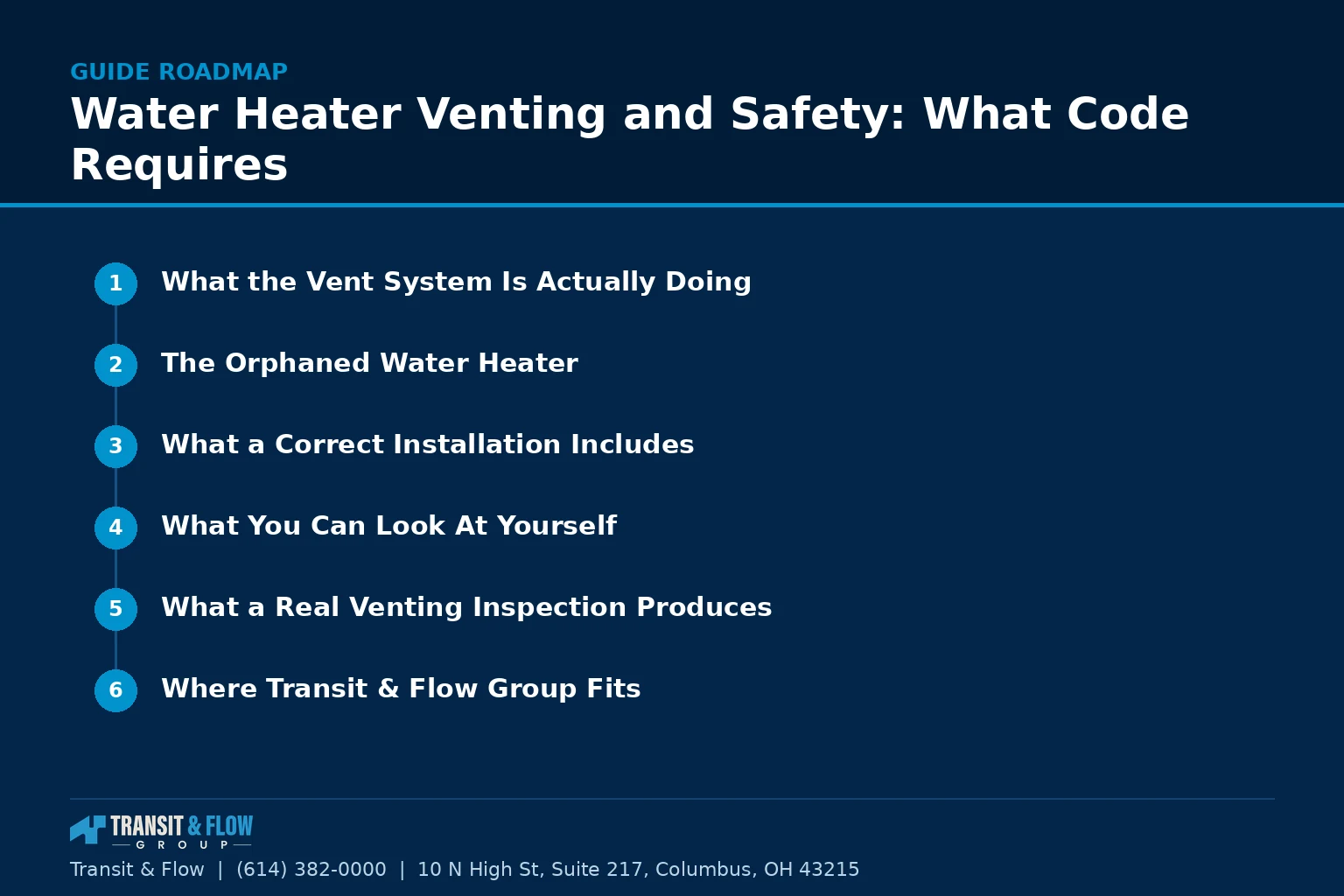
- Follow the vent pipe with your eyes from the top of the heater to where it enters the chimney or wall. Look for sections that sag, dip, or run downhill.
- Look for rust, scaling, or white powdery deposits on the vent connector or at the draft hood. Those indicate condensation, which indicates poor draft.
- Look for soot anywhere near the burner or the draft hood. Soot means incomplete combustion and it is a same-day call.
- Check whether the vent connector is actually fastened or merely resting in place.
- Note whether the furnace vents through a plastic pipe out the wall while the water heater vents into the chimney. That is the orphaned appliance pattern.
- Look at the room. Is the unit in a closet with a solid door and no vents or grilles? Combustion air is a question there.
- Note what else exhausts air from the same level. Kitchen hood, bath fans, dryer, radon fan. All of them compete with the vent.
- Confirm a working carbon monoxide alarm is present on that level and is within its sensor life. A powered detector past its sensor life is not a detector.
None of this replaces a combustion analysis and a worst-case draft test performed by a qualified technician with instruments. It tells you whether to schedule one urgently or routinely.
What a Real Venting Inspection Produces
- Recorded combustion readings, not a pass mark. Numbers are the year-over-year record that shows deterioration early.
- A worst-case draft test, performed with competing exhaust appliances running and the house in its most demanding configuration, because that is when the failure actually happens.
- A carbon monoxide measurement in the living space, stated as a number.
- A stated finding on vent sizing, particularly whether the appliance is orphaned.
- A combustion air calculation against the actual room volume.
- A written report that says what was found sound as well as what was found faulty.
On cost: this article contains no dollar figures on purpose. Venting corrections range from resecuring a connector to relining a chimney or converting an appliance to power venting, and the scope depends entirely on what is found. A published range would be wrong for nearly everyone reading. Get the written findings first, then price the specific correction.
Option A is addressing venting when the water heater is replaced, which is when most people think about it. Option B is having the venting assessed now, independently of the age of the appliance, particularly if a furnace has been replaced in the home in the last decade. My recommendation is Option B without hesitation. Venting defects do not announce themselves through comfort complaints, they do not get worse gradually in a way you notice, and the failure mode is a gas you cannot smell. This is the one item in the entire water heater conversation where waiting for a symptom is not a strategy.
Where Transit & Flow Group Fits
Transit & Flow Group coordinates water heater and heating projects across Columbus and Central Ohio and partners with properly licensed and insured specialty contractors when licensing is required. Our standard is that combustion readings and a worst-case draft result are recorded in writing on every gas appliance we touch, that any orphaned appliance is identified and named in the scope, and that permits are pulled so an independent inspection confirms the work. Because venting corrections regularly involve plumbing and mechanical trades together, one coordinator carries the project. To get a documented venting assessment, request an assessment.
Frequently Asked Questions
What is an orphaned water heater, and why does it matter?
It is a gas water heater left venting alone into a masonry chimney that was originally sized for the combined output of a furnace and the water heater together. When the furnace is replaced with a high efficiency condensing model, that furnace vents out a sidewall through plastic pipe and stops using the chimney entirely. The water heater is then producing a fraction of the heat that flue needs to establish draft, so exhaust cools, condenses, and lingers instead of rising. It is the most common venting defect created in Central Ohio homes, and it is almost always the byproduct of a well intentioned upgrade. If a furnace was replaced in your home and the water heater still vents into the old chimney, have it assessed by a licensed professional.
What should I do if a carbon monoxide alarm sounds?
Get everyone outside immediately and call from outside, and call emergency services if anyone has a headache, nausea, dizziness, or confusion. Do not open windows first, and do not silence the alarm and go back to bed. If you smell gas, leave the building and call from outside. This is not a situation to evaluate from indoors while you decide whether it is a false alarm.
What can a homeowner look at without touching anything?
Follow the vent pipe with your eyes from the top of the heater to where it enters the chimney or wall, watching for sections that sag, dip, or run downhill. Look for rust, scaling, or white powdery deposits on the vent connector or at the draft hood, which indicate condensation and therefore poor draft, and look for soot near the burner or draft hood, which indicates incomplete combustion and warrants a same day call. Note whether the furnace vents through plastic pipe out the wall while the water heater still vents into the chimney, since that is the orphaned appliance pattern. Note what else exhausts air from the same level, including the kitchen hood, bath fans, dryer, and any radon fan, because all of them compete with the vent. None of this replaces instrumented testing, and it does not qualify anyone to modify the vent.
What should a real venting inspection produce?
Recorded combustion readings rather than a pass mark, because numbers are the year over year record that shows deterioration early. It should include a worst case draft test performed with competing exhaust appliances running and the house in its most demanding configuration, since that is when the failure actually happens. Expect a carbon monoxide measurement in the living space stated as a number, a stated finding on vent sizing including whether the appliance is orphaned, and a combustion air calculation against the actual room volume. The written report should say what was found sound as well as what was found faulty. If a report contains none of that, it has not told you anything you can act on.
Does water heater venting work require a permit in Ohio?
Venting work is a licensed and permitted activity, and the permit and inspection are the independent check on everything else in the installation. That is the reason to insist on it rather than accept an offer to skip it for speed. Sizing, materials, clearances, and termination locations are set by the adopted code and the manufacturer’s published installation instructions for the specific appliance, not by general practice, so the authority on your installation is your local building department. Confirm who is pulling the permit before work starts.
Should venting be assessed now or handled when the water heater is replaced?
Have it assessed now, independently of the appliance’s age, and particularly if a furnace has been replaced in the home in the last decade. Venting defects do not announce themselves through comfort complaints, they do not degrade in a way anyone notices, and the failure mode involves a gas you cannot smell. Waiting for a symptom is not a strategy here in the way it can be for other equipment. Get the written findings first, then price whatever specific correction those findings identify.
Sources
- U.S. Consumer Product Safety Commission, carbon monoxide and fuel-burning appliance safety
- Ohio Construction Industry Licensing Board, plumbing and HVAC trade licensing
- City of Columbus, Get a Permit, plumbing and mechanical permit channels
About This Guide
Written and edited by Micheal Parker, founder of Transit & Flow Group. Published November 22, 2026. This guide is checked against the agency and code sources listed above, and it is revised when those sources change.
General contractor of record. Micheal Parker holds City of Columbus General Contractor Registration G12064, issued by the Columbus Department of Building and Zoning Services under Transit & Flow LLC and valid through June 30, 2027. Trade work that falls outside the scope of that registration is performed by licensed trade partners, and the responsible license holder is identified before work begins.
Transit & Flow Group, home and commercial services for Columbus and the surrounding Central Ohio communities. Phone (614) 382-0000. Email solutions@transitflowgroup.com. 10 N. High St., Suite 217, Columbus, OH 43215. Contact our team or review the communities we serve.
