

Central Ohio outages arrive in three flavors: the summer storm that drops a limb across a service line, the winter ice event that takes down a circuit for a day or more, and the brief flicker that ruins a refrigerator’s day and nothing else. Choosing between a permanently installed standby generator and a portable unit is really a question about which of those you are buying protection from, and how much complexity you are willing to own. This guide separates the two honestly. It is part of our electrical panel guide and it follows our article on adding large loads to a home panel.
In This Guide
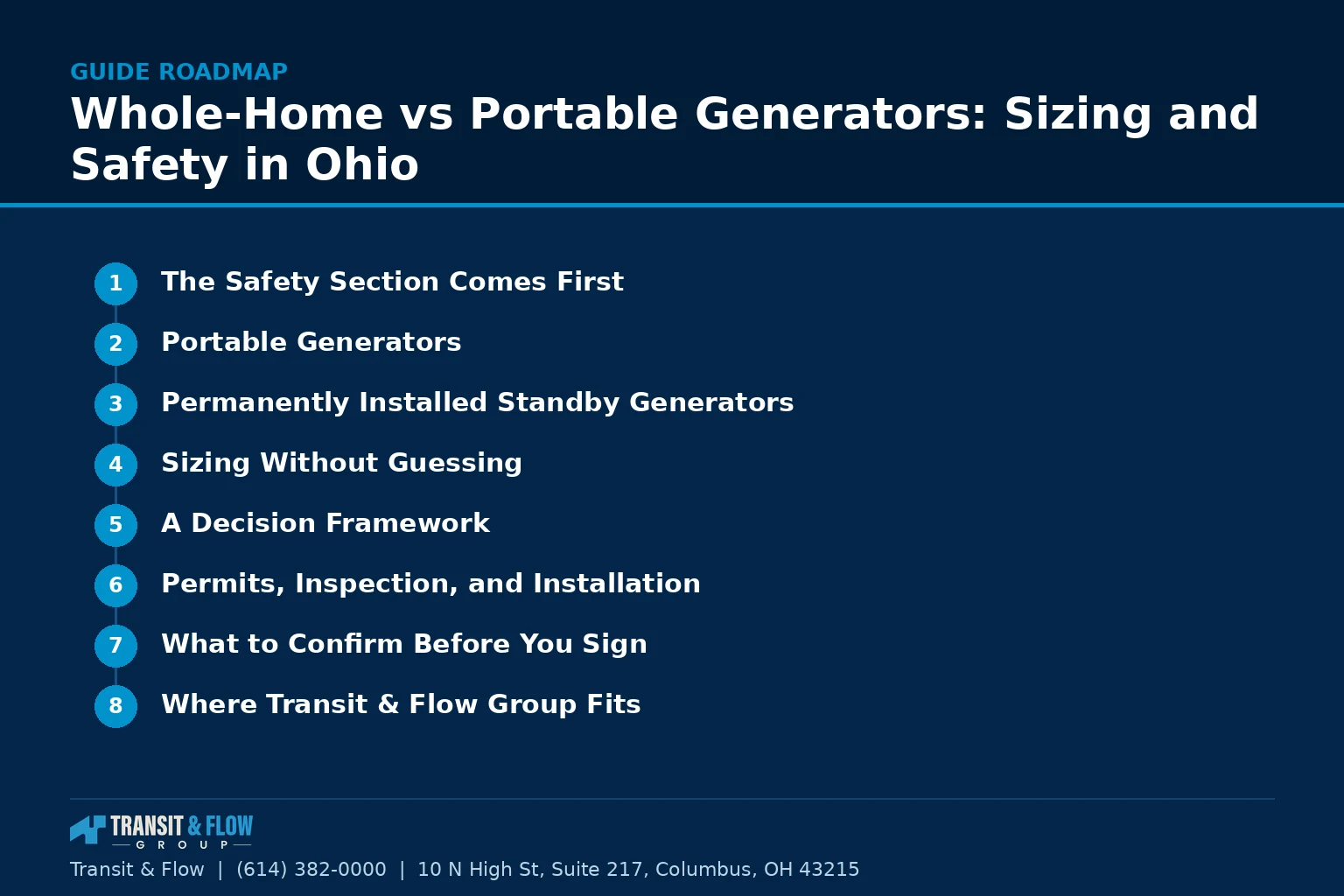
- The Safety Section Comes First
- Portable Generators
- Permanently Installed Standby Generators
- Sizing Without Guessing
- A Decision Framework
- Permits, Inspection, and Installation
- What to Confirm Before You Sign
- Where Transit & Flow Group Fits
- Frequently Asked Questions
Transit & Flow Group coordinates projects and partners with properly licensed and insured specialty contractors when licensing is required.
The Safety Section Comes First
Generators kill people every year in this country, and the causes are consistent and preventable. This is not a section to skim.
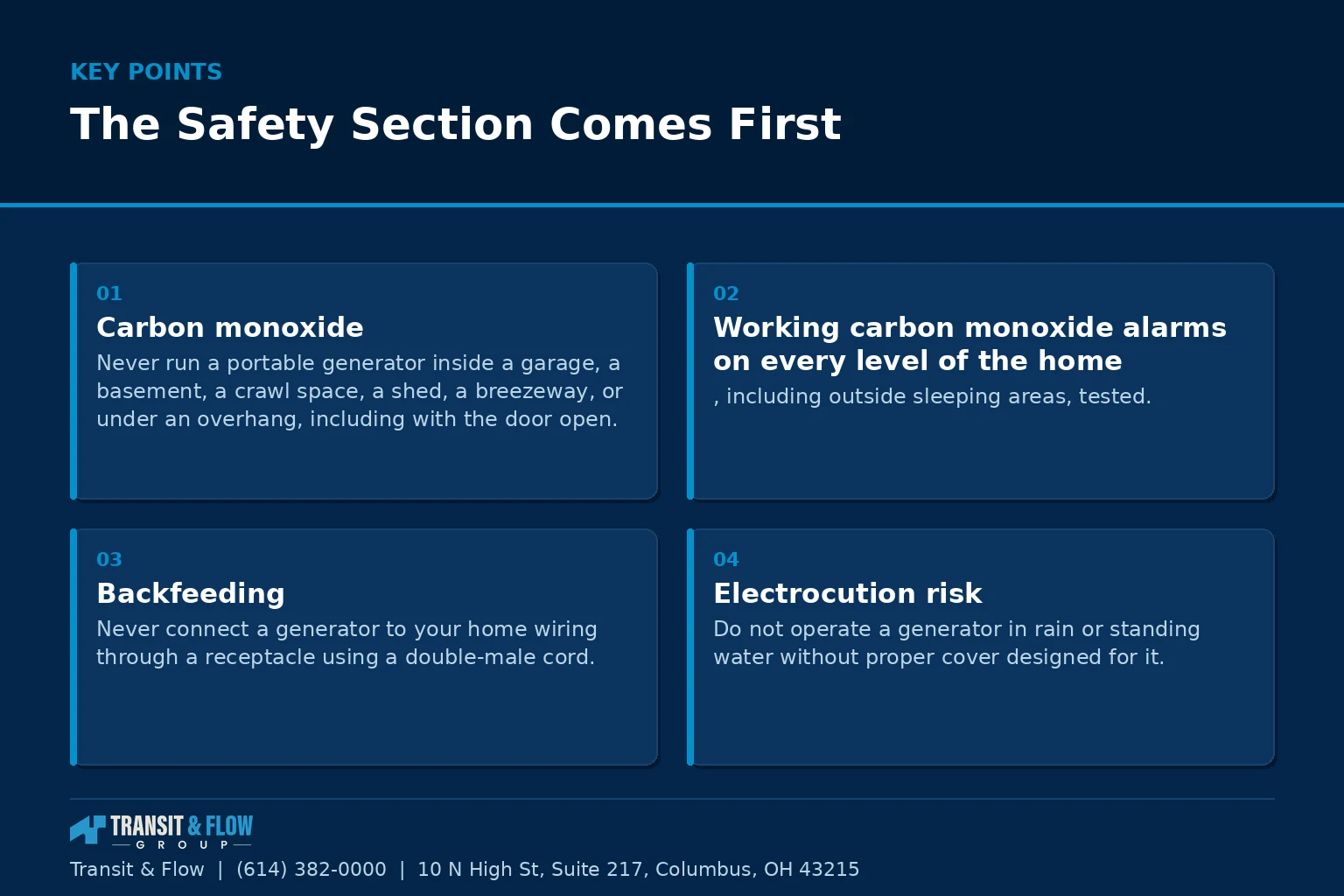
- Carbon monoxide. Never run a portable generator inside a garage, a basement, a crawl space, a shed, a breezeway, or under an overhang, including with the door open. Carbon monoxide is odorless, it accumulates, and an attached garage with the door up is still deadly. Outdoors, well away from the building, with the exhaust directed away from windows, doors, and vents.
- Working carbon monoxide alarms on every level of the home, including outside sleeping areas, tested. If you own a generator and do not have working alarms, that is the first purchase.
- Backfeeding. Never connect a generator to your home wiring through a receptacle using a double-male cord. This energizes your service conductors backward, it can kill a utility worker restoring your line, and it can destroy your equipment when the utility returns. A transfer switch or an interlock is the only correct way to feed a house.
- Electrocution risk. Do not operate a generator in rain or standing water without proper cover designed for it. Keep it dry and keep cords out of water.
- Fuel handling. Never refuel a hot or running engine. Store fuel in approved containers, outside living space, away from any ignition source including water heaters and furnaces.
- Cords. Use heavy-duty outdoor-rated cords sized for the load and the distance, undamaged, and fully uncoiled. A coiled cord under load builds heat.
Nothing in this article is instruction to wire a generator connection. Transfer switches and interlock kits connect to your service equipment, the work is permitted and inspected in Ohio jurisdictions, and it belongs to a licensed electrician.
Portable Generators
- How it works. An engine-driven generator you position outdoors, start manually, and connect either to individual appliances by cord or to the house through a properly installed inlet and transfer switch.
- What it covers. Selected loads. A refrigerator, a freezer, a sump pump, some lighting, device charging, and frequently a furnace blower if the connection was designed for it.
- The daily reality. You have to be home, awake, and willing to go outside in whatever the weather is doing to start it. You have to store and rotate fuel. Runtime is a fuel question, and extended outages mean refueling in the middle of the night.
- Where it fits. Households wanting protection from spoilage and a flooded basement rather than continuity of normal life. Also the right answer for anyone who moves often.
- The honest downside. The failure mode is human. It sits unused for a year, the fuel goes stale, and it does not start on the night it is needed. Monthly exercise is not optional.
Permanently Installed Standby Generators
- How it works. A permanently mounted unit on a pad outside, connected to natural gas or propane, wired to an automatic transfer switch. It senses the outage, starts itself, transfers load, and transfers back when utility power returns.
- What it covers. Depends entirely on sizing and the transfer switch. Either essential circuits or the whole house, and that decision is made at design time.
- The daily reality. It self-tests on a schedule, it runs whether or not you are home, and it needs annual service the way a furnace does.
- Where it fits. Homes on well and septic, where an outage means no water and no waste. Households with medical equipment. Homes where a finished basement depends on a sump pump. Anyone who travels and cannot be present to start a portable.
- The honest downside. It is a construction project. Gas line sizing, electrical work, a pad, permits, inspections, setback and noise considerations, and utility coordination if the gas service needs upsizing. Also an ongoing service obligation.
The gas point deserves emphasis because it surprises people. A standby generator is a large gas appliance, and an existing meter and gas piping sized for a furnace, a water heater, and a range may not support it with everything running. The load calculation on the gas side is as real as the one on the electrical side, and it sometimes means a utility meter change. Ask about it before you sign, not after the pad is poured.
Sizing Without Guessing
- List what must run. Be strict. Refrigerator, freezer, sump pump, furnace blower, well pump, a few lights and outlets, and any medical equipment. That list is the essential tier.
- List what you want to run. Cooking, water heating, laundry, air conditioning, home office. This is the comfort tier and it multiplies the size.
- Account for starting load. Motors draw substantially more at startup than while running. Well pumps, sump pumps, refrigeration compressors, and air conditioning are the ones that matter, and this is the single most common sizing error.
- Decide essential circuits or whole house. An essential-circuits transfer switch is smaller and cheaper. A whole-house switch with a load management module can shed large loads dynamically and often lets a smaller generator cover more.
- Have the sizing done in writing by the installer and ask which specific loads the number assumes. A verbal size is not a design.
- Confirm the fuel supply supports it. Gas piping and meter capacity for natural gas, or tank size and refill logistics for propane.
- Check the site. Setback from openings and property lines, noise, drainage, snow accumulation, and service access all constrain placement.
A Decision Framework
- Well and septic. Standby. An outage without water or waste disposal is not a comfort issue.
- Finished basement with a sump dependency. Standby, or at minimum a portable with a permanently installed inlet and a battery backup on the sump.
- Medical equipment in the home. Standby, and discuss the specific equipment with the installer.
- You travel frequently or are often away. Standby. A portable requires a person.
- City water and sewer, gas heat, no basement risk. Portable, correctly connected, covers the real exposure.
- You expect to move within a few years. Portable. It goes with you and it does not depend on recovering the value at sale.
- Outages here are brief and rare. Portable, or nothing plus a plan. That is a legitimate answer and not every home needs a generator.
- Budget is the binding constraint. Portable now with a properly installed inlet and interlock, which preserves the option to upgrade later without redoing the electrical work.
Permits, Inspection, and Installation
Both paths involve permitted work as soon as anything connects to house wiring. A portable connected through an inlet and interlock still requires electrical work at the panel. A standby unit typically involves an electrical permit and a mechanical or gas permit, sometimes a zoning review for placement, and separate inspections. Requirements and adopted code editions vary across Central Ohio jurisdictions, so confirm what applies at your address with the building department rather than assuming your neighbor’s experience transfers.
On cost: this guide contains no prices deliberately. Generator projects vary with unit size and brand, essential-circuit versus whole-house transfer, distance from the panel and the gas line, whether gas piping or the meter must be upsized, pad and site work, permit and inspection fees by jurisdiction, and the condition of the existing service equipment. Published averages mislead. Get a written scope on your property, and compare proposals by what they include rather than by the number at the bottom.
What to Confirm Before You Sign
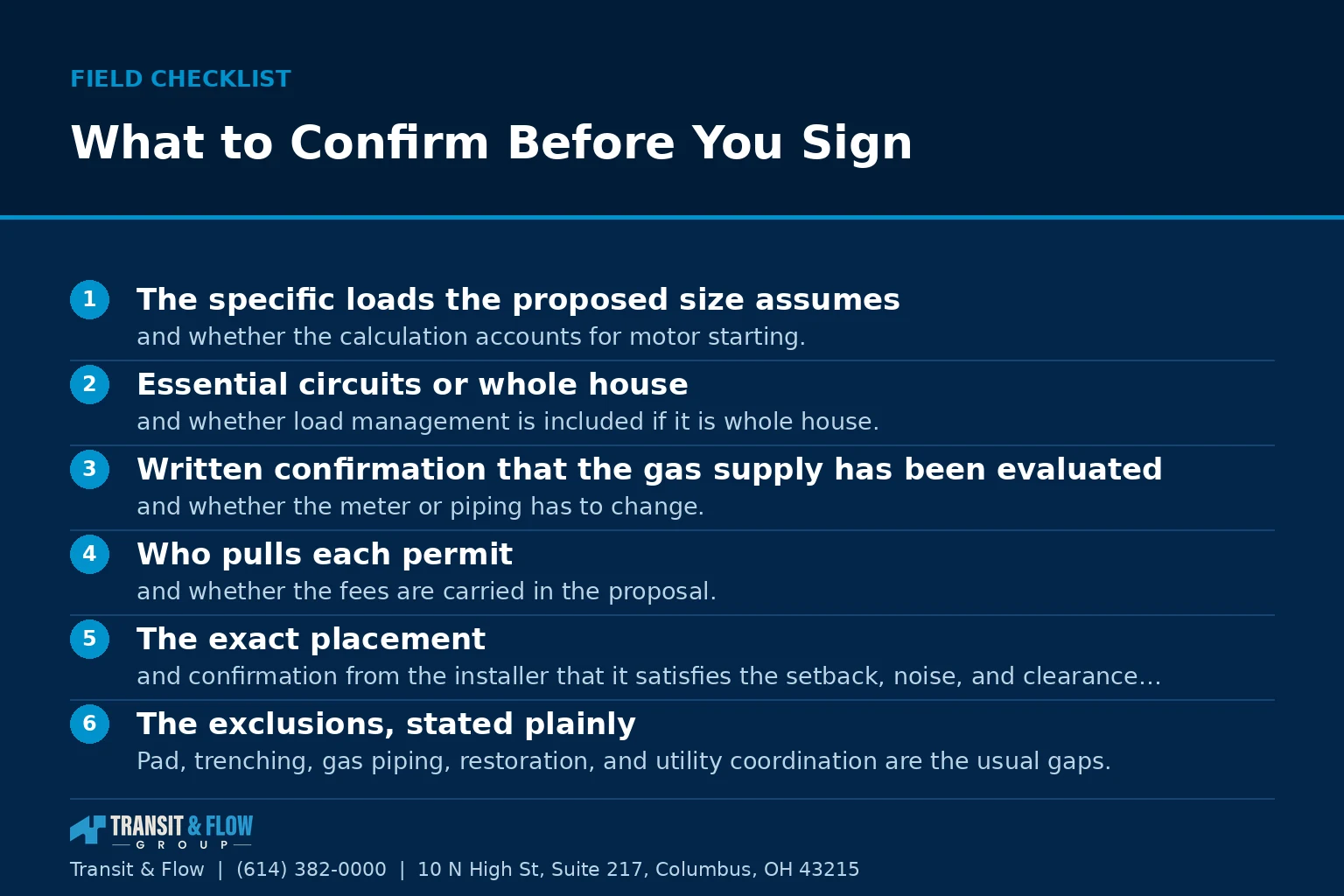
- The specific loads the proposed size assumes, and whether the calculation accounts for motor starting.
- Essential circuits or whole house, and whether load management is included if it is whole house.
- Written confirmation that the gas supply has been evaluated, and whether the meter or piping has to change.
- Who pulls each permit, and whether the fees are carried in the proposal.
- The exact placement, and confirmation from the installer that it satisfies the setback, noise, and clearance requirements your jurisdiction applies.
- The exclusions, stated plainly. Pad, trenching, gas piping, restoration, and utility coordination are the usual gaps.
- The maintenance schedule the unit requires, and what an annual service visit includes.
- The equipment warranty, the labor warranty, and whether the two run the same length.
- Lead time on the unit, and what secures the installation date.
- The unit’s behavior during a scheduled self-test, and whether the test window can be set.
Where Transit & Flow Group Fits
Transit & Flow Group coordinates electrical work across Columbus and Central Ohio and partners with properly licensed and insured specialty contractors when licensing is required. On backup power our standard is that the sizing calculation names the loads it assumes, that the gas supply is evaluated before a standby unit is proposed, and that every permit is pulled and every inspection is documented. Because a generator project touches the panel, the gas system, and often the heating system and the plumbing at the same time, one coordinator carries it end to end. To get a written scope on your property, request an assessment.
Frequently Asked Questions
Should I buy a portable generator or a permanently installed standby unit?
Start from what an outage actually costs you rather than from the equipment. A home on well and septic loses water and waste disposal in an outage, a finished basement can depend on a sump pump, and medical equipment in the home changes the calculus entirely, so those situations point toward standby. A household on city water and sewer with gas heat and no basement exposure is usually well served by a portable that is correctly connected. If you expect to move within a few years, a portable goes with you, and if outages at your address are brief and rare, no generator at all plus a plan is a legitimate answer.
Where can a portable generator be run safely?
Outdoors only, well away from the building, with the exhaust directed away from windows, doors, and vents. Never run one inside a garage, basement, crawl space, shed, or breezeway, or under an overhang, and an attached garage with the door up is not an exception. Carbon monoxide is odorless and it accumulates. Working carbon monoxide alarms on every level of the home, including outside sleeping areas, are the first purchase if you own a generator and do not already have them.
Can I power my house by plugging a generator into a receptacle?
No. Feeding house wiring through a receptacle with a double-male cord energizes your service conductors backward, which can kill a utility worker restoring your line and can destroy your equipment when utility power returns. A transfer switch or an interlock is the only correct way to feed a house. That equipment connects to your service equipment, the work is permitted and inspected in Ohio jurisdictions, and it belongs to a licensed electrician. Nothing in this article is instruction to wire a generator connection yourself.
How do I know a generator has been sized correctly?
Ask for the sizing in writing and ask which specific loads the number assumes, because a verbal size is not a design. The calculation should start from the essential tier, meaning refrigerator, freezer, sump pump, furnace blower, well pump, basic lighting and outlets, and any medical equipment, then treat cooking, water heating, laundry, air conditioning, and the home office as a separate comfort tier that multiplies the size. It also has to account for starting load, since motors draw substantially more at startup than while running, and that is the single most common sizing error. Whether you choose an essential-circuits or whole-house transfer switch belongs in the same conversation, because a whole-house switch with load management can shed large loads dynamically.
Does a standby generator affect my gas service?
It can, and this surprises people. A standby generator is a large gas appliance, and a meter and gas piping sized for a furnace, a water heater, and a range may not support it with everything running. The load calculation on the gas side is as real as the one on the electrical side, and it sometimes means a utility meter change coordinated with the gas provider. Get that evaluation done before you sign rather than after the pad is poured.
Do generator installations require permits in Central Ohio?
Both paths involve permitted work as soon as anything connects to house wiring. A portable connected through an inlet and interlock still requires electrical work at the panel. A standby unit typically involves an electrical permit and a mechanical or gas permit, sometimes a zoning review for placement, and separate inspections. Requirements and adopted code editions vary across Central Ohio jurisdictions, so confirm what applies at your address with your building department rather than assuming a neighbor’s experience transfers.
Sources
- U.S. Consumer Product Safety Commission, portable generator carbon monoxide hazards
- Ohio Construction Industry Licensing Board, electrical trade licensing
- City of Columbus, Get a Permit, permit application channels
About This Guide
Written and edited by Micheal Parker, founder of Transit & Flow Group. Published October 11, 2026. This guide is checked against the agency and code sources listed above, and it is revised when those sources change.
General contractor of record. Micheal Parker holds City of Columbus General Contractor Registration G12064, issued by the Columbus Department of Building and Zoning Services under Transit & Flow LLC and valid through June 30, 2027. Trade work that falls outside the scope of that registration is performed by licensed trade partners, and the responsible license holder is identified before work begins.
Transit & Flow Group, home and commercial services for Columbus and the surrounding Central Ohio communities. Phone (614) 382-0000. Email solutions@transitflowgroup.com. 10 N High St, Suite 217, Columbus, OH 43215. Contact our team or review the communities we serve.
