


There is a specific kind of frustration that comes from clearing the same drain for the third time in eighteen months. Each clearing works. Flow comes back. Everyone is satisfied. And then it happens again, and you start to wonder whether the problem is the drain or the person you keep calling. It is usually neither. A drain that clogs repeatedly at the same place is not having bad luck. It is telling you that something about the pipe itself has changed, and that clearing the blockage treats the deposit rather than the reason the deposit forms. This article is part of our drain and sewer guide.
In This Guide
- The Principle: Clogs Form Where Flow Slows
- The Six Conditions That Cause Recurrence
- Reading Your Own Recurrence Pattern
- Why the Camera Is the Turning Point
- The Three-Clog Rule
- What You Can Change, and What You Cannot
- Questions That Change the Conversation
- Where Transit & Flow Group Fits
- Frequently Asked Questions
Transit & Flow Group coordinates projects and partners with properly licensed and insured specialty contractors when licensing is required.
The Principle: Clogs Form Where Flow Slows
Drainage works because moving water carries solids with it. Keep the water moving at a reasonable velocity and material stays suspended until it reaches the municipal main. Slow that water down anywhere along the run, and the solids it was carrying settle out at exactly the point where the slowing happens.
That is the whole mechanism. It explains why clogs return to the same spot: the spot is where the flow slows, and clearing the accumulated material does nothing about the slowing. The material comes back because the condition that collected it never left. So the useful question is never “what is the clog made of.” It is “what is slowing the water down here, and can it be corrected.”
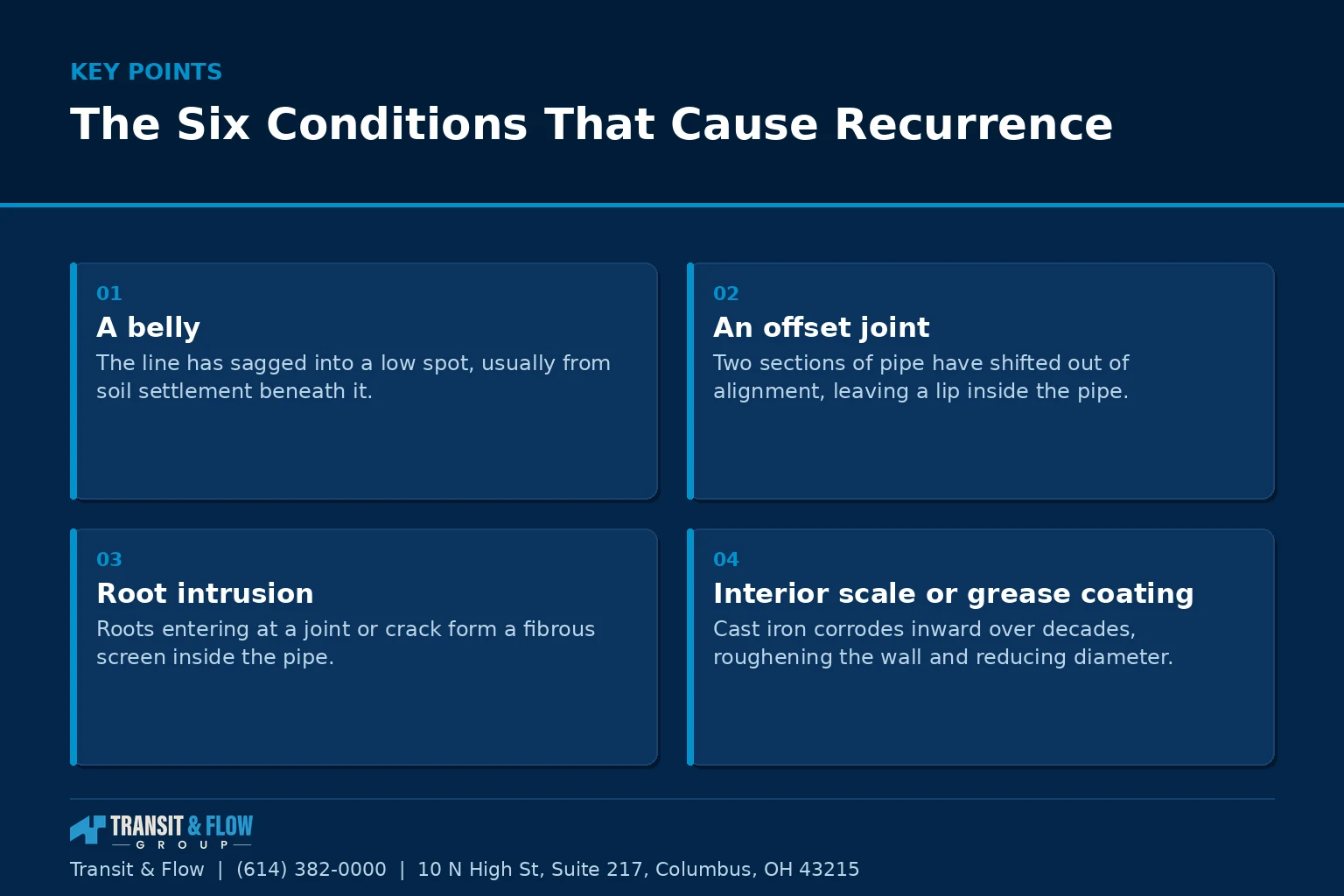
The Six Conditions That Cause Recurrence
- A belly. The line has sagged into a low spot, usually from soil settlement beneath it. Water stands in the sag instead of flowing through, solids drop out of suspension, and the sag fills from the bottom up. This is the single most common cause of a clog that returns on a predictable schedule.
- An offset joint. Two sections of pipe have shifted out of alignment, leaving a lip inside the pipe. Anything fibrous catches on the lip and begins building a mat. Offsets get worse over time as the mat traps more material and the trapped water works at the joint.
- Root intrusion. Roots entering at a joint or crack form a fibrous screen inside the pipe. A cable bores a hole through the screen and flow returns, but the root mass is still there and starts catching material again immediately. Root recurrence intervals of six to eighteen months are typical.
- Interior scale or grease coating. Cast iron corrodes inward over decades, roughening the wall and reducing diameter. Grease coats the wall in kitchen lines. Both narrow the pipe and add friction, which slows water and makes the narrowed section a permanent collection point.
- Inadequate slope. A drain line that was installed too flat never had enough velocity to self-clear. Too steep is also a problem: water outruns the solids and leaves them behind. This is an installation defect, and it means the line will collect material for as long as it exists in that configuration.
- A venting problem. If air cannot enter the system behind draining water, the water drains slowly and unevenly, and slow drainage produces the same deposition that a physical restriction does. Blocked vents, undersized vents, and vents that were never connected correctly all show up as recurring slow drains with gurgling.
Reading Your Own Recurrence Pattern
The interval and the trigger between clogs are diagnostic information. Write down what you observe and take the notes to whoever inspects the line.
- Every six to eighteen months, gradually worsening. Points at roots. The interval typically shortens year over year as the mass grows.
- Every few months, same fixture, same feel. Points at a belly or an offset. The interval is set by how fast your household fills the low spot.
- Worse after large water events like laundry. Points at a partial main line restriction that only shows when volume is high.
- Seasonal, worse in spring and summer. Points at roots again. Root activity tracks the growing season.
- Correlated with heavy rain rather than household use. Points away from a clog entirely and toward groundwater infiltration or municipal surcharge. Different problem, different conversation.
- Kitchen line only, slow build. Points at grease accumulation. This one is at least partly behavioral and partly fixable by jetting.
- New problem in a house that never had one. Points at a change: a new tree maturing, recent excavation nearby, settlement, or something introduced into the line.
Why the Camera Is the Turning Point
Every condition on the list above is visible on a camera inspection, and none of them are visible from the fixture. A cable machine tells you that something was in the way and that it is no longer in the way. It cannot tell you whether the pipe is sagged, offset, scaled, rooted, or flat, and those distinctions determine whether the correct answer is a habit change, a jetting, a spot repair, or a lining.
There is a defensible economics argument here that does not require any pricing claim. Compare the cost of one camera inspection against the cost of the clearings you expect to keep buying. If you have already paid for two clearings on the same line, the third clearing without a camera is a decision to keep paying for the symptom indefinitely. The inspection is what converts an open-ended maintenance expense into a bounded repair decision.
The Three-Clog Rule
- First clog. Treat it as an event. Clear it, note the date, note what was happening in the house when it occurred.
- Second clog at the same location. Stop treating it as an event. Ask for a camera inspection at the time of clearing, while the technician is already there with access to the line. Request the video file and the located distance to any defect.
- Third clog with no inspection done. You are now paying a subscription. Do not authorize another clearing without a camera, and be direct about why.
What You Can Change, and What You Cannot
Behavior fixes some of these conditions and none of the others, and knowing which is which prevents both wasted effort and false hope.
- Grease accumulation. Substantially behavioral. Cool grease, container it, throw it away. Combined with a professional jetting to reset the pipe wall, this one genuinely can be solved at home.
- Hair and fibrous material at fixtures. Fully behavioral. Drain screens on every tub and shower eliminate most branch clogs.
- Wipes and non-flushables. Fully behavioral, and worth being strict about regardless of what the packaging claims.
- Roots. Not behavioral. Root treatments and regular cutting manage the rate; they do not close the opening the roots enter through. Only a repair or a liner does that.
- Bellies and offsets. Not behavioral at all. These are physical conditions in the pipe and no household habit changes them.
- Slope defects. Not behavioral. This is an installation issue requiring the line to be re-laid in that section.
- Venting problems. Not behavioral. Diagnosis and correction by a qualified plumber.
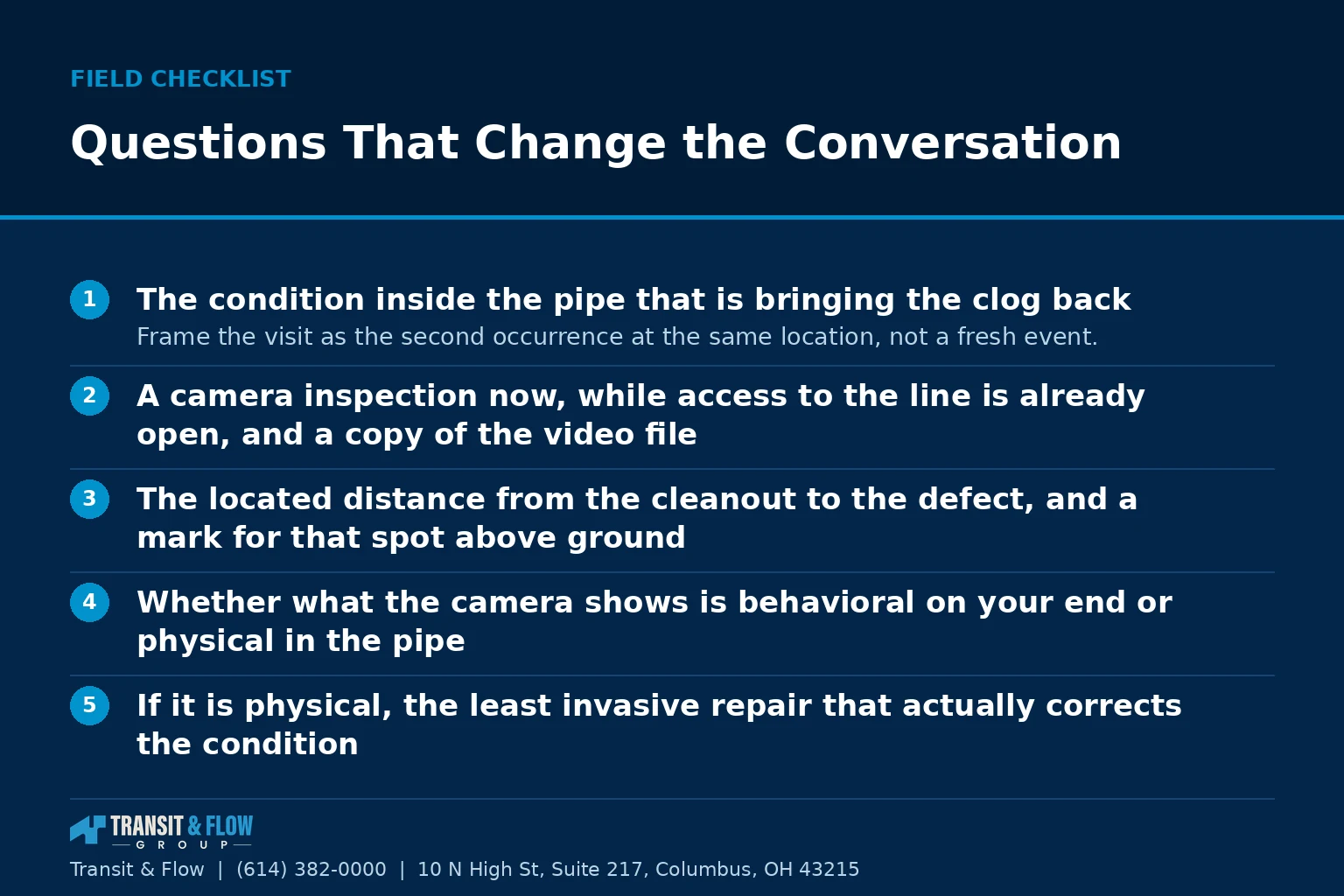
Questions That Change the Conversation
- The condition inside the pipe that is bringing the clog back. Frame the visit as the second occurrence at the same location, not a fresh event.
- A camera inspection now, while access to the line is already open, and a copy of the video file.
- The located distance from the cleanout to the defect, and a mark for that spot above ground.
- Whether what the camera shows is behavioral on your end or physical in the pipe.
- If it is physical, the least invasive repair that actually corrects the condition.
The first item is the one that matters. It reframes the visit from a clearing to a diagnosis, and a good technician will welcome it, because recurring calls to the same address are not a business anyone reputable wants.
Where Transit & Flow Group Fits
Our standard on drain and sewer work across Columbus and Central Ohio is that a second clog at the same location gets a camera, not another cable. You receive the video and the located distance, and the written scope names why the less invasive option was or was not sufficient. When the issue crosses into broader plumbing work, the same coordinator carries it. If you are on your second or third clearing, request an assessment and start with the inspection.
Frequently Asked Questions
Why does the same drain clog again after it was cleared?
Because clearing removes the deposit and leaves the reason the deposit forms. Drainage works by keeping water moving fast enough to carry solids along, so anywhere the flow slows, solids settle out at exactly that point. A clog that returns to the same spot is marking the place where the flow slows. The material comes back because the condition that collected it never left.
What conditions actually cause a clog to keep returning?
The article groups them into six: a belly where the line has sagged into a low spot, an offset joint leaving a lip inside the pipe, root intrusion forming a fibrous screen, interior scale or grease coating that narrows the pipe, inadequate slope from the original installation, and a venting problem that keeps air from entering behind draining water. Each of them slows water in a different way, and each calls for a different response. None of them can be identified from the fixture. Determining which one applies to your line is a job for whoever inspects it.
What does the interval between clogs tell me?
The pattern is genuine diagnostic information, so it is worth writing down and handing to whoever inspects the line. Recurrence every six to eighteen months that gradually worsens, or that tracks the growing season, tends to point toward roots. Every few months at the same fixture with the same feel points more toward a belly or an offset, with the interval set by how fast your household fills the low spot. Trouble that correlates with heavy rain rather than household use points away from a clog entirely and toward a different conversation.
Why is a camera inspection the turning point?
Because every one of those six conditions is visible on camera and none of them are visible from the fixture. A cable machine tells you something was in the way and now is not, which does not distinguish a sag from an offset from scale from roots from a flat run. Those distinctions are what determine whether the right answer is a habit change, a jetting, a spot repair, or a lining. Without the inspection you are choosing a remedy without knowing what you are remedying.
When should I stop authorizing clearings and insist on an inspection?
Treat the first clog as an event, clear it, and note the date and what was happening in the house. Treat a second clog at the same location as a pattern and ask for a camera inspection at the time of clearing, while the technician already has access to the line, requesting the video file and the located distance to any defect. By a third clearing with no inspection done, you are paying for the symptom on an open-ended basis. A reputable technician will welcome the reframe, because repeat calls to the same address are not work anyone wants.
Which of these can I fix with my own habits?
Some, and being clear about which prevents both wasted effort and false hope. Grease is substantially behavioral, and cooling it, containering it, and throwing it away, combined with a professional jetting to reset the pipe wall, genuinely can resolve it. Hair and fibrous material at fixtures are fully behavioral, and drain screens on tubs and showers eliminate most branch clogs, as does being strict about wipes and non-flushables regardless of packaging claims. Roots, bellies, offsets, slope defects, and venting problems are not behavioral at all, and correcting them is work for a qualified plumber.
Sources
- U.S. Environmental Protection Agency, causes of blockages and collection system failures
- Ohio Revised Code 3781.28, excavation notice requirements
About This Guide
Written and edited by Micheal Parker, founder of Transit & Flow Group. Published September 11, 2026. This guide is checked against the agency and code sources listed above, and it is revised when those sources change.
General contractor of record. Micheal Parker holds City of Columbus General Contractor Registration G12064, issued by the Columbus Department of Building and Zoning Services under Transit & Flow LLC and valid through June 30, 2027. Trade work that falls outside the scope of that registration is performed by licensed trade partners, and the responsible license holder is identified before work begins.
Transit & Flow Group, home and commercial services for Columbus and the surrounding Central Ohio communities. Phone (614) 382-0000. Email solutions@transitflowgroup.com. 10 N High St, Suite 217, Columbus, OH 43215. Contact our team or review the communities we serve.
