

Drain and sewer problems have a cruel structure: the symptom you notice is almost never the problem you have. A slow bathroom sink is usually a local clog. The same slow sink combined with a gurgling toilet is a main line message. Learning to read that difference is the single most valuable skill a homeowner can have here, because it decides whether you spend an hour with a hand auger or whether you stop using water until someone gets a camera down the line.
In This Guide
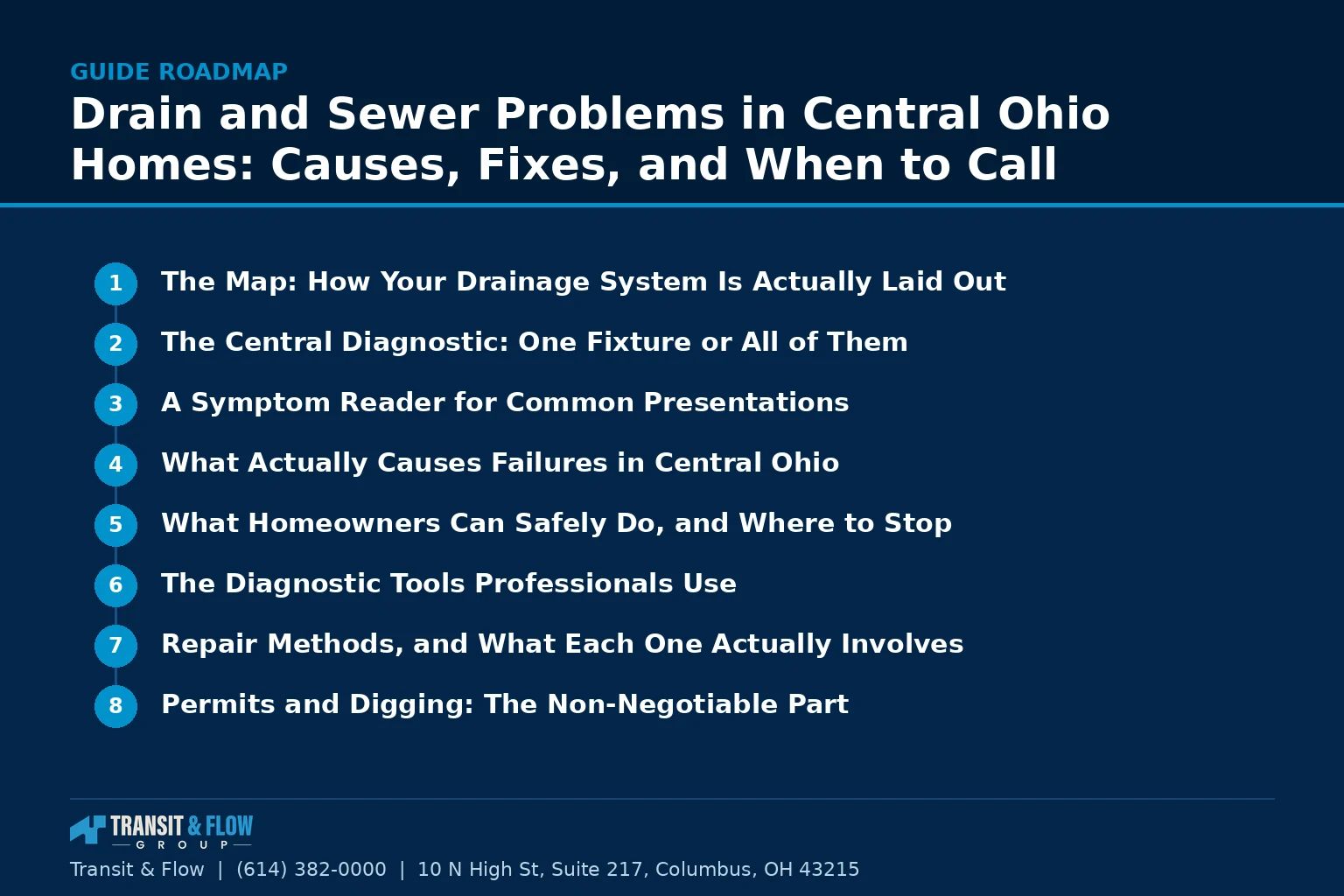
- The Map: How Your Drainage System Is Actually Laid Out
- The Central Diagnostic: One Fixture or All of Them
- A Symptom Reader for Common Presentations
- What Actually Causes Failures in Central Ohio
- What Homeowners Can Safely Do, and Where to Stop
- The Diagnostic Tools Professionals Use
- Repair Methods, and What Each One Actually Involves
- Permits and Digging: The Non-Negotiable Part
- Prevention That Actually Works
- What to Confirm Before You Hire
- What a Sewer Repair Project Actually Looks Like, Day by Day
- Special Cases Worth Knowing About
- A Glossary Worth Keeping
- Where Transit & Flow Group Fits
- Frequently Asked Questions
This guide is the anchor for our drain and sewer series. It covers how a residential drainage system is actually laid out, how to tell a branch problem from a main line problem, what causes failures in Central Ohio specifically, what each repair method involves, how to prevent the expensive ones, and how to hire for this work without getting sold a sewer replacement you did not need. It is long because the subject is genuinely layered, and because the most common way homeowners lose money here is by skipping straight to a quote.
Transit & Flow Group coordinates projects and partners with properly licensed and insured specialty contractors when licensing is required.
The Map: How Your Drainage System Is Actually Laid Out
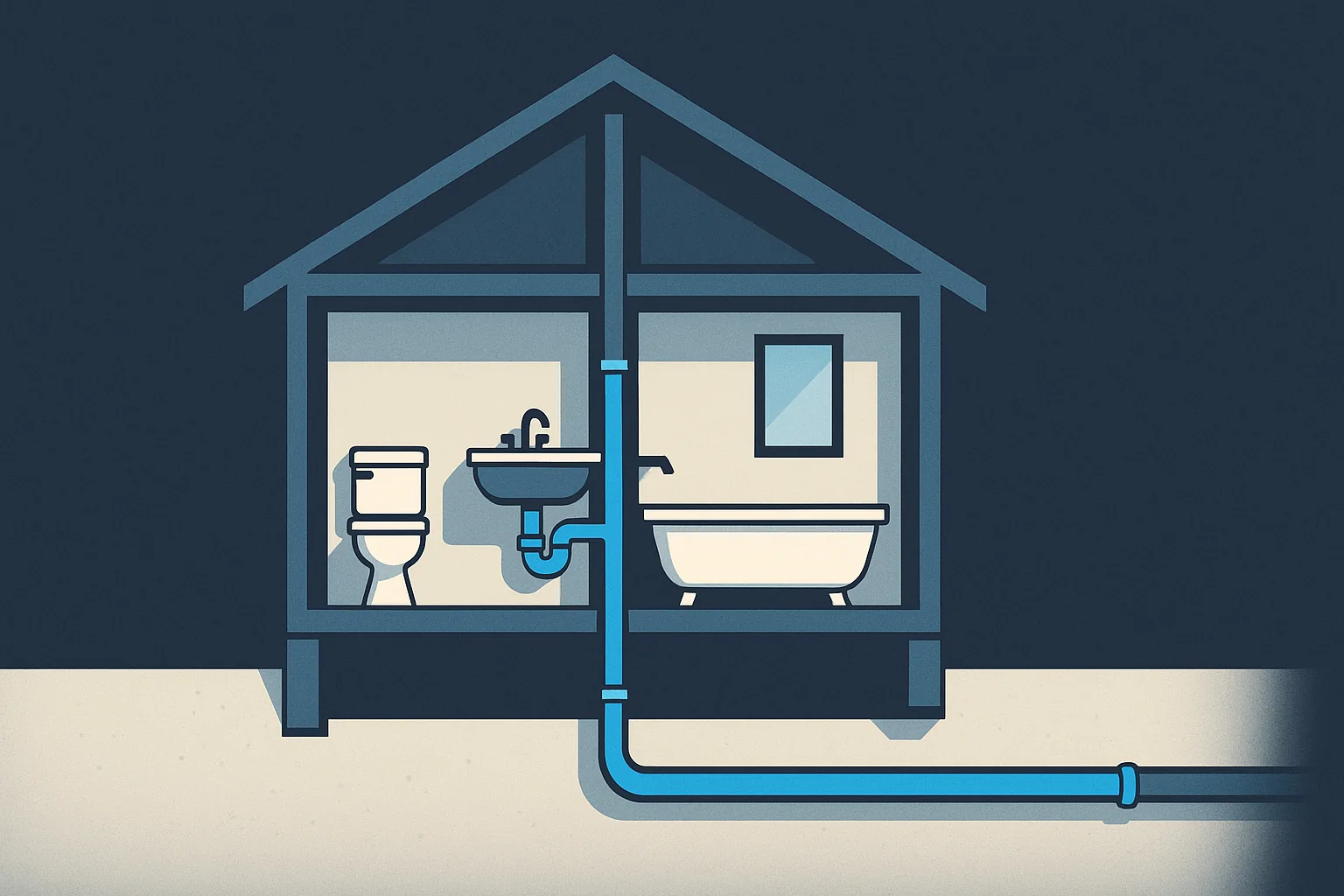
Every diagnosis in this guide depends on one picture, so build it first. Your drainage system is a tree, and water flows downhill through it by gravity alone. There is no pump in a typical Central Ohio home unless you have a basement bathroom or an ejector pit.
At the leaves of the tree are fixtures: sinks, tubs, showers, toilets, the washing machine standpipe, the dishwasher. Each connects to a trap, the U-shaped bend that holds a plug of water and blocks sewer gas from entering the house. Traps are why a floor drain that has dried out smells, and why pouring a cup of water down an unused drain fixes that smell.
Traps feed branch lines, the smaller horizontal pipes running inside walls and under floors. Branch lines feed the stack, the large vertical pipe that runs the height of the house. The stack continues up through the roof as the vent, which is not decorative: it lets air into the system behind draining water so the water does not siphon traps dry as it goes. A blocked vent produces glugging drains and, in bad cases, sewer odor in the house.
Below the lowest floor, the stack turns horizontal and becomes the building drain, which exits the foundation and becomes the sewer lateral, sometimes called the service line. That lateral runs under your yard to the municipal main, usually in the street. It is typically the longest, deepest, oldest, and least accessible pipe you own, and in most jurisdictions the portion on your property is your financial responsibility. Confirm the exact ownership boundary with your local utility, because it varies and it is the difference between a repair you pay for and one you do not.
Somewhere near where the drain exits the house, there should be a cleanout: a capped access fitting, often a few inches across, in the basement wall or floor, or outside near the foundation. Find yours today, before you need it. A technician who has a cleanout can work from it. A technician without one may have to pull a toilet or open the line, which adds time and cost to an emergency call.
The Central Diagnostic: One Fixture or All of Them
This is the fork that everything else hangs on. Run the test deliberately rather than guessing.
- Fill and drain the fixture that is misbehaving. Watch the speed and listen for air noise.
- Run a fixture on a different branch, ideally a different room, and watch it too.
- Run water in an upstairs sink and watch the lowest drain in the house, usually a basement floor drain or a first floor tub.
- Flush a toilet and immediately watch nearby tubs and showers for rising water or bubbles.
- Run the washing machine through a drain cycle, which discharges a large volume fast, and watch the lowest drain again.
Now read the result. If only the original fixture is slow and everything else drains normally, the restriction is local to that fixture or its branch. That is the good outcome, and it is usually hair, soap scum, grease, or a fouled pop-up assembly within a few feet of the drain opening.
If multiple fixtures on different branches misbehave, or if using one fixture causes a reaction at another, the restriction is downstream of where those branches join. That points at the stack, the building drain, or the lateral. Two symptoms are especially loud: a toilet flush that pushes water up into a nearby tub, and any water appearing at a basement floor drain. Both mean the system has backed up far enough to find the lowest opening in the house, and that opening is inside your home.
The correct response to a main line indication is to stop adding water. No laundry, no dishwasher, minimal flushing. Every gallon you send down a blocked main has to go somewhere, and the lowest fixture in the house is the place it chooses. This one behavior change is the difference between a service call and a cleanup.
A Symptom Reader for Common Presentations
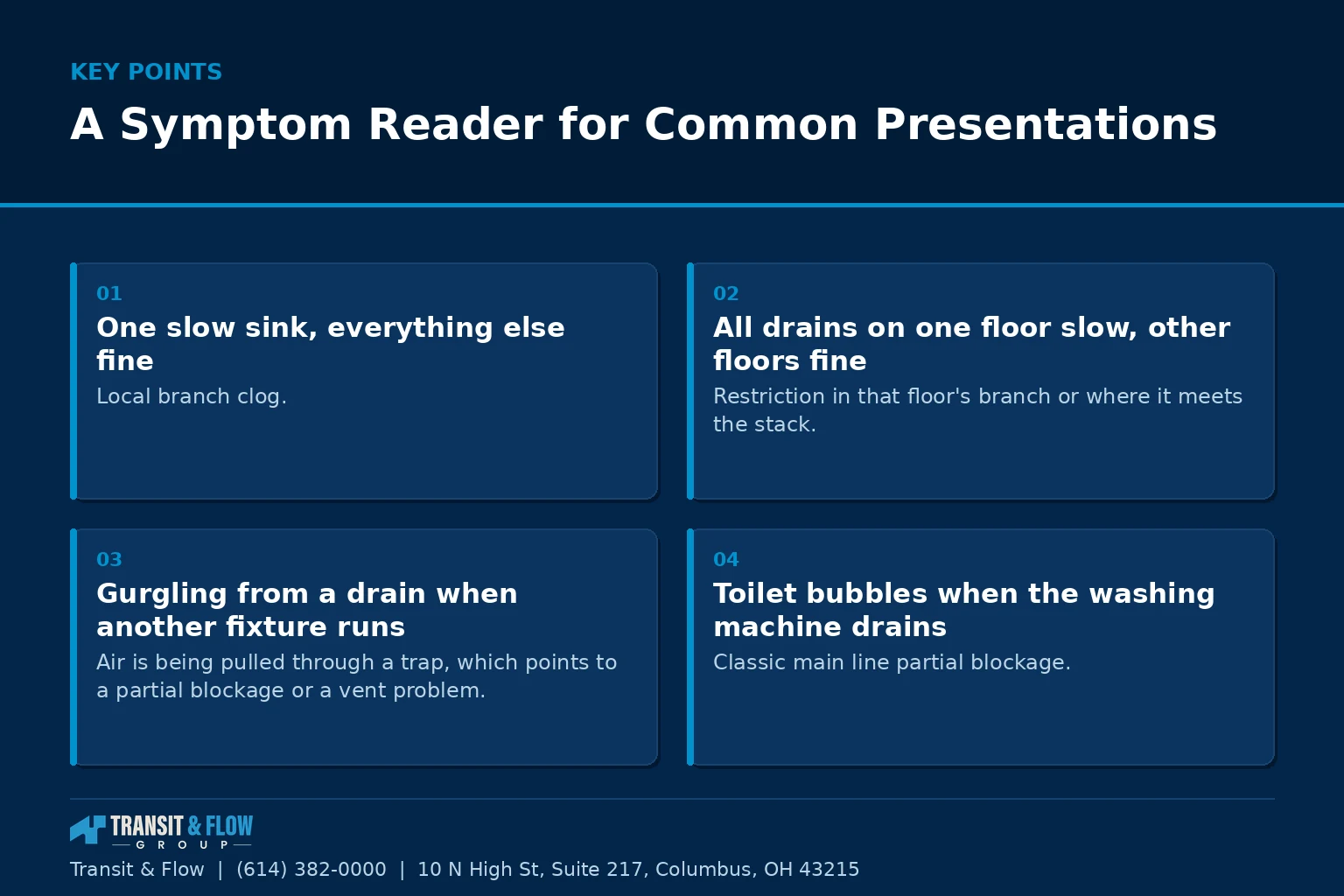
- One slow sink, everything else fine. Local branch clog. Homeowner-addressable in most cases.
- All drains on one floor slow, other floors fine. Restriction in that floor’s branch or where it meets the stack.
- Gurgling from a drain when another fixture runs. Air is being pulled through a trap, which points to a partial blockage or a vent problem.
- Toilet bubbles when the washing machine drains. Classic main line partial blockage. The washer’s fast discharge exposes a restriction that gentler flows hide.
- Water at the basement floor drain. Main line blockage or a municipal surcharge condition. Treat as urgent and stop water use.
- Sewer odor with normal drainage. Usually a dry trap or a vent issue rather than a blockage. Check unused floor drains and guest bathrooms first.
- Recurring clogs at the same fixture every few months. Something structural is wrong: a belly, a partial root intrusion, an offset joint, or a fixture drain that was installed with inadequate slope. Repeat clearing without a camera is treating a symptom.
- Unusually green, fast-growing grass in a line over the yard. Possible lateral leak feeding the soil. Worth investigating even without an interior symptom.
What Actually Causes Failures in Central Ohio
Tree Roots
Roots are the dominant cause of lateral failure in established Central Ohio neighborhoods, and the mechanism is not what most people assume. Roots do not break into sound pipe. They find existing openings: joints in clay tile, cracks, failed seals. Sewer lines carry warm, nutrient-rich water, so a root that reaches a joint gets rewarded, thickens, and over years fills the pipe with a fibrous mass that catches everything else moving past it. Neighborhoods platted before the 1970s often combine mature trees with vitrified clay or Orangeburg lateral material, which is precisely the pairing that produces root intrusion.
Grease and Soap Accumulation
Cooking fats go down the drain as warm liquid and cool into a solid coating on the pipe wall within a few feet. Every subsequent load of grease, soap, and food particles adheres to that coating. This is a slow narrowing, not a sudden plug, which is why the symptom is gradual slowing rather than a hard stop. Running hot water afterward does not solve it; it just moves the cooling point further down the line.
Wipes and Non-Flushables
Products labeled flushable clear the toilet. They do not break down like toilet paper, and in a line that already has a root mass or a grease layer they are the material that turns a partial restriction into a full blockage. Municipal utilities across the country have documented the cost of this at the treatment end. In a home, the practical rule is simple: toilet paper and human waste only, regardless of label.
Pipe Material and Age
Material tells you the failure mode to expect. Vitrified clay tile, common in older Central Ohio housing stock, is durable but installed in short sections with joints at every connection, and those joints are root entry points. Cast iron corrodes from the inside over decades, roughening and narrowing until the interior diameter is a fraction of its original. Orangeburg, a bituminized fiber pipe used in some mid-century construction, deforms and collapses with age and is essentially a replacement candidate wherever it is found. Modern PVC is jointed with solvent welds and is the most trouble-free of the group. Ask what you have, and if nobody knows, a camera inspection answers it in twenty minutes.
Bellies, Offsets, and Settlement
A drainage line works because it slopes. When a section of ground under a lateral settles, the pipe sags into a low spot, called a belly, where water and solids stand instead of flowing. Bellies produce exactly the recurring-clog pattern described above. Offsets happen when adjacent sections shift out of alignment at a joint, leaving a lip that catches debris. Neither is fixable by clearing. Both are visible on camera, which is why the camera matters more than the auger for a repeat problem.
Stormwater and Municipal Surcharge
In heavy rain, some older systems experience surcharge, where the municipal main fills faster than it can drain and pressure backs toward connected properties. If your backups correlate with storms rather than with household water use, that is a different problem than a clog, and the conversation is with your municipal utility about their system and about backwater protection for yours. Do not let anyone sell you a lateral replacement for a rain-correlated backup without ruling this out first.
What Homeowners Can Safely Do, and Where to Stop
- Reasonable: removing and cleaning a sink pop-up assembly or a tub drain strainer, which resolves a surprising share of slow bathroom drains.
- Reasonable: a small hand auger, sometimes called a drum snake, on a single slow branch, run gently and withdrawn slowly.
- Reasonable: a plunger on a toilet, with the overflow of a sink or tub blocked if you are plunging a fixture that shares a branch.
- Reasonable: pouring water into unused floor drains and guest bathroom traps monthly to keep them sealed.
- Stop: chemical drain openers. They are caustic, they frequently fail to clear the actual restriction, and they leave a technician working in a line full of chemicals. Tell any technician immediately if they have been used.
- Stop: renting a powered drain machine for a main line without training. These machines can bind, injure the operator, and damage compromised pipe.
- Stop: any situation with sewage on the floor. That is a contamination event with its own remediation and safety requirements, not a plumbing task.
- Stop: any digging in the yard. Excavation near a lateral requires utility locating first, which is covered below and is a legal requirement in Ohio.
The Diagnostic Tools Professionals Use
Understanding the toolkit lets you judge whether a proposal is diagnosis-driven or catalog-driven.
- Cable machine, also called a snake or auger. A rotating cable with a cutting head that bores through a blockage. Fast and effective for restoring flow. Its limitation is that it opens a channel through an obstruction rather than removing the obstruction, which is why root problems cleared by cable tend to return.
- Hydro jetting. High-pressure water through a specialized nozzle that scours the pipe wall and flushes debris downstream. Far more thorough than cabling for grease and scale. It requires an assessment of pipe condition first, because pressure is not appropriate in a line that is already compromised.
- Camera inspection. A push camera on a flexible rod, fed from a cleanout, that records the interior of the line. This is the tool that converts guessing into knowing. It shows material, condition, root locations, bellies, offsets, and distance measured from the entry point.
- Locator. A transmitter in the camera head plus a receiver above ground, used to mark the exact position and depth of a problem in your yard. Essential before any excavation, and the reason a camera report should come with marked locations rather than a vague description.
- Smoke or dye testing. Used to trace connections and find where a line goes when the layout is unknown or when improper connections are suspected.
The pattern to trust is diagnosis before proposal. A technician who cables a line, restores flow, and then recommends a full lateral replacement without putting a camera down it has skipped the step that would justify the recommendation. Ask for the video. It is your line.
Repair Methods, and What Each One Actually Involves
- Clearing. Cable or jet to restore flow. The right answer for a genuine one-time blockage. The wrong answer as a repeated annual event.
- Spot repair. Excavate a limited section, replace the failed portion, backfill. Appropriate when the camera shows one defect in an otherwise sound line. Involves yard disruption limited to that area.
- Cured-in-place pipe lining, often called CIPP. A resin-saturated liner is pulled or inverted into the existing pipe and cured, forming a new pipe inside the old one. Trenchless, so the yard is largely undisturbed. Requires the host pipe to be structurally continuous, which means a collapsed or badly offset line may not qualify. Slightly reduces interior diameter, which is usually immaterial.
- Pipe bursting. A bursting head is pulled through the old pipe, fracturing it outward while simultaneously pulling new pipe into place. Trenchless apart from access pits at each end. Suits lines that are collapsed or too deteriorated to line, and can accommodate an increase in diameter. Requires clearance from other buried utilities along the path.
- Full open-cut replacement. Trenching the length of the lateral and installing new pipe. The most disruptive and generally the most expensive path, and still the correct answer when the line’s alignment is wrong, when depth or obstructions defeat trenchless methods, or when the run must be rerouted.
- Backwater valve installation. A one-way valve on the building drain that closes against reverse flow. Protective rather than corrective, and specifically relevant to surcharge-driven backups. It requires proper placement and periodic maintenance access.
On cost: we do not publish flat prices for this work, and neither should anyone else. Sewer pricing is driven by length, depth, pipe material, soil conditions, access, permit requirements, restoration of driveways or landscaping, and whether the work is trenchless or open cut. Any figure quoted before a camera inspection and a locate is a marketing number, not an estimate. Get the diagnosis, then get written scopes from more than one qualified contractor, and compare the scopes rather than the totals.
Permits and Digging: The Non-Negotiable Part
Sewer work is permitted work in essentially every Central Ohio jurisdiction, and excavation triggers a separate legal requirement. Ohio law requires notice to the protection service before excavating. The Ohio Revised Code sets the window precisely: notice must be given “at least two working days, not including the day of the notification, but not more than sixteen calendar days before commencing excavation” (ORC 3781.28(A)). Working days exclude Saturdays, Sundays, and legal holidays.
This is your contractor’s responsibility to handle, and it is also a competence check you can perform in one question: ask for the date the locate ticket was called in and for the ticket number. A contractor who plans to dig tomorrow on a ticket called this morning is telling you something about how they operate. Our dedicated guide on this covers the process in full.
Prevention That Actually Works
- Locate and label your cleanout. Ten minutes now, meaningful savings during an emergency call.
- Get a baseline camera inspection if your home predates 1980, if you have mature trees near the lateral run, or if you have just bought the property. Knowing the condition of the line changes every decision that follows.
- Keep grease out entirely. Cool it, container it, trash it. This is the highest-leverage daily habit in the entire system.
- Toilet paper and waste only. No wipes regardless of packaging claims, no cotton products, no dental floss.
- Screen every shower and tub drain. Hair is the single most common branch clog material and a two dollar screen eliminates most of it.
- Water unused traps monthly. Prevents the sewer odor problem entirely.
- Plant with the lateral in mind. Know where the run is before you plant anything with an aggressive root system near it.
- Treat the second identical clog as a signal. The first is an event. The second is a diagnosis request.
What to Confirm Before You Hire
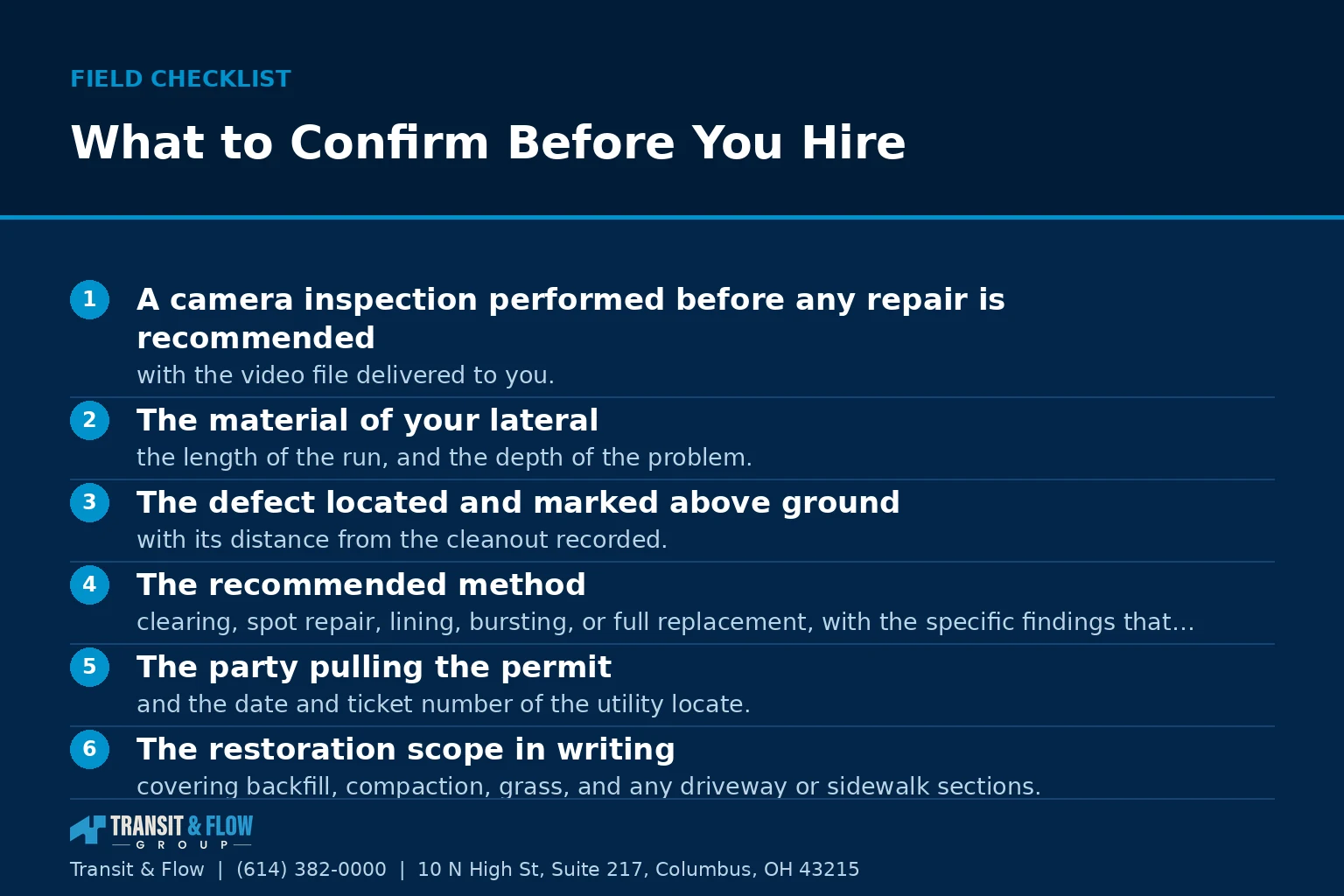
- A camera inspection performed before any repair is recommended, with the video file delivered to you.
- The material of your lateral, the length of the run, and the depth of the problem.
- The defect located and marked above ground, with its distance from the cleanout recorded.
- The recommended method, clearing, spot repair, lining, bursting, or full replacement, with the specific findings that rule out the less invasive options.
- The party pulling the permit, and the date and ticket number of the utility locate.
- The restoration scope in writing, covering backfill, compaction, grass, and any driveway or sidewalk sections.
- The warranty terms, the duration, and whether coverage survives a sale of the house.
- A certificate of insurance and local references for this specific type of work.
A contractor who addresses all eight in writing has done the diagnostic work. One who responds to the first item with a price has not.
What a Sewer Repair Project Actually Looks Like, Day by Day
Homeowners consistently underestimate the sequencing of this work and overestimate how long the disruptive part lasts. Knowing the shape of the project lets you plan around it and lets you tell whether a contractor’s schedule is realistic.
- Inspection and locate. A camera goes down the line from the cleanout, the defect is found and its distance recorded, and a locator marks the position and depth on the ground above. This is usually a single visit of an hour or two. Everything downstream depends on this step being done properly, which is why it is worth insisting on it even when a contractor offers to skip straight to a proposal.
- Scope, permit, and utility notice. The contractor writes a scope naming the method, submits the permit application to the correct jurisdiction, and calls in the utility locate. Ohio law sets the waiting period at a minimum of two working days after notification, so this stage has a floor built into it that nobody can compress. Expect several days to a couple of weeks depending on the jurisdiction’s permit turnaround.
- Utility marking. Member utilities come out and paint or flag their buried facilities in the work area. You will see colored paint appear in your yard. Those marks are the boundary conditions for the dig, and they occasionally change the plan, for example when a gas service crosses the intended path of a pipe bursting run.
- Site preparation. Access is established, landscaping in the path is removed or protected, and equipment is staged. On a trenchless job this footprint is small, typically access pits at each end. On an open cut it is the length of the run.
- The work itself. This is the shortest phase and the one people expect to be the longest. A lining or bursting job on a residential lateral is often a single day. A spot repair can be less. A full open-cut replacement of a long or deep run is the case that stretches to several days.
- Inspection and closure. The jurisdiction inspects the work before it is covered. This is the step that protects you, and it is the reason a contractor who wants to backfill before inspection should be stopped immediately.
- Backfill, compaction, and restoration. Soil goes back in lifts with compaction, because dumping it loosely produces the settlement that creates the next belly. Surface restoration follows: grass, driveway or sidewalk sections, landscaping. Get the restoration scope in writing before work starts, because this is the most common gap between what a homeowner expected and what the contract said.
- Documentation handoff. Closed permit, post-repair camera video confirming the finished condition, warranty terms, and the as-built location of the new line. Keep all of it with your home records. The post-repair video in particular is the proof that what you paid for is what was installed.
Two expectations worth setting now. First, the calendar is dominated by permitting and utility notice, not by digging, so a contractor promising to start tomorrow on a permitted excavation is either not permitting it or not noticing it, and both are problems. Second, restoration always looks worse before it looks better. Fresh backfill settles, and reputable contractors return to top-dress. Ask up front whether a return visit for settlement is included, because it should be.
Special Cases Worth Knowing About
- Shared or common laterals. Some older properties, particularly in dense pre-war neighborhoods, share a lateral run with a neighbor. This changes both the diagnosis and the cost responsibility, and it is discovered on camera. If your line joins another before reaching the main, get the ownership question answered in writing before anyone digs.
- Basement bathrooms and ejector pits. A fixture below the level of the building drain cannot drain by gravity, so it discharges into a sealed pit with a pump. Pump failures present as a basement backup and look like a main line problem but are not. If your basement bathroom is the only thing backing up, check the ejector first.
- Sump pumps discharging into the sanitary sewer. This is prohibited in most jurisdictions because it loads the sanitary system with stormwater, and in older homes it is sometimes found during an inspection. It is a correction you will be asked to make, and it is worth doing regardless because it is a direct contributor to surcharge conditions.
- Recently purchased homes. A standard home inspection does not include a sewer camera unless it is specifically ordered. If you bought without one, the condition of your lateral is currently unknown, and a baseline inspection is the cheapest information you can buy about the most expensive pipe you own.
- Occupied rental or multi-family property. Water use cannot be controlled by a single household, which makes the “stop using water” instruction unenforceable during a main line event. Plan for tenant communication as part of the project, not as an afterthought.
A Glossary Worth Keeping
- Trap. The U-bend at a fixture that holds water and blocks sewer gas.
- Vent. The pipe admitting air behind draining water so traps are not siphoned.
- Stack. The main vertical drain running the height of the house.
- Building drain. The horizontal line below the lowest floor carrying everything to the exterior wall.
- Lateral or service line. The buried run from the house to the municipal main.
- Cleanout. A capped access point for inserting a cable or camera.
- Belly. A sag in the line where water stands instead of flowing.
- Offset. Misalignment at a joint that catches debris.
- Surcharge. A condition where the municipal main is full and pressure backs toward properties.
- Backwater valve. A one-way valve that closes against reverse flow into the house.
- CIPP. Cured-in-place pipe, a resin liner cured inside the existing pipe.
- Pipe bursting. A trenchless method that fractures the old pipe outward while pulling new pipe through.
Where Transit & Flow Group Fits
Drain and sewer work sits at the intersection of plumbing, excavation, permitting, and sometimes restoration, and that intersection is where homeowners get handed between companies. Transit & Flow Group coordinates drain and sewer projects across Columbus and Central Ohio as one scope with one point of contact, working alongside our broader plumbing services when a problem crosses that line. Our standard is diagnosis before proposal: camera first, located and marked, video delivered to you, then a written scope that names the method and says why the less invasive options were ruled out. If your drains are telling you something, request an assessment and start with the camera.
Frequently Asked Questions
How do I tell a local clog from a main line problem?
Run a deliberate test rather than guessing. Drain the fixture that is misbehaving, then run a fixture on a different branch in a different room, then run water upstairs while watching the lowest drain in the house. If only the original fixture is slow and everything else drains normally, the restriction is local to that fixture or its branch. If multiple fixtures on different branches react, or if using one fixture causes a reaction at another, the restriction is downstream of where those branches join, which points at the stack, the building drain, or the lateral.
Water came up at my basement floor drain. What should I do first?
Stop adding water. No laundry, no dishwasher, minimal flushing. Water at the lowest opening in the house means the system has backed up far enough to find that opening, and every additional gallon you send down a blocked main has to go somewhere. That single behavior change is often the difference between a service call and a cleanup. If sewage is on the floor, that is a contamination event with its own remediation and safety requirements rather than a plumbing task, and it should be handled by qualified professionals.
Why do the same drains keep clogging every few months?
Recurring clogs at the same location usually mean something structural rather than something that keeps accumulating. The common causes are a belly where the line sags and water stands, a partial root intrusion at a joint, an offset where adjacent sections shifted out of alignment, or a fixture drain installed with inadequate slope. None of these is fixed by clearing, and repeat cabling is treating the symptom. All of them are visible on a camera inspection, which is why the camera matters more than the auger once a problem repeats.
Why are tree roots such a common cause of sewer failure here?
Roots do not break into sound pipe. They find existing openings, such as joints in clay tile, cracks, or failed seals, and sewer lines carry warm nutrient-rich water, so a root that reaches a joint is rewarded and thickens over years into a fibrous mass that catches everything moving past it. Central Ohio neighborhoods platted before the 1970s often combine mature trees with vitrified clay or Orangeburg lateral material, which is exactly the pairing that produces intrusion. A camera inspection identifies both the material and the root locations.
Is it safe to use a chemical drain opener or rent a powered drain machine?
Neither belongs in a homeowner’s toolkit. Chemical openers are caustic, they frequently fail to clear the actual restriction, and they leave a technician working in a line full of chemicals, so tell any technician immediately if they have been used. A rented powered drain machine on a main line can bind, injure the operator, and damage pipe that is already compromised. What is reasonable is cleaning a sink pop-up or tub strainer, gentle use of a small hand auger on a single slow branch, plunging a toilet, and pouring water into unused traps monthly.
How long does a sewer repair project actually take?
The calendar is dominated by permitting and utility notice, not by digging. Inspection and locate is usually one visit of an hour or two. Scope, permit, and utility notice can run several days to a couple of weeks, and Ohio law sets a floor on the notice period before excavation that nobody can compress. The work itself is the shortest phase, often a single day for a lining or bursting job on a residential lateral, with a long or deep open-cut replacement being the case that stretches to several days. A contractor promising to start tomorrow on a permitted excavation is either not permitting it or not noticing it.
Sources
- Ohio Revised Code 3781.28, excavation notice requirements
- Ohio Revised Code 3781.25, definitions including working days
- U.S. Environmental Protection Agency, sanitary sewer overflows and collection system causes
- City of Columbus, Get a Permit, permit application channels
About This Guide
Written and edited by Micheal Parker, founder of Transit & Flow Group. Published September 9, 2026. This guide is checked against the agency and code sources listed above, and it is revised when those sources change.
General contractor of record. Micheal Parker holds City of Columbus General Contractor Registration G12064, issued by the Columbus Department of Building and Zoning Services under Transit & Flow LLC and valid through June 30, 2027. Trade work that falls outside the scope of that registration is performed by licensed trade partners, and the responsible license holder is identified before work begins.
Transit & Flow Group, home and commercial services for Columbus and the surrounding Central Ohio communities. Phone (614) 382-0000. Email solutions@transitflowgroup.com. 10 N High St, Suite 217, Columbus, OH 43215. Contact our team or review the communities we serve.
