


Every property manager in Central Ohio knows the drill: one contractor for HVAC, another for plumbing, a third for electrical, and a fourth on speed dial for the repairs nobody else will touch. That fragmented approach quietly drains time, money, and accountability. This is exactly why vendor consolidation property management Central Ohio owners now pursue has become one of the smartest operational moves a portfolio can make, and why Transit & Flow built a single, multi-trade partnership model around it.
In This Guide
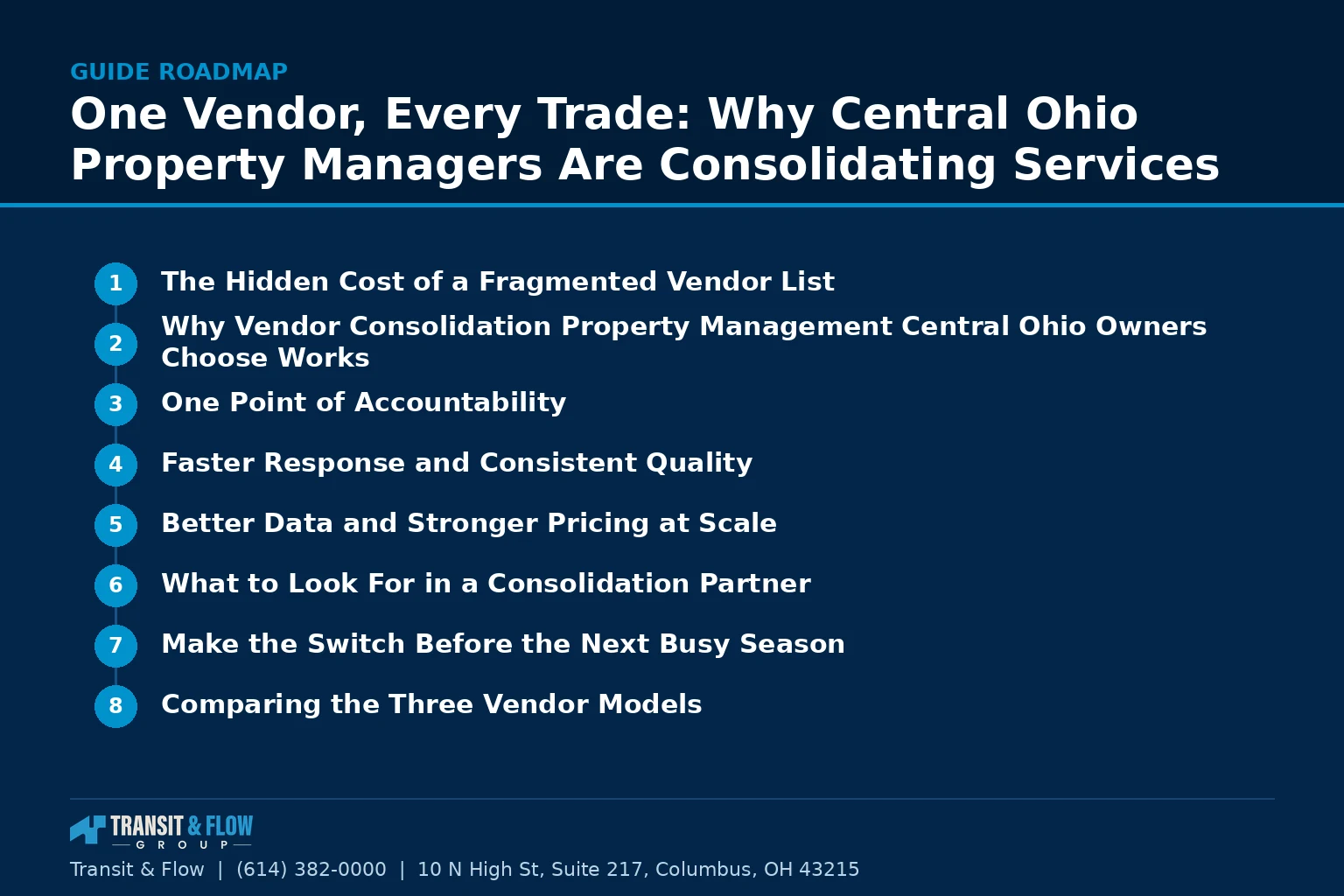
- The Hidden Cost of a Fragmented Vendor List
- Why Vendor Consolidation Property Management Central Ohio Owners Choose Works
- One Point of Accountability
- Faster Response and Consistent Quality
- Better Data and Stronger Pricing at Scale
- What to Look For in a Consolidation Partner
- Make the Switch Before the Next Busy Season
- Comparing the Three Vendor Models
- Choosing Your Consolidation Path
- What to Verify Before Signing
- Sources
- Related Transit & Flow Services
- Frequently Asked Questions
From Dublin to Gahanna to Grove City, the managers who consolidate are not just simplifying their contact list. They are protecting net operating income, shortening response times, and turning a scattered vendor roster into one accountable relationship. Here is the operational and financial case for making that shift before the next busy season.
The Hidden Cost of a Fragmented Vendor List
When you juggle a dozen specialty contractors, the real expense is rarely the invoice line item. It is the overhead around it. Every vendor means a separate onboarding process, a separate insurance certificate to chase, a separate scheduling call, and a separate person to hold accountable when something slips. Multiply that across a portfolio of properties and the administrative drag becomes a full-time job.
Worse, fragmentation creates finger-pointing. When a water stain appears on a ceiling, the plumber blames the roofer, the roofer blames the HVAC tech, and your team spends a week coordinating diagnoses that a single multi-trade contractor in Ohio could have resolved in one visit. The cost of that delay, in tenant frustration and secondary damage, dwarfs any savings from shopping each trade separately.

Why Vendor Consolidation Property Management Central Ohio Owners Choose Works
Consolidating to one accountable partner changes the math in your favor. Instead of managing many relationships, you manage one. Instead of reconciling stacks of invoices, you get clean, consistent billing. And instead of hoping the right specialist is available, you call a single team that handles HVAC, plumbing, electrical, and general repairs under one roof. For property managers across Columbus, Westerville, and Hilliard, that consolidation is the difference between reacting to problems and controlling them.
The single vendor facilities Columbus model also produces something fragmented rosters never can: continuity. The same partner learns your buildings, your equipment history, and your standards. That institutional knowledge means faster diagnoses, fewer repeat visits, and maintenance decisions made with the whole property in mind rather than one narrow trade.
One Point of Accountability
Accountability is the quiet superpower of consolidation. With Transit & Flow, there is one number to call and one team that owns the outcome. No more triangulating between contractors who each see only a slice of the problem. When a rooftop unit fails and it turns out to be an electrical fault feeding a mechanical issue, one multi trade contractor in Ohio diagnoses the full picture and fixes it, rather than scheduling three separate trucks across three separate weeks.
That single line of responsibility also protects your reputation with owners and tenants. When you can promise a resolution and know a committed partner stands behind it, you deliver on that promise consistently. Reliability compounds, and it is far easier to build with one partner than with fifteen.
Faster Response and Consistent Quality
Speed is where consolidation pays off most visibly. A dedicated multi-trade partner already knows your portfolio, so dispatching help does not require re-explaining the property, the access codes, or the history of that finicky boiler. Priority scheduling for consolidated clients means your emergencies move to the front of the line, and coordinated crews knock out several work orders in a single visit.
Quality also stabilizes. When every trade runs through one organization with shared standards, training, and documentation, you stop gambling on whichever subcontractor happened to be available. The consistency shows up in cleaner work, fewer callbacks, and a maintenance record you can actually stand behind during owner reviews and lease-up season.
Better Data and Stronger Pricing at Scale
Consolidation turns maintenance from a black box into a managed program. One partner means one reporting stream: every work order, every asset serviced, every dollar spent, captured in a format you can analyze. That visibility lets you spot failing equipment before it fails again, plan capital replacements with real numbers, and defend your budget with evidence rather than guesswork.
Scale also earns leverage. When you route the full breadth of your property management services through a single trusted partner, you unlock volume-based pricing that no single-trade specialist can match. Consider what consolidation delivers across a portfolio:
- Fewer invoices and dramatically less administrative overhead
- Volume pricing across HVAC, plumbing, electrical, and repairs
- Consolidated reporting that supports smarter capital planning
- Priority response backed by knowledge of your specific buildings
- One insurance and compliance relationship to verify and maintain
What to Look For in a Consolidation Partner
Not every provider that claims to do it all can actually deliver. The right partner staffs genuine expertise in each trade rather than subcontracting the work and marking it up. Look for licensed, insured, in-house technicians, transparent pricing, documented response-time commitments, and a service footprint that matches your portfolio. If you operate in New Albany, Powell, Upper Arlington, Worthington, or Pickerington, confirm the partner truly covers those markets rather than stretching thin. Done right, vendor consolidation property management Central Ohio teams adopt should feel less like a purchasing decision and more like adding a reliable extension of your own staff.
Transit & Flow was built specifically for this model: one confident, operationally excellent team accountable across every trade, serving property managers and facilities directors throughout Central Ohio. You can review the full breadth of our coverage on our service areas page, and explore practical maintenance strategy in our related guides. The goal is simple: fewer headaches, better data, and a single partner who treats your portfolio like an asset worth protecting.
Make the Switch Before the Next Busy Season
Vendor consolidation property management Central Ohio managers embrace is not about doing less. It is about achieving more with one accountable relationship that scales alongside your portfolio. The managers who consolidate now enter turnover and winter-prep season with faster response, cleaner reporting, and stronger pricing already locked in. Get an instant estimate on the Transit & Flow homepage or call our team at (614) 382-0000 to see how one vendor across every trade can protect your NOI and simplify your operations for good.
Comparing the Three Vendor Models
Most Central Ohio portfolios sit in one of three arrangements.
| Dimension | Full roster of specialists | Partial consolidation | Single accountable partner |
|---|---|---|---|
| Vendor administration | Onboarding, insurance verification, and billing repeated for every trade | Reduced, but still duplicated across the trades left outside | One onboarding, one compliance file, one billing stream |
| Diagnosis of cross-trade failures | Each vendor sees only its slice, so the cause gets negotiated | Better within the consolidated group, unresolved at the seams | One team owns the full picture and the outcome |
| Response time | Depends on each vendor’s queue and familiarity with the building | Mixed, and unpredictable during peak season | Priority scheduling backed by knowledge of your specific assets |
| Reporting and capital planning | Fragmented records that resist analysis | Partial history with gaps at the handoffs | One reporting stream covering every work order and asset |
| Pricing leverage | Trade by trade, with no volume position | Limited leverage on the consolidated share | Volume pricing across the full breadth of work |
Choosing Your Consolidation Path
Option A is phased consolidation. You move the highest-volume trades first, usually HVAC and general repairs, and leave the specialty work in place for a cycle. The advantage is a low-disruption transition with a clear before-and-after on the trades that generate the most work orders. The cost is that the seams remain.
Option B is a full transition at one contract cycle. Every trade moves to a single accountable partner at the same time, with one onboarding, one compliance verification, and one service history handoff. It demands more coordination in one window, so it belongs in a low-volume stretch rather than turnover season.
Our recommendation for most Central Ohio portfolios is Option B, executed in the shoulder season. Single-point accountability, unified reporting, and volume pricing only arrive once the seams are gone. Phase the move only when long specialty contracts cannot be exited without penalty, and set the full transition to land when those agreements expire.
What to Verify Before Signing
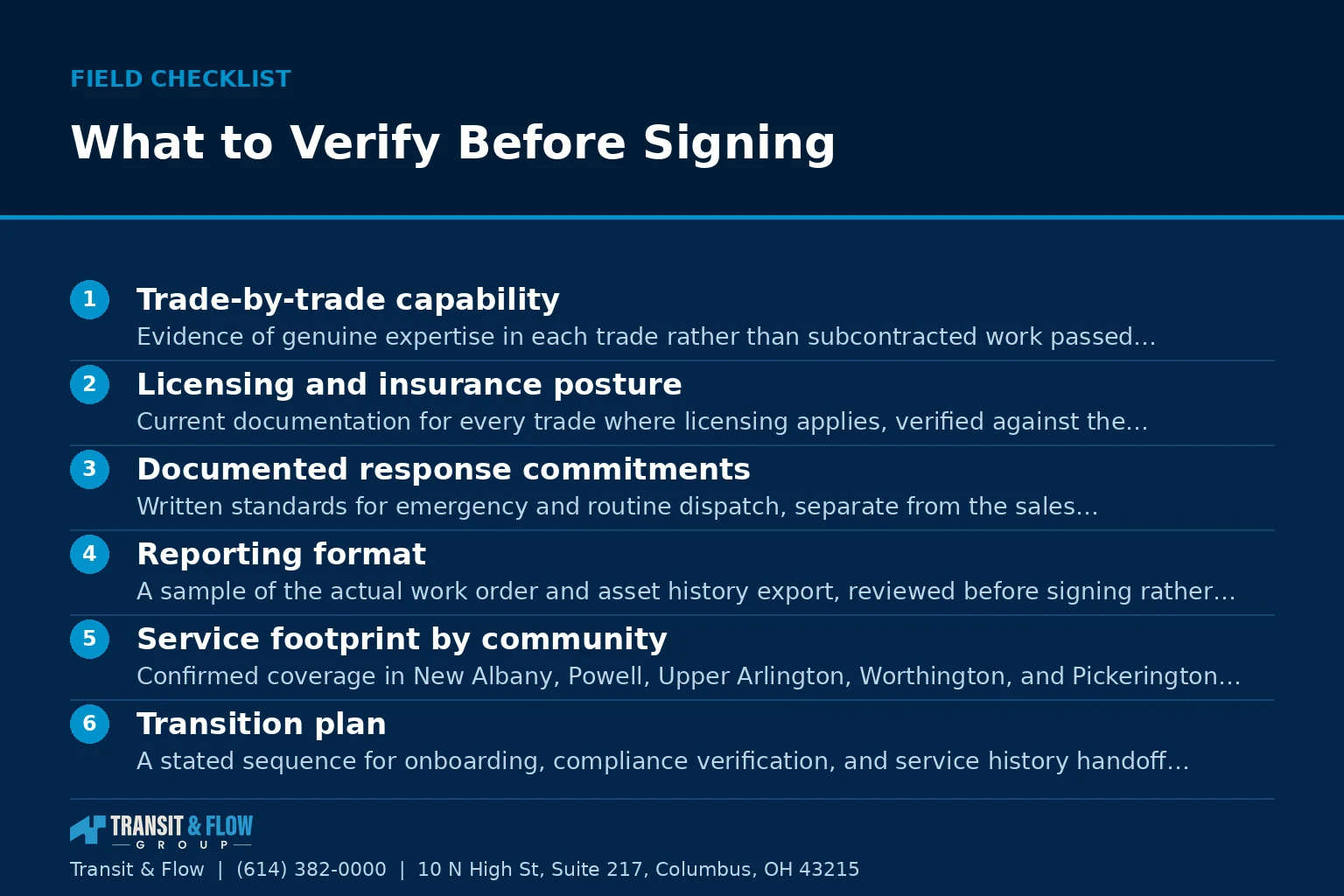
- Trade-by-trade capability. Evidence of genuine expertise in each trade rather than subcontracted work passed through with a markup.
- Licensing and insurance posture. Current documentation for every trade where licensing applies, verified against the jurisdictions your properties sit in.
- Documented response commitments. Written standards for emergency and routine dispatch, separate from the sales conversation.
- Reporting format. A sample of the actual work order and asset history export, reviewed before signing rather than after the first quarter.
- Service footprint by community. Confirmed coverage in New Albany, Powell, Upper Arlington, Worthington, and Pickerington rather than a general claim about Central Ohio.
- Transition plan. A stated sequence for onboarding, compliance verification, and service history handoff, with named owners on both sides.
Sources
- Ohio Department of Commerce, Division of Industrial Compliance, licensing and code enforcement
- Electrical Safety Foundation International, home electrical safety
- U.S. Department of Energy, Energy Saver home energy guidance
Related Transit & Flow Services
Every service below is delivered by the same accountable Transit & Flow team, so one call covers the whole property.
Serving Columbus and every community across Central Ohio. See the full service areas map, or get an instant estimate on the Transit & Flow homepage.
Frequently Asked Questions
What does vendor consolidation actually mean for a property portfolio?
It means routing the trades you already use through one accountable partner instead of a separate contractor for each specialty. The work still gets done by qualified people in each trade, but onboarding, insurance verification, scheduling, and billing collapse into a single relationship. For a Central Ohio portfolio, that usually shows up first as less administrative drag and fewer invoices to reconcile. The operational benefit is that one team owns the outcome rather than each vendor owning only a slice of it.
Why does a fragmented vendor list cost more than the invoices suggest?
The invoice line item is rarely where the money goes. Each additional vendor adds an onboarding process, an insurance certificate to chase, a scheduling call, and another person to hold accountable when something slips. Across a portfolio those small costs become a full time coordination job. Fragmentation also creates finger pointing, and the delay while trades diagnose around each other can cause secondary damage that dwarfs whatever was saved by shopping each trade separately.
How does consolidation improve response times?
A partner who already knows your buildings does not need the property, the access codes, or the equipment history re-explained before dispatching. That alone removes a real delay from every call. Consolidated clients also get priority scheduling, and coordinated crews can close several work orders in a single visit rather than sending three trucks across three weeks. Continuity is what makes this possible, and it is the one thing a rotating roster of specialists cannot offer.
What kind of reporting should a consolidated partner provide?
One reporting stream covering every work order, every asset serviced, and every expense, in a format you can actually analyze. That visibility is what turns maintenance from a black box into a managed program. It lets you spot equipment that is failing repeatedly before it fails again, plan capital replacements from real service history, and defend a budget with evidence during owner reviews. If a partner cannot produce that record, the consolidation benefit is only half realized.
How do you tell a genuine multi-trade partner from a broker?
Look for real in-house expertise in each trade rather than subcontracted work passed through with a markup. Confirm that technicians are licensed and insured where licensing applies, that pricing and response-time commitments are documented rather than implied, and that the stated service footprint genuinely covers your properties. If you operate in New Albany, Powell, Upper Arlington, Worthington, or Pickerington, verify coverage in those specific markets rather than accepting a general claim about Central Ohio.
When is the right time to make the switch?
Ahead of the busy season rather than during it. Turnover and winter preparation are the periods when response time and reporting matter most, and a partner needs some runway to learn your buildings before those pressures arrive. Making the change while volume is lower means the onboarding, the insurance and compliance verification, and the service history handoff all happen without an emergency on top of them. Managers who wait until the season starts spend it re-explaining their portfolio.
Transit & Flow Group coordinates projects and partners with properly licensed and insured specialty contractors when licensing is required.
About This Guide
Written and edited by Micheal Parker, founder of Transit & Flow Group. Published August 3, 2026. This guide is checked against the agency and code sources listed above, and it is revised when those sources change.
General contractor of record. Micheal Parker holds City of Columbus General Contractor Registration G12064, issued by the Columbus Department of Building and Zoning Services under Transit & Flow LLC and valid through June 30, 2027. Trade work that falls outside the scope of that registration is performed by licensed trade partners, and the responsible license holder is identified before work begins.
Transit & Flow Group, home and commercial services for Columbus and the surrounding Central Ohio communities. Phone (614) 382-0000. Email solutions@transitflowgroup.com. 10 N. High St., Suite 217, Columbus, OH 43215. Contact our team or review the communities we serve.
