

As a construction manager who has walked more Central Ohio roofs than I can count, I can tell you the difference between a dry winter and a leaking one usually comes down to a few hours of work in September. Smart fall roof maintenance Central Ohio homeowners rely on is your last clear window to catch small problems before snow, ice, and freeze-thaw cycles turn them into expensive interior damage. Whether you own a home in Dublin or manage a commercial building in Columbus, the same principle holds: what you inspect now, you won’t be repairing in January.
In This Guide
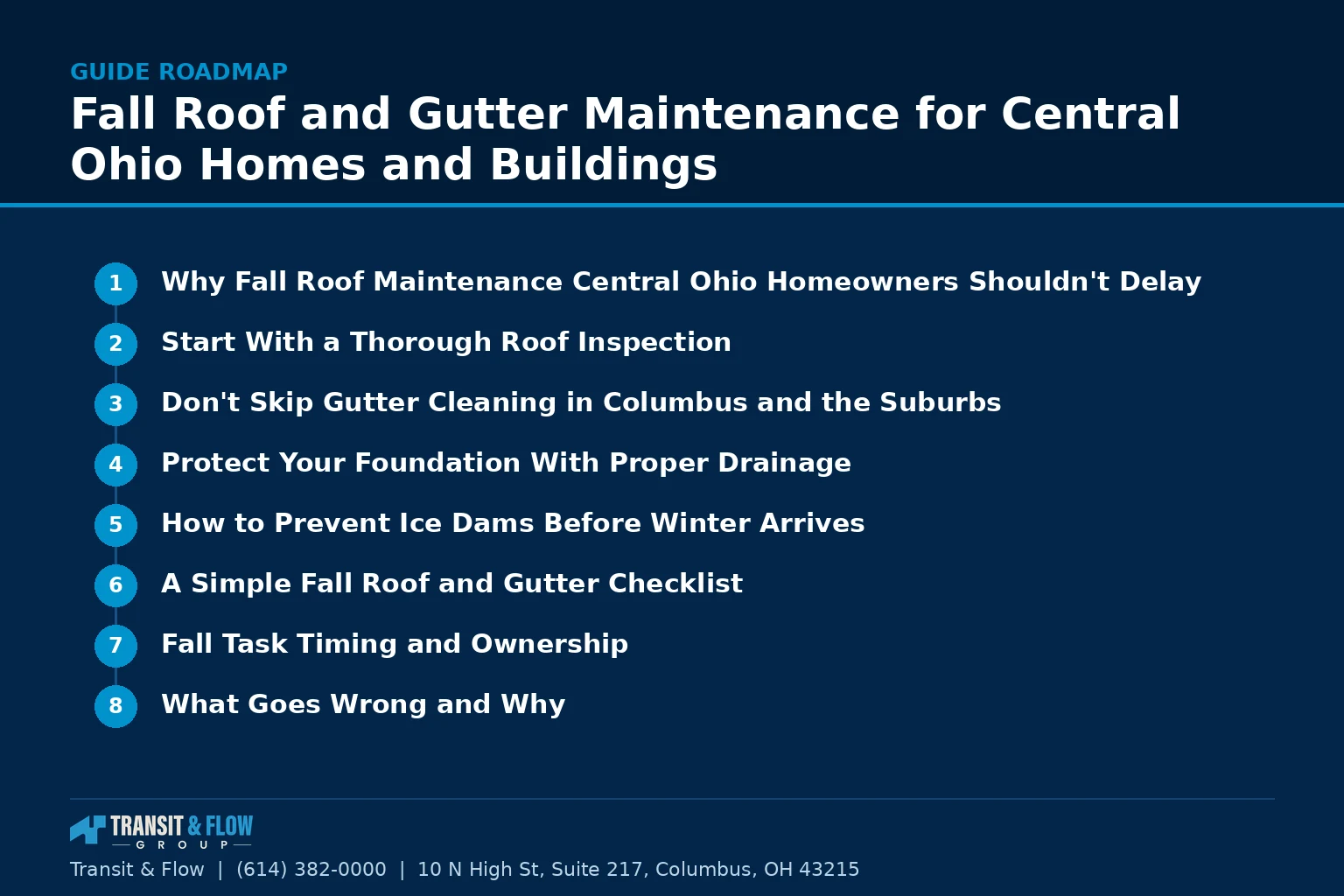
- Why Fall Roof Maintenance Central Ohio Homeowners Shouldn’t Delay
- Start With a Thorough Roof Inspection
- Don’t Skip Gutter Cleaning in Columbus and the Suburbs
- Protect Your Foundation With Proper Drainage
- How to Prevent Ice Dams Before Winter Arrives
- A Simple Fall Roof and Gutter Checklist
- Fall Task Timing and Ownership
- What Goes Wrong and Why
- When to Call a Professional
- Frequently Asked Questions
- Sources
- Related Transit & Flow Services
Why Fall Roof Maintenance Central Ohio Homeowners Shouldn’t Delay
Central Ohio hands your roof a punishing schedule. Late-summer storms loosen shingles and flashing, autumn leaves clog drainage, and then winter arrives with repeated freezing and thawing that pries open every weak seam. Water is patient, and it only needs one gap. A missing shingle tab or a hairline crack in flashing that looks harmless in September becomes an active leak once meltwater has somewhere to travel. Homeowners in Westerville, Hilliard, and Gahanna see the same pattern every year: the roof was “fine” until the first hard freeze, and then it wasn’t. Getting ahead of that cycle is the entire point of a fall check.
Start With a Thorough Roof Inspection
A proper roof inspection in Ohio looks at more than shingles. From the ground with binoculars, or safely up top, you are hunting for curling, cupping, or missing shingles, granule loss that shows up as dark bare patches, and any spot where the surface looks uneven or spongy. Then comes the detail work most people skip: the flashing around chimneys, vents, skylights, and where the roof meets a wall. Flashing failures cause more leaks than worn shingles do. Check that sealant hasn’t cracked, that nails haven’t backed out, and that no metal has lifted. On flat and low-slope commercial roofs, look for ponding water, blistering, and open seams. Thorough fall roof maintenance Central Ohio properties depend on always begins with this kind of honest, detailed inspection.
Don’t Skip Gutter Cleaning in Columbus and the Suburbs
Gutters are the unglamorous half of a healthy roof, and they fail quietly. When leaves and shingle grit pack a gutter solid, water overflows the back edge, soaks the fascia, and runs down the wall instead of away from the house. Reliable gutter cleaning in Columbus properties means clearing every run, flushing the downspouts until water flows freely, and confirming the hangers are still tight. While you are up there, check that downspouts actually carry water several feet away from the foundation. A clogged system in Grove City or Upper Arlington can push water into a basement just as easily as a roof leak can. If your trees are heavy shedders, a mid-fall second pass after the leaves drop is money well spent.
Protect Your Foundation With Proper Drainage
Roof and gutter work only pays off if the water ends up in the right place. I tell every client the same thing: follow the water all the way to the ground. Downspouts should discharge onto splash blocks or extensions that move runoff at least four to six feet from the foundation, and the grade around the building should slope away, not toward it. In older neighborhoods around Worthington and Upper Arlington, settled soil often pitches water back against the house without anyone noticing. Correcting drainage now prevents the kind of foundation moisture and basement seepage that shows up as a much larger, much colder-weather emergency.
How to Prevent Ice Dams Before Winter Arrives
If you want one reason to take fall seriously, it is this: to prevent ice dams. Ice dams form when heat escaping through the attic melts snow on the upper roof, the water runs down to the cold eaves, and it refreezes into a ridge of ice that backs meltwater up under your shingles. The fixes are almost all done before winter. Make sure attic insulation is adequate and even, confirm that soffit and ridge vents are clear so the attic stays cold, and seal air leaks around light fixtures, bath fans, and the attic hatch. Clean gutters help too, because a clogged, frozen gutter gives the ice something to build on. Handle these items in September and you take away the conditions ice dams need in New Albany, Powell, and Pickerington homes alike.
A Simple Fall Roof and Gutter Checklist
Here is the short version I hand crews and homeowners when we walk a property together:
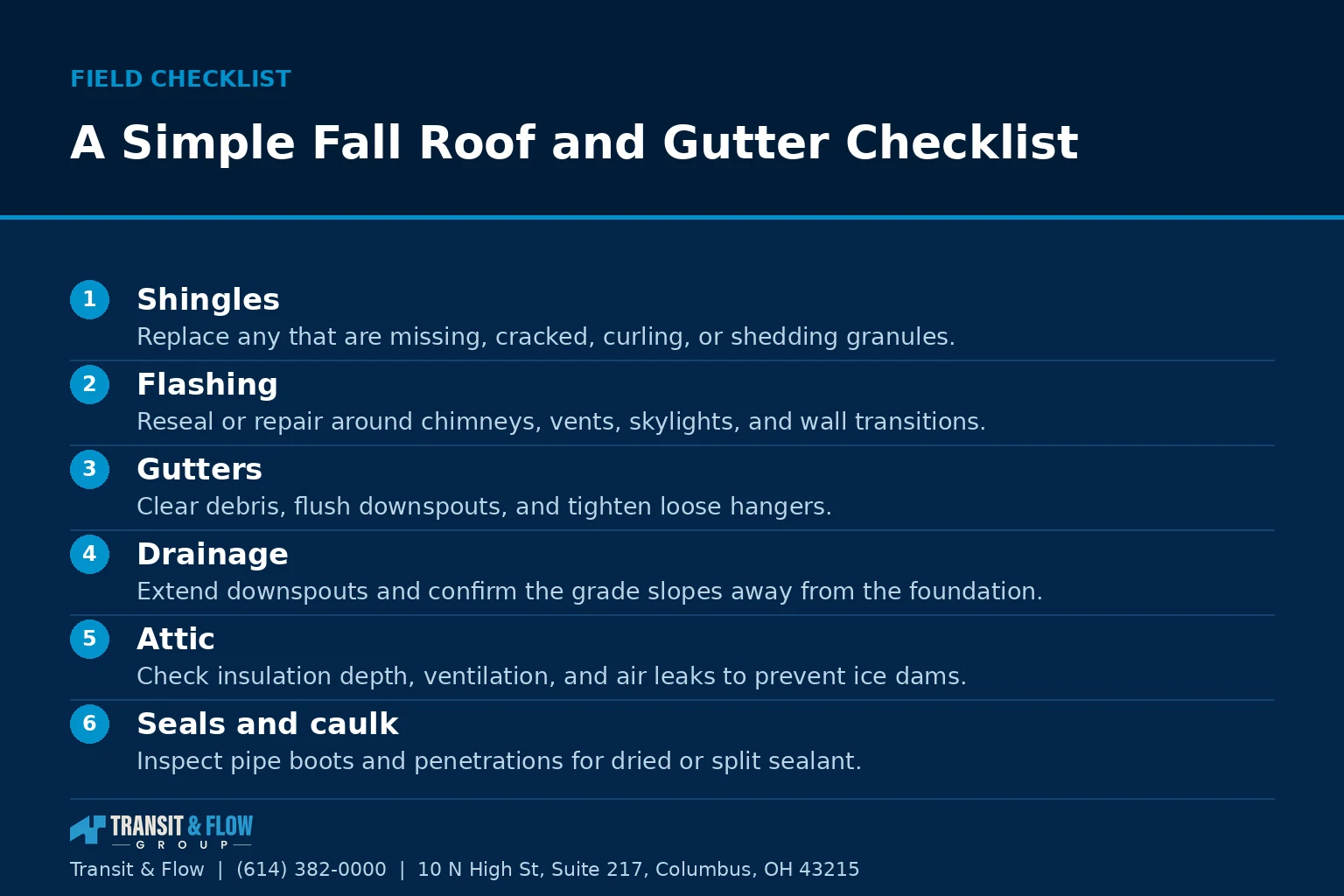
- Shingles: Replace any that are missing, cracked, curling, or shedding granules.
- Flashing: Reseal or repair around chimneys, vents, skylights, and wall transitions.
- Gutters: Clear debris, flush downspouts, and tighten loose hangers.
- Drainage: Extend downspouts and confirm the grade slopes away from the foundation.
- Attic: Check insulation depth, ventilation, and air leaks to prevent ice dams.
- Seals and caulk: Inspect pipe boots and penetrations for dried or split sealant.
Fall Task Timing and Ownership
The checklist above tells you what to look at. This table tells you when each item is worth doing and who should be doing it, which is where most fall plans fall apart. Use it to build a schedule rather than a to-do list, and treat the ownership column as guidance for judgment rather than a rule for your property.
| Task | Best Window | Signal It Is Overdue | Sensible Owner |
|---|---|---|---|
| Roof surface and flashing review | Early September | Stains on interior ceilings | Roofing professional on anything steep or commercial |
| First gutter clearing | Early to mid fall | Water sheeting over the front edge | Homeowner on single story, crew otherwise |
| Second gutter pass | After leaf drop finishes | Standing debris visible from the ground | Same as the first pass |
| Downspout and grade check | Any dry fall day | Damp basement wall after rain | Homeowner, with a contractor for regrading |
| Attic insulation and ventilation review | Before the first hard freeze | Ice ridges at the eaves last winter | Insulation or building performance professional |
What Goes Wrong and Why
The failures we get called about in January are rarely surprises. They trace back to a handful of fall decisions that looked reasonable at the time.
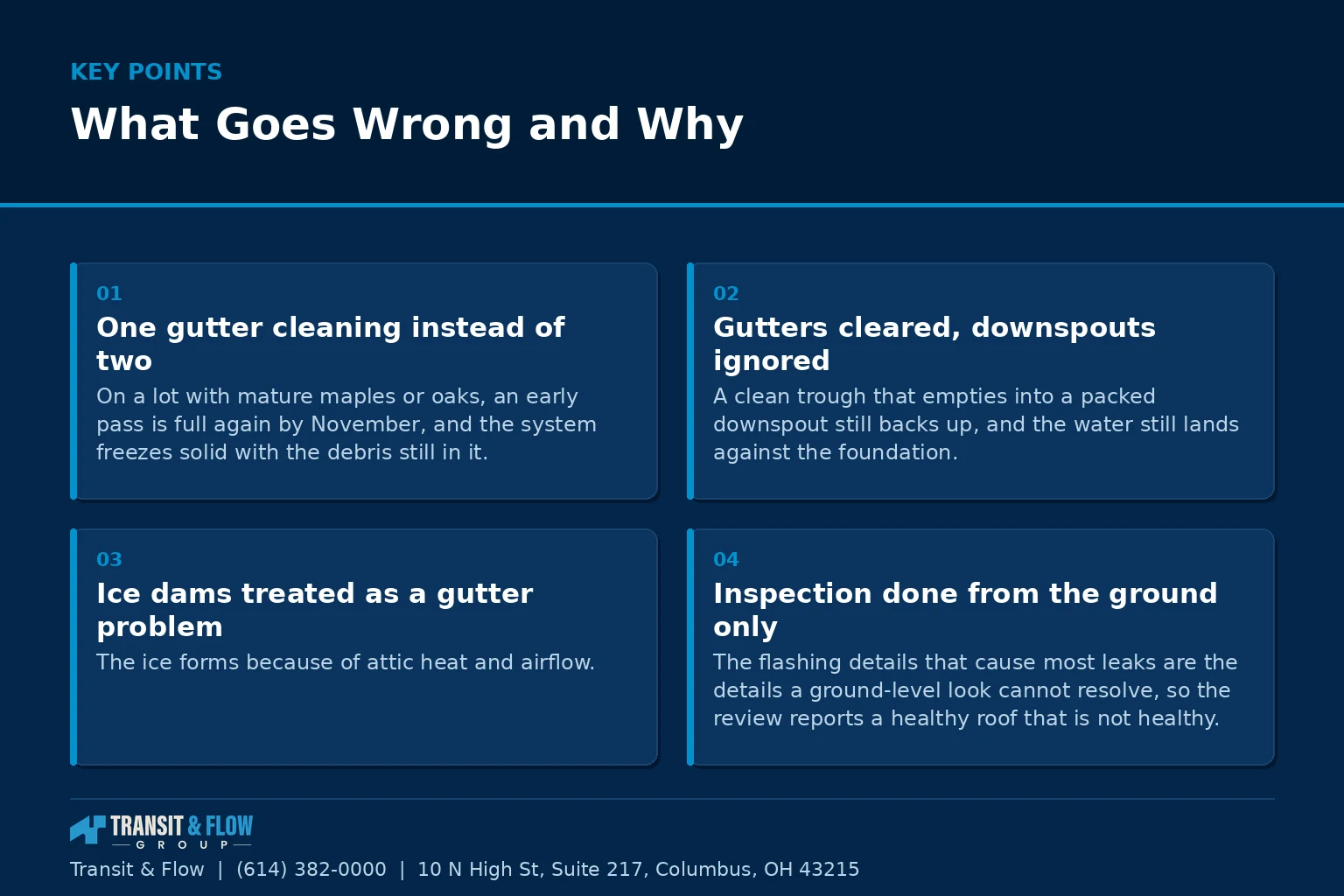
- One gutter cleaning instead of two. On a lot with mature maples or oaks, an early pass is full again by November, and the system freezes solid with the debris still in it.
- Gutters cleared, downspouts ignored. A clean trough that empties into a packed downspout still backs up, and the water still lands against the foundation.
- Ice dams treated as a gutter problem. The ice forms because of attic heat and airflow. Clean gutters help, but insulation and ventilation are where the condition is actually resolved.
- Inspection done from the ground only. The flashing details that cause most leaks are the details a ground-level look cannot resolve, so the review reports a healthy roof that is not healthy.
When to Call a Professional
Plenty of this is doable for a careful homeowner on a dry Saturday. But steep pitches, multi-story buildings, active leaks, and any commercial roof deserve a trained crew with the right safety equipment. A professional catches the subtle failures, the lifted flashing, the soft decking, the hairline separation at a seam, that are easy to miss until they cost you a ceiling. For property managers running multiple buildings, coordinating roof, gutter, and drainage work with one accountable partner keeps every site protected on the same schedule. At Transit & Flow, we bring that same operational discipline to roof inspection in Ohio, gutter cleaning in Columbus, and full fall roof maintenance Central Ohio property owners can count on, whether it is a single home or an entire portfolio. You can explore our related guides for more seasonal maintenance planning, and review the full list of communities we cover on our service areas page.
Fall is short, and the good weather is shorter. Don’t wait for the first leak to find out where your roof was vulnerable. Get an instant estimate right on the Transit & Flow homepage, or call our team at (614) 382-0000 to schedule your fall roof and gutter service. We will help you head into winter with a roof that is sealed, gutters that flow, and one less thing to worry about when the snow starts.
Transit & Flow Group coordinates projects and partners with properly licensed and insured specialty contractors when licensing is required, and work is performed under the appropriate permits.
Frequently Asked Questions
When is the right window for fall roof and gutter work in Central Ohio?
September into early fall, before the first hard freeze. The point is to close gaps while the weather still allows safe access and while sealant and repairs can cure in reasonable conditions. Once freeze and thaw cycles begin, a hairline crack that looked harmless becomes a path for meltwater, and the same repair has to happen in worse conditions on a shorter schedule. If the property has heavy shedding trees, plan on a second pass after the leaves finish dropping.
What causes more roof leaks, worn shingles or failed flashing?
Flashing failures cause more leaks than worn shingles do, which is why the detail work around chimneys, vents, skylights, and roof to wall transitions matters more than a quick look at the field of the roof. Cracked sealant, backed out nails, and lifted metal are the specific conditions worth noting. These are also the failures that are easiest to miss from the ground. If you are not able to see those areas safely and clearly, that is a reason to have the roof looked at rather than to assume it is fine.
How do ice dams form, and what prevents them?
Heat escaping through the attic melts snow on the upper roof, the water runs down to the colder eaves, and it refreezes into a ridge that backs meltwater up under the shingles. Because the cause is the attic rather than the roof surface, most of the prevention happens before winter and from inside the house. Adequate and even attic insulation, clear soffit and ridge ventilation so the attic stays cold, and sealed air leaks around fixtures, bath fans, and the attic hatch all remove the conditions ice dams need. Clean gutters help as well, since a clogged frozen gutter gives ice something to build on.
Why does gutter cleaning matter for the basement and not just the roof?
Because a packed gutter sends water over the back edge, into the fascia, and down the wall instead of away from the building. From there it reaches the soil directly against the foundation, which is the same route that produces basement seepage. Following the water all the way to the ground is the part most homeowners skip, and it includes confirming that downspouts discharge well clear of the foundation and that the grade slopes away from the building. In older neighborhoods, settled soil often pitches water back toward the house without anyone noticing.
Which parts of fall roof maintenance should a homeowner leave to a professional?
Steep pitches, multi story buildings, active leaks, and any commercial roof call for a trained crew with proper fall protection, and that judgment should be made before anyone goes up rather than partway through. A professional is also looking for the subtle failures, lifted flashing, soft decking, a hairline separation at a seam, that are difficult to spot without close access. If accessing the area safely is in question at all, treat that as the answer. Ground level observation with binoculars is a reasonable first step for a homeowner in any case.
What is different about a low-slope or commercial roof in a fall inspection?
The failure modes are different, so the inspection looks for different things. On flat and low-slope roofs the concerns are ponding water, blistering, and open seams rather than curling shingles and granule loss. Drainage points matter more because there is no pitch to carry water off quickly. For property managers running several buildings, coordinating roof, gutter, and drainage work through one accountable partner keeps every site on the same schedule instead of leaving the last building for after the first freeze.
Sources
- Ready.gov, U.S. Department of Homeland Security, severe weather preparedness
- U.S. Environmental Protection Agency, mold and moisture guidance
- National Weather Service, winter weather safety
Related Transit & Flow Services
Every service below is delivered by the same accountable Transit & Flow team, so one call covers the whole property.
- Roof Replacement and Repair
- Roof Repair
- Gutter Cleaning
- Gutter Guards
- Snow and Ice Roof Services
- Storm Damage Restoration
Serving Columbus and every community across Central Ohio. See the full service areas map, or get an instant estimate on the Transit & Flow homepage.
About This Guide
Written and edited by Micheal Parker, founder of Transit & Flow Group. Published August 10, 2026. This guide is checked against the agency and code sources listed above, and it is revised when those sources change.
General contractor of record. Micheal Parker holds City of Columbus General Contractor Registration G12064, issued by the Columbus Department of Building and Zoning Services under Transit & Flow LLC and valid through June 30, 2027. Trade work that falls outside the scope of that registration is performed by licensed trade partners, and the responsible license holder is identified before work begins.
Transit & Flow Group, home and commercial services for Columbus and the surrounding Central Ohio communities. Phone (614) 382-0000. Email solutions@transitflowgroup.com. 10 N. High St., Suite 217, Columbus, OH 43215. Contact our team or review the communities we serve.
