


Ask three neighbors how long a roof lasts and you will get three different numbers, all of them borrowed from somewhere else. The truthful answer for Central Ohio is a range, and where your roof lands in that range depends on five factors, only one of which is the material itself. This article explains the ranges, the factors, and the inspection habit that tells you where your own roof actually stands. For the full decision once a roof nears its end, see our complete roof replacement guide.
In This Guide
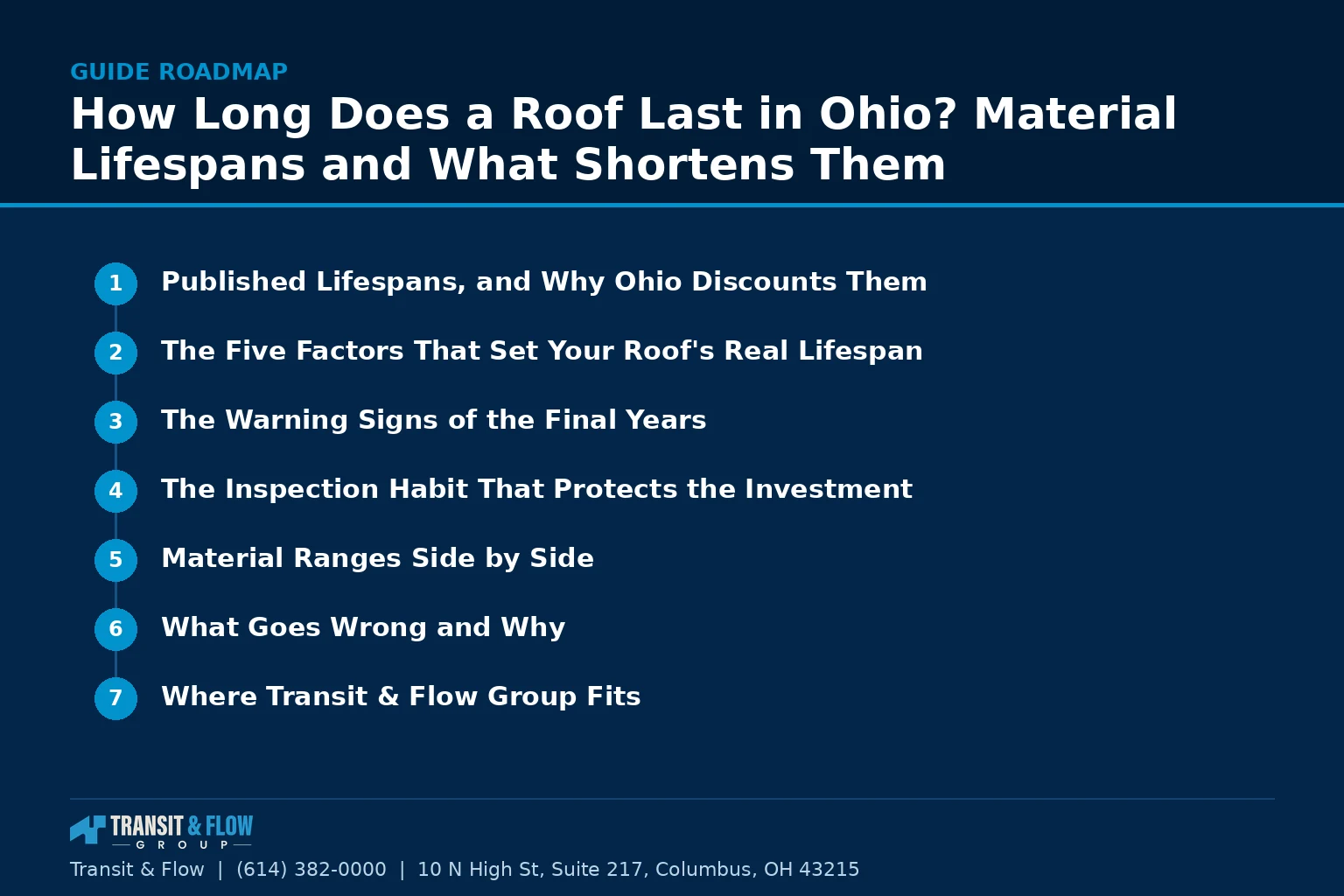
- Published Lifespans, and Why Ohio Discounts Them
- The Five Factors That Set Your Roof’s Real Lifespan
- The Warning Signs of the Final Years
- The Inspection Habit That Protects the Investment
- Material Ranges Side by Side
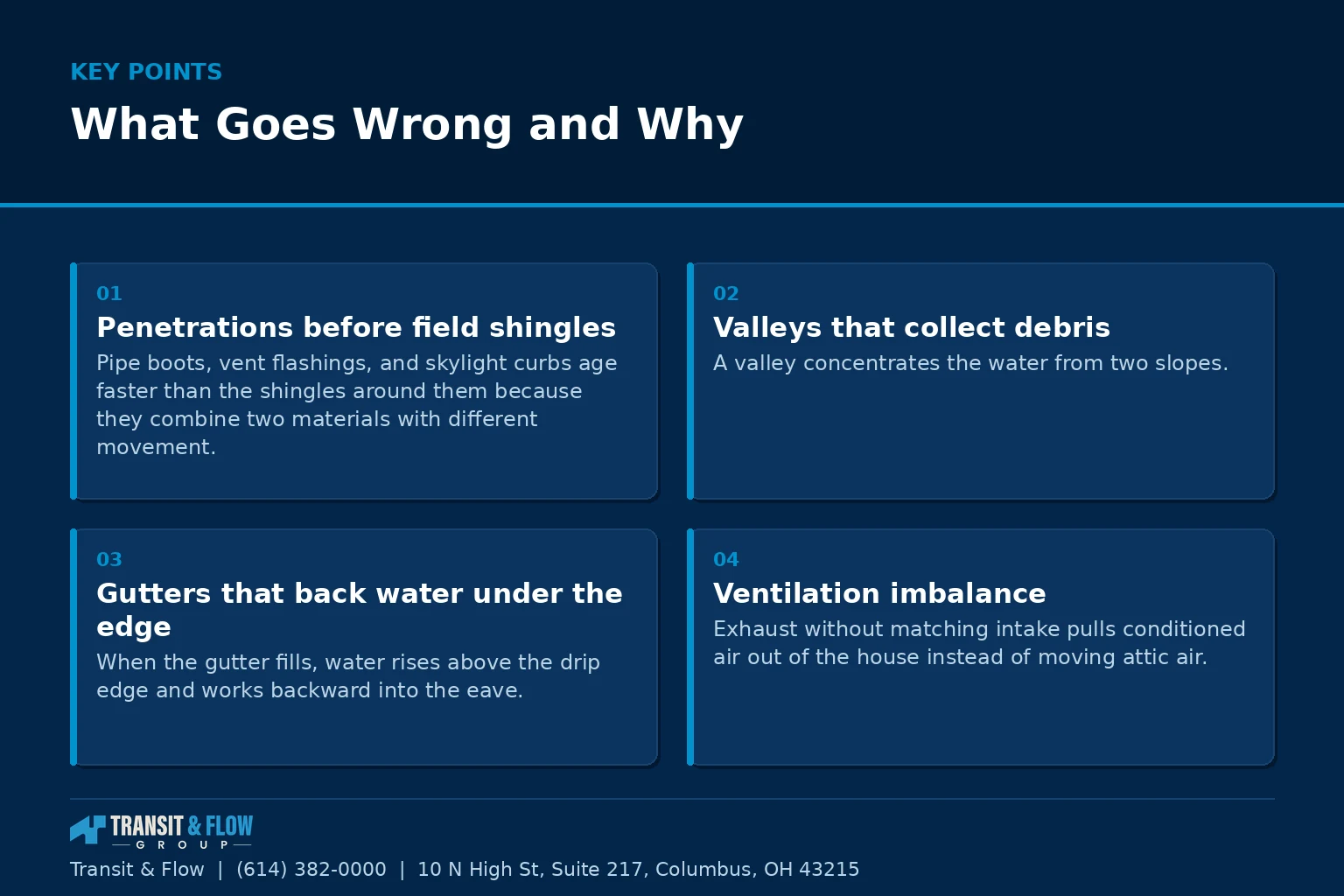
- What Goes Wrong and Why
- Glossary of Roof Lifespan Terms
- Where Transit & Flow Group Fits
- Frequently Asked Questions
Published Lifespans, and Why Ohio Discounts Them
Manufacturers and industry bodies publish expected service ranges by material: three-tab asphalt shingles at the short end of common materials, architectural asphalt meaningfully longer, standing seam metal longer still, and premium materials such as slate and tile measured in generations. Those figures assume correct installation, adequate ventilation, and a moderate climate. Central Ohio is not a moderate climate for roofs. We cycle through freeze and thaw dozens of times each winter, take hail-capable storms in spring and summer, and bake attics through July. The National Weather Service office covering the Columbus area documents this pattern every year. The practical effect is simple: local roofs tend to finish their service life at the lower end of the published range, and a roof that reaches the high end here has usually earned it through good ventilation and maintenance.
The Five Factors That Set Your Roof’s Real Lifespan
Material Class
The material sets the ceiling. Architectural asphalt shingles are the Central Ohio default for a reason: they carry better wind ratings and more mass than three-tab, at a price far below metal. Metal costs more up front and typically outlasts two asphalt roofs. No maintenance program makes a budget material perform like a premium one, but poor installation reliably makes a premium material perform like a budget one.
Installation Quality
Nailing pattern, underlayment choice, flashing work, and edge details are where lifespan is won or lost on day one. The National Roofing Contractors Association publishes the installation standards that manufacturer warranties lean on, and the most common installation faults, high nails, missed nailing zones, reused flashing, are invisible from the street on the day you pay the invoice. This is why contractor selection is a lifespan decision, not just a price decision.
Attic Ventilation
An attic that cannot breathe kills shingles from below. Summer heat builds under the deck and cooks the asphalt; winter moisture condenses on the cold deck and feeds rot and ice damming at the eaves. Balanced intake at the soffits and exhaust at the ridge, sized to the attic volume, is the fix, and the U.S. Department of Energy’s guidance on roofs and attics explains how the same airflow that protects shingles also trims cooling load. If your shingles aged out years ahead of schedule, ventilation is the first suspect.
Sun, Slope, and Trees
South and west slopes take more ultraviolet exposure and age faster than north-facing ones, which is why an inspector checks slopes separately. Overhanging branches drop debris that holds moisture against shingles and feeds moss, and branches that contact the roof in wind abrade granules with every gust. Steeper roofs shed water and snow faster and generally age more gracefully than low-slope sections, where water lingers.
Maintenance Habits
Roofs do not need much, but they need it consistently: gutters kept clear so water drains off the edge instead of backing under it, debris cleared from valleys, sealant at penetrations checked as it ages, and small faults fixed while they are small. A cracked pipe boot costs little to replace and a great deal to ignore. The Insurance Institute for Business and Home Safety’s roof research keeps reaching the same conclusion: roofs rarely fail all at once, they fail at neglected details first.
The Warning Signs of the Final Years
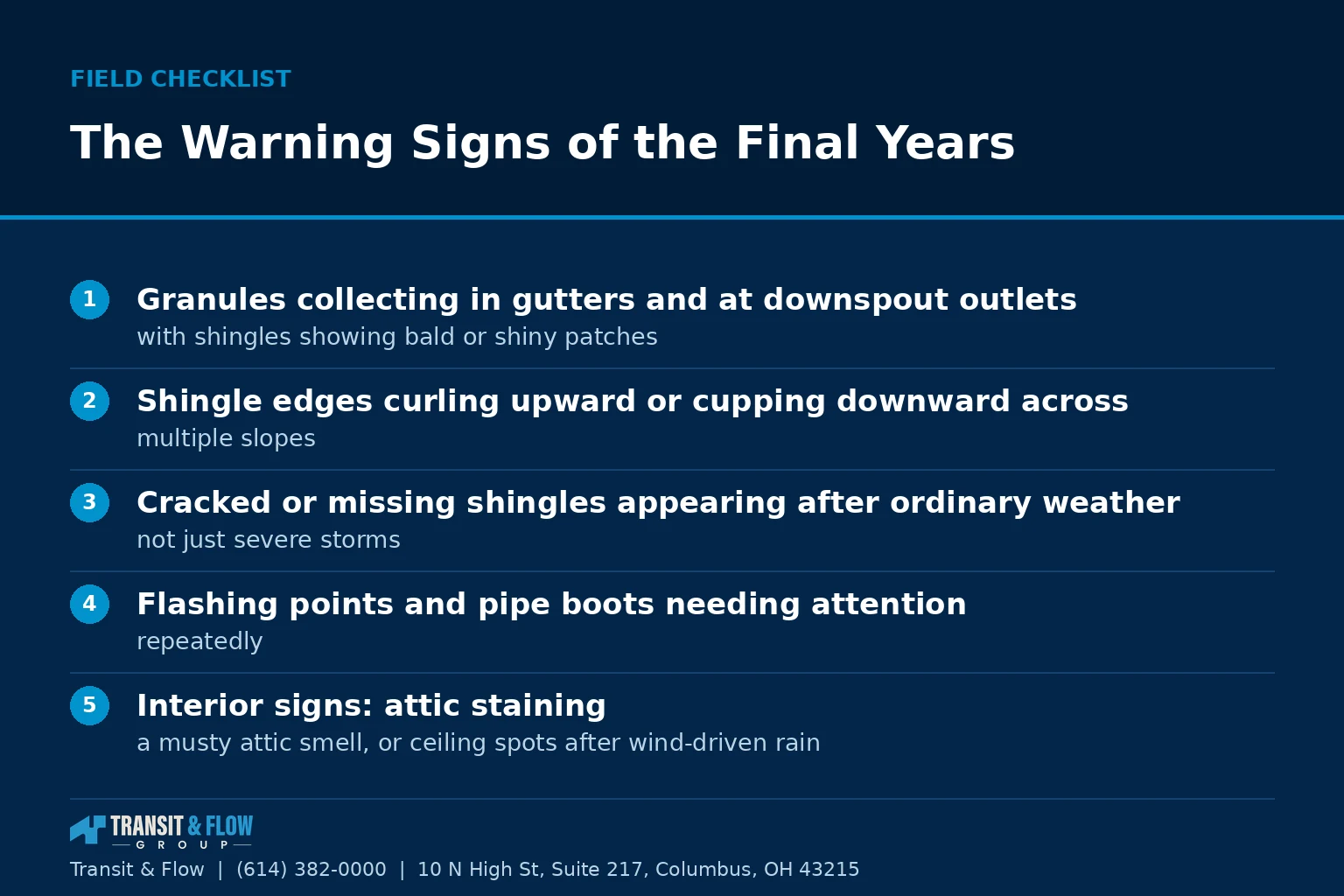
- Granules collecting in gutters and at downspout outlets, with shingles showing bald or shiny patches
- Shingle edges curling upward or cupping downward across multiple slopes
- Cracked or missing shingles appearing after ordinary weather, not just severe storms
- Flashing points and pipe boots needing attention repeatedly
- Interior signs: attic staining, a musty attic smell, or ceiling spots after wind-driven rain
One of these is a maintenance item. Several together, on a roof deep into its range, is the roof announcing its schedule. Our repair-or-replace framework walks through how to respond when the signs start clustering.
The Inspection Habit That Protects the Investment
Twice a year, spring and fall, walk the house and look at every slope from the ground, then look along the eaves from inside the attic with a flashlight. After any storm severe enough to make the local news, do it again and photograph anything that changed. Ten minutes twice a year builds the dated photo record that settles arguments later, with contractors, and if it ever comes to it, in an insurance conversation. Professional inspections make sense at the roof’s midlife point and annually in its final third.
Material Ranges Side by Side
The table below sets the common materials against each other on the terms that matter locally. Treat the service expectations as the ranges manufacturers publish, then apply the Central Ohio discount described above.
| Material | Published Service Expectation | What Shortens It Here | Best Fit |
|---|---|---|---|
| Three-tab asphalt | Shortest of the common materials | Wind uplift at the tab edges, granule loss on south and west slopes | Rarely the right answer on an owner-occupied home |
| Architectural asphalt | Meaningfully longer than three-tab | Poor attic ventilation, hail bruising, nailing faults at install | The Central Ohio default |
| Impact-rated asphalt | Comparable to architectural, better hail behavior | The same ventilation and installation issues | Homes where hail is the main worry |
| Standing seam metal | Typically outlasts two asphalt roofs | Poor detailing at penetrations and terminations | Owners staying long enough to harvest the life |
| Slate and clay tile | Measured in generations | Structural capacity limits, scarce repair trades | Historic and architect-driven houses only |
What Goes Wrong and Why
Roofs almost never fail across the whole field at once. They fail at a detail, and the field takes the blame years later.
- Penetrations before field shingles. Pipe boots, vent flashings, and skylight curbs age faster than the shingles around them because they combine two materials with different movement. They are the first place water finds a path.
- Valleys that collect debris. A valley concentrates the water from two slopes. Anything that slows that water down, leaves and needles most often, keeps moisture against the surface long enough to matter.
- Gutters that back water under the edge. When the gutter fills, water rises above the drip edge and works backward into the eave. That is a maintenance failure that reads as a roof failure.
- Ventilation imbalance. Exhaust without matching intake pulls conditioned air out of the house instead of moving attic air. The remedy is a sizing exercise for a qualified contractor working from the adopted code and the manufacturer’s published instructions.
- Reused flashing on a new roof. Flashing that was tired under the old shingles does not become new under the new ones. It is a line item worth confirming on any estimate.
Glossary of Roof Lifespan Terms
- Architectural shingle. A laminated asphalt shingle built from bonded layers, giving it more mass and better wind performance than a single-layer three-tab.
- Three-tab shingle. The single-layer asphalt shingle that defined the budget tier for decades and now sits at the short end of every published range.
- Deck. The structural sheathing the roof system is fastened to. Its condition governs whether a new roof can go on at all.
- Underlayment. The water-resisting layer between the deck and the covering, and the last defense once the surface is compromised.
- Flashing. The metal that bridges the roof to walls, chimneys, and other interruptions in the plane. Most leaks are flashing leaks.
- Drip edge. The metal at eaves and rakes that directs runoff into the gutter rather than behind it.
- Pipe boot. The collar sealing a plumbing vent where it passes through the roof. A small, inexpensive part with an outsized failure record.
- Soffit intake. The low ventilation openings under the eaves that let outside air enter the attic.
- Ridge exhaust. The high ventilation path at the peak that lets warm attic air leave. Intake and exhaust have to be balanced to work.
- Granule loss. The wearing away of the mineral surface that shields asphalt from ultraviolet light. Granules in the gutter are the roof reporting its own age.
- Ice damming. The ridge of ice that forms at a cold eave when melt from a warm roof refreezes, backing water under the covering.
- Freeze-thaw cycling. The repeated freezing and thawing of trapped water that pries at seams and cracks, and the defining Central Ohio stress on any roof.
Where Transit & Flow Group Fits
Transit & Flow Group coordinates projects and partners with properly licensed and insured specialty contractors when licensing is required. For roofing across Columbus and Central Ohio, that means documented assessments with photos you keep, honest reads on remaining life, and, when the time comes, a replacement managed end to end with one point of contact. If you do not know where your roof is on its clock, request an assessment and find out while the answer is still cheap.
Frequently Asked Questions
Why do Ohio roofs often fall short of the manufacturer’s published lifespan?
Published service ranges assume correct installation, adequate ventilation, and a moderate climate. Central Ohio is not a moderate climate for roofs, because we cycle through freeze and thaw dozens of times each winter, take hail-capable storms in spring and summer, and bake attics through July. The practical effect is that local roofs tend to finish at the lower end of the published range. A roof that reaches the high end here has usually earned it through good ventilation and consistent maintenance.
Which factor matters most, the material or the installation?
The material sets the ceiling and the installation decides whether you reach it. Architectural asphalt carries better wind ratings and more mass than three-tab, and metal typically outlasts two asphalt roofs, but no maintenance program makes a budget material perform like a premium one. Poor installation, on the other hand, reliably makes a premium material perform like a budget one. That is why contractor selection is a lifespan decision rather than only a price decision.
How does attic ventilation shorten or extend shingle life?
An attic that cannot breathe damages shingles from below. Summer heat builds under the deck and cooks the asphalt, and winter moisture condenses on the cold deck, which feeds rot and ice damming at the eaves. Balanced intake at the soffits and exhaust at the ridge, sized to the attic volume by someone qualified to size it, is the correction. If a roof aged out well ahead of schedule, ventilation is the first thing worth evaluating.
Do all slopes of a roof wear at the same rate?
No, which is why an inspector checks slopes separately rather than judging the roof as one surface. South and west slopes take more ultraviolet exposure and age faster than north-facing ones. Overhanging branches drop debris that holds moisture against shingles and feeds moss, and branches that touch the roof abrade granules with every gust of wind. Steeper roofs shed water and snow faster and generally age more gracefully than low-slope sections where water lingers.
Which warning signs suggest a roof is in its final years?
Granules collecting in gutters and at downspout outlets, with bald or shiny patches on the shingles, is the common first signal. Curling or cupping edges across multiple slopes, cracked or missing shingles after ordinary weather rather than severe storms, and flashing points or pipe boots that need attention repeatedly all point the same direction. Interior signs matter too, including attic staining, a musty attic smell, or ceiling spots after wind-driven rain. One of these alone is usually a maintenance item, while several together on a roof deep into its range is the roof announcing its schedule.
How often should a homeowner actually look at the roof?
Twice a year, in spring and fall, look at every slope from the ground, then look along the eaves from inside the attic with a flashlight. Repeat it after any storm severe enough to make the local news and photograph anything that changed. Ten minutes twice a year builds the dated photo record that settles arguments later with contractors, and in an insurance conversation if it comes to that. Professional inspections make sense at the roof’s midlife point and annually in its final third.
Sources
- National Roofing Contractors Association, installation standards
- Insurance Institute for Business and Home Safety, roof performance research
- U.S. Department of Energy, Energy Saver, roof and attic guidance
- National Weather Service, Wilmington Ohio office, regional climate and storm records
About This Guide
Written and edited by Micheal Parker, founder of Transit & Flow Group. Published August 16, 2026. This guide is checked against the agency and code sources listed above, and it is revised when those sources change.
General contractor of record. Micheal Parker holds City of Columbus General Contractor Registration G12064, issued by the Columbus Department of Building and Zoning Services under Transit & Flow LLC and valid through June 30, 2027. Trade work that falls outside the scope of that registration is performed by licensed trade partners, and the responsible license holder is identified before work begins.
Transit & Flow Group, home and commercial services for Columbus and the surrounding Central Ohio communities. Phone (614) 382-0000. Email solutions@transitflowgroup.com. 10 N. High St., Suite 217, Columbus, OH 43215. Contact our team or review the communities we serve.
