
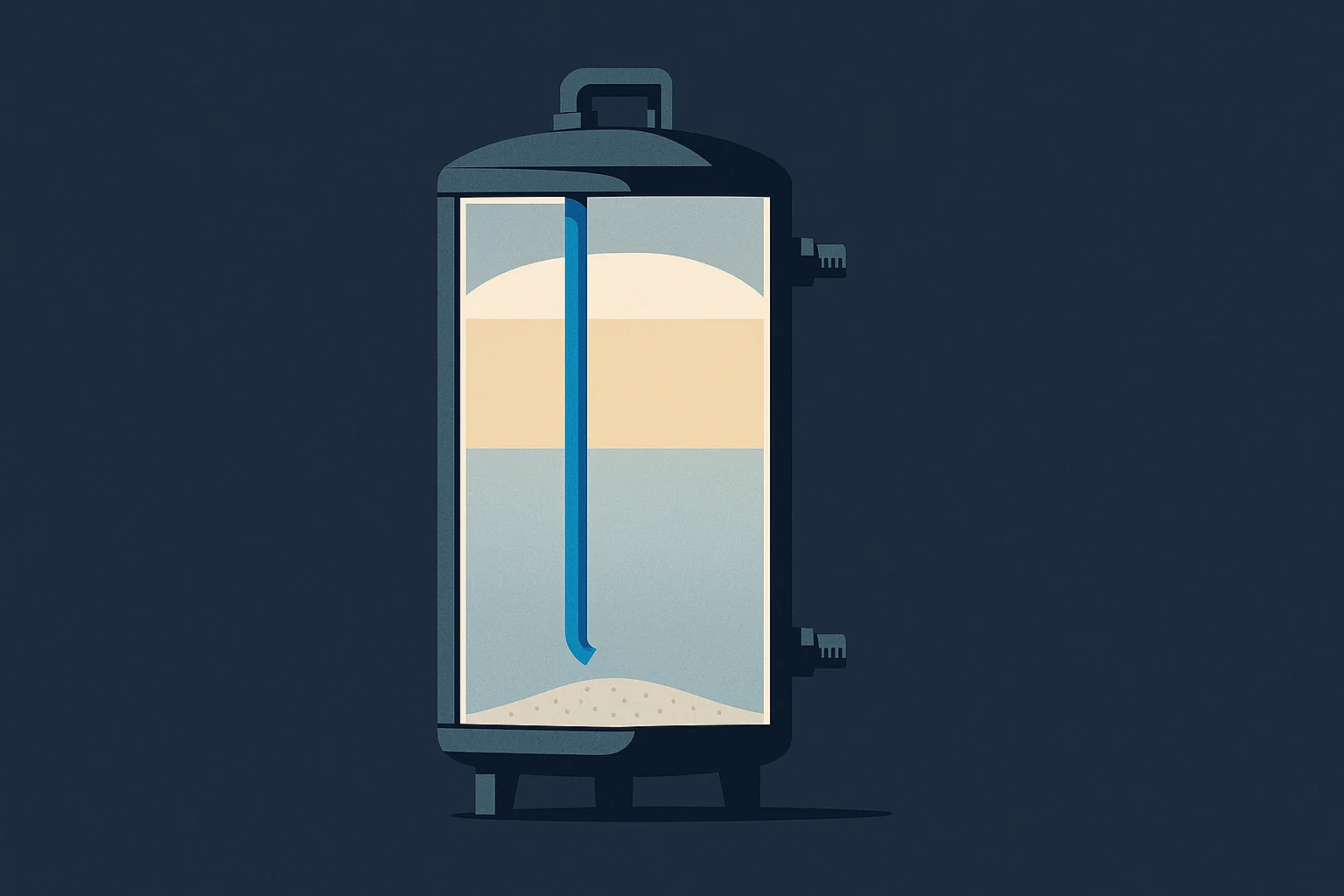

When a Central Ohio cold snap drops below zero overnight, the difference between a quiet winter and a flooded basement often comes down to a few dollars of foam and an hour of preparation. As a construction manager who has walked through more thawed-out disasters than I can count, I can tell you that learning how to prevent frozen pipes in Central Ohio is one of the highest-return maintenance moves a homeowner can make. This guide breaks down where pipes fail, why they burst, and the proven steps that keep water flowing from Columbus to Dublin and Westerville.
In This Guide
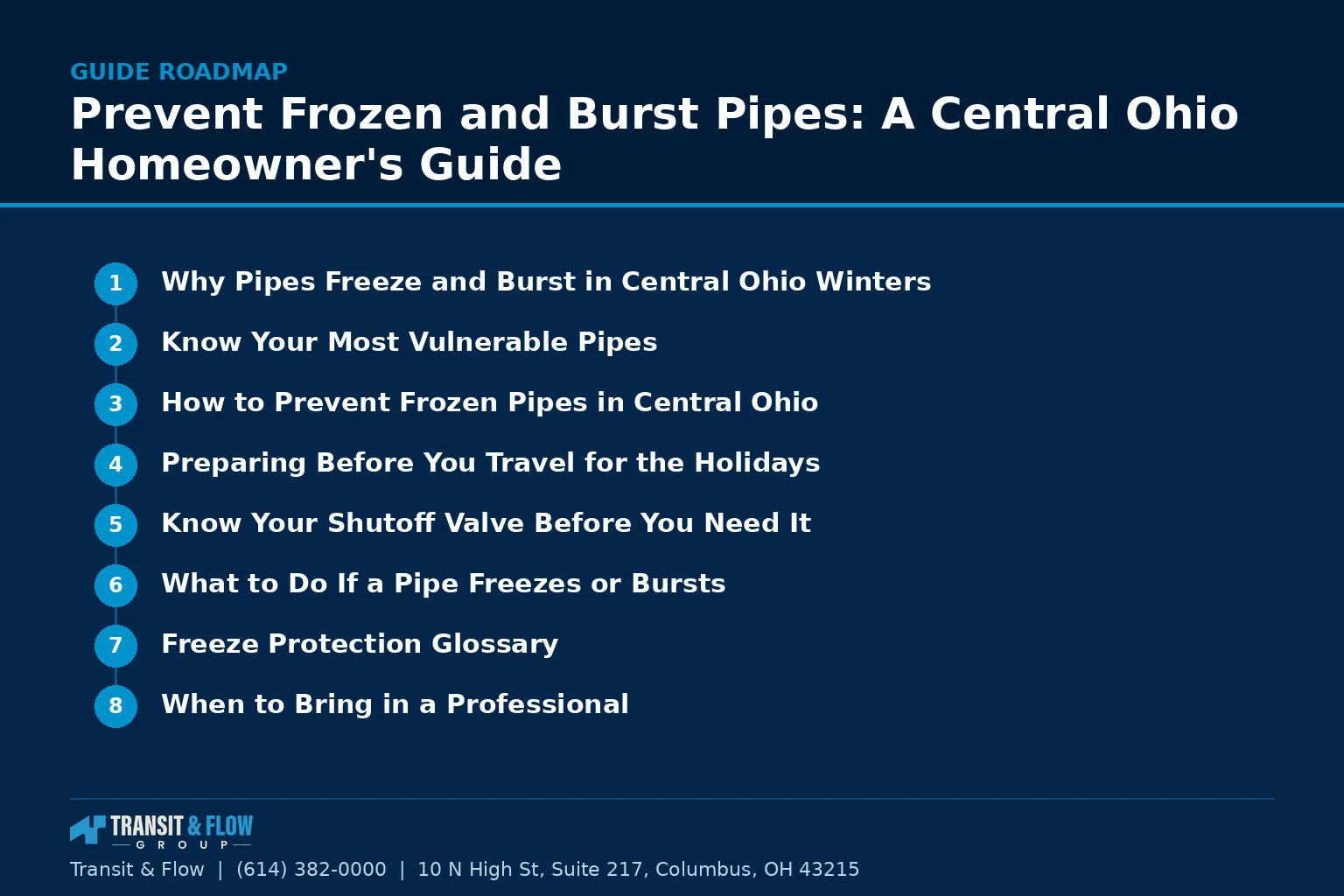
- Why Pipes Freeze and Burst in Central Ohio Winters
- Know Your Most Vulnerable Pipes
- How to Prevent Frozen Pipes in Central Ohio
- Preparing Before You Travel for the Holidays
- Know Your Shutoff Valve Before You Need It
- What to Do If a Pipe Freezes or Bursts
- Freeze Protection Glossary
- When to Bring in a Professional
- Sources
- Related Transit & Flow Services
- Frequently Asked Questions
Why Pipes Freeze and Burst in Central Ohio Winters
Frozen pipes are not just an inconvenience. When water freezes, it expands by roughly nine percent, and that expansion generates enormous pressure inside a closed pipe. The ice itself rarely splits the pipe. Instead, pressure builds between the ice blockage and a closed faucet until the weakest fitting or wall gives way. That is why burst pipe prevention in Columbus homes is really about managing pressure and heat, not just fighting cold. Central Ohio is especially prone to trouble because our winters swing hard: a mild week lulls people into complacency, then an arctic front pushes temperatures into the single digits for days. Older housing stock in Upper Arlington and Worthington adds another layer of risk, since many of these homes have uninsulated crawl spaces and pipes running through exterior walls.
Know Your Most Vulnerable Pipes
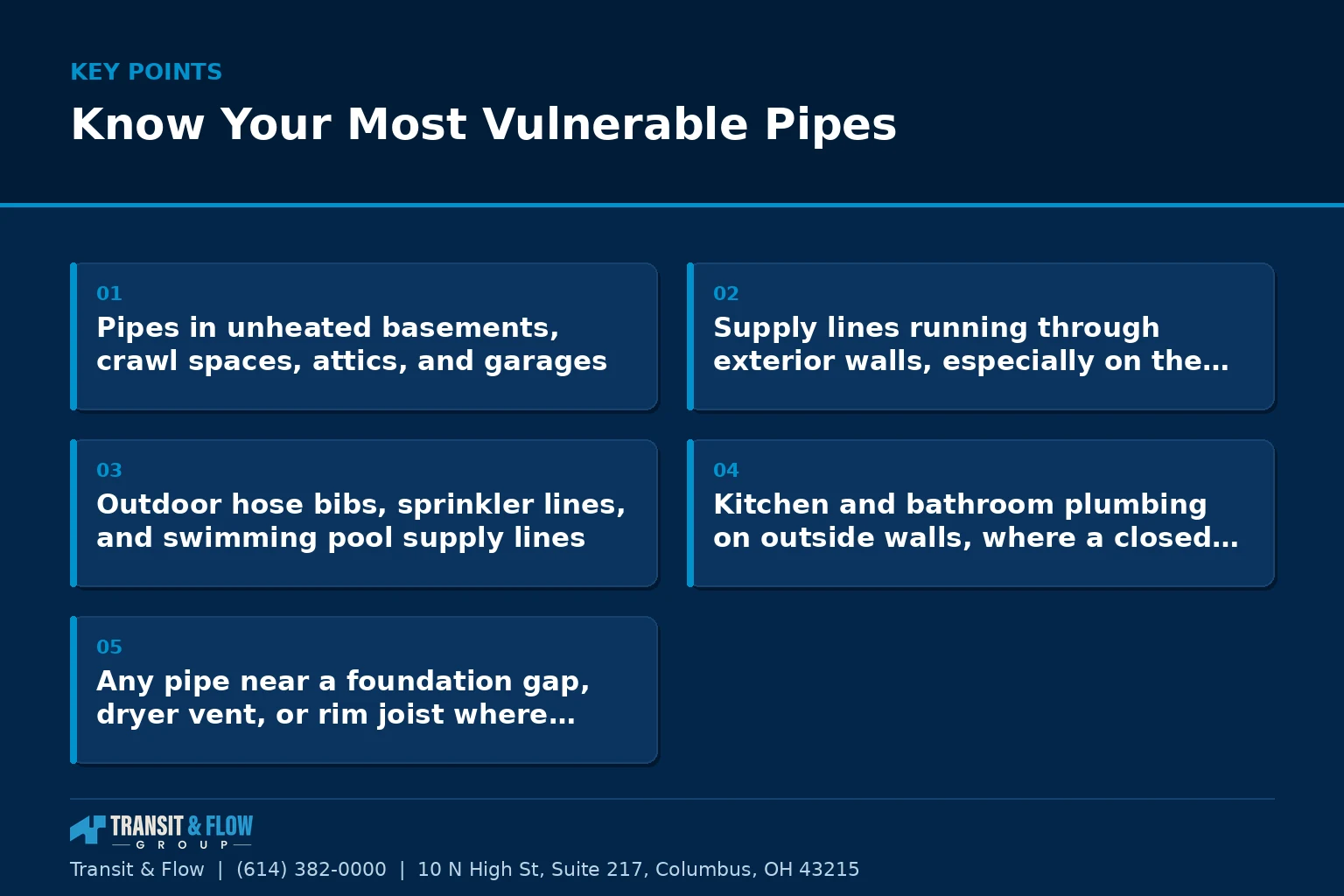
Not every pipe carries the same risk. The lines most likely to freeze are the ones exposed to unconditioned or poorly heated space. Before the first hard freeze, walk your property and pay close attention to these trouble spots:
- Pipes in unheated basements, crawl spaces, attics, and garages
- Supply lines running through exterior walls, especially on the north and west sides that face winter wind
- Outdoor hose bibs, sprinkler lines, and swimming pool supply lines
- Kitchen and bathroom plumbing on outside walls, where a closed cabinet door traps cold air
- Any pipe near a foundation gap, dryer vent, or rim joist where outside air sneaks in
Mapping these locations first tells you where to concentrate your effort. In many Gahanna and Hilliard homes, a single vulnerable run under a cantilevered floor is responsible for nearly every claim we see.
How to Prevent Frozen Pipes in Central Ohio
The good news is that stopping frozen pipes in Ohio comes down to a handful of reliable tactics. Start with quality pipe insulation for winter: foam sleeves and fiberglass wrap are inexpensive and slide right over exposed lines. For pipes in the coldest, most exposed spots, add UL-listed heat tape or heat cable, which uses a thermostat to warm the line only when temperatures drop. Seal the air leaks that let frigid air reach your plumbing, using caulk or spray foam around penetrations where pipes pass through walls, floors, and the rim joist. On the coldest nights, let a faucet drip slightly on your most vulnerable fixtures, because moving water resists freezing and the open faucet relieves the pressure that actually bursts pipes. Open cabinet doors under sinks on exterior walls so household heat can circulate, and never set your thermostat below 55 degrees, even when you are away.
Preparing Before You Travel for the Holidays
December and January send many Central Ohio families to warmer places, and empty houses are where the worst damage happens because no one is there to catch the first drip. If you are leaving Powell, New Albany, Pickerington, or Grove City for a week, take a few extra precautions. Keep the heat on at a minimum of 55 degrees rather than shutting the furnace off to save money, since a single burst pipe erases years of those savings. Ask a neighbor to check the home daily and confirm the heat is running. If the house will sit empty for an extended stretch, the safest move is to shut off the main water supply and drain the lines by opening the lowest faucets.
Know Your Shutoff Valve Before You Need It
Every homeowner should be able to find and operate the main water shutoff valve in under a minute. This single piece of knowledge is the most important part of burst pipe prevention, because when a line lets go, minutes decide whether you are drying a small area or replacing floors, drywall, and cabinets. The main valve is usually near where the water line enters the home, often on the basement wall facing the street or near the water meter. Test it now to be sure it turns freely, and tag it so everyone knows where it is. Also locate the individual shutoffs beneath sinks and behind toilets to isolate a problem without cutting water to the whole house.
What to Do If a Pipe Freezes or Bursts
If you turn on a faucet and only a trickle comes out, you likely have a frozen section. Keep the faucet open, then apply gentle heat with a hair dryer, a space heater kept away from flammables, or warm towels. Never use an open flame or a propane torch, which cracks pipes and starts house fires. Work from the faucet end toward the blockage so melting water can escape. If a pipe has already burst, shut off the main valve immediately, open faucets to drain the system, and call a professional. Frozen and burst pipes rarely come alone, so once one line freezes, others in the same wall or crawl space are usually at risk. For more seasonal maintenance strategy, our related guides cover furnace prep, winterization checklists, and whole-home readiness across Central Ohio.
Freeze Protection Glossary
Most of the confusion around winter plumbing comes from vocabulary. These are the terms you will hear from a plumber, an insurer, or a product label, in plain language.
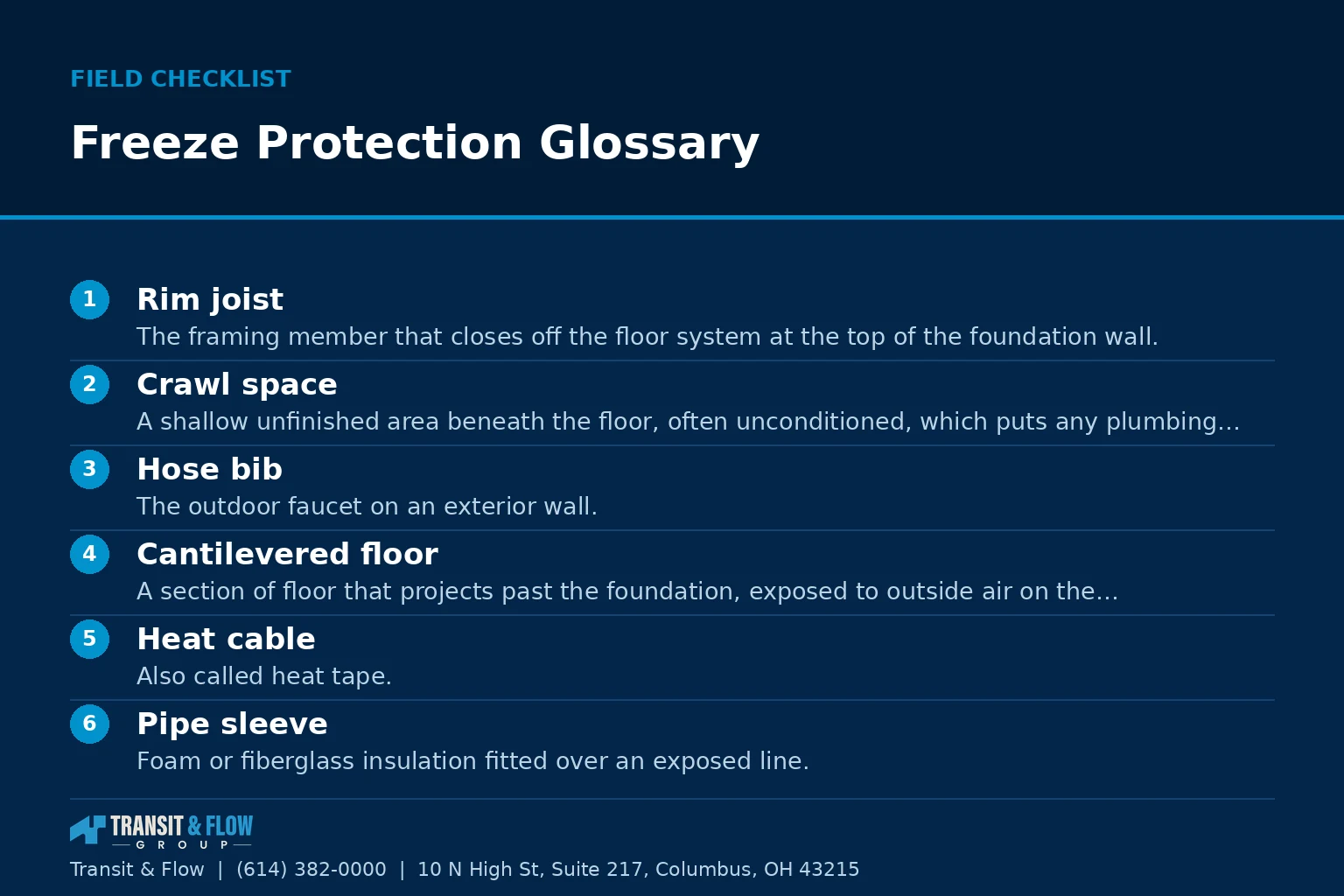
- Rim joist. The framing member that closes off the floor system at the top of the foundation wall. It is a common path for outside air to reach plumbing.
- Crawl space. A shallow unfinished area beneath the floor, often unconditioned, which puts any plumbing routed through it at elevated freeze risk.
- Hose bib. The outdoor faucet on an exterior wall. Frost-resistant versions place the shutoff inside the heated envelope, but they still depend on the hose being disconnected.
- Cantilevered floor. A section of floor that projects past the foundation, exposed to outside air on the underside. Plumbing routed through one is a frequent source of winter claims.
- Heat cable. Also called heat tape. An electric cable that warms a pipe under thermostatic control. Selection and installation follow the manufacturer’s published instructions and the electrical code adopted by your jurisdiction.
- Pipe sleeve. Foam or fiberglass insulation fitted over an exposed line. It slows heat loss but does not add heat, so it buys time rather than immunity.
- Conditioned space. Any area intentionally heated or cooled. Plumbing kept inside the conditioned envelope is the strongest protection available.
- Building envelope. The boundary between conditioned and unconditioned space, formed by walls, floors, roof, and the sealing between them.
- Main shutoff valve. The valve controlling water to the entire house, usually near the point of entry or the meter. Locating and testing it is the single highest-value winter task.
- Fixture shutoff. The smaller valve serving one sink or toilet, which isolates a problem without cutting water to the whole house.
- Water hammer. The pressure shock that travels through a line when flow stops abruptly. It stresses joints and can make an already weak fitting the failure point.
- Freeze-thaw cycle. The repeated crossing of the freezing point that defines a Central Ohio winter. It matters because damage accumulates across cycles rather than arriving in one event.
When to Bring in a Professional
Some pipe protection is a weekend project, and some is best left to licensed trades. If you have recurring freezes in the same location, pipes buried in finished walls, or a home with aging galvanized plumbing, a professional assessment pays for itself. At Transit & Flow, our plumbers pressure-test, insulate, reroute vulnerable lines, and install heat cable and shutoff upgrades so you head into winter protected. You can see every community we cover on our service areas page. Getting ahead of frozen pipes in Ohio is always cheaper than the cleanup.
Do not wait for the first hard freeze to find out where your plumbing is weak. Take the steps above to prevent frozen pipes in Central Ohio this winter, and let Transit & Flow handle the rest with the operational discipline our customers count on. Get an instant estimate on the Transit & Flow homepage, or call us at (614) 382-0000 to schedule a pre-winter plumbing inspection before the cold sets in.
Transit & Flow Group coordinates projects and partners with properly licensed and insured specialty contractors when licensing is required.
Sources
- National Weather Service, winter weather safety
- U.S. Environmental Protection Agency, WaterSense, household leak detection
- U.S. Environmental Protection Agency, mold and moisture guidance
Related Transit & Flow Services
Every service below is delivered by the same accountable Transit & Flow team, so one call covers the whole property.
Serving Columbus and every community across Central Ohio. See the full service areas map, or get an instant estimate on the Transit & Flow homepage.
Frequently Asked Questions
Which pipes in a Central Ohio home are most likely to freeze?
The lines at greatest risk are the ones exposed to unconditioned or poorly heated space. That means pipes in unheated basements, crawl spaces, attics, and garages, supply lines running through exterior walls on the north and west sides that face winter wind, outdoor hose bibs and sprinkler lines, and plumbing behind closed cabinet doors on outside walls. Any pipe near a foundation gap, a dryer vent, or the rim joist is also worth attention, because that is where outside air gets in. Walking the property and mapping those runs before the first hard freeze tells you where to concentrate effort.
Why does a frozen pipe actually burst?
The ice itself rarely splits the pipe. Water expands by roughly nine percent when it freezes, and the pressure that expansion creates builds up in the closed section between the ice blockage and a shut faucet until the weakest fitting or wall section gives way. That is why prevention is really about managing pressure and heat together rather than simply fighting cold, and it is also why an open faucet helps.
Does letting a faucet drip on a cold night really help?
Yes, for two reasons that work together. Moving water resists freezing, and an open faucet relieves the pressure that is what actually bursts a pipe when a blockage forms upstream. Reserve the tactic for your most vulnerable fixtures on the coldest nights rather than running every tap in the house. Pair it with open cabinet doors under sinks on exterior walls so household heat can reach the lines.
What should I do with the heat before leaving town in winter?
Leave it on. An empty house is where the worst damage happens because no one is there to catch the first drip, so keep the thermostat at a minimum of fifty five degrees rather than shutting the furnace off, and never set it lower than that even when the house is occupied. Ask a neighbor to check the home daily and confirm the heat is still running. If the house will sit empty for an extended stretch, the safest move is shutting off the main water supply and draining the lines by opening the lowest faucets.
What should I do first if a pipe has already burst?
Shut off the main valve immediately, then open faucets to drain the system and call a professional. This is why every homeowner should be able to find and operate the main shutoff in under a minute, because when a line lets go the minutes decide whether you are drying a small area or replacing floors, drywall, and cabinets. Test the valve now to confirm it turns freely and tag it so everyone in the house knows where it is. Frozen and burst pipes rarely come alone, so treat other lines in the same wall or crawl space as at risk too.
When is this a job for a professional rather than a weekend project?
Foam sleeves, cabinet doors, and sealing obvious air leaks are reasonable homeowner work. Bring in a licensed trade when you have recurring freezes in the same location, pipes buried in finished walls, or a home with aging galvanized plumbing, because those situations need assessment rather than a wrap. Transit & Flow coordinates pressure testing, insulation, rerouting of vulnerable lines, and heat cable and shutoff upgrades ahead of winter. Getting ahead of a freeze is always less disruptive than the cleanup afterward.
About This Guide
Written and edited by Micheal Parker, founder of Transit & Flow Group. Published August 26, 2026. This guide is checked against the agency and code sources listed above, and it is revised when those sources change.
General contractor of record. Micheal Parker holds City of Columbus General Contractor Registration G12064, issued by the Columbus Department of Building and Zoning Services under Transit & Flow LLC and valid through June 30, 2027. Trade work that falls outside the scope of that registration is performed by licensed trade partners, and the responsible license holder is identified before work begins.
Transit & Flow Group, home and commercial services for Columbus and the surrounding Central Ohio communities. Phone (614) 382-0000. Email solutions@transitflowgroup.com. 10 N High St, Suite 217, Columbus, OH 43215. Contact our team or review the communities we serve.
