
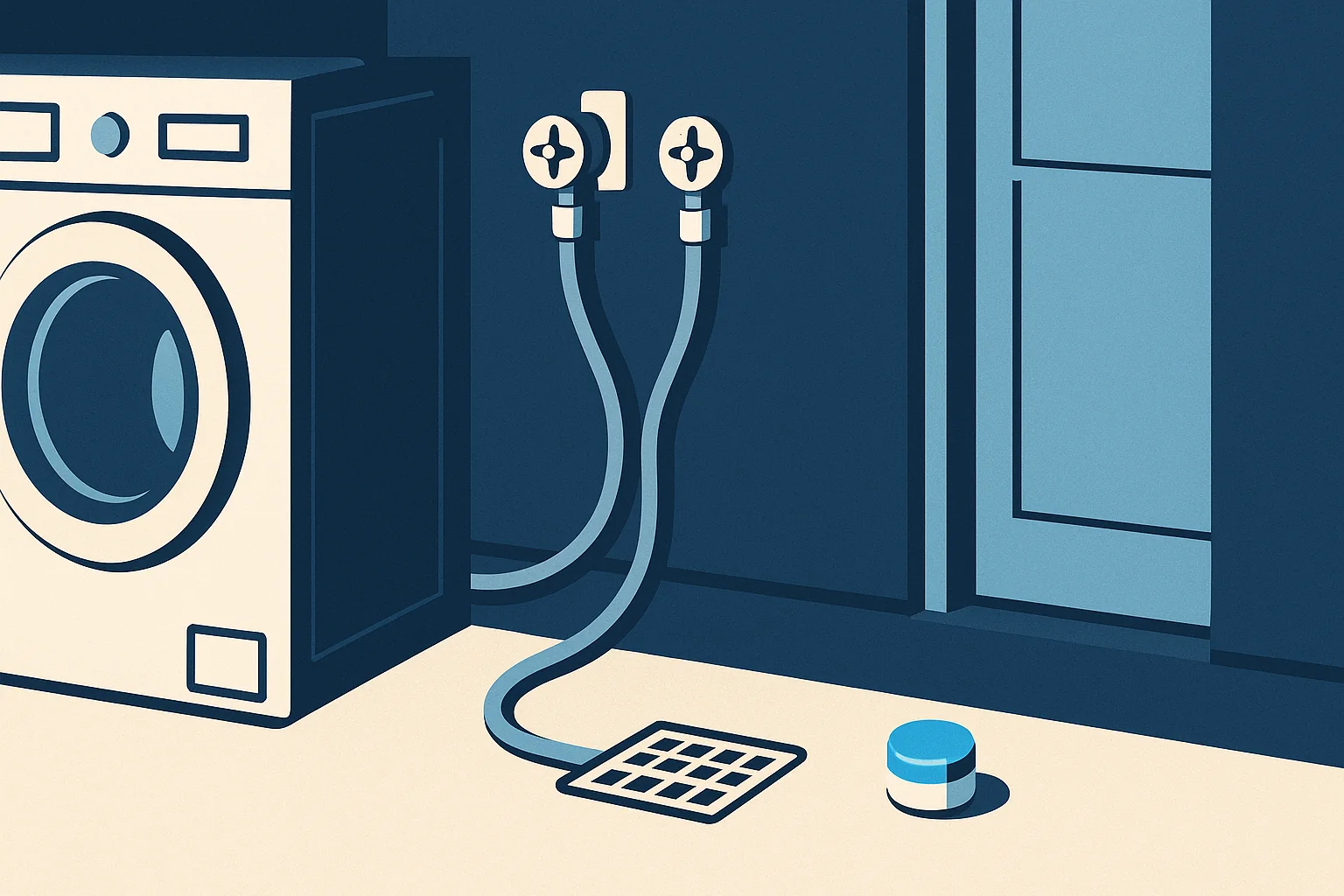

Three protective technologies do most of the work of keeping a modern home electrically safe, and they protect against three completely different failures. Most homeowners know one of them by sight, guess at the second, and have never heard of the third being a real product decision. This guide explains what each one actually does, where each belongs, why they trip, and how to tell a nuisance from a warning. It is part of our electrical panel guide, and it pairs with our article on legacy panels in older Ohio homes.
In This Guide
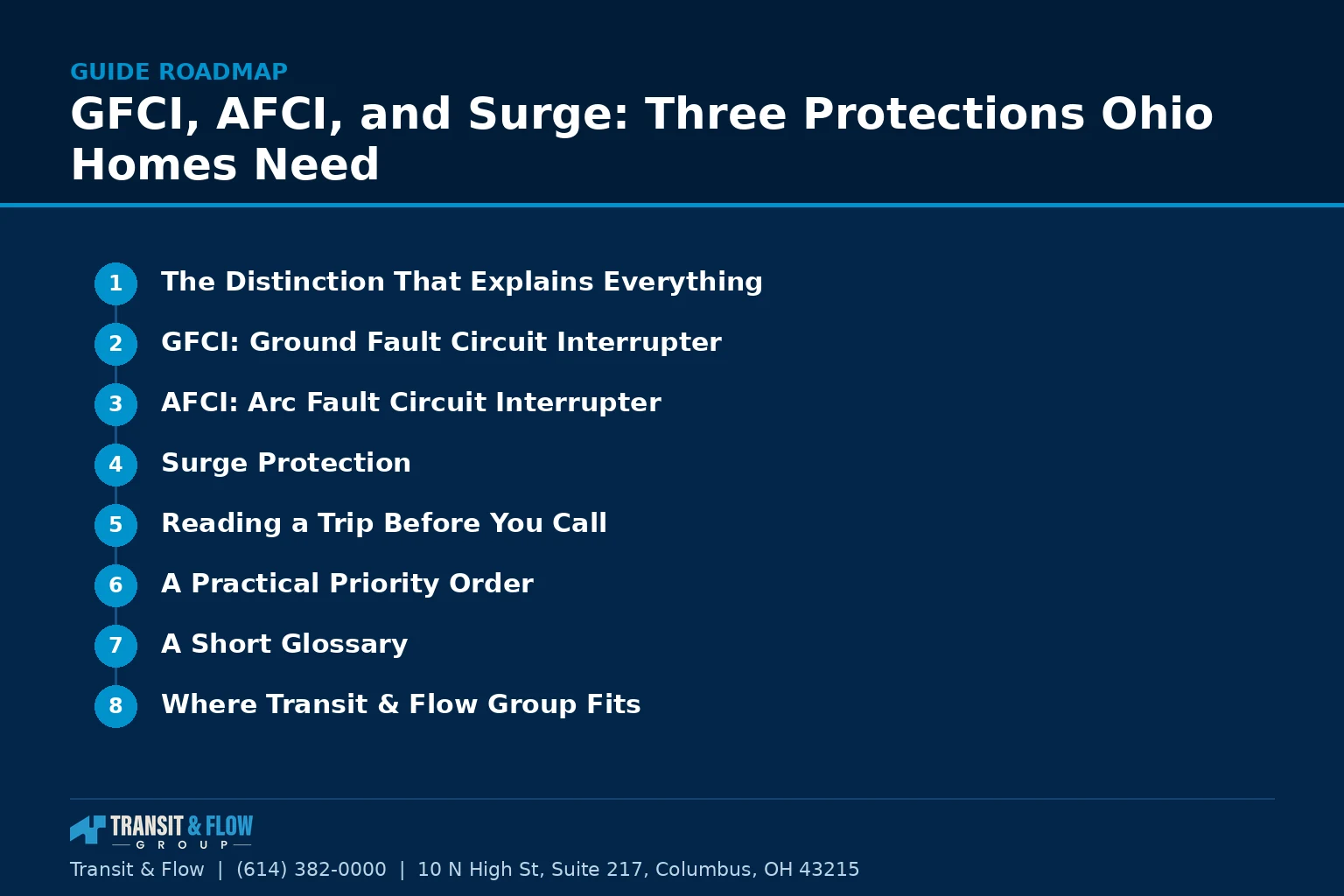
- The Distinction That Explains Everything
- GFCI: Ground Fault Circuit Interrupter
- AFCI: Arc Fault Circuit Interrupter
- Surge Protection
- Reading a Trip Before You Call
- A Practical Priority Order
- A Short Glossary
- Where Transit & Flow Group Fits
- Frequently Asked Questions
Transit & Flow Group coordinates projects and partners with properly licensed and insured specialty contractors when licensing is required.
A boundary before the detail. This guide covers what these devices do and how to test the ones designed to be tested from the outside. It is not instruction to install a protective device or to work inside a panel. Installation is licensed, permitted work.
The Distinction That Explains Everything
Start with a fact that reorganizes the whole subject: an ordinary circuit breaker protects the wire in your wall, not you and not your equipment. It watches for current above what the wire can safely carry and opens the circuit before the wire overheats. That is its entire job, and it does it well.
The problem is that the two most common ways people are hurt or homes catch fire do not involve enough current to trip an ordinary breaker. A current path through a person to ground can be lethal at a tiny fraction of what a breaker tolerates. An arcing connection inside a wall can start a fire while drawing current a breaker considers perfectly normal. That gap is what the three protections fill.
GFCI: Ground Fault Circuit Interrupter
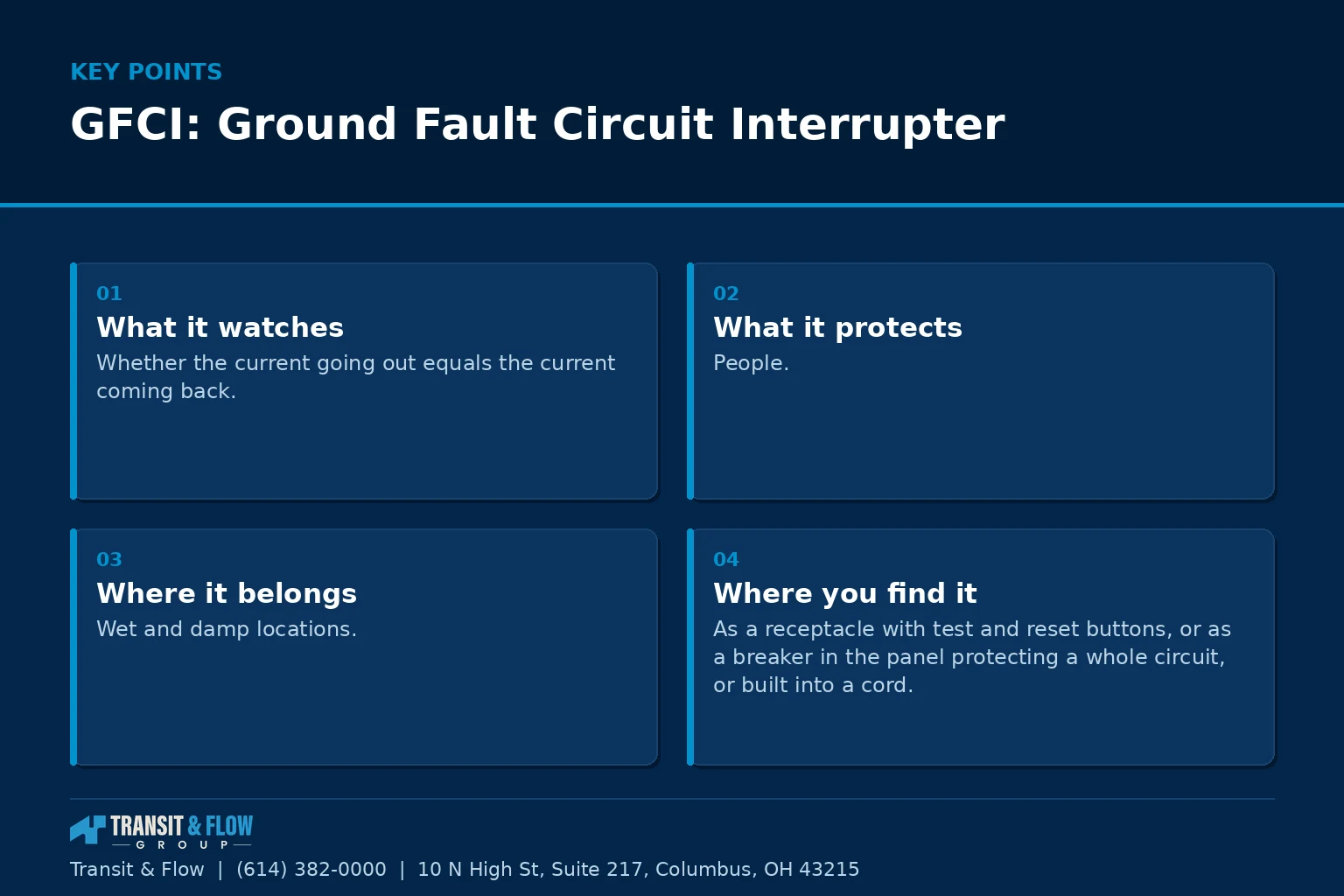
- What it watches. Whether the current going out equals the current coming back. If some current is leaving the circuit by another path, and a person is the most concerning version of another path, the device opens in a fraction of a second.
- What it protects. People. This is the shock and electrocution device.
- Where it belongs. Wet and damp locations. Bathrooms, kitchens, garages, unfinished basements, crawl spaces, outdoors, near laundry equipment and utility sinks, and around pools and hot tubs. Requirements have expanded across code cycles, so confirm current requirements for your project with your electrician and your building department rather than matching what an older house happens to have.
- Where you find it. As a receptacle with test and reset buttons, or as a breaker in the panel protecting a whole circuit, or built into a cord.
- How to test it. Press Test. Power should drop. Press Reset. Power should return. If pressing Test does nothing, the device has failed and it needs replacement. A GFCI that will not trip is providing no protection while looking exactly like one that is.
- How often. Monthly is the common manufacturer recommendation. Realistically, quarterly and after any storm or basement moisture event puts you far ahead of most households.
A note on the ungrounded-outlet case, because it comes up constantly in older Central Ohio homes. There is a recognized approach that allows a GFCI to be used where no equipment ground exists, with specific labeling required. It provides shock protection without providing a ground. This is a conversation with an electrician about your specific circuits, not a shortcut to install yourself.
AFCI: Arc Fault Circuit Interrupter
- What it watches. The electrical signature of arcing. A damaged conductor, a loose terminal screw, a cord crushed under furniture, or a nail driven through a cable can produce a small persistent arc. The device recognizes the pattern and opens the circuit.
- What it protects. The building. This is the fire device.
- Where it belongs. Living areas. Bedrooms, living rooms, hallways, and over successive code cycles a widening share of the rest of the house. Adoption varies by jurisdiction and by code edition, so verify locally.
- Where you find it. Most often as a breaker in the panel, sometimes as a receptacle, and combination devices provide both arc and ground fault protection in one unit.
- The reputation problem. Early-generation AFCIs earned a name for nuisance tripping, and some of that reputation is now outdated. Current devices are considerably better at distinguishing a genuine arc from the normal electrical noise of a vacuum motor or a dimmer.
Here is the part that matters. When an AFCI trips repeatedly, the instinct is to conclude the device is defective and to ask for an ordinary breaker instead. Sometimes the device really is reacting to a specific appliance, and sometimes it has found exactly what it was installed to find, which is a real arcing condition inside a wall you cannot see. Replacing it with an ordinary breaker does not fix anything. It removes the only thing that noticed. The correct response is diagnosis: isolate whether the trip follows a specific device or a specific circuit, and let an electrician trace it.
Surge Protection
- What it watches. Voltage spikes. Lightning nearby, utility switching events, and large motors cycling inside your own house all put transient voltage onto the wiring.
- What it protects. Equipment. Not people, not the structure. Electronics, appliance control boards, furnace and air conditioner boards, well pump controls, and increasingly the smart devices embedded in ordinary appliances.
- Whole-house protection. A device installed at the panel that clamps large transients entering from outside. This is the first layer and it belongs at the service.
- Point-of-use protection. Quality plug strips and equipment-level protectors that handle what gets past the first layer and the transients your own house generates internally.
- Both, not either. The layered approach is the correct one. A whole-house device alone does not cover internally generated surges. Point-of-use alone faces the full magnitude of an external event.
- Consumable. Surge protection degrades as it absorbs events. Many devices have an indicator light showing they are still functional, and a plug strip from a decade ago has probably become an ordinary extension cord with a light on it.
The reason this has moved from optional to sensible is that the equipment in a modern house has changed. A furnace from 1985 had a mechanical control. A furnace installed this year has a circuit board that costs real money and can take weeks to source. The same is true of ranges, refrigerators, washers, and heat pumps. Surge protection is inexpensive relative to a single board replacement.
Reading a Trip Before You Call
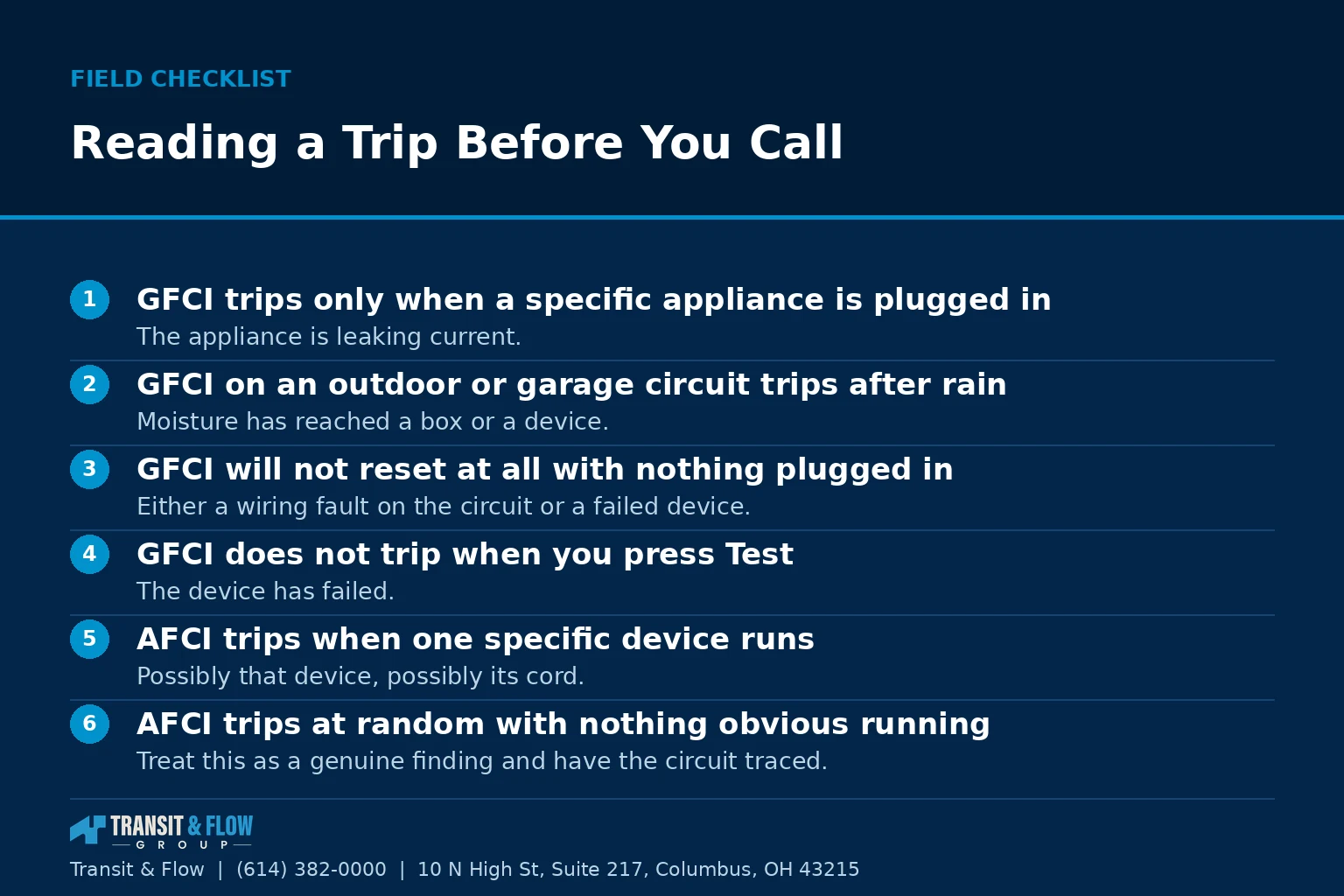
- GFCI trips only when a specific appliance is plugged in. The appliance is leaking current. Stop using it. The device is working.
- GFCI on an outdoor or garage circuit trips after rain. Moisture has reached a box or a device. Real finding, needs correction, not a defective GFCI.
- GFCI will not reset at all with nothing plugged in. Either a wiring fault on the circuit or a failed device. Electrician.
- GFCI does not trip when you press Test. The device has failed. Replace it. This is the most important sentence in this article because the failure is silent.
- AFCI trips when one specific device runs. Possibly that device, possibly its cord. Try a different outlet on a different circuit to separate the two.
- AFCI trips at random with nothing obvious running. Treat this as a genuine finding and have the circuit traced.
- An ordinary breaker trips when two appliances run together. Overload, not a fault. The answer is load redistribution or a dedicated circuit, never a larger breaker.
- Multiple different circuits trip with no pattern. The question moves to the panel itself.
A Practical Priority Order
- Test every GFCI in the house this week. Free, takes fifteen minutes, and it finds failed devices that have been providing nothing for years.
- Replace any GFCI that fails its test. Not a project, and not optional.
- Add GFCI protection where wet-location circuits lack it. Bathrooms, kitchen counters, garage, exterior, basement, laundry.
- Install whole-house surge protection at the panel, particularly if you have recently installed or plan to install high-value equipment.
- Address ungrounded circuits with a documented approach chosen by an electrician for your specific situation.
- Add AFCI protection during any panel work, since the incremental cost while the panel is already open is far lower than a separate visit.
- Refresh point-of-use protectors on anything expensive, and check that the indicator light on each one is still lit.
A Short Glossary
- Ground fault. Current leaving the intended circuit by an unintended path to earth.
- Arc fault. A sustained electrical discharge across a gap or a poor connection, capable of ignition at currents an ordinary breaker ignores.
- Transient. A voltage spike lasting a tiny fraction of a second. What surge devices exist to clamp.
- Combination device. A single unit providing both arc fault and ground fault protection.
- Nuisance trip. A trip with no underlying fault. Real, and far less common than it is blamed for.
- Downstream protection. A GFCI receptacle can protect additional receptacles wired after it, which is why a dead bathroom outlet is often fixed by resetting a device in the garage.
- Clamping. How a surge device works, diverting excess voltage rather than switching a circuit off.
Where Transit & Flow Group Fits
Transit & Flow Group coordinates electrical work across Columbus and Central Ohio and partners with properly licensed and insured specialty contractors when licensing is required. Our standard on protective devices is that a repeated trip is diagnosed before any device is replaced, and that no protective device is ever swapped for an ordinary breaker to quiet a symptom. Because surge events reach heating and cooling equipment and water heaters as readily as they reach electronics, we evaluate protection across the whole house rather than one circuit. To have your protection reviewed, request an assessment.
Frequently Asked Questions
What is the difference between GFCI, AFCI, and surge protection?
They address three unrelated failures. A GFCI watches whether the current going out equals the current coming back, and it protects people from shock and electrocution. An AFCI watches for the electrical signature of arcing, and it protects the building from fire. Surge protection clamps voltage spikes and protects equipment, not people and not the structure. Because they do different jobs, having one does not substitute for another.
Why does an ordinary circuit breaker not cover these situations?
An ordinary breaker protects the wire in the wall. It watches for current above what the conductor can safely carry and opens before the wire overheats, and it does that job well. The difficulty is that a current path through a person to ground can be dangerous at a tiny fraction of what a breaker tolerates, and an arcing connection inside a wall can start a fire while drawing current the breaker considers normal. That gap is exactly what the three protective technologies exist to fill.
How often should GFCI devices be tested, and what does a failed test mean?
Monthly is the common manufacturer recommendation, and following the instructions published with your specific device is the right standard. Realistically, testing quarterly and after any storm or basement moisture event puts a household well ahead of most. Press Test and power should drop, then press Reset and power should return. If pressing Test does nothing, the device has failed and needs replacement, and that failure is silent, since a GFCI that will not trip looks exactly like one that is protecting you.
An AFCI breaker keeps tripping. Should it be swapped for an ordinary breaker?
No. Sometimes the device is reacting to a specific appliance, and sometimes it has found exactly what it was installed to find, which is a real arcing condition inside a wall you cannot see. Replacing it with an ordinary breaker does not correct anything, it removes the only thing that noticed. The correct response is diagnosis, which means isolating whether the trip follows a specific device or a specific circuit and having a licensed electrician trace it. Panel work of this kind is licensed, permitted work, not a homeowner task.
Is whole-house surge protection enough, or are plug strips still needed?
Both, as layers. A device installed at the service clamps the large transients arriving from outside, from lightning nearby or utility switching, and that is the first layer. Point of use protectors handle what gets past that first layer and the transients your own house generates when large motors cycle. Surge protection is also consumable, meaning it degrades as it absorbs events, so check that the indicator light on each protector is still lit and treat a very old plug strip as an extension cord rather than a protective device.
What about ungrounded outlets in an older Central Ohio home?
This comes up constantly in older housing stock, and there is a recognized approach that allows a GFCI to be used where no equipment ground exists, with specific labeling required. It provides shock protection without providing a ground, which is an important distinction to understand before assuming the circuit has been brought up to current standards. Which approach is appropriate for your specific circuits is a determination for a licensed electrician, made against the code edition your jurisdiction has adopted, and it is not a shortcut to install yourself. Requirements have also expanded across code cycles, so confirm current requirements with your electrician and your building department rather than matching what an older house happens to have.
Sources
- U.S. Consumer Product Safety Commission, residential electrical safety and protective devices
- Ohio Construction Industry Licensing Board, electrical trade licensing
- City of Columbus, Get a Permit, permit application channels
About This Guide
Written and edited by Micheal Parker, founder of Transit & Flow Group. Published October 14, 2026. This guide is checked against the agency and code sources listed above, and it is revised when those sources change.
General contractor of record. Micheal Parker holds City of Columbus General Contractor Registration G12064, issued by the Columbus Department of Building and Zoning Services under Transit & Flow LLC and valid through June 30, 2027. Trade work that falls outside the scope of that registration is performed by licensed trade partners, and the responsible license holder is identified before work begins.
Transit & Flow Group, home and commercial services for Columbus and the surrounding Central Ohio communities. Phone (614) 382-0000. Email solutions@transitflowgroup.com. 10 N High St, Suite 217, Columbus, OH 43215. Contact our team or review the communities we serve.
