


Two furnace proposals for the same house can differ substantially in total and both be honest, because they cover different work. They can also differ because one of them left things out that will reappear later as change orders. You cannot tell which is which by looking at the totals, and the totals are the only thing most homeowners compare. This article gives you the line-by-line structure a complete proposal should have, so you can read three of them and see exactly where they diverge. It supports our furnace replacement guide.
In This Guide
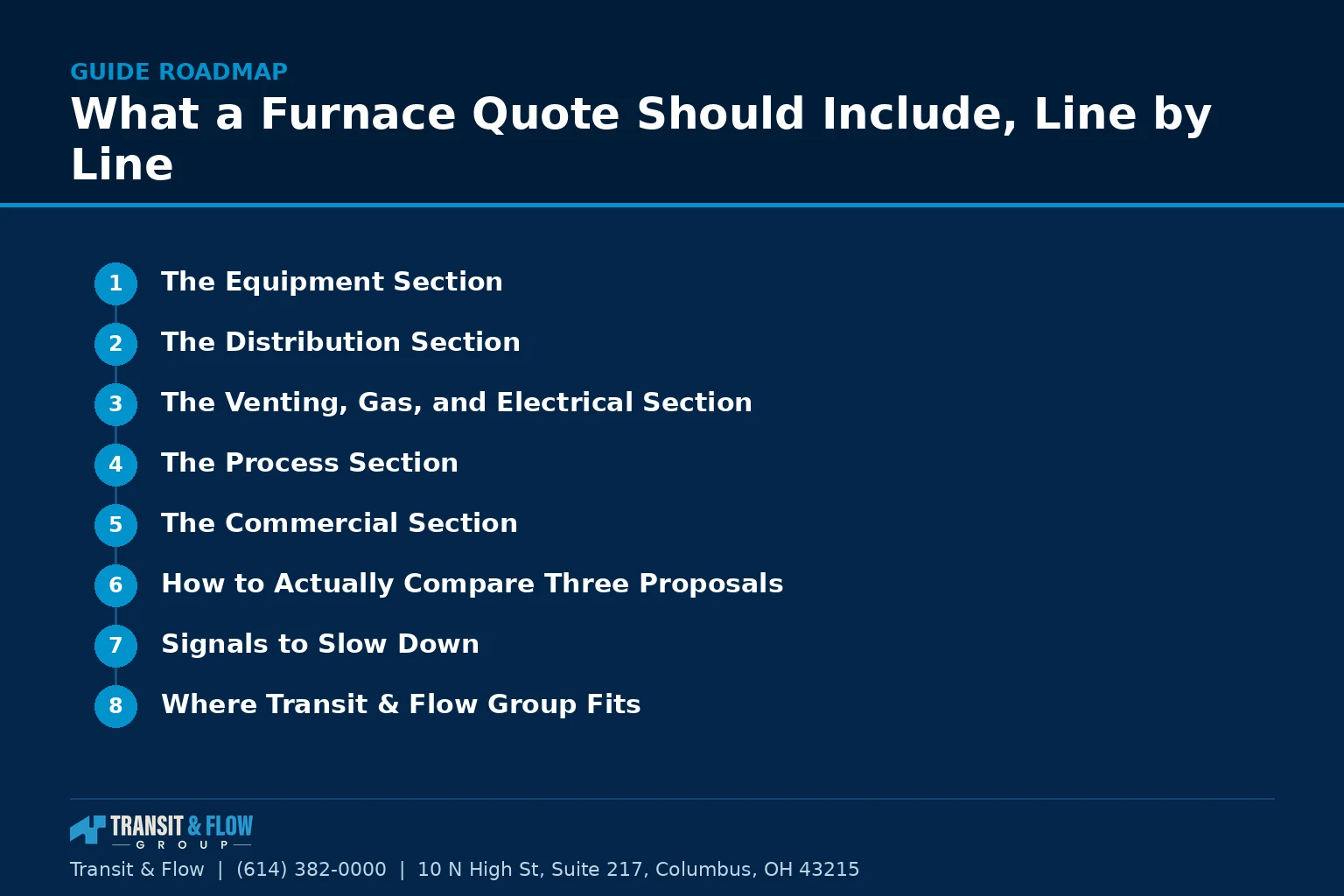
- The Equipment Section
- The Distribution Section
- The Venting, Gas, and Electrical Section
- The Process Section
- The Commercial Section
- How to Actually Compare Three Proposals
- Signals to Slow Down
- Where Transit & Flow Group Fits
- Frequently Asked Questions
Transit & Flow Group coordinates projects and partners with properly licensed and insured specialty contractors when licensing is required.
On cost, plainly: this article publishes no dollar figures, no ranges, and no rules of thumb about what a furnace replacement should total. Pricing depends on equipment selection, the venting path in your specific building, existing duct condition, gas and electrical work required, access to the mechanical space, permit requirements in your jurisdiction, disposal, and current market conditions for both equipment and labor. Any number published on a website would be wrong for your house and would set an expectation your actual project could not meet. What this article gives you instead is the structure that lets you evaluate the numbers you receive.
One boundary. This is purchasing guidance. Installation, venting, and gas work are licensed, permitted, and inspected activities in Ohio and are not homeowner tasks.
The Equipment Section
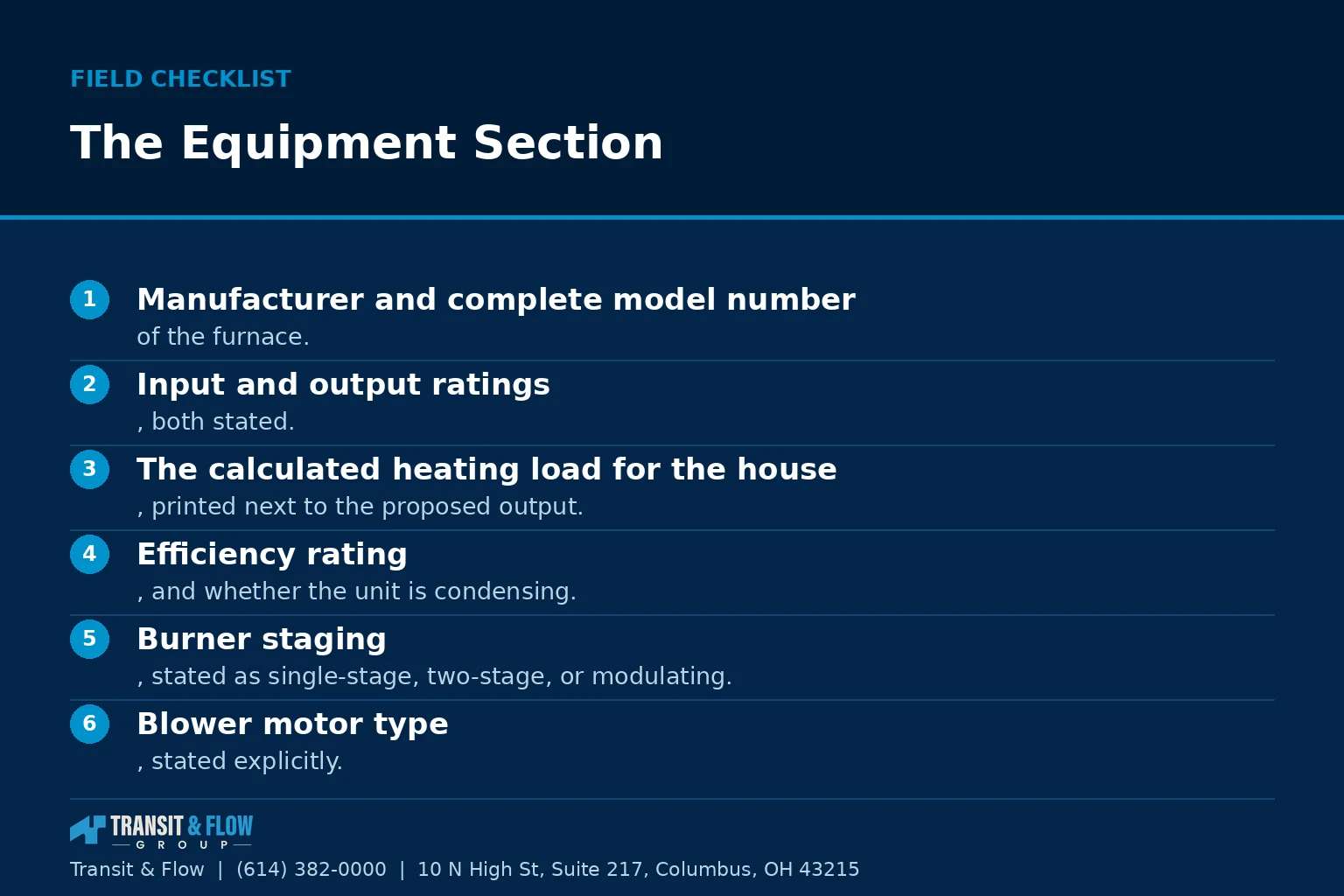
- Manufacturer and complete model number of the furnace. Not a series name. The full model number, which is what lets you look up specifications independently.
- Input and output ratings, both stated. Output is the number that has to match your calculated load.
- The calculated heating load for the house, printed next to the proposed output. If this is absent, ask for it before anything else.
- Efficiency rating, and whether the unit is condensing.
- Burner staging, stated as single-stage, two-stage, or modulating.
- Blower motor type, stated explicitly. This has a large effect on perceived comfort and it is frequently omitted.
- Cabinet dimensions and orientation, if the mechanical space is tight or the airflow configuration is changing.
- Thermostat, manufacturer and model, and confirmation it can control the staging the equipment offers.
- Filter type, size, and cabinet, including whether a media filter cabinet is included and where replacement filters come from.
The Distribution Section
This is the section that most often distinguishes a complete proposal from a swap, and it is where two totals genuinely diverge.
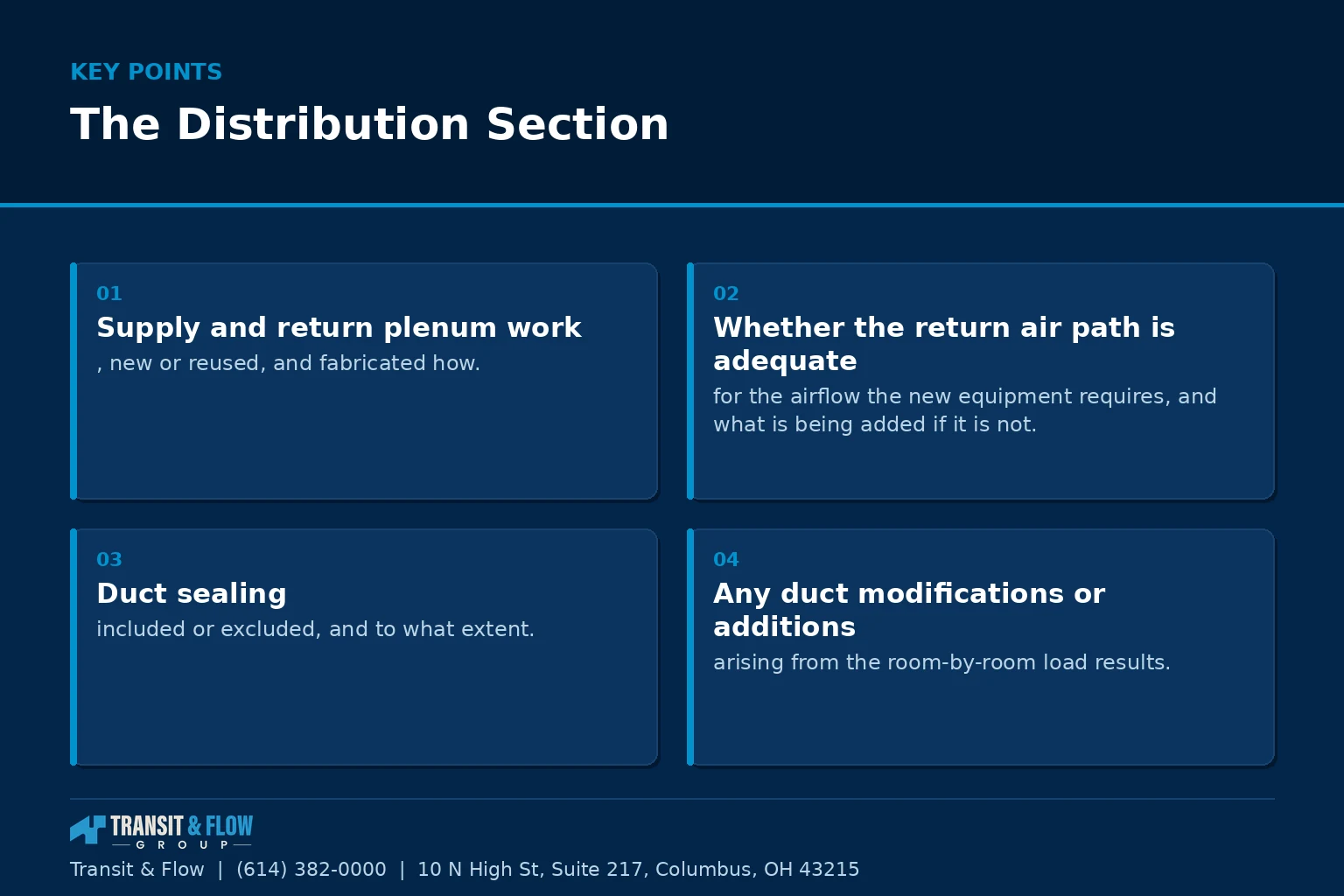
- Supply and return plenum work, new or reused, and fabricated how.
- Whether the return air path is adequate for the airflow the new equipment requires, and what is being added if it is not. Undersized returns are extremely common and they cap what any furnace can deliver.
- Duct sealing included or excluded, and to what extent.
- Any duct modifications or additions arising from the room-by-room load results.
- Register or grille replacement, if included.
- Zoning equipment, if proposed, with the reasoning.
The Venting, Gas, and Electrical Section
- Vent material, routing, and termination location, described specifically enough that you can picture where the pipe exits the building.
- Combustion air intake, routing and termination.
- Wall or roof penetration and exterior patching, named as included or excluded. This is a classic omission.
- Condensate handling on a condensing unit: drain route, pump if required, discharge point, and neutralization if applicable.
- The disposition of any existing chimney, and specifically what happens to a gas water heater left venting alone in it. A proposal silent on this is incomplete. Our water heater page covers the equipment side of that question.
- Gas piping, whether existing piping is adequate for the new input rating and what is being modified.
- Gas shutoff and sediment trap, included.
- Electrical circuit, whether the existing circuit and disconnect are adequate, and what is being added. Some installations require an electrical scope the mechanical contractor does not carry.
- Carbon monoxide alarm placement and whether any is included.
The Process Section
- Permit, named, with who applies, who pays, and who meets the inspector.
- Inspection, and confirmation the job is not considered complete until it passes.
- Removal and disposal of the old equipment.
- Protection of finished areas and cleanup.
- Expected duration and whether the house will be without heat overnight.
- Commissioning readings delivered in writing, covering combustion, temperature rise, static pressure, and gas pressure. This is the strongest single indicator of a professional installation and it costs nothing to request.
- Startup walkthrough, covering filter changes, thermostat operation, and what normal sounds like.
- Manufacturer registration, who performs it and by when, because extended coverage frequently depends on registration inside a limited window.
The Commercial Section
- Three warranty durations stated separately: heat exchanger, parts, and labor. Assume nothing is shared between them.
- What voids the warranty, particularly maintenance requirements.
- Payment schedule, with what triggers each payment. Deposit at signing, balance at completion after inspection is a normal residential structure.
- An explicit exclusions list. A proposal with no exclusions section has hidden its exclusions rather than eliminated them.
- Allowances, if any, and what happens if the actual condition exceeds the allowance.
- Change order procedure, confirming that price is agreed in writing before additional work proceeds.
- Proposal validity period, since equipment pricing does move.
- License number and insurance, verifiable independently rather than accepted as a forwarded document.
On incentives: if a proposal shows a rebate or a tax credit reducing your total, treat that reduction as contingent until verified. Program funds exhaust, qualifying lists change between periods, and some programs require pre-approval before installation begins. Ask the contractor to show the total both with and without the incentive, and confirm the program yourself with the administering utility or agency.
How to Actually Compare Three Proposals
- Build a single column list of every line item that appears in any of the three, then mark each proposal included, excluded, or silent. Silent is its own category and it is where the surprises live.
- Compare calculated load to proposed output across all three. If they disagree on the load, at least two of them did not calculate it.
- Compare the distribution scope before the equipment scope. This is usually the real difference and it is usually the difference that determines whether you are comfortable.
- Identify the cheapest proposal’s exclusions and price them. Frequently the lowest number becomes the middle number once the same work is covered.
- Ask each contractor one question the others raised. The quality of the answer separates the field faster than anything on paper.
- Weight commissioning and permit handling heavily. Both are cheap to promise, both are visible afterward, and both correlate strongly with everything else you cannot inspect.
Signals to Slow Down
- A price that expires today. Legitimate proposals have validity periods measured in weeks, not hours.
- A total with no line items. A single number for a multi-trade installation is not a proposal, it is a request for trust you have no basis to give yet.
- No permit mentioned. Skipping the permit transfers risk to you, complicates any future sale, and removes the independent check on the work.
- A large deposit demanded before any material is ordered.
- Refusal to provide a written diagnosis on the failure that started the conversation.
- Sizing stated without a load calculation after you asked for one.
- Silence on the chimney when the furnace is moving to sidewall venting and a gas water heater remains.
Option A is choosing on total price with a proposal you have not itemized. Option B is spending an hour building the comparison grid above before you decide. My recommendation is Option B without qualification. That hour is the highest-leverage hour in the entire project, it routinely changes which proposal wins, and it changes the conversation with every contractor you are still talking to, because they can tell immediately that you are reading the scope rather than the number.
Where Transit & Flow Group Fits
Transit & Flow Group coordinates heating and cooling projects across Columbus and Central Ohio and partners with properly licensed and insured specialty contractors when licensing is required. Our standard proposal states the calculated load next to the proposed output, itemizes distribution separately from equipment, names the venting termination and the chimney disposition explicitly, carries an exclusions section rather than hiding one, and commits to written commissioning readings at completion. To receive a proposal built that way, request an assessment.
Frequently Asked Questions
Why can two furnace proposals for the same house differ so much?
Because they frequently cover different work, and the totals do not show that. One may include plenum fabrication, return air corrections, duct sealing, venting penetration and exterior patching, and a chimney resolution, while the other quotes an equipment swap. Both can be honest. The only way to see where they diverge is to list every line item that appears in any of them and mark each proposal included, excluded, or silent.
What is the first thing to look for in a furnace proposal?
The calculated heating load for the house, printed next to the proposed output rating of the equipment. Output is the number that has to match the load, and a proposal that states a size without showing the calculation has not demonstrated that the equipment fits the building. If the load calculation is absent, ask for it before discussing anything else. When three proposals disagree on the load, at least two of them did not calculate it.
Why does the chimney matter when a furnace is replaced?
A high-efficiency condensing furnace typically vents through a wall or roof rather than the existing chimney, which changes the conditions inside that chimney for anything still venting into it. If a gas water heater remains on the old chimney, the proposal needs to say explicitly what happens to it. A proposal that is silent on this is incomplete, and silence on the chimney is one of the clearest signals to slow down. The correct disposition is a determination for the licensed installer working from the adopted code and the manufacturer’s published instructions.
Are written commissioning readings worth asking for?
They are the strongest single indicator of a professional installation, and requesting them costs nothing. Readings covering combustion, temperature rise, static pressure, and gas pressure show that the system was set up and verified rather than simply connected and left running. Because they are cheap to promise and visible afterward, they also correlate strongly with the quality of everything else you cannot inspect. Weight them heavily alongside permit handling when you compare proposals.
How should I treat a rebate or tax credit shown on a proposal?
Treat the reduction as contingent until you have verified it yourself. Program funds exhaust, qualifying equipment lists change between periods, and some programs require pre-approval before installation begins. Ask the contractor to show the total both with and without the incentive so you can see what you are actually committing to. Confirm current terms directly with the administering utility or agency, and confirm eligibility with a tax professional.
Is the lowest furnace proposal usually the best value?
Often it is simply the proposal that covers the least work. Identify what the cheapest one excludes or stays silent on, then price that scope, and the lowest number frequently becomes the middle number once every proposal covers the same job. A proposal with no exclusions section has hidden its exclusions rather than eliminated them. Spending an hour building a line-by-line comparison grid before deciding is the highest-leverage hour in the entire project.
Sources
- Ohio Construction Industry Licensing Board, HVAC trade licensing
- Ohio Attorney General, consumer protection resources
- City of Columbus, Get a Permit, mechanical permit channels
About This Guide
Written and edited by Micheal Parker, founder of Transit & Flow Group. Published November 1, 2026. This guide is checked against the agency and code sources listed above, and it is revised when those sources change.
General contractor of record. Micheal Parker holds City of Columbus General Contractor Registration G12064, issued by the Columbus Department of Building and Zoning Services under Transit & Flow LLC and valid through June 30, 2027. Trade work that falls outside the scope of that registration is performed by licensed trade partners, and the responsible license holder is identified before work begins.
Transit & Flow Group, home and commercial services for Columbus and the surrounding Central Ohio communities. Phone (614) 382-0000. Email solutions@transitflowgroup.com. 10 N. High St., Suite 217, Columbus, OH 43215. Contact our team or review the communities we serve.
