
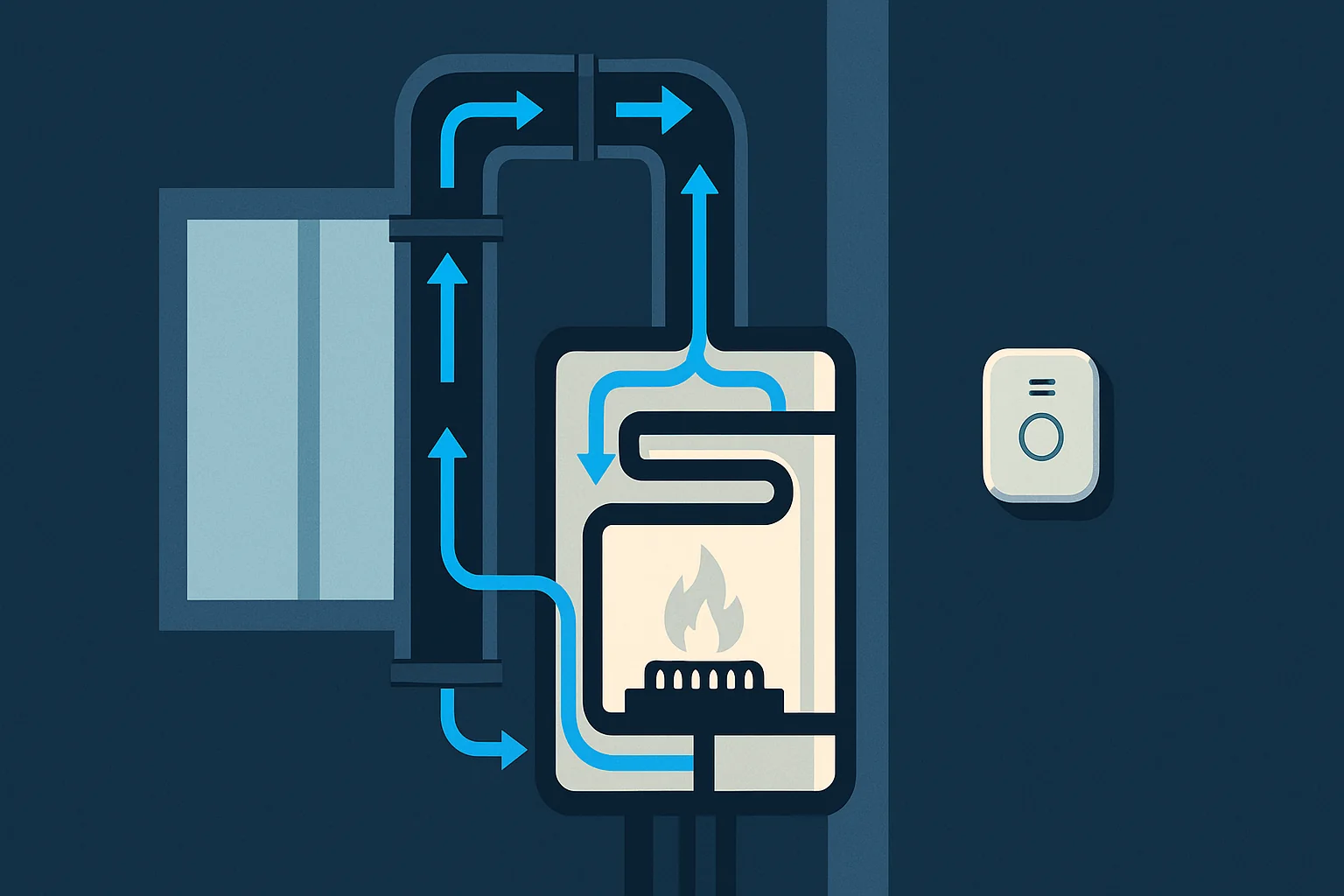

Carbon monoxide is the one home safety subject where the correct behavior is not intuitive. It has no smell, no color, and no taste. The early symptoms read as a mild illness, which is exactly why people go to bed instead of going outside. Every gas appliance in a house is a potential source, and the equipment that runs hardest is the heating system. This article covers what actually produces carbon monoxide in a home, where detectors belong, what a heating inspection should check, and the response sequence that matters when an alarm sounds. It extends the safety material in our furnace replacement guide.
In This Guide
- Where It Comes From
- Detectors: Where They Belong and What They Do Not Do
- What a Heating Inspection Should Actually Check
- Signals That Deserve a Same-Day Call
- A Short Glossary
- Where Transit & Flow Group Fits
- Frequently Asked Questions
Transit & Flow Group coordinates projects and partners with properly licensed and insured specialty contractors when licensing is required.
Read this first. If a carbon monoxide alarm sounds, get everyone outside into fresh air and call from outside. Do not open windows first, do not search for the source, and do not silence the alarm and go back to sleep. If anyone has a headache, dizziness, nausea, confusion, or unusual drowsiness, call emergency services from outside. If you smell gas, leave the building and call from outside. Combustion appliance service is licensed, permitted work and is not a homeowner task.
Where It Comes From
Carbon monoxide is a product of incomplete combustion. Any appliance that burns fuel makes some, and a correctly operating, correctly vented appliance sends it outside. Problems arise when combustion goes wrong, when venting fails, or when the two happen together.
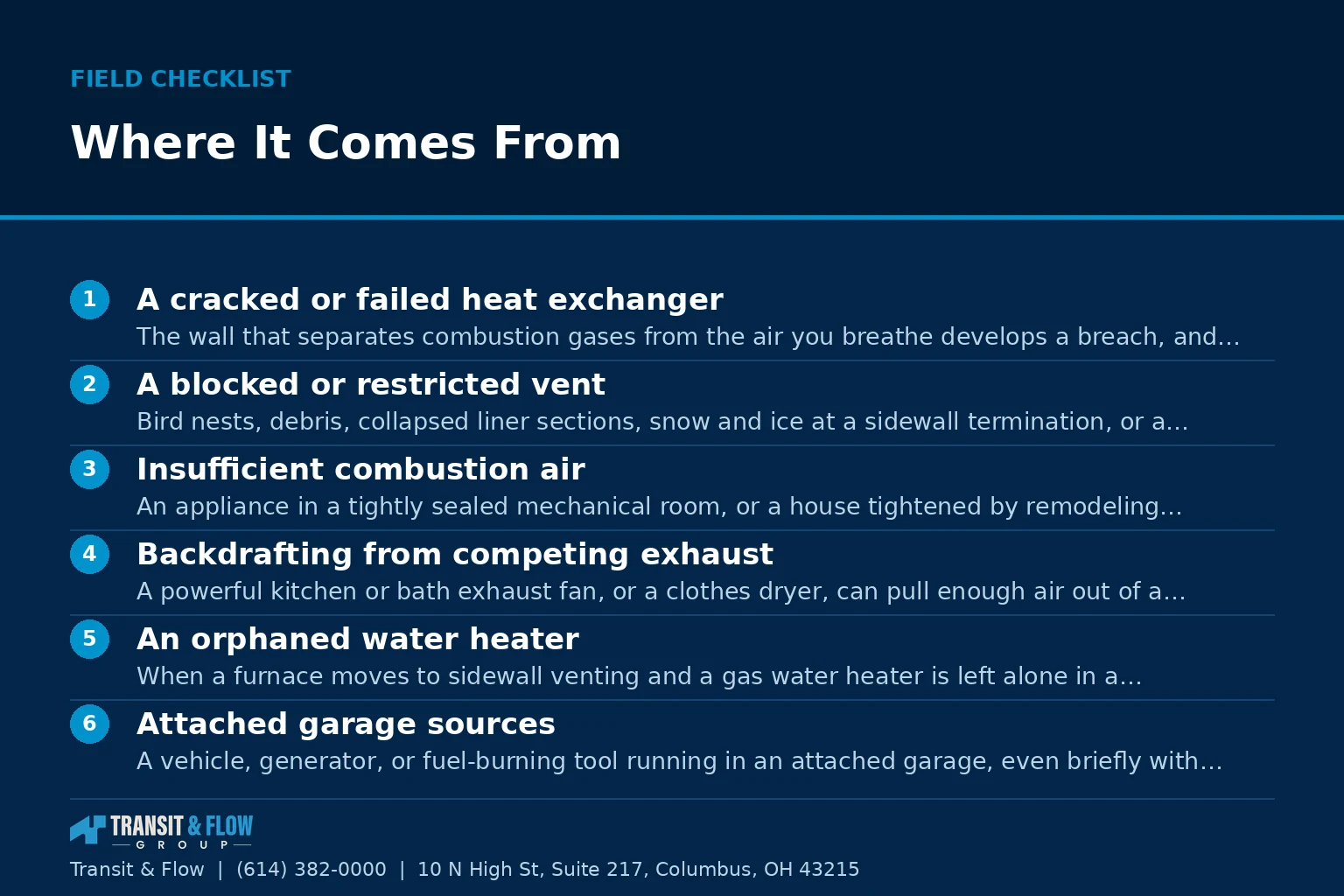
- A cracked or failed heat exchanger. The wall that separates combustion gases from the air you breathe develops a breach, and exhaust enters the supply air stream. This is the failure people know about, and it is a replacement condition, not a repair condition.
- A blocked or restricted vent. Bird nests, debris, collapsed liner sections, snow and ice at a sidewall termination, or a chimney that has partially failed internally. Exhaust that cannot leave the building comes back into it.
- Insufficient combustion air. An appliance in a tightly sealed mechanical room, or a house tightened by remodeling, without a deliberate air supply. Starved combustion is incomplete combustion.
- Backdrafting from competing exhaust. A powerful kitchen or bath exhaust fan, or a clothes dryer, can pull enough air out of a tight house to reverse the draft on a natural draft appliance and pull exhaust back down the flue.
- An orphaned water heater. When a furnace moves to sidewall venting and a gas water heater is left alone in a chimney sized for both appliances, the flue can be too large and too cool for the water heater to draft properly. This is a recognized condition with recognized remedies and it must be addressed as part of the furnace project. Our water heater page covers the equipment side.
- Attached garage sources. A vehicle, generator, or fuel-burning tool running in an attached garage, even briefly with the door open.
- Portable and unvented sources. Generators, charcoal, camp stoves, and unvented space heaters used indoors. Generators belong well away from the building with exhaust pointed away, never in a garage, never in a basement, never near a window or intake.
Detectors: Where They Belong and What They Do Not Do
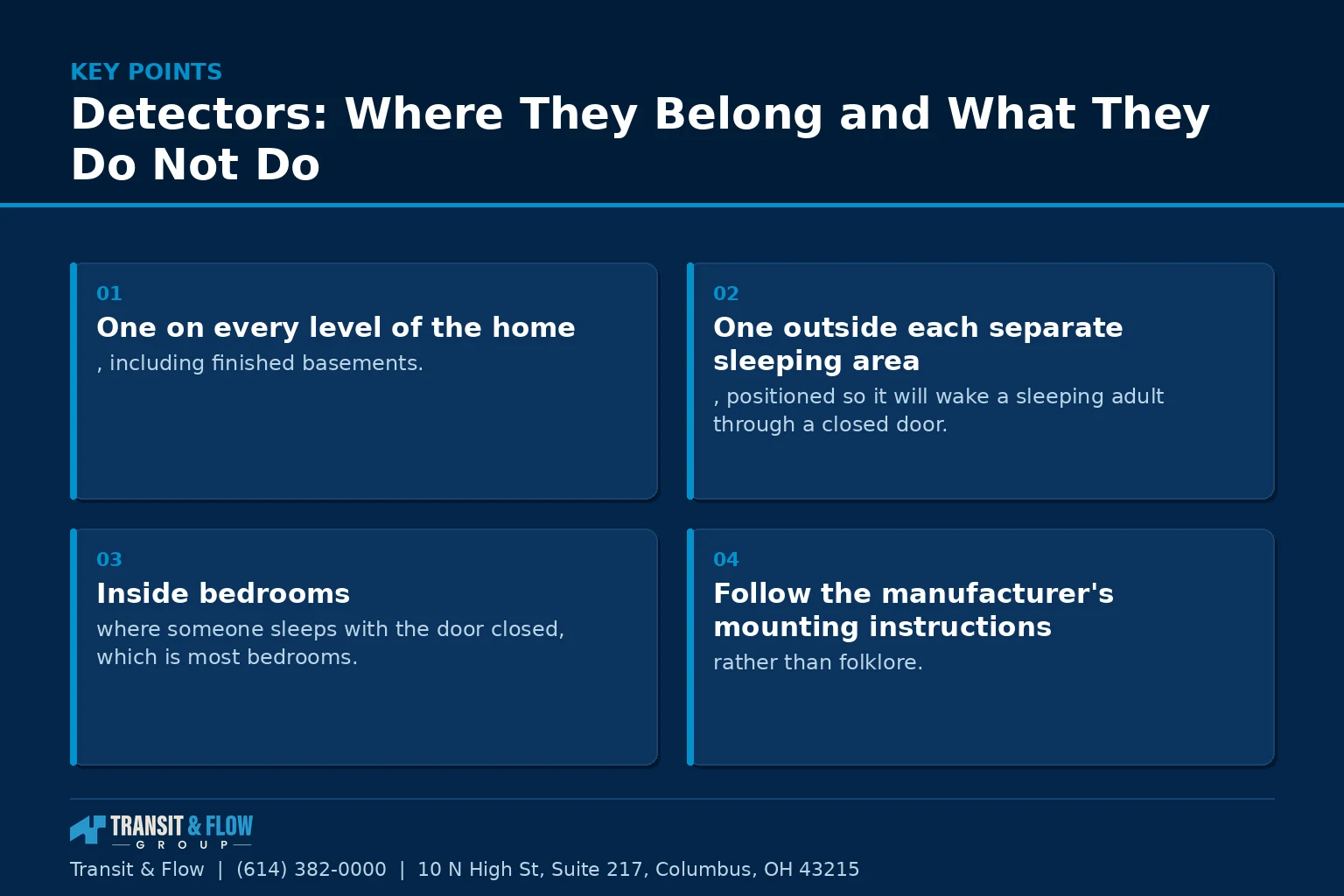
- One on every level of the home, including finished basements.
- One outside each separate sleeping area, positioned so it will wake a sleeping adult through a closed door.
- Inside bedrooms where someone sleeps with the door closed, which is most bedrooms.
- Follow the manufacturer’s mounting instructions rather than folklore. Carbon monoxide mixes with air rather than settling in a layer, and manufacturers specify placement for their own sensor design.
- Not directly above a fuel-burning appliance, not in a garage, not in a bathroom, and not within the manufacturer’s stated exclusion distance from cooking appliances or vents, all of which produce nuisance alarms that lead people to remove the device.
- Sensors expire. This is the point most homeowners miss. A carbon monoxide sensor has a service life stated by the manufacturer, typically counted in years from manufacture, after which the device must be replaced entirely. A powered detector past its sensor life is not a detector. Check the date printed on the back of every unit in the house tonight.
- Test monthly and replace batteries on schedule. Combination units or sealed long-life battery units reduce the number of ways this gets neglected.
What a detector does not do is warn you early enough to be your only protection. Alarm thresholds are set to avoid nuisance trips, which means a low-level exposure that produces headaches and fatigue over weeks can stay below the alarm point. Detectors are the last line. Correct combustion and correct venting are the first line, and they are verified by inspection rather than by silence.
What a Heating Inspection Should Actually Check
- A visual and instrument examination of the heat exchanger, with the method used stated rather than a bare pass or fail.
- Combustion analysis, with the measured readings written down. This is the single most informative item on the list and it is frequently skipped.
- A draft test on natural draft appliances, performed with the house in worst-case condition, meaning exhaust fans and the dryer running and the house closed up.
- Vent and chimney inspection along the full accessible run, checking connections, slope, support, corrosion, and the termination itself.
- Combustion air verification, confirming the appliance has the supply it requires for the space it occupies.
- Gas pressure and gas leak check at connections.
- Burner and ignition condition, including flame appearance and any signs of sooting or flame rollout.
- Temperature rise across the furnace, confirming airflow is inside the manufacturer’s stated range. Airflow problems and combustion problems are linked, which is why duct defects belong in a safety conversation and not only a comfort one.
- Carbon monoxide measurement in the living space, not only at the appliance.
- A written report with the readings, not a checklist of ticks. Numbers on paper are what let a second opinion mean anything.
On cost: this article contains no dollar figures on purpose. Inspection scope, appliance count, chimney condition, and any remediation required all vary by house, and a published number would set an expectation your specific building may not match. Ask what is included in the inspection and get the written report either way.
Signals That Deserve a Same-Day Call
- Symptoms that improve when you leave the house and return when you come back. This pattern is the classic presentation and it is the one people rationalize away.
- Soot or black staining around an appliance, a vent connector, or a chimney base.
- A yellow, lazy, or flickering burner flame where it should be crisp and blue.
- Visible corrosion or rust flakes on the vent connector or in the appliance area.
- Persistent moisture on windows near the appliance in cold weather, which can indicate exhaust entering the space.
- A vent connector that is loose, disconnected, sloping the wrong way, or unsupported.
- An alarm that has ever sounded, even once, even if it stopped. A single event is an event.
A Short Glossary
- Combustion analysis. Measurement of the exhaust stream with an instrument, producing numbers that describe how completely the appliance is burning fuel.
- Draft. The pressure difference that carries exhaust out of the building. Weak or reversed draft is how exhaust ends up indoors.
- Backdrafting. Exhaust flowing back down a vent into the building, usually because something else in the house is pulling harder.
- Heat exchanger. The barrier that transfers heat to your air while keeping combustion gases separate from it.
- Orphaned appliance. A gas appliance left venting alone into a chimney that was sized for it plus something that has been removed.
- Sealed combustion. A design drawing combustion air directly from outdoors through a dedicated pipe rather than from the room.
Option A is annual heating maintenance with a standard checklist. Option B is annual maintenance that requires combustion analysis, a worst-case draft test, and written readings delivered to you. My recommendation is Option B in every gas-heated home without exception, and it is worth changing providers to get it. The added scope is small, the readings create a year-over-year record that shows deterioration before it becomes a failure, and it converts an invisible risk into a documented number. Pair it with detectors that are inside their sensor life on every level.
Where Transit & Flow Group Fits
Transit & Flow Group coordinates heating and cooling projects across Columbus and Central Ohio and partners with properly licensed and insured specialty contractors when licensing is required. On any gas heating scope our standard is that combustion readings and draft results are delivered in writing, that the disposition of every appliance sharing a vent is stated explicitly, and that detector placement is reviewed as part of the work rather than left to the homeowner. Because venting frequently intersects electrical and water heater scope, one coordinator carries the project. To schedule a combustion safety evaluation, request an assessment.
Frequently Asked Questions
What should happen the moment a carbon monoxide alarm sounds?
Get everyone outside into fresh air and make the call from outside. Do not open windows first, do not search for the source, and do not silence the alarm and go back to sleep. If anyone has a headache, dizziness, nausea, confusion, or unusual drowsiness, call emergency services from outside. If you smell gas, leave the building and call from outside. Carbon monoxide in a home is a health question, and the assessment belongs to emergency responders and qualified professionals, not to the household.
Do carbon monoxide detectors expire?
Yes, and this is the point most homeowners miss. The sensor inside a carbon monoxide detector has a service life stated by the manufacturer, typically counted in years from the date of manufacture, after which the whole device is meant to be replaced rather than simply given a new battery. A powered detector that is past its sensor life is not a detector, even though it looks and sounds like one. Check the date printed on the back of every unit in the house, and follow the replacement interval published with your specific model.
Where should carbon monoxide detectors be placed?
One on every level of the home including finished basements, one outside each separate sleeping area positioned so it will wake a sleeping adult through a closed door, and one inside any bedroom where someone sleeps with the door closed. Follow the mounting instructions published by the manufacturer rather than folklore about high or low placement, because carbon monoxide mixes with air rather than settling in a layer and each manufacturer specifies placement for its own sensor design. Avoid locations directly above a fuel burning appliance, in a garage, in a bathroom, or inside the manufacturer’s stated exclusion distance from cooking appliances and vents, since those produce nuisance alarms that lead people to remove the device entirely.
If the detector has never alarmed, does that mean the heating system is safe?
No, and treating silence as verification is the common mistake. Alarm thresholds are set to avoid nuisance trips, which means an exposure low enough to stay below the alarm point can still produce headaches and fatigue over an extended period. Detectors are the last line of defense. Correct combustion and correct venting are the first line, and those are confirmed by inspection with instruments, not by the absence of an alarm.
What should an annual gas heating inspection include?
Ask for combustion analysis with the measured readings written down, a draft test on natural draft appliances performed with the house in worst case condition, examination of the heat exchanger with the method used stated rather than a bare pass or fail, inspection of the vent and chimney along the full accessible run, combustion air verification, a gas pressure and leak check, burner and ignition condition, temperature rise confirmed against the manufacturer’s stated range, and a carbon monoxide measurement taken in the living space rather than only at the appliance. Insist on a written report with the actual readings instead of a checklist of ticks, because numbers on paper are what let a second opinion mean anything. Combustion appliance service is licensed, permitted work and is not a homeowner task. The year over year record those readings create is what shows deterioration before it becomes a failure.
What is an orphaned water heater, and why does it come up during a furnace project?
It is a gas water heater left venting alone into a chimney that was sized for it plus an appliance that has since been removed, which typically happens when a furnace moves to sidewall venting. The concern is that the remaining flue can be too large and too cool for the water heater to draft properly. This is a recognized condition with recognized remedies, and it needs to be addressed as part of the furnace project rather than discovered afterward. The determination and the correction belong to a licensed professional working under the appropriate permit, and the disposition of every appliance sharing a vent should be stated explicitly in writing.
Sources
- U.S. Consumer Product Safety Commission, carbon monoxide hazard and alarm guidance
- Ohio Construction Industry Licensing Board, HVAC trade licensing
- City of Columbus, Get a Permit, mechanical permit channels
About This Guide
Written and edited by Micheal Parker, founder of Transit & Flow Group. Published November 6, 2026. This guide is checked against the agency and code sources listed above, and it is revised when those sources change.
General contractor of record. Micheal Parker holds City of Columbus General Contractor Registration G12064, issued by the Columbus Department of Building and Zoning Services under Transit & Flow LLC and valid through June 30, 2027. Trade work that falls outside the scope of that registration is performed by licensed trade partners, and the responsible license holder is identified before work begins.
Transit & Flow Group, home and commercial services for Columbus and the surrounding Central Ohio communities. Phone (614) 382-0000. Email solutions@transitflowgroup.com. 10 N. High St., Suite 217, Columbus, OH 43215. Contact our team or review the communities we serve.
