


Incentives for heating upgrades are real, and almost everything homeowners believe about them is out of date. Federal credits, state programs, and utility rebates each have their own qualifying equipment lists, their own paperwork, their own funding limits, and their own timing rules, and all of those move between program periods. This article does not tell you what any program pays. It tells you how to find out for yourself, from the authority that actually administers the money, before an incentive influences a purchase you cannot undo. It supports our furnace replacement guide.
In This Guide
- The Four Layers, and Why They Behave Differently
- The Verification Sequence
- What Contractors Can and Cannot Tell You
- Where the Money Usually Is
- A Decision Rule Worth Keeping
- Where Transit & Flow Group Fits
- Frequently Asked Questions
Transit & Flow Group coordinates projects and partners with properly licensed and insured specialty contractors when licensing is required.
Two boundaries, stated plainly. First, this article publishes no credit amounts, no percentages, no income thresholds, and no expiration dates, because every one of those changes and a stale number on a website is worse than no number at all. Second, this is not tax advice. Whether you can use a credit depends on your own tax situation and that is a question for a qualified tax professional, not for a contractor and not for an article.
The Four Layers, and Why They Behave Differently
- Federal tax credits. Claimed on your tax return after the fact rather than paid at purchase. They reduce tax owed, which means their value depends on your tax position. Qualifying efficiency thresholds are specific and equipment must meet them exactly, not approximately.
- State programs. Administered through Ohio agencies and sometimes delivered through partner organizations rather than directly. Availability, eligibility, and funding cycles vary, and some programs are income qualified.
- Utility rebates. Offered by your specific electric or gas utility, which means your neighbor on a different provider may have entirely different options. These are the ones most often paid quickly, and also the ones most often exhausted mid-year when funds run out.
- Manufacturer promotions. Offered by the equipment maker, usually seasonal, usually requiring a participating dealer and registration within a window. These are commercial offers, not public programs, and they carry no obligation to remain available.
The layers stack differently. Some can be combined, some reduce the basis of another, and some explicitly exclude equipment that received a different incentive. Assume nothing about stacking without written confirmation from each administrator.
The Verification Sequence
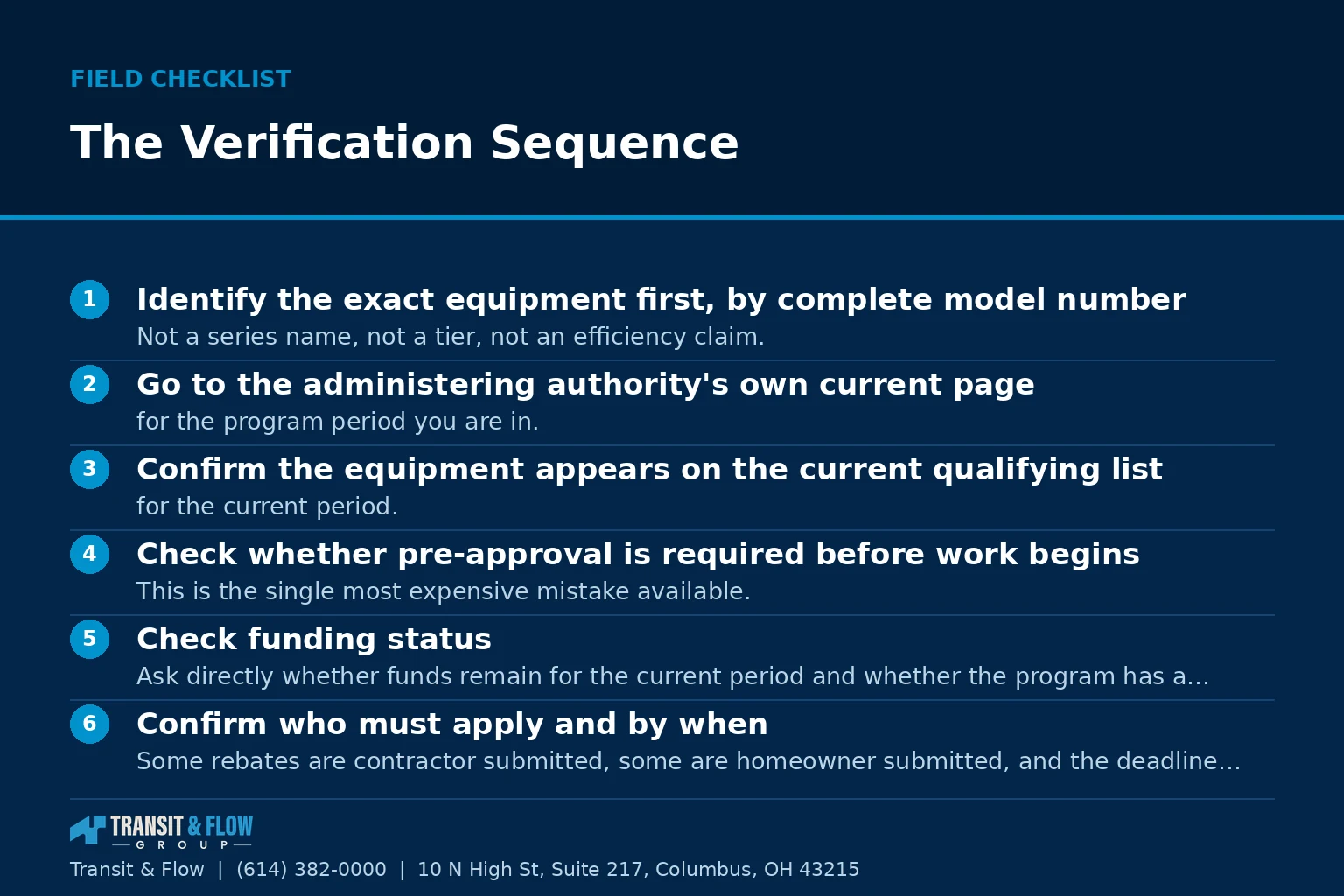
- Identify the exact equipment first, by complete model number. Not a series name, not a tier, not an efficiency claim. Qualifying lists are keyed to specific model numbers and a near match does not qualify.
- Go to the administering authority’s own current page for the program period you are in. For federal credits that means the Internal Revenue Service and the Department of Energy. For state programs it means the Ohio agency running the program. For utility rebates it means your own utility’s efficiency program page, reached from your bill rather than from a search result.
- Confirm the equipment appears on the current qualifying list for the current period. Lists are revised and equipment that qualified in a prior period is not automatically carried forward.
- Check whether pre-approval is required before work begins. This is the single most expensive mistake available. Some programs will not pay retroactively on an installation that started before an application was approved, and the money is simply gone.
- Check funding status. Ask directly whether funds remain for the current period and whether the program has a reservation mechanism.
- Confirm who must apply and by when. Some rebates are contractor submitted, some are homeowner submitted, and the deadline often runs from the installation date rather than the invoice date.
- Confirm what documentation is required and collect it during the project rather than after. Typically that means the itemized invoice, the model and serial numbers, proof of efficiency rating, the permit, and sometimes photographs.
- Get the total both with and without the incentive in writing from the contractor, and make the decision on the number without it.
What Contractors Can and Cannot Tell You
A good contractor knows the utility programs in their service territory well, because they submit the paperwork routinely. That knowledge is genuinely useful and worth asking for. What no contractor can do is confirm your eligibility for a tax credit, because that depends on facts about you they do not have. Treat a contractor’s incentive statement as a lead to verify, not as a finding.
- Reasonable: naming the utility program, providing the model numbers, handling submission, and telling you what has been paying out recently in their experience.
- Reasonable: showing the proposal with the incentive as a separate line rather than folded into the total.
- Not reasonable: presenting an incentive as guaranteed, deducting it from the contract price before it is approved, or discouraging you from verifying it yourself.
- Not reasonable: using an expiring incentive as pressure to sign the same day. Programs with real deadlines publish those deadlines publicly, so you can check the claim in a minute.
Where the Money Usually Is
Incentive programs concentrate on measures with the strongest measurable savings, which means the categories that tend to be supported are fairly predictable even when the amounts are not.
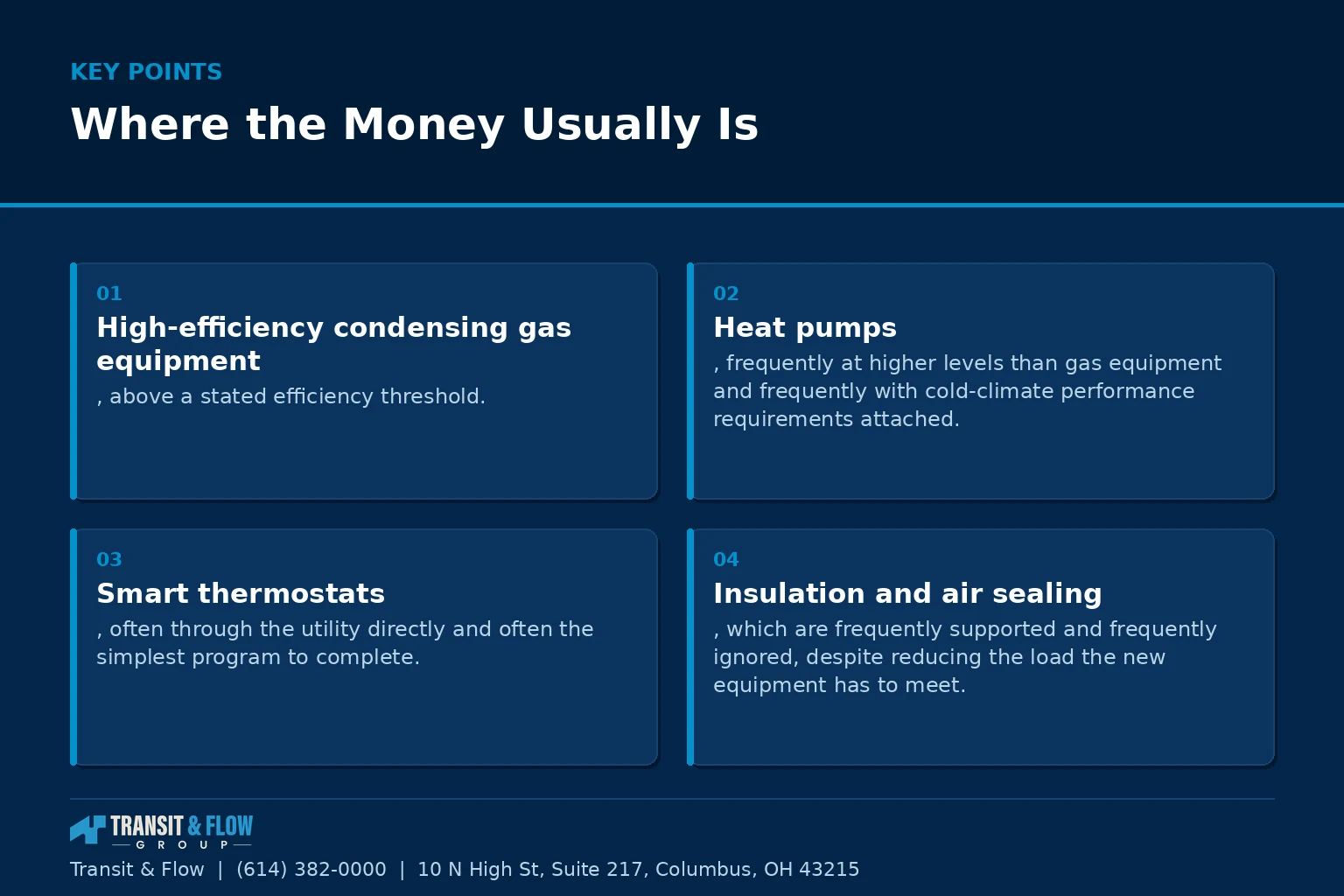
- High-efficiency condensing gas equipment, above a stated efficiency threshold. Our article on efficiency ratings explains what that threshold actually measures.
- Heat pumps, frequently at higher levels than gas equipment and frequently with cold-climate performance requirements attached. Our article on heat pumps in an Ohio winter covers the design questions that come with them.
- Smart thermostats, often through the utility directly and often the simplest program to complete.
- Insulation and air sealing, which are frequently supported and frequently ignored, despite reducing the load the new equipment has to meet.
- Energy audits, sometimes free or discounted through a utility, and sometimes a prerequisite for other rebates in the same program.
The audit point deserves emphasis. Where a program requires an audit before other measures qualify, doing the work first disqualifies it. Sequence matters more than speed.
A Decision Rule Worth Keeping
Option A is selecting equipment because an incentive makes a higher tier affordable. Option B is selecting the right equipment for the house first, then pursuing every incentive that equipment happens to qualify for. My recommendation is Option B without qualification. An incentive that shifts you into equipment that does not suit your ducts, your venting path, or your actual load has cost you more than it paid, and it will keep costing you for the life of the system. Incentives should reduce the price of a correct decision, never determine which decision you make.
Practical version: build the comparison on unincentivized totals, choose on scope and design, then apply for everything. If the incentive arrives, it is a discount on a good decision. If it does not, you still own the right system.
Where Transit & Flow Group Fits
Transit & Flow Group coordinates heating and cooling projects across Columbus and Central Ohio and partners with properly licensed and insured specialty contractors when licensing is required. Our standard is that proposals state the total both with and without any incentive, that model numbers are listed completely so you can verify qualification yourself, and that no incentive is deducted from a contract price before it is approved by the administering authority. To get a proposal built that way, request an assessment.
Frequently Asked Questions
Why will nobody just tell me what a heating incentive is worth?
Because the amounts, the qualifying equipment lists, the funding limits, and the timing rules all change between program periods, and a stale number is worse than no number. Federal credits, state programs, utility rebates, and manufacturer promotions each move on their own schedule. The only reliable figure comes from the authority that administers the money, on its current page, for the period you are in. Anything else, including a contractor’s recollection, is a lead to verify rather than a finding.
What is the difference between a tax credit and a utility rebate?
A federal tax credit is claimed on your return after the fact rather than paid at purchase, and it reduces tax owed, so its value depends on your own tax position. A utility rebate comes from your specific electric or gas provider, is usually paid more quickly, and is also the type most often exhausted mid-year when program funds run out. Because rebates are tied to your provider, a neighbor served by a different utility may have entirely different options. Whether you can actually use a credit is a question for a qualified tax professional, not for a contractor.
What is the most expensive mistake people make with these programs?
Starting the installation before checking whether pre-approval is required. Some programs will not pay retroactively on work that began before an application was approved, and at that point the money is simply gone with no appeal. The related trap is sequence: where a program requires an energy audit before other measures qualify, doing the work first disqualifies it. Confirm pre-approval and sequencing with each administrator before scheduling anything.
What should I verify before assuming a specific system qualifies?
Start with the complete model number rather than a series name, a tier, or an efficiency claim, because qualifying lists are keyed to specific models and a near match does not qualify. Then confirm that exact model appears on the current qualifying list for the current period, since lists are revised and prior-period qualification does not carry forward. Ask whether funds remain for the period and whether the program has a reservation mechanism. Confirm who must apply and by when, because some rebates are contractor submitted and the deadline often runs from the installation date rather than the invoice date.
What is fair to expect from a contractor on incentives, and what is not?
It is reasonable to expect them to name the utility program, provide complete model numbers, handle submission, describe what has been paying out recently in their experience, and show any incentive as a separate line rather than folded into the total. It is not reasonable for them to present an incentive as guaranteed, deduct it from the contract price before it is approved, or discourage you from verifying it yourself. Using an expiring incentive as pressure to sign the same day is also a signal worth noticing, since programs with real deadlines publish them publicly. Ask for the total both with and without the incentive in writing.
Should an available incentive change which equipment I buy?
No. Select the right equipment for the house first, then pursue every incentive that equipment happens to qualify for. An incentive that shifts you into equipment that does not suit your ducts, your venting path, or your actual load costs more than it pays, and it keeps costing for the life of the system. Build the comparison on unincentivized totals, choose on scope and design, then apply for everything. If the incentive arrives it is a discount on a good decision, and if it does not, you still own the right system.
Sources
- U.S. Department of Energy, Building Technologies Office, efficiency program and equipment guidance
- Ohio Construction Industry Licensing Board, HVAC trade licensing
- Ohio Attorney General, consumer protection resources
About This Guide
Written and edited by Micheal Parker, founder of Transit & Flow Group. Published November 8, 2026. This guide is checked against the agency and code sources listed above, and it is revised when those sources change.
General contractor of record. Micheal Parker holds City of Columbus General Contractor Registration G12064, issued by the Columbus Department of Building and Zoning Services under Transit & Flow LLC and valid through June 30, 2027. Trade work that falls outside the scope of that registration is performed by licensed trade partners, and the responsible license holder is identified before work begins.
Transit & Flow Group, home and commercial services for Columbus and the surrounding Central Ohio communities. Phone (614) 382-0000. Email solutions@transitflowgroup.com. 10 N. High St., Suite 217, Columbus, OH 43215. Contact our team or review the communities we serve.
