
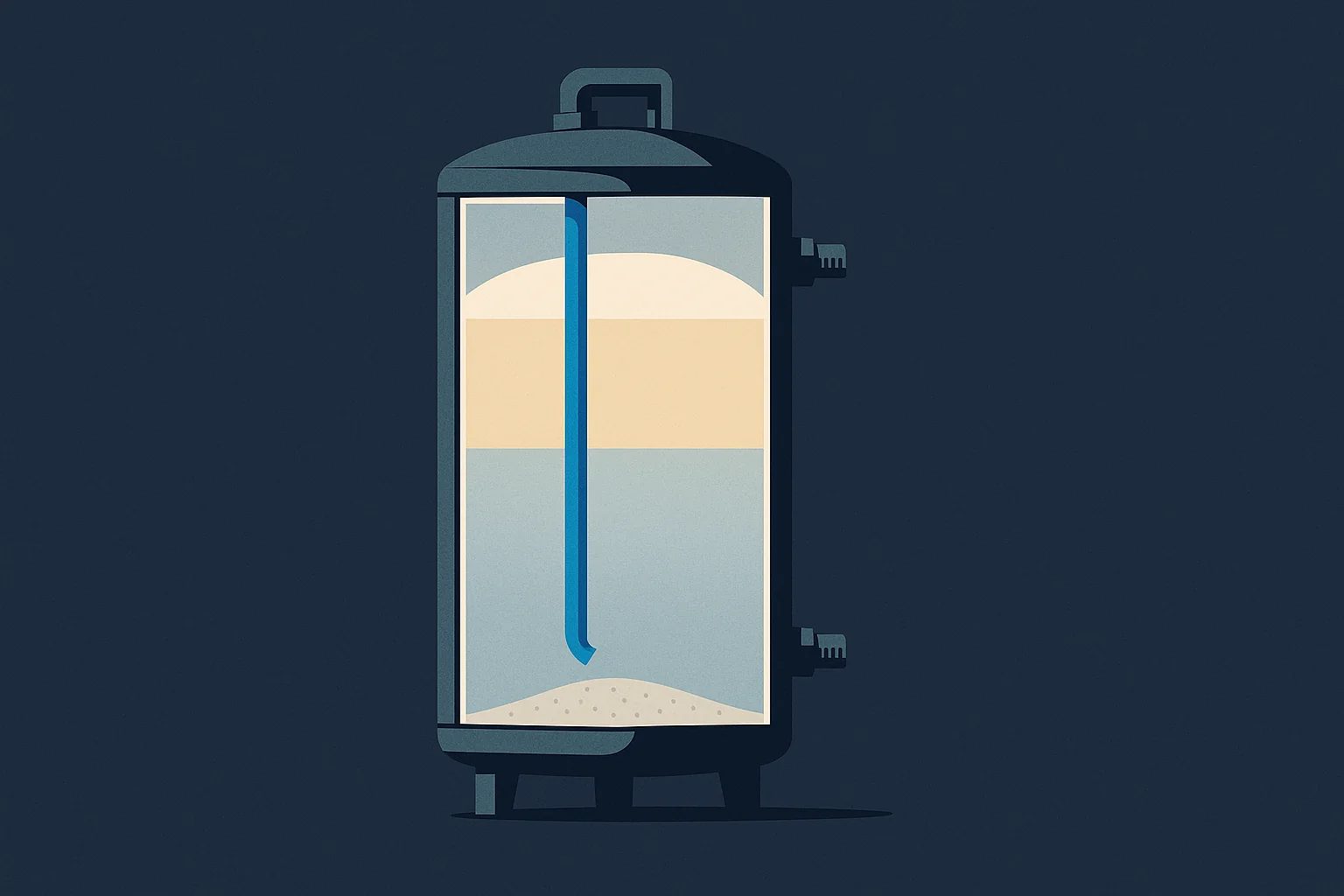

Running out of hot water is one symptom with a dozen causes, and most of them are not the water heater. Replacing the tank is the most common response and it is frequently the most expensive way to not fix the problem, because a household that outgrew its capacity, a failing mixing valve, or a heavily scaled tank each produce the same complaint at the shower head. This article walks the diagnosis in the order that eliminates causes cheaply first. It supports our water heater service work.
In This Guide
- Describe the Symptom Precisely First
- The Causes, Roughly in Order of How Often They Are Actually It
- What You Can Check Without Touching Anything
- What a Defensible Diagnosis Looks Like
- Where Transit & Flow Group Fits
- Frequently Asked Questions
Transit & Flow Group coordinates projects and partners with properly licensed and insured specialty contractors when licensing is required.
One boundary before anything else. Water heaters combine scalding water, pressurized vessels, and either gas combustion or high-current electrical circuits. Observation is a homeowner activity. Service is not. If you smell gas, leave the building and call from outside. Never adjust or cap a temperature and pressure relief valve, which is the safety device that prevents a tank from becoming a hazard.
Describe the Symptom Precisely First
The single most useful diagnostic step costs nothing and almost nobody performs it. “Not enough hot water” describes at least four different failures, and naming which one you have eliminates most of the possibilities immediately.
- Hot water runs out faster than it used to, but is properly hot while it lasts. This points at capacity, at sediment reducing usable volume, or at a lower element failing on an electric unit.
- Water is warm rather than hot, from the start. This points at the thermostat setting, a mixing valve, a failed upper element, or a crossed connection.
- Hot water temperature swings during a single shower. This points at a mixing valve, a pressure balancing valve at the fixture, or simultaneous demand elsewhere.
- Only one fixture has the problem. That is a fixture problem, not a water heater problem, and it is the cheapest outcome on this list.
- Recovery takes much longer than it used to. This points at burner or element condition, at heavy scale, or at a gas supply or venting issue.
Write down which of those describes your situation, when it started, and whether it appeared suddenly or drifted over months. Sudden onset points at a component failure. Gradual drift points at scale, at wear, or at changed household demand.
The Causes, Roughly in Order of How Often They Are Actually It
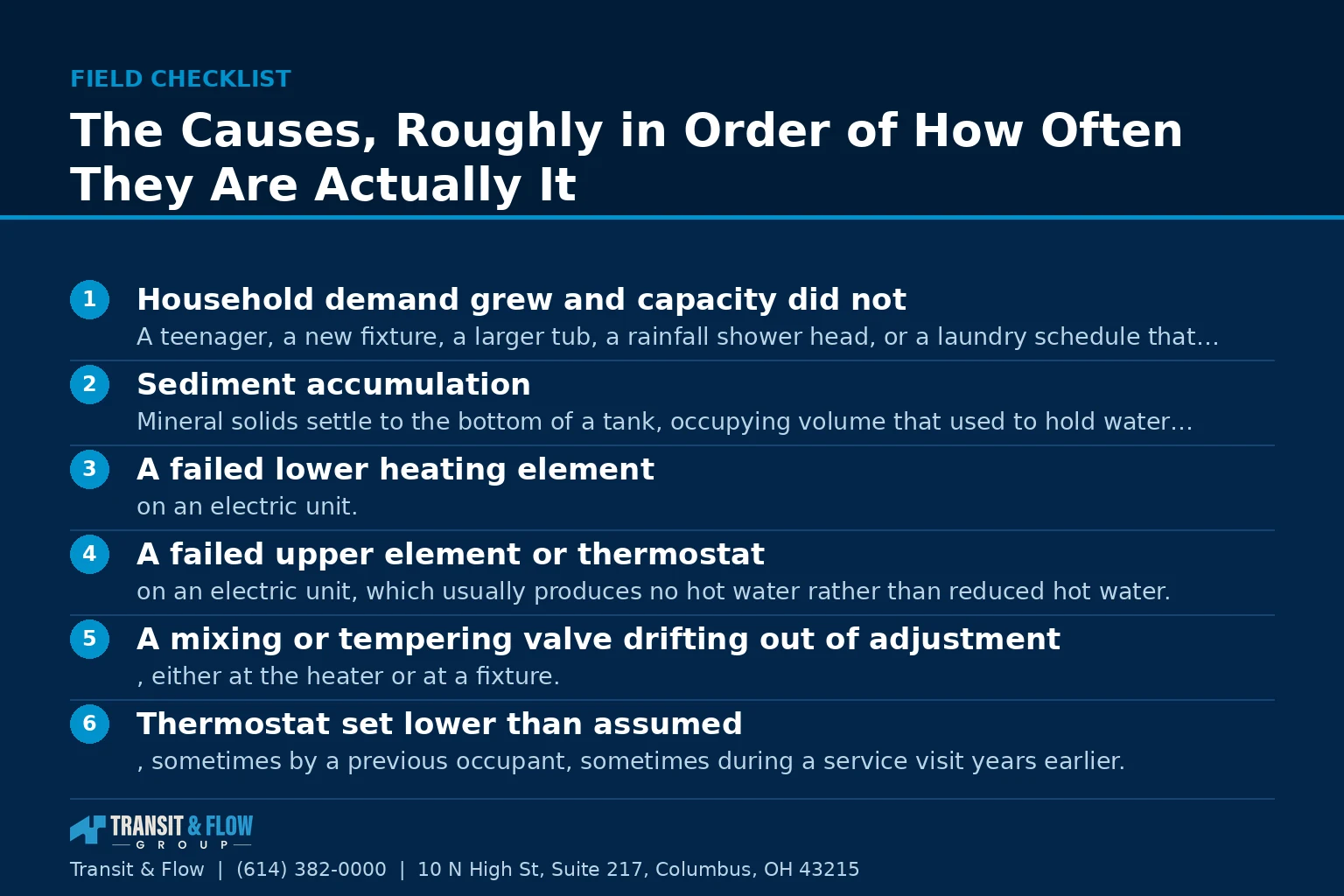
- Household demand grew and capacity did not. A teenager, a new fixture, a larger tub, a rainfall shower head, or a laundry schedule that overlaps morning showers. Nothing failed. The system was sized for a household that no longer exists.
- Sediment accumulation. Mineral solids settle to the bottom of a tank, occupying volume that used to hold water and insulating the burner from the water above it on a gas unit. Central Ohio water hardness makes this a routine finding rather than an exotic one. Symptoms include reduced usable capacity, slower recovery, and rumbling or popping during heating.
- A failed lower heating element on an electric unit. This produces the classic pattern of hot water that runs out unusually fast while still being properly hot, because only the upper portion of the tank is being heated.
- A failed upper element or thermostat on an electric unit, which usually produces no hot water rather than reduced hot water.
- A mixing or tempering valve drifting out of adjustment, either at the heater or at a fixture. This is frequently missed because attention goes to the tank while the valve quietly blends the temperature down.
- Thermostat set lower than assumed, sometimes by a previous occupant, sometimes during a service visit years earlier.
- A failing dip tube, which allows incoming cold water to mix at the top of the tank rather than being delivered to the bottom.
- Burner, gas supply, or venting problems on a gas unit, which reduce heat input. These belong in a combustion safety conversation as much as a comfort one, and our article on carbon monoxide safety covers why.
- A crossed hot and cold connection, usually created during a fixture or appliance installation, which lets cold water enter the hot line continuously.
- Recirculation loop problems in homes that have one, where a pump or check valve failure produces exactly this complaint.
What You Can Check Without Touching Anything
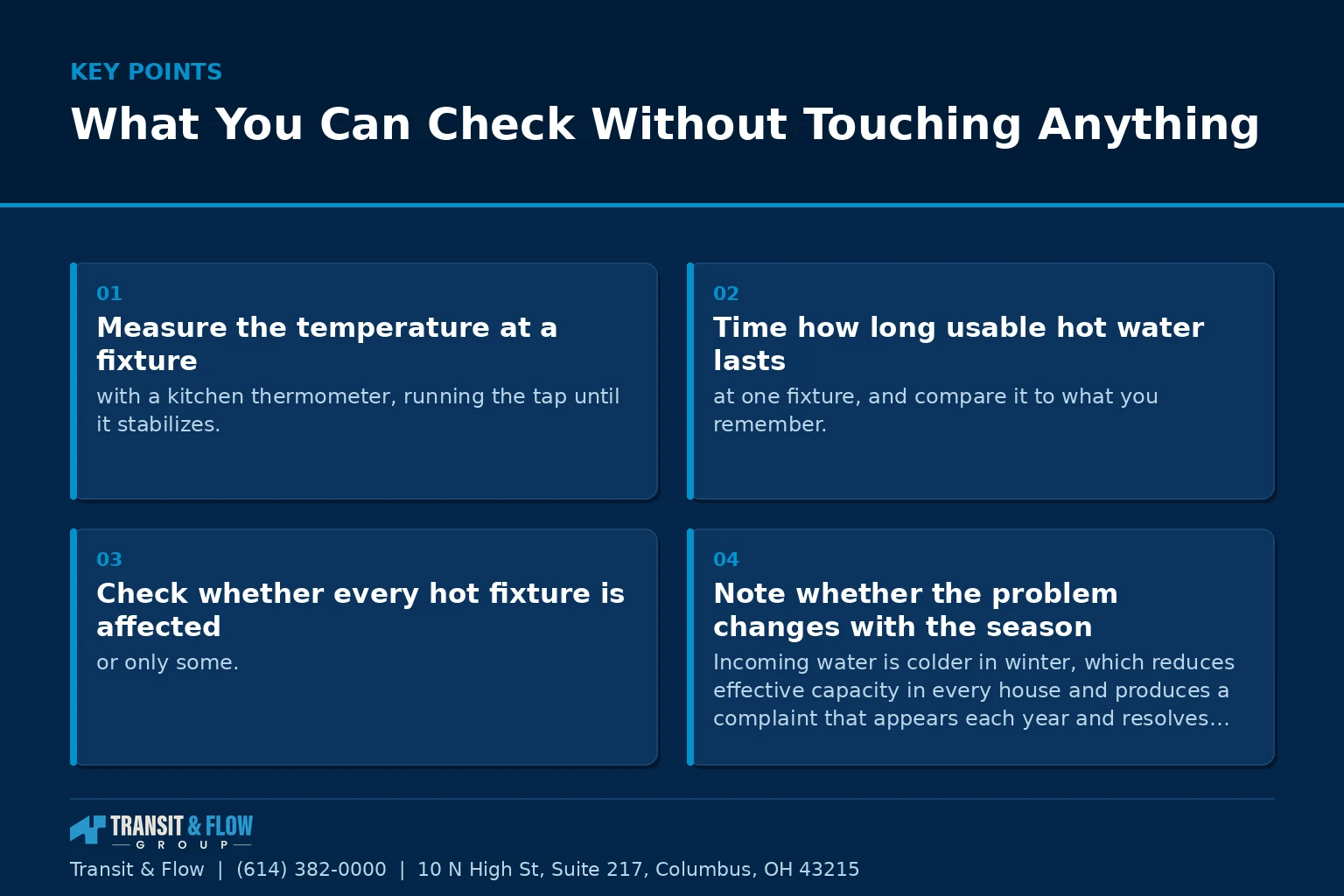
- Measure the temperature at a fixture with a kitchen thermometer, running the tap until it stabilizes. Write the number down. This single number separates a temperature problem from a volume problem.
- Time how long usable hot water lasts at one fixture, and compare it to what you remember. An actual duration is worth more than an impression.
- Check whether every hot fixture is affected or only some. Two minutes of walking the house eliminates the most expensive possibility.
- Note whether the problem changes with the season. Incoming water is colder in winter, which reduces effective capacity in every house and produces a complaint that appears each year and resolves each spring.
- Read the age from the serial number on the data plate, along with the capacity and the fuel type. Photograph the plate.
- Listen during a heating cycle for rumbling or popping, which is a sediment signature.
- Look at the floor and the base of the unit for staining, corrosion, or moisture, which changes the conversation from repair to replacement immediately.
- Note any recent household change that coincides with onset. New fixture, new appliance, new occupant, new schedule.
That set of observations, handed to a technician, shortens the visit and changes the recommendation you receive. It also gives you a basis to evaluate whether the recommendation matches the evidence.
What a Defensible Diagnosis Looks Like
- The symptom is named specifically, matching one of the patterns above rather than a general complaint.
- A measured delivery temperature is stated, not estimated.
- The component identified is named, along with how it was tested.
- What was found sound is stated, not only what was found faulty. A report that lists only problems has not eliminated anything.
- Household demand is discussed, because a capacity mismatch cannot be repaired and replacing with the same capacity will reproduce the complaint exactly.
- It is delivered in writing before a purchase decision is requested.
On cost: this article contains no dollar figures on purpose. The outcomes here range from a valve adjustment to a full replacement with venting and plumbing modifications, and any published range would be wrong for most readers. Get the written diagnosis first, then get pricing on the specific remedy it identifies.
Option A is replacing the water heater when hot water runs short. Option B is spending one service visit on a documented diagnosis before deciding anything. My recommendation is Option B in every case where the unit is not visibly leaking and is not near the end of its expected life. A meaningful share of these complaints resolve at a valve, an element, a thermostat setting, or a maintenance step, and the ones that genuinely need replacement are better served by a decision that also corrects the capacity mismatch rather than reproducing it. When the tank is leaking, skip straight to replacement and stop reading.
Where Transit & Flow Group Fits
Transit & Flow Group coordinates water heater projects across Columbus and Central Ohio and partners with properly licensed and insured specialty contractors when licensing is required. Our standard is that a measured delivery temperature and a named component finding are delivered in writing before any replacement is proposed, and that household demand is sized deliberately rather than matched to whatever is currently installed. Because water heater work regularly touches gas venting and heating scope in the same mechanical space, one coordinator carries the project. To get a documented diagnosis, request an assessment.
Frequently Asked Questions
Does running short on hot water mean the tank needs to be replaced?
Usually not, and replacement is the most common response as well as the most expensive way to leave the real problem in place. The same complaint at the shower head can come from household demand that grew while capacity stayed the same, a mixing valve drifting out of adjustment, a failed element on an electric unit, a thermostat someone set lower years ago, or sediment reducing usable volume. One documented service visit that names the component and states a measured delivery temperature is the step that separates those. The exception is a visibly leaking tank, which moves straight to replacement.
Why does the hot water run out quickly but still feel properly hot while it lasts?
That specific pattern is diagnostic, which is why describing the symptom precisely matters more than describing it loudly. Hot water that is genuinely hot and simply short points toward capacity, toward sediment occupying volume that used to hold water, or toward a failed lower element on an electric unit that leaves only the upper portion of the tank heated. Water that is warm rather than hot from the very start points somewhere else entirely, toward a thermostat setting, a mixing valve, an upper element, or a crossed connection. Write down which pattern you have before anyone opens a panel.
What is sediment and why does it come up so often here?
Mineral solids settle to the bottom of a tank over time, taking up volume that used to hold water and, on a gas unit, insulating the burner from the water above it. Central Ohio water hardness makes this a routine finding rather than an unusual one. The signatures are reduced usable capacity, slower recovery, and rumbling or popping during a heating cycle. Confirming it and deciding what to do about it are work for a licensed plumbing professional, not a homeowner task.
Only one fixture is giving me lukewarm water. Is the water heater the problem?
Probably not. When a single fixture is affected and the rest of the house is fine, the issue lives at that fixture rather than at the tank, and this article calls that the cheapest outcome on the list. Two minutes of walking the house and running each hot tap eliminates the most expensive possibility before anyone quotes you a replacement. Bring that observation to the technician, because it changes which components are worth testing.
Why does this happen every winter and then go away in the spring?
Incoming water is colder in winter, which reduces effective capacity in every house regardless of equipment condition. A complaint that appears reliably each cold season and resolves each spring is describing that seasonal swing rather than a failure. It can still mean the system is undersized for how the household actually uses hot water, which is a capacity conversation rather than a repair one. Noting the seasonal pattern is one of the observations worth handing to a technician.
Can I flush the tank or adjust the relief valve myself?
No. A water heater combines scalding water, a pressurized vessel, and either gas combustion or a high-current electrical circuit, and this article draws the line clearly: observation is a homeowner activity and service is not. Never adjust or cap the temperature and pressure relief valve, which is the safety device that keeps the tank from becoming a hazard. If you smell gas, leave the building and call from outside. Everything beyond looking, listening, measuring at a fixture, and photographing the data plate belongs to a licensed professional working under the manufacturer’s published instructions and the adopted code.
Sources
- U.S. Department of Energy, Building Technologies Office, water heating guidance
- Ohio Construction Industry Licensing Board, plumbing trade licensing
- City of Columbus, Get a Permit, plumbing permit channels
About This Guide
Written and edited by Micheal Parker, founder of Transit & Flow Group. Published November 15, 2026. This guide is checked against the agency and code sources listed above, and it is revised when those sources change.
General contractor of record. Micheal Parker holds City of Columbus General Contractor Registration G12064, issued by the Columbus Department of Building and Zoning Services under Transit & Flow LLC and valid through June 30, 2027. Trade work that falls outside the scope of that registration is performed by licensed trade partners, and the responsible license holder is identified before work begins.
Transit & Flow Group, home and commercial services for Columbus and the surrounding Central Ohio communities. Phone (614) 382-0000. Email solutions@transitflowgroup.com. 10 N. High St., Suite 217, Columbus, OH 43215. Contact our team or review the communities we serve.
