

Central Ohio water is hard. That is a measurable mineral content, not an opinion, and it is doing something to every water-using appliance and fixture in your home right now at a rate set by how much of it passes through. Most homeowners meet the consequences as a series of unrelated annoyances: a water heater that recovers slowly, a faucet aerator that clogs, a dishwasher that leaves film, a shower head that sprays sideways. They are one problem. This article explains what hardness actually does and what is worth doing about it. It supports our water heater and plumbing work.
In This Guide
- What Hardness Actually Is
- What It Does, System by System
- The Maintenance That Matters Without Any Equipment
- Treatment Options and What Each One Actually Does
- How to Evaluate a Treatment Proposal
- Where Transit & Flow Group Fits
- Frequently Asked Questions
Transit & Flow Group coordinates projects and partners with properly licensed and insured specialty contractors when licensing is required.
One boundary. Water treatment equipment connects to potable supply and sometimes to drainage and electrical circuits, all of which are permitted work in Ohio. Water heater service involves scalding water and a pressurized vessel. Never adjust or cap a temperature and pressure relief valve. If you smell gas, leave the building and call from outside.
What Hardness Actually Is
Hardness is dissolved calcium and magnesium, picked up as water moves through limestone and dolomite, which is exactly what much of Central Ohio sits on. It is not a contaminant and it is not a health concern. It is a chemistry problem with mechanical consequences.
Those minerals stay dissolved in cold water and come out of solution when the water is heated or when it evaporates. That single fact explains everything else in this article. It is why the water heater is the first casualty, why the effects concentrate on the hot side of the house, and why the residue appears on surfaces where water sits and dries rather than on surfaces where it flows.
Your actual hardness number depends on your supplier and, on a private well, on your own geology. Municipal systems publish water quality reports. Well owners need a test. Either way, get the number before buying anything, because the correct response to moderately hard water and to very hard water are different responses.
What It Does, System by System
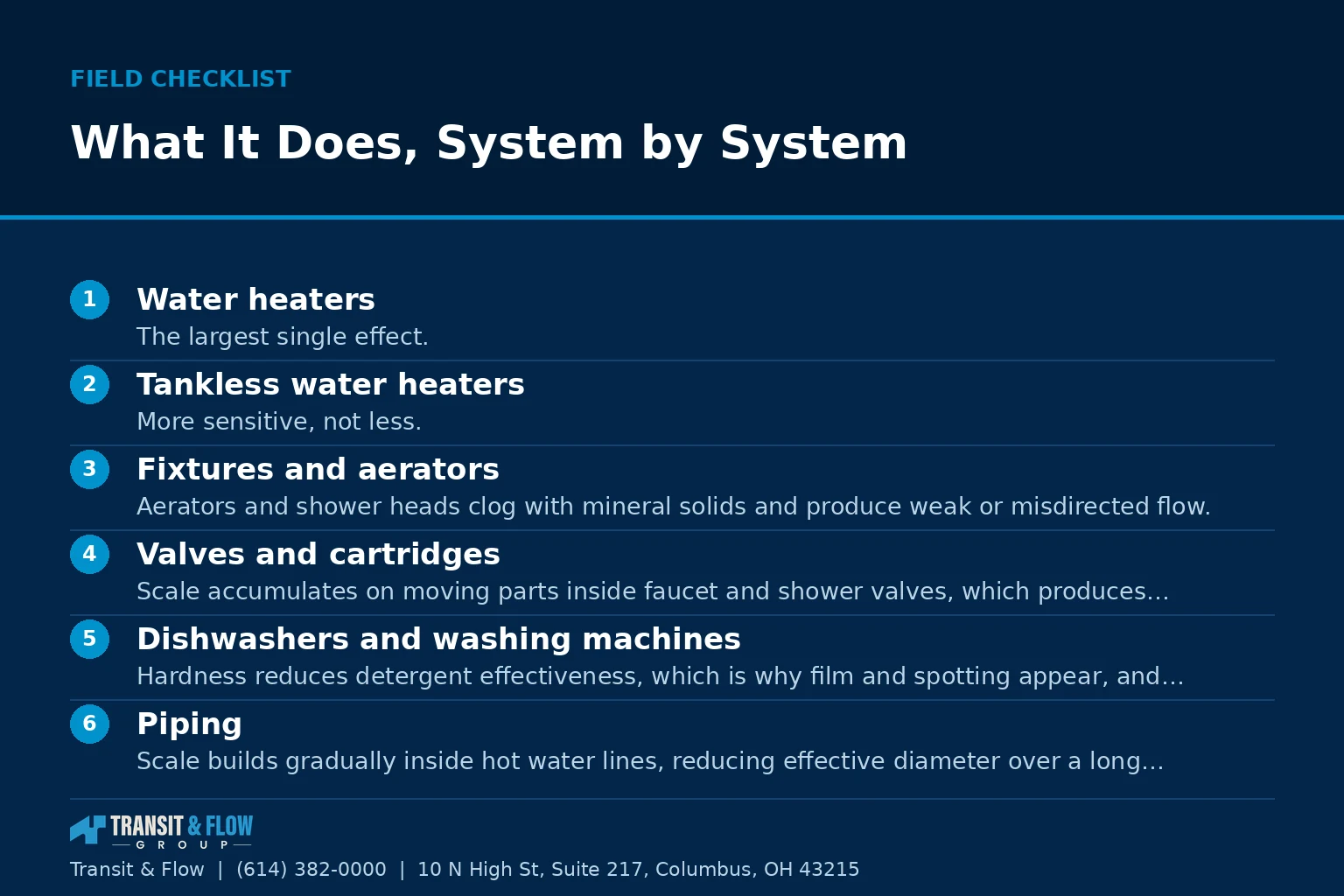
- Water heaters. The largest single effect. Minerals precipitate at the hottest surfaces and settle as a sediment bed at the bottom of a tank, where the burner is. That layer insulates the burner from the water, driving the steel above it hotter than intended, which accelerates vessel corrosion. It also occupies volume that used to hold hot water, so the practical symptom is a tank that seems to have shrunk. Our article on diagnosing a water heater that is not keeping up covers how that presents.
- Tankless water heaters. More sensitive, not less. A tankless unit heats water in a narrow heat exchanger passage, and scale forms exactly there. Manufacturers specify a descaling interval, and in hard water that interval is a genuine maintenance obligation rather than a suggestion.
- Fixtures and aerators. Aerators and shower heads clog with mineral solids and produce weak or misdirected flow. This is often mistaken for a pressure problem in the house when it is a debris problem at one fixture.
- Valves and cartridges. Scale accumulates on moving parts inside faucet and shower valves, which produces stiffness, drips, and shortened service life.
- Dishwashers and washing machines. Hardness reduces detergent effectiveness, which is why film and spotting appear, and scale accumulates on heating elements and internal passages.
- Piping. Scale builds gradually inside hot water lines, reducing effective diameter over a long period. On older galvanized systems the interaction with existing corrosion is worse.
- Surfaces. Spotting on glass, crusting at fixtures, and the mineral ring at the base of a water heater that sometimes gets mistaken for a leak. Sometimes it is a leak. That distinction is worth an inspection.
The Maintenance That Matters Without Any Equipment
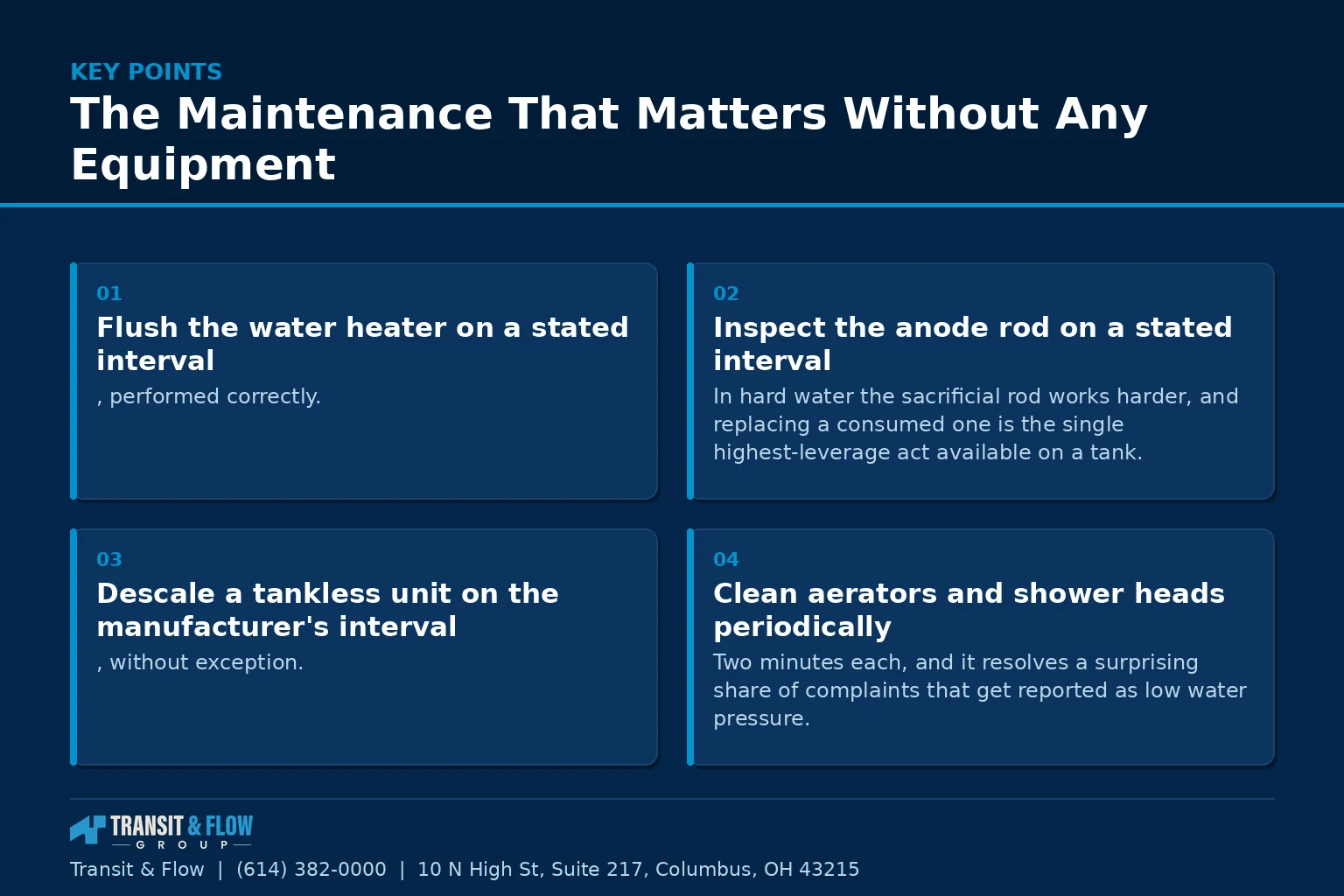
- Flush the water heater on a stated interval, performed correctly. This removes sediment before it becomes a thick insulating bed. One caution worth stating plainly: an aggressive flush on a heavily scaled older tank can reveal a weakness that the sediment was effectively masking. That is a reason to start the practice early and keep it up, not a reason to avoid it.
- Inspect the anode rod on a stated interval. In hard water the sacrificial rod works harder, and replacing a consumed one is the single highest-leverage act available on a tank.
- Descale a tankless unit on the manufacturer’s interval, without exception. This is the maintenance item most often skipped and most often decisive.
- Clean aerators and shower heads periodically. Two minutes each, and it resolves a surprising share of complaints that get reported as low water pressure.
- Keep the operating temperature reasonable. Higher setpoints accelerate scale formation as well as vessel wear, and the safe range is a conversation worth having with a licensed plumber rather than a dial to guess at.
- Verify the expansion tank, because a waterlogged one looks entirely normal while providing no protection at all.
Treatment Options and What Each One Actually Does
- Ion exchange softener. The conventional approach. It genuinely removes hardness minerals by exchanging them, which means it prevents scale rather than managing it. It requires salt, it requires a drain connection for regeneration, it uses water in the process, and it adds sodium or potassium to the treated water. It is the option with the longest track record and the clearest mechanism.
- Salt-free conditioners. These do not remove hardness. They alter how the minerals crystallize so they are less likely to adhere to surfaces. No salt, no drain, no regeneration water. Whether the effect is sufficient depends on your hardness level and your expectations, and claims in this category vary widely in how well they are supported. Ask what the specific mechanism is and what independent testing exists.
- Point of use treatment. Filtration or treatment at a single fixture. Useful for drinking water quality, largely irrelevant to protecting a water heater on the other side of the house.
- Doing nothing, deliberately. A legitimate choice at moderate hardness combined with disciplined flushing and anode maintenance. The right answer is not automatically equipment.
On cost: this article contains no dollar figures on purpose. Treatment equipment pricing varies with capacity, technology, whether a drain and an electrical outlet are already present at the installation point, plumbing modifications required to tie into the main, permit requirements, and ongoing consumables. Any published number would mislead. Get a scoped proposal against your tested hardness number and your actual plumbing layout.
How to Evaluate a Treatment Proposal
- Your measured hardness is stated as a number, from a test rather than from an assumption about the area.
- The equipment is sized to that number and your household usage, with the sizing logic explained rather than asserted.
- The mechanism is described accurately. A conditioner that does not remove hardness should not be described as a softener.
- Consumables and maintenance are stated up front, including salt consumption and service intervals.
- The installation scope is complete, naming the tie-in point, the drain provision, the electrical provision, and any bypass arrangement.
- The bypass is included, so outdoor spigots and irrigation are not treated unnecessarily.
- Permit responsibility is named.
- Nobody uses a scare demonstration in place of a test result. A tabletop precipitate demonstration is a sales device, not a measurement.
Option A is treating hardness at the whole house with equipment. Option B is testing first, then committing to disciplined water heater flushing, anode inspection, and tankless descaling, and adding equipment only if the tested number justifies it. My recommendation is Option B as the starting point in every case, because the maintenance is required regardless of whether you install equipment, and because a tested number turns the equipment question from a sales conversation into an engineering one. Where hardness tests high and the household includes a tankless unit or a recent water heater you intend to keep for its full life, equipment becomes straightforwardly worth it. Our guidance on water heater lifespan explains why the maintenance side moves the number more than most people expect.
Where Transit & Flow Group Fits
Transit & Flow Group coordinates plumbing and water heater projects across Columbus and Central Ohio and partners with properly licensed and insured specialty contractors when licensing is required. Our standard is that a hardness number is measured before any treatment equipment is proposed, that the mechanism of any recommended product is described accurately, and that maintenance obligations are stated in writing at the time of sale rather than discovered later. To get water tested and a scoped recommendation, request an assessment.
Frequently Asked Questions
Is hard water in Central Ohio a health concern?
No. Hardness is dissolved calcium and magnesium picked up as water moves through limestone and dolomite, which is what much of Central Ohio sits on. It is not a contaminant. It is a chemistry problem with mechanical consequences, and those consequences land on equipment and fixtures rather than on people.
Why does hard water affect the water heater first?
Because hardness minerals stay dissolved in cold water and come out of solution when water is heated. Inside a tank they precipitate at the hottest surfaces and settle as a sediment bed at the bottom, directly above the burner, where the layer insulates the burner from the water and drives the steel above it hotter than intended. That accelerates vessel wear and occupies volume that used to hold hot water, so the practical symptom is a tank that seems to have shrunk. The same chemistry is why the effects concentrate on the hot side of the house.
Are tankless water heaters immune to scale?
They are more sensitive, not less. A tankless unit heats water in a narrow heat exchanger passage, and scale forms exactly there. Manufacturers specify a descaling interval, and in hard water that interval is a genuine maintenance obligation rather than a suggestion. It is the maintenance item most often skipped and most often decisive for the life of the unit.
Do I need a water softener, or is maintenance enough?
Test first, because the correct response to moderately hard water and to very hard water are different responses. Disciplined water heater flushing, anode rod inspection, and tankless descaling are required regardless of whether equipment is installed, so that is the sensible starting point in every case. Where the tested number comes back high and the household includes a tankless unit or a recent water heater you intend to keep for its full life, treatment equipment becomes straightforwardly worth it. Doing nothing deliberately, paired with that maintenance, is a legitimate choice at moderate hardness.
What is the difference between a softener and a salt-free conditioner?
An ion exchange softener genuinely removes hardness minerals by exchanging them, so it prevents scale rather than managing it. It needs salt, a drain connection for regeneration, and water for the regeneration process, and it adds sodium or potassium to the treated water. A salt-free conditioner does not remove hardness at all; it alters how the minerals crystallize so they adhere less readily, with no salt, drain, or regeneration water. Whether that is sufficient depends on your hardness level and your expectations, so ask what the specific mechanism is and what independent testing supports it.
How do I tell a legitimate treatment proposal from a sales pitch?
A legitimate proposal states your measured hardness as a number from an actual test rather than an assumption about the area, and sizes the equipment to that number and your household usage with the sizing logic explained. It describes the mechanism accurately, so a conditioner that does not remove hardness is not called a softener. It states consumables and service intervals up front, names the tie-in point, drain provision, electrical provision, and bypass, and names who carries permit responsibility. A tabletop precipitate demonstration is a sales device, not a measurement, and it should never stand in for a test result.
Sources
- U.S. Department of Energy, Building Technologies Office, water heating efficiency guidance
- Ohio Construction Industry Licensing Board, plumbing trade licensing
- Ohio Attorney General, consumer protection resources on in-home sales
About This Guide
Written and edited by Micheal Parker, founder of Transit & Flow Group. Published November 25, 2026. This guide is checked against the agency and code sources listed above, and it is revised when those sources change.
General contractor of record. Micheal Parker holds City of Columbus General Contractor Registration G12064, issued by the Columbus Department of Building and Zoning Services under Transit & Flow LLC and valid through June 30, 2027. Trade work that falls outside the scope of that registration is performed by licensed trade partners, and the responsible license holder is identified before work begins.
Transit & Flow Group, home and commercial services for Columbus and the surrounding Central Ohio communities. Phone (614) 382-0000. Email solutions@transitflowgroup.com. 10 N. High St., Suite 217, Columbus, OH 43215. Contact our team or review the communities we serve.
