


The question arrives the same way in almost every case. The wood siding on a Central Ohio house is somewhere between twelve and thirty years past its last serious coating cycle, the south and west elevations look considerably worse than the north and east, and two contractors have delivered two proposals that are not remotely comparable. One is a paint job. One is a replacement. The homeowner is trying to decide between them on price, which is the one basis on which they cannot honestly be compared.
In This Guide
- What Coating Actually Is
- The Condition Assessment That Determines the Answer
- The Comparison in Ownership Terms
- The Arithmetic That Actually Matters
- A Note on Pre 1978 Housing
- The Items That Separate a Real Proposal From a Number
- On Cost
- Glossary
- The Decision
- Where Transit & Flow Group Fits
- Frequently Asked Questions
Paint and replacement do different things over different periods, and they leave the house in different conditions afterward. The useful comparison is not what each costs this spring. It is what each commits you to over the years you plan to own the house, and what each does to the wall underneath.
What Coating Actually Is
A coating on wood siding is a sacrificial layer. It is designed to fail slowly so the substrate does not. Ultraviolet exposure breaks down the binder, moisture cycling moves the wood beneath it, and the coating loses adhesion gradually, first at the surfaces with the most sun and the most water. This is normal and expected. A coating that has failed on schedule is not a defect. It is a system that worked and now needs renewal.
What determines the length of that cycle is mostly preparation and substrate condition, not the price of the paint. A coating applied over sound, dry, properly prepared wood with sealed end grain lasts far longer than the same coating applied over a surface that was pressure washed on Tuesday and painted on Wednesday. Moisture trapped under a fresh coating is the single most common reason a repaint fails early, and it is invisible on the day the crew leaves.
The Condition Assessment That Determines the Answer
Neither option is correct in the abstract. What decides it is the condition of the existing wood and the condition of what is behind it. These are the subjects a competent assessment records.
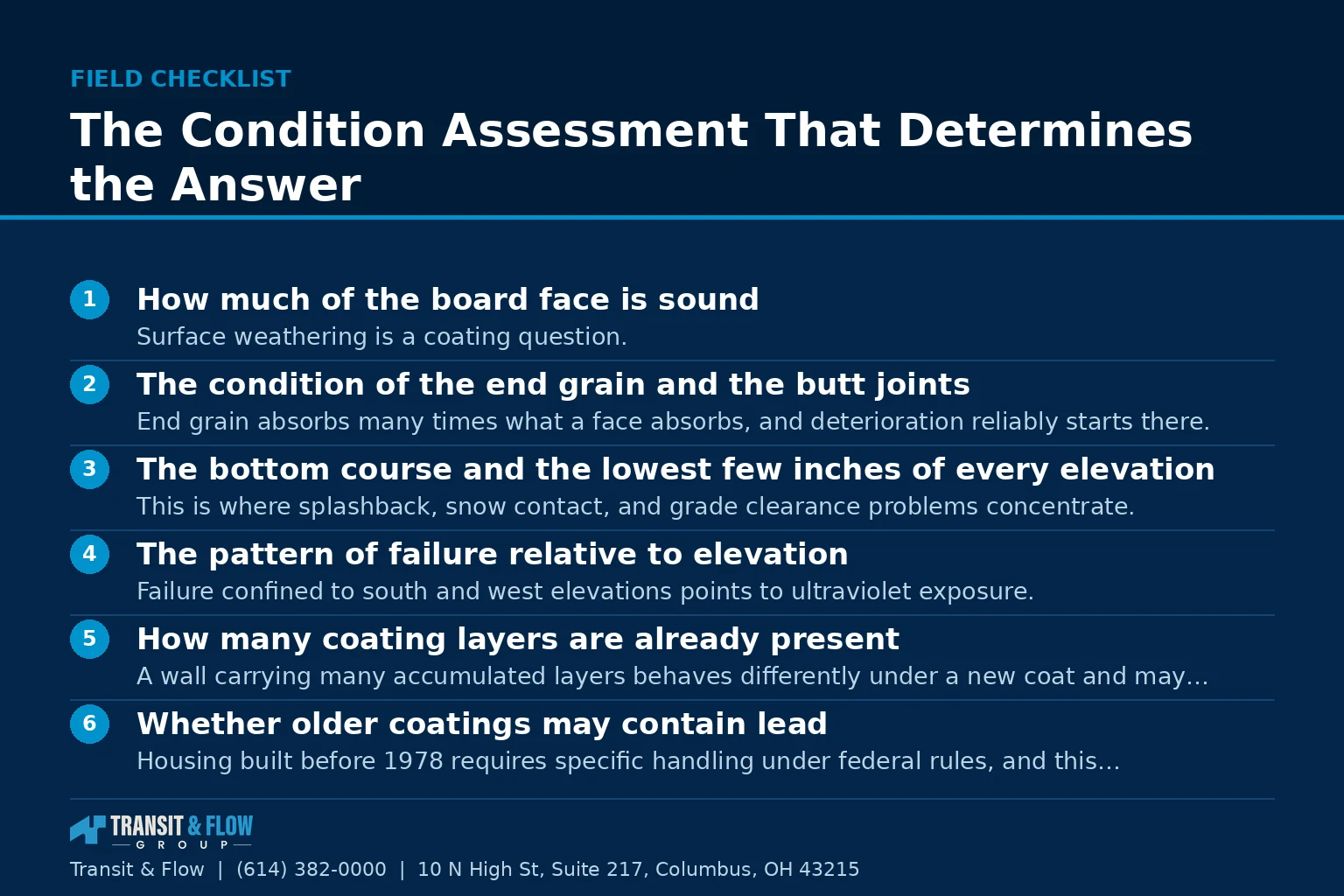
- How much of the board face is sound. Surface weathering is a coating question. Softness, punkiness, and loss of section are a replacement question.
- The condition of the end grain and the butt joints. End grain absorbs many times what a face absorbs, and deterioration reliably starts there.
- The bottom course and the lowest few inches of every elevation. This is where splashback, snow contact, and grade clearance problems concentrate.
- The pattern of failure relative to elevation. Failure confined to south and west elevations points to ultraviolet exposure. Failure below windows, at inside corners, and below penetrations points to water.
- How many coating layers are already present. A wall carrying many accumulated layers behaves differently under a new coat and may require far more preparation.
- Whether older coatings may contain lead. Housing built before 1978 requires specific handling under federal rules, and this materially affects preparation scope on both paths.
- The condition of the water resistive barrier and sheathing. Only replacement gives access to this, and on many older walls it is the actual question.
- Whether the trim and the flashing details are intact. Coating over a bad flashing detail preserves the appearance of a wall that is still taking on water.
- Movement at fasteners and joints. Nail pops, cupping, and opened joints indicate a moisture cycle that a coating will not stop.
- How long you intend to own the house. This is not a building condition, but it changes the arithmetic more than any single building condition does.
The Comparison in Ownership Terms
| Dimension | Coating the existing wood | Replacing the cladding |
|---|---|---|
| What it addresses | Appearance and surface protection of sound wood | The full wall assembly, including what is behind the cladding |
| Recurrence | Repeats on a cycle that shortens as the substrate ages | Resets the clock, with maintenance depending on the material chosen |
| Access to the barrier and sheathing | None, the wall stays closed | Complete, and the only practical opportunity to correct it |
| Disruption | Days, exterior only, house remains fully occupied | Weeks, noisy, elevation by elevation |
| Preparation sensitivity | Very high, outcome depends almost entirely on prep and moisture | High, outcome depends on barrier and flashing detail work |
| Pre 1978 housing complication | Significant, disturbance of existing coatings is regulated | Also significant, removal is a disturbance activity |
| Effect on existing rot | Conceals it unless boards are replaced first | Exposes and allows correction of it |
| Best fit | Sound substrate, intact details, shorter remaining tenure | Deteriorating substrate, suspect details, longer tenure |
The Arithmetic That Actually Matters
Comparing a coating cycle to a replacement is not a matter of dividing one price by the other. Three factors distort that comparison in ways worth naming.
The first is that coating cycles shorten. A repaint on wood that was sound fifteen years ago may hold for a long interval. The next one, over a substrate that has absorbed another fifteen years of moisture cycling and now carries an additional coating layer, will not hold as long, and each subsequent cycle carries more carpentry within it. Assuming a constant interval across three cycles overstates the value of the coating path.
The second is that carpentry is the variable, not the paint. A repaint proposal that includes board replacement, trim replacement, and end grain sealing is a different product than one that includes washing and two coats. Two paint proposals can differ by a wide margin and both be honest, because they are describing different amounts of work.
The third is that only one of these paths tells you what is behind the wall. If the barrier is failed or the flashing details are wrong, coating the outside preserves the appearance of a wall that is quietly wetting its sheathing. That risk does not appear in either proposal, and it does not appear in any comparison of the two prices, but it is real and it is the reason the decision is not purely financial. The detail work that governs it is covered in our article on house wrap, flashing, and trim.
A Note on Pre 1978 Housing
Read this carefully. A large share of the housing stock in Columbus, Bexley, Clintonville, Grandview Heights, and the older parts of Worthington predates 1978, and coatings on those houses may contain lead. Federal rules govern how contractors disturb painted surfaces in pre 1978 target housing, including certification requirements and specific work practices. This article does not tell you whether your house is affected, it does not describe testing methods, and it does not describe how any surface should be prepared.
What it does say is that this belongs in the conversation before either proposal is priced, because it affects the scope on both paths. Ask any contractor bidding the work whether they are certified for the applicable rules and how that certification changes their approach on your house. The Environmental Protection Agency and the Ohio Department of Health publish current requirements and homeowner information, and those are the sources to rely on rather than a contractor’s summary of them.
The Items That Separate a Real Proposal From a Number
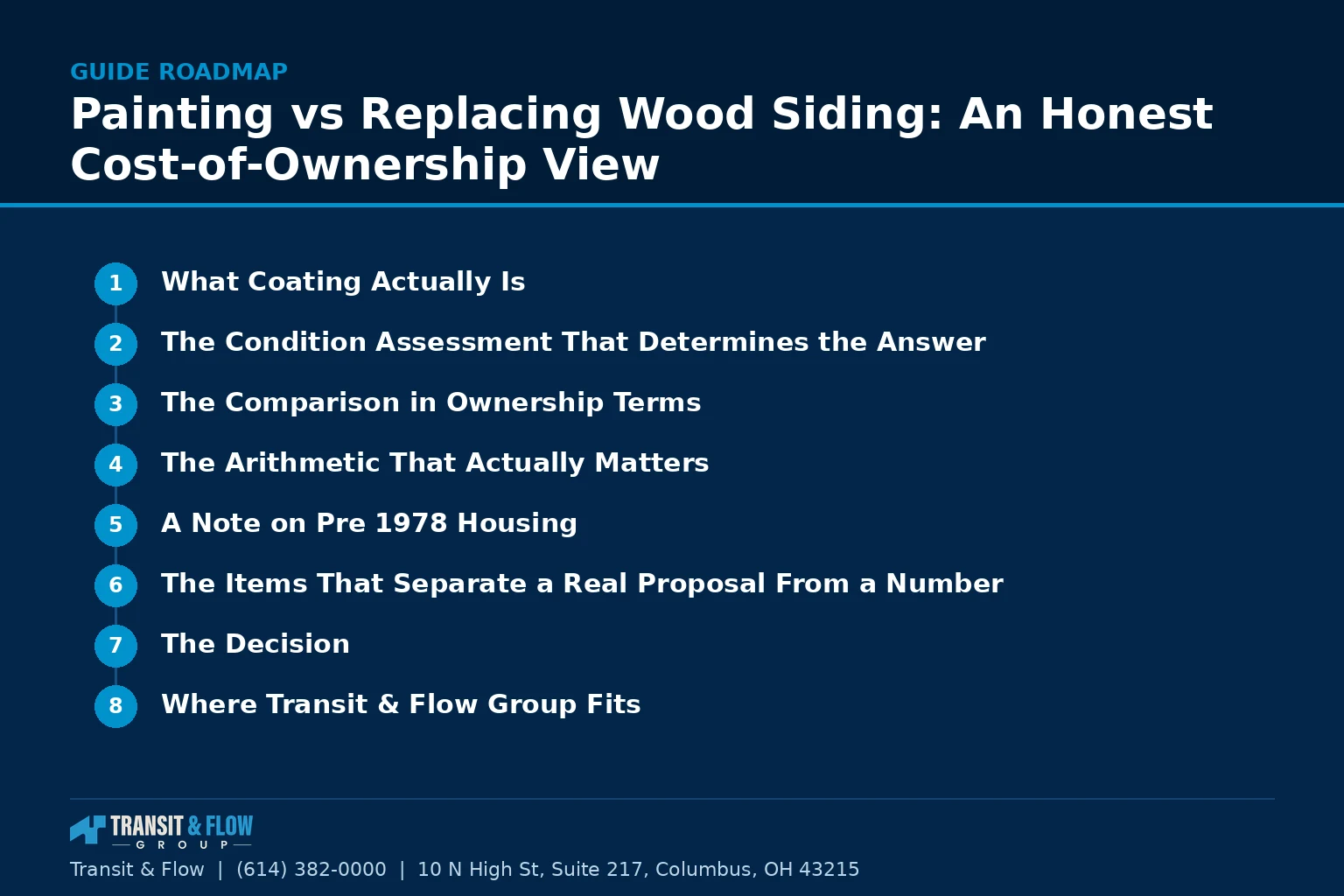
- The preparation included, described specifically. Scraping, sanding, priming bare wood, sealing end grain, and caulking joints are distinct operations with distinct costs.
- The method for verifying moisture content before coating. A contractor who has an answer to this has thought about why coatings fail early.
- The number of boards included in the price, and the rate beyond that. Carpentry discovered during prep is the most common source of change orders on a repaint.
- Whether the trim is included, and whether end grain is sealed on every cut. Trim is where wood siding projects usually fail first.
- The contractor’s certification for work on pre 1978 housing, and how it changes this scope. Get the answer before the price.
- The expected service interval for this system on this house. A specific answer tied to elevation and exposure is more credible than a product warranty period.
- On the replacement path, what happens if the sheathing or barrier is found deteriorated. A stated unit rate and a photographic documentation requirement prevents the standard dispute.
- The warranty on labor as distinct from material. On coatings the labor warranty is the meaningful one, because preparation is what fails.
On Cost
This article contains no dollar figures on purpose. Coating and replacement pricing in Central Ohio varies with elevation count and height, access and staging difficulty, the amount of carpentry discovered during preparation, the coating system specified, the cladding material selected on the replacement path, and the requirements that apply to pre 1978 housing. A figure published here would be quoted back in situations it was never meant to describe. What is durable and worth carrying forward is the structure of the comparison: total the coating path across the number of cycles you will actually own, weight the later cycles as shorter and more carpentry heavy than the first, and then decide whether you are willing to leave the barrier and flashing unexamined for that entire period.
Glossary
- Substrate. The wood surface a coating is applied to.
- End grain. The cut end of a board, far more absorbent than the face, and the usual starting point of deterioration.
- Adhesion failure. Loss of bond between coating and substrate, typically appearing as peeling or flaking.
- Cupping. Curvature across the width of a board, indicating uneven moisture between faces.
- Nail pop. A fastener working out of the substrate as the wood moves through moisture cycles.
- Primer. The coating layer formulated for adhesion to the substrate rather than for appearance or weathering.
- Coating cycle. The interval between renewals of the coating system.
- Target housing. The federal term for most pre 1978 residential property in the lead rules.
- Water resistive barrier. The continuous sheet behind cladding that sheds bulk water.
- Cost of ownership. The total of acquisition and recurring maintenance across the period of ownership, rather than the price on a single day.
The Decision
Option A. Coat the existing wood, with carpentry included. This is the correct choice when the boards are largely sound, the trim and flashing details are intact, the failure pattern reads as ultraviolet exposure rather than water, and your remaining tenure in the house is short enough that you will run one or two cycles rather than four. It also preserves original material, which matters on houses where the wood siding is part of the architectural character.
Option B. Replace the cladding and correct the assembly while the wall is open. This is the correct choice when deterioration has moved past the surface, when the failure pattern points to water rather than sun, when the wall has already been through several coating cycles, or when you intend to hold the house long enough that the third and fourth coating cycles are real events rather than hypothetical ones.
Our recommendation is condition driven rather than universal. Where the failure pattern is concentrated on the south and west elevations and the boards remain sound, Option A is the better use of money and we will say so. Where deterioration clusters below windows, at inside corners, below penetrations, and at the bottom course, that pattern is describing water reaching the wall, and coating it is spending money to hide the evidence. In that case Option B is not the more expensive choice. It is the only one that addresses what is actually happening. If you are undecided, the deciding move is to open a small area at the worst cluster and look at the barrier and sheathing before either proposal is signed.
Where Transit & Flow Group Fits
We assess before we propose, which on this question means reading the failure pattern by elevation, checking the bottom course and the details around openings, and telling you plainly when the answer is a coating cycle rather than a replacement. We are equally willing to write either scope, which is the point. Our siding and gutters work is scoped as wall assembly work, the full framework sits in our siding replacement guide, and the material comparison for the replacement path is in vinyl, fiber cement, and engineered wood compared.
Transit & Flow Group coordinates projects and partners with properly licensed and insured specialty contractors when licensing is required, and work is performed under the appropriate permits.
Frequently Asked Questions
Should I paint my wood siding or replace it?
Neither option is correct in the abstract, and the deciding input is the condition of the existing wood plus the condition of what sits behind it. Coating is the better use of money when the boards are largely sound, the trim and flashing details are intact, the failure pattern reads as ultraviolet exposure, and your remaining tenure is short enough that you will run one or two cycles rather than four. Replacement is the right answer when deterioration has moved past the surface, when the pattern points to water rather than sun, when the wall has already been through several coating cycles, or when you intend to hold the house long enough that later cycles are real events. If you are undecided, the deciding move is opening a small area at the worst cluster and looking at the barrier and sheathing before either proposal is signed.
What does the failure pattern by elevation tell me?
A great deal, and it is the fastest read available on the wall. Failure confined to the south and west elevations points to ultraviolet exposure, which is a coating question. Deterioration clustered below windows, at inside corners, below penetrations, and along the bottom course is describing water reaching the wall, and coating that is spending money to hide the evidence. The bottom course and the lowest few inches of every elevation deserve particular attention, because splashback, snow contact, and grade clearance problems concentrate there. End grain and butt joints matter for the same reason, since end grain absorbs many times what a face absorbs and deterioration reliably starts there.
Why do coating cycles get shorter each time?
Because the substrate is older and the wall is carrying more accumulated coating with every cycle. A repaint over wood that was sound may hold for a long interval, but the next one goes over a substrate that has absorbed years of additional moisture cycling and now sits under another layer, so it will not hold as long, and each subsequent cycle carries more carpentry inside it. Assuming a constant interval across three cycles overstates the value of the coating path. When you total the coating path, weight the later cycles as shorter and more carpentry heavy than the first.
Why do two paint proposals for the same house differ so widely?
Because carpentry is the variable, not the paint. A proposal that includes board replacement, trim replacement, and end grain sealing is a different product from one that includes washing and two coats, and both can be entirely honest. Preparation is also where the outcome is decided, since a coating applied over sound, dry, properly prepared wood with sealed end grain lasts far longer than the same coating rushed onto a surface that was pressure washed the day before. Moisture trapped under a fresh coating is the most common reason a repaint fails early, and it is invisible the day the crew leaves. Ask each proposal to describe preparation as distinct operations rather than as a single word.
What should I know about lead in coatings on an older house?
A large share of the housing stock in Columbus, Bexley, Clintonville, Grandview Heights, and the older parts of Worthington predates 1978, and coatings on those houses may contain lead. Federal rules govern how contractors disturb painted surfaces in pre 1978 target housing, including certification requirements and specific work practices, and this affects scope on both the coating path and the replacement path. This is not something to determine from a general article, and it belongs in the conversation before either proposal is priced. Ask any contractor bidding the work whether they are certified for the applicable rules and how that certification changes their approach on your house. Rely on the Environmental Protection Agency and the Ohio Department of Health for current requirements rather than on a contractor’s summary of them.
What does only one of these paths tell me about the wall?
Only replacement gives access to the water resistive barrier and the sheathing, and on many older walls that is the actual question. If the barrier has failed or the flashing details are wrong, coating the outside preserves the appearance of a wall that is quietly wetting its sheathing. That risk does not appear in either proposal and it does not appear in any comparison of the two prices, which is why the decision is not purely financial. Coating over a bad flashing detail preserves the look of a wall that is still taking on water, so intact trim and flashing details are a precondition for the coating path rather than a detail.
Sources
- U.S. Environmental Protection Agency, lead information for renovation and repair
- Ohio Department of Health
- Ohio Construction Industry Licensing Board
- U.S. Department of Energy, moisture control
About This Guide
Written and edited by Micheal Parker, founder of Transit & Flow Group. Published March 19, 2027. This guide is checked against the agency and code sources listed above, and it is revised when those sources change.
General contractor of record. Micheal Parker holds City of Columbus General Contractor Registration G12064, issued by the Columbus Department of Building and Zoning Services under Transit & Flow LLC and valid through June 30, 2027. Trade work that falls outside the scope of that registration is performed by licensed trade partners, and the responsible license holder is identified before work begins.
Transit & Flow Group, home and commercial services for Columbus and the surrounding Central Ohio communities. Phone (614) 382-0000. Email solutions@transitflowgroup.com. 10 N High St, Suite 217, Columbus, OH 43215. Contact our team or review the communities we serve.
